Thursday, 10 December 2009

War and peace as Obama accepts Nobel Prize

Today President Barack Obama is here in Oslo, where he received the Nobel Peace Prize in a ceremony at the City Hall at 1 p.m. Tonight approximately 10,000 people came to see and cheer him, or to protest, when he and Michelle Obama made a brief appearance on the balcony of Grand Hotel before the Nobel banquet.
In his Nobel speech, Obama spoke almost as much about war as about peace. He quoted Martin Luther King, who received the Peace Prize in 1964: “Violence never brings permanent peace. It solves no social problem: it merely creates new and more complicated ones”.
“As someone who stands here as a direct consequence of Dr. King’s life work, I am living testimony to the moral force of non-violence”, Obama said, but added: “But as a head of state sworn to protect and defend my nation, I cannot be guided by their [King’s and Gandhi’s] examples alone. I face the world as it is, and cannot stand idle in the face of threats to the American people. For make no mistake: Evil does exist in the world. [...] To say that force may sometimes be necessary is not a call to cynicism - it is a recognition of history; the imperfections of man and the limits of reason”.
He did however mark a clear difference from the regime of his predecessor George W. Bush: “Where force is necessary, we have a moral and strategic interest in binding ourselves to certain rules of conduct. And even as we confront a vicious adversary that abides by no rules, I believe the United States of America must remain a standard bearer in the conduct of war. [...] We lose ourselves when we compromise the very ideals that we fight to defend. And we honor - we honor those ideals by upholding them not when it's easy, but when it is hard”.
The whole speech may be read here:
http://www.whitehouse.gov/the-press-office/remarks-president-acceptance-nobel-peace-prize

Barack Obama was by the way not the only person to receive a Nobel Peace Prize today. Shirin Ebadi, the 2003 laureate, today got back the medal and the diploma which Iranian authorities stole from her bank safety box recently. It was the first time a Nobel Peace Prize had been confiscated by a political regime.

Wednesday, 9 December 2009

New books: Bernadottes and Romanovs

A book on the Bernadottes and the Romanovs in itself sounds like a good idea. It was the then Crown Prince Carl Johan’s alliance with Emperor Aleksandr I in 1812 which ultimately brought about the union with Norway and which greatly helped secure his position as an upstart monarch. Russia remained a key ally throughout most of Carl XIV Johan’s reign, until his son, Oscar I, broke with his father’s pro-Russian policy by concluding the November Treaty with Britain and France in 1855.
But as the subtitle indicates, the scope of Gunna Wendt’s new book Die Bernadottes und die Romanoffs. Europäische Dynastien auf der Mainau (published by Verlag Huber in Frauenfeld), is narrower than so.
At the centre of her story stands a marital rather than a martial alliance – in fact the only such alliance concluded between the Bernadottes and the Romanovs. In 1908 Prince Wilhelm of Sweden, the second son of King Gustaf V and Queen Victoria, was married off to Grand Duchess Maria Pavlovna of Russia, a granddaughter of Emperor Aleksandr II. It was arguably the grandest match the Bernadottes ever made as well as the most disastrous. Princess Maria ran away after five years and divorce followed in 1914. Maria wrote about the marriage with great bitterness in her memoirs, while Wilhelm passed the whole thing over in his.
The fruit of the marriage was an only son, Prince Lennart, who, having lost his royal title by marrying a commoner in 1932, became known as the multi-talented Lennart Bernadotte and lived to a great age – he died on Mainau five years ago this month, aged 95.
This book has been written in connection with the exhibition “100 Jahre Lennart Bernadotte – Zurück zu den Wurzeln”, which was held at Mainau this year to celebrate his centenary. The author, who has earlier written a biography of Lennart Bernadotte’s second wife, Sonja, cooperated with her, Lennart’s cousin Prince Michel Romanoff and the French author Jacques Ferrand, in preparing the exhibition, but sadly all of them, except Wendt, died before its opening.
The book begins with a chapter on Carl XIV Johan. It is obviously based mostly on Fritz Corsing’s 1946 biography, but it is well written and Wendt offers some interesting perspectives on the founder of the Bernadotte dynasty.
After this we hear quite little about the Bernadottes and comparatively more about the Romanovs, as the author charts the life story of Lennart Bernadotte and some of his Russian relatives – his great-grandfather Aleksandr II, his maternal grandfather Grand Duke Pavel Aleksandrovich, his mother Maria Pavlovna and his uncle Grand Duke Dimitry Pavlovich, as well as Grand Duke Pavel’s three children from his second, morganatic marriage. One of them, Princess Irina Paley, was the mother of Prince Michel Romanoff, a first cousin who came to be a close friend of Lennart Bernadotte.
What many of those persons had in common was that their lives turned out quite differently from what they had expected. Grand Duke Pavel was banished from Russia because of his morganatic marriage, but was allowed to return at the outbreak of World War I, only to be executed by the Bolsheviks because of “the sins of his family” in 1919. Grand Duke Dimitry escaped this fate by having been banished from St Petersburg because of his involvement in the murder of Rasputin.
Lennart Bernadotte himself was thrown out of the royal family and had to make his own living by the use of his many talents. And his mother, Grand Duchess Maria Pavlovna, refused to live in a loveless marriage with Prince Wilhelm and became one of the Russian royals who best succeeded in creating a new existence for herself following the revolution. It must however be said that Gunna Wendt puts somewhat too much faith in Maria Pavlovna’s memoirs, particularly when it comes to her version of her marriage and divorce.
The Bernadottes have produced more interesting and talented characters than most royal dynasties, yet they remain in the shadow of Lennart Bernadotte’s closest Russian relatives throughout this book. The relations between the two dynasties would also be worth a study, but is mostly bypassed by Wendt.
All in all this is an easily read and mostly correct book, but some significant voids make it less interesting than it might have been.

Tuesday, 8 December 2009

New Swedish royal monogramme published

The Swedish Royal Court today made public the monogramme which will be used by Crown Princess Victoria and her future husband Daniel Westling. The monogramme has been designed by Vladimir A. Sagerlund at the Swedish National Archives.

Press release (in Swedish):
http://www.kungahuset.se/ovrigt/pressrum/pressmeddelanden/aretsarkiv/kronprinsessparetsmonogram.5.62402a8b12475b47cdb80003423.html

My latest article: Obituary of Princess Grete Sturdza

Following the aforementioned death of the Norwegian-born Princess Grete Sturdza on 29 November I have gathered some information about her and compiled a short obituary which is published in Aftenposten today.
The basic biographical facts are that she was born in Oslo on 27 April 1915 as the daughter of a Norwegian father and a Russian mother. She won a Norwegian junior championship in tennis and studied British literature and philosophy at Magdalen College in Oxford. There she met the law student Prince Gheorghe (Georges) M. Sturdza, who belonged to a Romanian princely family which included two sovereign princes of Moldavia and one Romanian prime minister.
Having known each other for 1 ½ year they married in St Nikolaus’s Orthodox Church in Oslo on 12 April 1937 and settled in Iasi in Romania. They had three sons. In the years after World War II, when Romania was hit by famine and draughts, Princess Grete Sturdza and her mother-in-law were involved in relief work and were able to draw upon Princess Grete’s acquaintanceship with Folke Bernadotte.
The Sturdzas had to flee Romania when the monarchy fell in December 1947. With the help of the Swedish minister the Princess and her children managed to flee to Prague, while her husband walked on his feet from Iasi to Vienna.
The family first came to Norway, but later moved to Varangeville-sur-Mer near Dieppe in Normandy. There the Princess in 1957 opened the private botanical garden Vasterival, where she collected 10,000 different species. She was honorary President of the International Dendrological Society and received a number of other honours.

Monday, 7 December 2009

Late royals: Princess Margaretha of Denmark (1899-1977)

Princess Margaretha was one of only three women in modern history to have been a princess of all the three Scandinavian countries – the others were her mother and her grandmother.
Princess Margaretha Sofia Lovisa Ingeborg of Sweden and Norway was the eldest child of Prince Carl and Princess Ingeborg. She was born at her parents’ summer house Parkudden in Stockholm on 25 June 1899. She eventually got two younger sisters, Märtha and Astrid, and a baby brother, Carl Jr. The siblings had a happy childhood with Fridhem, their new summer house, as their preferred home.
When she was six years old, the personal union between Norway and Sweden was dissolved and the Norwegian Parliament offered its country’s crown to Margaretha’s father. As he did not yet have a son, the Norwegians were willing to amend the Constitution to make Margaretha his heir. However, the Norwegian throne eventually went to Margaretha’s maternal uncle, who became King Haakon VII.
Swedish society columnists rejoiced when Princess Margaretha was confirmed – it was a very long time since there had been eligible young princesses in the male-dominated Bernadotte dynasty. Queen Mary of Britain also took note of the young princess and wrote to Princess Ingeborg suggesting that Margaretha might be a suitable consort for the Prince of Wales. However, Margaretha had to turn down the British crown as she was already secretly engaged to the talented Prince Axel of Denmark, a first cousin of her mother eleven years her senior.
The wedding took place in the Cathedral of Stockholm on 22 May 1919. It was the first royal wedding in Stockholm since Margaretha’s maternal grandmother Lovisa had married the future King Frederik VIII of Denmark in 1869. The wedding came only a few months after Sweden in November 1918 had stood at the brink of revolution – a large celebration was just what the monarchy needed to revive its popularity.
Prince Axel and Princess Margaretha settled in a villa called Bernstorffshøj, located near Bernstorff Palace in Gentofte outside Copenhagen. Margaretha gave birth to Prince Georg in 1920 and to Prince Flemming (pictured above) in 1922. Prince Axel made a career in the navy and in the East Asiatic Company, whose director he became, and also held several other positions such as member of the IOC and chairman of the board of Scandinavian Airlines.
Margaretha dedicated herself to family and charity, but also accompanied her husband on some of his official journeys. In 1930 they made a long journey to Asia together with Crown Prince Frederik and Prince Knud, and in 1953 Prince Axel and Princess Margaretha represented Denmark at the coronation of Queen Elizabeth II in London.
Princess Margaretha’s life was not without sorrows and difficulties. Her marriage was not always happy as Prince Axel had a roving eye. In 1922 the family lost most of their money when the Danish bank Landmandsbanken collapsed. And in 1936 their home burnt down to the ground.
In 1935 her youngest sister, Queen Astrid of the Belgians, was killed in a car accident at the age of 29. Margaretha remained in Brussels for several months after the funeral to look after the motherless children. In 1954 her other sister, Crown Princess Märtha of Norway, died after a long illness. “Aunt Tha” again stepped in to comfort her nephews and nieces and try to take on the role as a maternal figure in their lives.
Princess Margaretha was a tireless letter writer – letters in her characteristic, challenging hand were regularly sent off to her relatives in many different countries and were expected to be answered promptly.
After her husband’s death in 1964 she became a keen traveller. She always went to her native Stockholm in early December, saying she would die if she did not hear Handel’s “Messiah” in the Cathedral on the first Sunday of Advent. Christmas war mostly spent with her family in Norway.
Princess Margaretha was considered the most regal of the three sisters and was anxious for etiquette and royal dignity to be maintained. But she was also a bit shy and these factors combined occasionally caused outsiders to find her arrogant and aloof. Those who knew her thought nothing could be further from the truth.
Princess Margaretha suffered a stroke during Christmas of 1974 and was dependent on a wheelchair for the rest of her life. She died from another stroke during a New Year visit to her second son at Tranemosegaard on 4 January 1977, aged 77. She was buried in the park of Bernstorff Palace.

Saturday, 5 December 2009

At the road’s end: Lizanne Kelly LeVine (1933-2009), sister of Princess Grace

This piece of news from last week had passed me by: Elizabeth Anne “Lizanne” Kelly LeVine, the last surviving sibling of Princess Grace of Monaco, died from cancer at the retirement home Quadrangle in Haverford on Tuesday 24 November, aged 76.
She was born on 25 June 1933, as the youngest of the four children of John B. and Margaret Kelly, and held a bachelor’s degree from the University of Philadelphia. She was married to Donald C. LeVine, who died in 2000, a year after their daughter Grace had died from cancer at 43. She is survived by her son Chris.
Her funeral was held at St. Bridget’s Church last Friday and was attended by her nephew, Sovereign Prince Albert II of Monaco.

Philadelphia Daily News has an obituary:
http://www.philly.com/philly/obituaries/20091127_Lizanne_LeVine__a_Philadelphia_Kelly.html

Friday, 4 December 2009

Funeral of Prince Alexandre of Belgium

The funeral of Prince Alexandre of Belgium, who died suddenly last Sunday, was held at the Church of Our Lady in Laeken today. Among the mourners were his widow Léa with her children Renaud Bichara and Laetitia Spetchinsky, the latter’s husband Didier Nagant de Deuxchaisnes, King Albert II and Queen Paola, a frail Queen Fabiola, Princess Esmeralda with her husband Salvador Moncada and children Alexandra and Leopoldo, Prince Philippe and Princess Mathilde (whose tenth wedding anniversary falls on this date), Prince Laurent and Princess Claire, Grand Duke Henri of Luxembourg, Archduchess Marie-Astrid and Archduke Christian of Austria-Hungary, Princess Margaretha of Liechtenstein and Princess Maria Gabriella of Savoy. Prince Alexandre’s sister, Princess Marie Christine, was absent, as from the funerals of her parents. The Prince was laid to rest in the vault of the church, which has been the burial place of the Belgian royals since the days of Léopold I.

Thursday, 3 December 2009

At the road’s end: Princess Grete Sturdza (1915-2009)

Several years ago I read an old newspaper article (I believe it was from the summer of 1937) about a young Norwegian woman, Grete Kvaal, marrying a Romanian prince in Oslo. In Aftenposten today her sister Vera Blom announces the passing of Princess Grete Sturdza in Varangeville on 29 November, aged 94.

Flashback to the 1930s

A few days ago a substantial majority of the Swiss people, against the wishes of their government and parliament, voted to forbid the building of minarets. This attack on the freedom of belief has naturally been endorsed by far-right wing parties across Europe. Here in Norway MP Per-Willy Amundsen (Progress Party) has said he finds the Swiss decision “interesting” and in VG yesterday there was a letter to the editor signed “Per, Bergen”, which read in full: “Now there must be a referendum on mosques also in our dear Norway”. Try substituting the word “mosques” with “synagogues” and it becomes obvious why this sounds eeriely familiar.

Tuesday, 1 December 2009

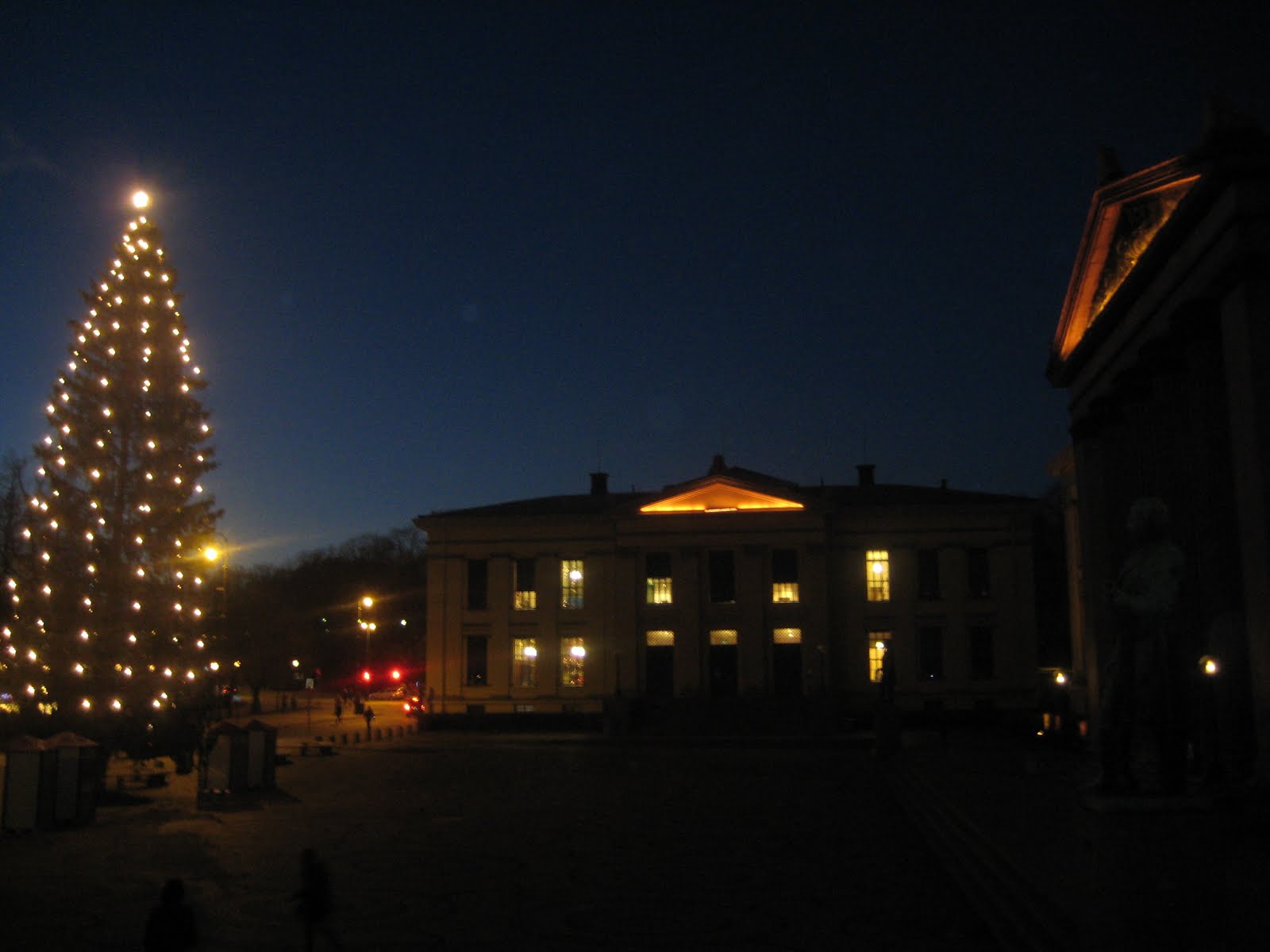
A neoclassical Christmas


With the coming of December and Advent, the Christmas trees have come up at the Royal Palace and the University Square here in Oslo.

Monday, 30 November 2009

New books: The memoirs of Frederik VII’s great-granddaughter

As mentioned earlier an elderly Danish lady named Ellen Margrethe “Gete” Bondo Oldenborg Maaløe this autumn published her memoirs, Getes erindinger – Slægshistorie, erindringer og beretning om et “jævnt og (for det meste) muntert, (altid) virksomt liv”, in which she documents that she is the illegitimate great-granddaughter of King Frederik VII – the last monarch of the Oldenburg dynasty, who has been generally considered unable to have children.
One of my friends in Denmark has now sent me the relevant chapter of this book, which provides some details about the descendants of Frederik VII by Else Maria Guldberg Poulsen (later Larsen). The affair resulted in a son, Frederik Carl Christian Poulsen, who was raised by a Commander Tuxen.
The book generally mentions few dates and no year is given for his birth, but it is said that his father was Crown Prince at the time and that the child on his birthday every year used to be taken to the palace, where his grandfather, Christian VIII, gave him presents and candy – this means that he must have been born in the 1840s.
The meetings with Christian VIII are also quite interesting as it means that the King must have known that his son was in fact capable of producing children. The author quotes four letters in her possession, in which Frederik VII clearly acknowledges the child as his. The King’s morganatic widow, Countess Danner, stayed in touch with him after the King’s death in 1863 and also left him an annual sum in her will.
Frederik Carl Christian Poulsen married Hansigne Åkerberg. They lived to celebrate their golden wedding, but died within three months of each other. They had a son, Poul, and a daughter, Ellen. The latter died unmarried and childless, while Poul Frederik Oldenborg Poulsen, who became a priest and amateur musician, married a woman called Nelly Bondo. They were the parents of the author and another daughter.
Gete Bondo Oldenborg Maaløe is herself childless after two marriages – to Valdemar Urban Maaløe and his second cousin Carl Adolph Saabye Maaløe – while her sister married four times and had two sons. Both these nephews are childless, meaning that the line of Frederik VII seems likely to come to an end in a not too distant future.

Sunday, 29 November 2009

At the road’s end: Prince Alexandre of Belgium (1942-2009)

The Belgian Royal Court this evening announced the sudden death of Prince Alexandre, King Albert II’s half-brother, from an acute pulmonary embolism.
His Royal Highness Prince Alexandre Emmanuel Henri Albert Marie Léopold of Belgium was born on 18 July 1942 as the eldest child of the controversial union between King Léopold III and Lilian Baels. King Léopold, who had been widowed in 1935 when the adored Queen Astrid was killed in a car crash, married Lilian Baels in 1941 while held captive by the Germans after he had refused to follow his government into exile. These actions eventually led to the King’s abdication in 1951.
Prince Alexandre, a businessman who was not in line to the Belgian throne, married Léa Wolman in 1991, but the marriage was kept secret until 1998. The couple had no children, although the Princess has two children and a grandson from her previous marriages.

New books: A Norwegian perspective on Elizabeth II

Norwegian publishers rarely bring out books on foreign royals, believing that this is not something which will sell in this country. The occasional exception is the British royal family and this month NRK Aktivum has published Englands dronning – dronningens England – Streiftog gjennom Elizabeth IIs liv by Kari-Grete Alstad, a former correspondent in London for Norwegian state television NRK.
The author says in the preface that this is not a biography of Elizabeth II, but rather a “tale of how I, as a journalist and former London correspondent, have seen Elizabeth II from my position as a bystander. This is also a book about England, the English people and its history”. She acknowledges that the book’s title is strictly speaking wrong and that Elizabeth II is not actually Queen of England, but, the confused author adds, of “the United Kingdom of Great Britain, Wales and Scotland”!
The book begins with Elizabeth II’s state visit to Norway in 1955 – her first such visit outside the Commonwealth following her accession three years previously. This provides a glimpse of another age, when a state visit could be a cause for public rejoicing and draw huge crowds, yet be taken quite lightly by the authorities – the author quotes the head of Oslo’s police saying less than two weeks before the British Queen’s arrival that he had not made any detailed plans for how to deal with the visit and was not yet sure from where he would get the extra personnel needed. In contrast we know that when Barack Obama comes to town in less than two weeks 2,600 police will be on duty and that the police will get at least 92 million NOK extra to cover their expenses.
Alstad was herself a fourteen-year-old girl who got a glimpse of Elizabeth II during the state visit in 1955 and this chapter I found the best part of the book, although the author insists on interviewing the actor Toralv Maurstad because he had a role in a play attended by Queen Elizabeth II during the state visit. As Maurstad does not remember much of that performance 54 years ago, the author lapses into a digression about what he is doing these days.
In the next chapter she starts with the Norwegian royals’ official visit to London fifty years later and the fact that Norway, unlike Britain, still has a royal yacht makes her mention that HMY Britannia’s last great journey was to the handover of Hong Kong in 1997. This causes a seven-page digression about the history of Hong Kong, Sino-British trade relations and the opium wars before she returns to London in 2005.
What then follows is a long narrative of Elizabeth II’s childhood, mostly based on the very sugary account given by her former governess Marion Crawford in her bestselling book The Little Princesses. By the time Princess Elizabeth marries Prince Philip, we are already on page 113 with less than half the book left for the next 62 years of her life. The author then travels to Kenya to visit Treetops, where the Princess spent the night when her father died and she became queen. The author’s fourteen-year-old granddaughter accompanies her and Alstad cannot resist drawing comparisons between this child and the nearly 26-year-old Princess. Most of this chapter is however based on Jim Corbett’s book Tree Tops, which she makes a point of stressing that she “managed to track down through an antiquarian bookseller in London” (183 copies are easily available on BookFinder.com).
Then Alstad breaks off and jumps to 2005 when she attended a garden party at Buckingham Palace, which gives her a cause to write about the Queen’s clothes, handbags and corgis, followed by an account of the Swan Upping ceremony. Then follows a chapter titled “The Queen and her people”, which opens with a “scene from the documentary [sic!] The Queen”. This chapter deals mostly with Princess Diana and her death before the author tells the life story of a man of Iraqi origins who basically says he admires Elizabeth II. In the final chapter the author writes about Prince Charles, his wedding to Camilla Parker Bowles and her own visit to his Highgrove Shop in Tetbury, which she really cannot make up her mind if is spelled Highgrove or Higrove.
This is quite symptomatic of a book where the author often contradicts herself, particularly when it comes to dates. The abdication takes place in both 1936 and 1937, Princess Elizabeth was confirmed both at the age of 13 and 16, George III died in both 1820 and 1829, Queen Victoria in both 1901 and 1902 and the latter also succeeded to the throne when she was both 18 and 19.
The language is often quite naïve and filled with clichés, and the book is littered with typos and mistranslations. “Prince Regent” is for example translated as “arveprins” (hereditary prince) rather than “prinsregent” and Prince Edward’s wife is called “Duchess of Wessex”, while Prince Philip’s grandmother is made “Margravine of Milford Haven”. Both English words (like “Ascott” and “State Appartments”) and Norwegian ones (“tunell” and “tunnell”, but never the correct “tunnel”) are misspelled. Family relations also seem to be too difficult for Kari-Grete Alstad to get right: George IV was not the great-great-great-great-grandfather of Elizabeth II (in fact she is not descended from him at all), Edward VII was not Prince Charles’s great-great-great-grandfather, nor was Alice Keppel the Duchess of Cornwall’s great-great-grandmother. And none of Prince Philip’s aunts married Germans (but rather Russians, Greeks and Swedes).
The book is quite unreflective and some of the statements made in it are also rather naïve in themselves. Alstad tells us that Tony Blair’s handling of Princess Diana’s death “has later been called the most important political episode in his entire political career in the same way as the Falklands War was for Margaret Thatcher”. “Later” turns out to be Independent on Sunday the day following the Princess’s funeral. Some of us would consider that a little early to decide on the most important event of Blair’s entire political career and some of us would perhaps dear to suggest that the Iraq War was a more important “political episode”. I also very much doubt the Vatican “demonstratively” chose the Prince of Wales’s intended wedding day for the Pope’s funeral.
This book on the Queen of Britain begins well, but ends up as a badly written and rather insignificant book which almost entirely avoids Elizabeth II’s 57-year-reign. And the quality of the illustrations is horrendous.

Friday, 27 November 2009

What to see: Arco della Pace, Milan


When Emperor Napoléon I became King of Italy he ordered the construction of a rod linking his capitals Milan and Paris via Lake Maggiore, Switzerland and the Simplon Pass. The beginning of that road, the tree-lined Corso Sempione, was modelled on Avenue des Champs-Élysées. At the top of Corso Sempione, serving as an entrance to the Sempione Park and its medieval Castello Sforzesco, stands the Arco della Pace, the triumphal arch commemorating Napoléon’s victories, which he commissioned the architect Luigi Cagnola to build.
The building of the Arch of Victories, as it was then called, was not completed at the time of Napoléon’s downfall, when Milan reverted to the Habsburgs. Work was only resumed in 1826 on the orders of Emperor Franz I, who changed the subjects of the reliefs to commemorate the peace of 1815 rather than his son-in-law’s victories, thereby also giving the arch its new name. It was inaugurated in connection with Emperor Ferdinand I’s coronation as King of Lombardy in September 1838.
The arch is made of Crevola marble and on top is a bronze quadriga – the Chariot of Peace by Abbondio Sangiorgio, each horse cast in one piece. The quadriga originally faced the Corso Sempione – and thereby France – but the Habsburgs had it turned around so that it now faces the Castello and the centre of Milan beyond it.
The arch is flanked by two identical, now disused guards’ pavilions (second photo). As the arch is currently under renovation (third photo), the first photo is borrowed from Wikipedia.

Thursday, 26 November 2009

New books: Peder Anker, landowner and Prime Minister

When it comes to the union between Norway and Sweden, chroniclers of Norwegian history have tended to focus on the beginning (1814) and the end (1905). It was only in 2005 that a history of the union itself (by a Swedish historian) was published. The important, formative early years of the union have been particularly overlooked and the historian Bård Frydenlund’s biography of Norway’s first Prime Minister Peder Anker, Stormannen Peder Anker – En biografi, published by Aschehoug in mid-November, is therefore a welcome addition.
Peder Anker, who, with his brothers and cousins, was ennobled in 1778, belonged to a family of tradesmen which played an important role in Christiania (as Oslo was then called). He did however remain in the shadow of his elder brother Bernt until the latter’s death in 1805. Peder Anker bought Bogstad Manor outside the city from relatives and this became not only his patrician seat, but the centre of his vast estates – an “empire” which came to cover large parts of Southern Norway. The production and export of timber and iron was the foundation of Peder Anker’s great wealth.
Peder Anker was first and foremost a businessman and landowner for the most of his life – his entry into politics came only in the last decades of his life. But Anker also came to play a role as an official under the Danish Crown before the secession in 1814. He came to the notice of Crown Prince Frederik, who reigned in the name of his insane father, when he took part in the military campaign in Sweden in 1788 and was afterwards put in charge of road construction in the eastern half of Southern Norway.
As a businessman Anker was clearly quite efficient and innovative as well as successful, but in my opinion these are not the most interesting aspects of Peder Anker’s life and I could have done with less than half the book devoted to this. 3 ½ pages on a dispute over the construction of a bridge linking Strømsø and Bragernes (later united as Drammen) came close to causing me to lose interest.
More interesting to me is Anker’s role in the schemes laid by him and other fellow aristocrats and landowners, led by his son-in-law, Count Herman of Wedel-Jarlsberg, to bring about a union between Norway and Sweden. The policy of King Frederik VI (as he now had become) during the Napoleonic Wars made Anker and his friends increasingly sceptical both of him and the union with Denmark. Frydenlund argues that this was mostly because of the effect the events on the world stage had on Anker’s business interest rather than for ideological or political reasons.
Their contacts with certain Swedes who also encouraged a union between the two countries were possibly treacherous, but the union was not brought about in the way they had imagined. Anker was critical of Prince Christian Frederik, who was proclaimed regent when Frederik VI ceded Norway by the Treaty of Kiel in January 1814 and who called a Constitutional Assembly to meet at Eidsvold Værk, a manor belonging to Anker’s cousin Carsten, in April.
Peder Anker was elected a member of the Assembly and also became its first Speaker, yet he did not play a leading role. Count Wedel became the leader of the minority “unionist party”, while Anker remained in the background. As we know, the unionists were not victorious at the Constitutional Assembly, but after a brief war in July/August, Norway and Sweden agreed to form a personal union with further details to be settled by an extraordinary Parliament.
Anker failed to be elected to this extraordinary Parliament, which approved the union with Sweden and passed a revised Constitution on 4 November. Two weeks later Anker was appointed Prime Minister, allegedly quite unwillingly, but talked into it by Crown Prince Carl Johan. He thereafter had to leave his business interests in the hands of others and move to Stockholm – as the King of Norway would mostly be resident in Sweden, it had been decided that the Prime Minister and two ministers should also reside there, with the rest of the government “holding the fort” in Christiania.
This constitutional construction was unique, but when Frydenlund explains it, he does not do so by quoting the November Constitution. Instead he quotes the relevant article from a secondary source, but in a version which says that “one of the Prime Ministers” should reside in Sweden – i.e. the version from after 1873, more than fifty years after Anker’s resignation. One of Anker’s first and most important duties was to take part in the negotiations over the Act of the Union, which was approved in 1815. But Frydenlund says not a word about what was Anker’s contribution to this or if his views were taken note of. When it comes to the Act of the Union itself, Frydenlund briefly describes it and a footnote points us to “Steen 1952, p. 26-28” as his source. There is in fact no Steen 1952 in the bibliography, but a Steen 1953 and a Steen 1954. More importantly this shows that, incredibly, Anker’s biographer has not bothered to consult either the November Constitution or the Act of the Union, the constitutional texts upon which both the union itself and Anker’s job were based. The texts of both are easily available, but the author apparently only knows them from two secondary sources, one of which is not relevant for Anker’s time.
It is quite funny to see that when Frydenlund describes the Prime Minister’s official residence in Stockholm, he sounds surprised when he notes that there was a “tambur” and writes that it is not known how often the drummer was on duty. “Tambur” does indeed mean a military drummer in Norwegian, but in Swedish it means a small entrance hall or vestibule.
It is generally acknowledged that Anker was neither a great politician nor a strong leader and that the real power in government lay with his son-in-law, who was Minister of Finance in Christiania and often found himself at odds with King Carl Johan. Anker is however considered to have played a rather important role as a go-between and mediator between these two strong-willed men, but Frydenlund says little about this and even less about the interaction between Anker and Wedel. One may also wonder what if any role was played by Anker’s daughter and Wedel’s wife, Countess Karen of Wedel-Jarlsberg, who served as Mistress of the Robes for three decades, but she is hardly mentioned.
Anker’s own relationship with Carl XIV Johan soon deteriorated and Frydenlund writes that the Prime Minister tendered his resignation after the King had slapped his face during a stormy State Council meeting. Yet Anker changed his mind and remained in office until 1822, when he returned to Bogstad, dying two years later.
It seems to me that the author finds Anker the businessman, landowner, private man and genial host most interesting and deals quite left-handedly with his political career. To me the book would have been more interesting if it were the other way around. As it is, the part of the biography dealing with Anker as Prime Minister left me with more questions than answers and the chapters dealing with 1814 and the schemes leading up to those momentous events are probably the book’s most interesting parts.

Monday, 23 November 2009

What to see: Bäckaskog Castle, Fjälkinge


Bäckaskog Castle is best known as the summer residence of King Carl XV of Sweden and Norway. Situated on a narrow strip of land between the lakes Ivosjön and Oppmannasjön near Kristianstad in the province of Scania, the castle started out as a monastery and is now a hotel.
The monastery was founded in the 1220s and the church (seen in the third and fourth photos) and the kitchen are the oldest parts to have survived. This was when Scania was Danish and following the reformation in 1537, Bäckaskog was confiscated by the Danish Crown. In 1584 the Crown exchanged Bäckaskog with other estates belonging to Henrik Ramel, the future Christian IV’s governor. Ramel built the castle as we know it today, with four wings enclosing a courtyard. Bäckaskog is quite unique in having kept its 16th century appearance up until our time.
In 1664, after Scania had been ceded to Sweden, Ove Ramel the Younger swore allegiance to the Swedish King and was incorporated into the Swedish nobility. But it was not long before he changed his mind and in 1680 Bäckaskog was confiscated by the Swedish Crown.
Between 1696 and 1818 Bäckaskog was the official residence of the colonel of the Southern Scanian Cavalry Regiment. The last military man to reside at Bäckaskog was Field Marshal Johan Christopher Toll, who lived there 1782-1797 and 1798-1817. King Gustaf IV Adolf was a frequent visitor and it was at Bäckaskog on 3 October 1905 that the treaty with Britain, whereby Sweden joined the Third Coalition against France, was signed. This was a decision which in 1809 led to the loss of Finland and the fall of Gustaf IV Adolf.
The Napoleonic Wars brought a new dynasty, the Bernadottes, to Sweden and in 1819 Bäckaskog was put at the disposal of Crown Prince Oscar. He rarely came there, but the west wing was rebuilt to house modern accommodations for the royal family and their court. In 1845, a year after he had succeeded to the throne as Oscar I, he ceded the right to use Bäckaskog to his oldest son, Crown Prince Carl. The Crown Prince was also Duke of Scania and came to stay at Bäckaskog every summer, also after he became King Carl XV in 1859. He was very popular with the locals and did not hesitate to take part in their festivities.
Today the royal apartments are filled with period furniture, but not all of it is original. The King’s portrait (said to be a self-portrait) hangs over his bed (sixth photo) and above a sofa in the drawing room (fifth picture) is one of the many landscapes painted by Carl XV himself.
Carl XV greatly improved the agricultural business at Bäckaskog and had the park remodelled in the fashion of a landscape park. It was under the tree seen in the last picture that Crown Prince Frederik of Denmark in 1868 proposed to Carl XV’s only surviving child, Princess Lovisa. When Carl XV died prematurely four years later, it was they who took over the lease of Bäckaskog. But they did not go there much, the place fell into disrepair and in 1900 they renounced their right of disposal.
That was also the end of Bäckaskog’s royal epoch. Since 1956 it has been a conference hotel, with guided tours of the royal apartments and park taking place on certain days in summer. Earlier this year, the Swedish Property Board resolved that Bäckaskog was not considered of great historical value and may therefore be sold by the state.

Saturday, 21 November 2009

New books: The nanny and her nephew

The Prince and the Nanny: The Life of Prince Harald, now King of Norway, as told in Historical Context and through the Journal of his Nurse, Inga Berg is the title of a book I found in a museum shop here in Oslo earlier this week. Written by Odell M. Bjerkness and published by Skandisk in Bloomington, Minnesota, the book is based on the diary kept by the author’s late aunt, Inga Berg, when she worked as a pediatric nurse caring for the then Prince Harald between March 1937 and July 1938.
The author, who is said to be a Professor Emeritus (what discipline is not mentioned) apparently considers his aunt’s diaries a source of great historical value. In reality they are almost entirely without interest. A typical diary entry reads: “Cloudy, but he’s still outside today and in a great mood. Sleeps well at night and slept until 5:00 A.M. this morning [sic]” or “Sun, but cold wind. Took a picture of the Prince and me. He cried”.
This rather monotonous day-by-day account of the Prince’s weight and mood, the weather and what was for lunch is supplemented by an introduction, a postscript and footnotes by Bjerkness. The subtitle promises a “historical context” – the author therefore starts with Norwegian unification in the 9th century and goes on to describe some events in Norwegian history and his aunt’s family background, and after she leaves royal service he summarises the Second World War and the births, deaths and marriages in the royal family up until the present day. Americans of Norwegian descent are often more proud to be Norwegian than Norwegians themselves and subsequently the author or publisher, in a rather distasteful manner, puts a Norwegian flag on top of every other page.
The “facts” presented in his footnotes and chapters of “historical context” are nearly always wrong. When it comes to history he is blatantly ignorant of the nature of the 19th century union between Norway and Sweden. The Swedish Parliament had as little say in Norwegian affairs as Norway’s Parliament had in Swedish issues, yet the author tells us that King Carl XIII ruled Norway “with the oversight of Sweden’s parliament”. The Royal Palace in Oslo (which is not a castle) was not built by the Swedish monarchy, but by the Norwegian State. It could be added that no royal has ever married in the Palace Chapel and that King Olav did not use Oscarshall Palace as a summer residence.
It was in 1814, and not when the union came to an end in 1905, that Norway became independent. Bjerkness claims that Norway in 1905 “surveyed those European royals with the highest probability of Norwegian ancestry”. This is just silly – naturally there were more important concerns than that to be considered. Women did not take part in the referendum by which King Haakon was elected.
Fritz Wedel Jarlsberg, who was one of the Norwegian negotiators in 1905, was not a Count, as he was born more than three decades after nobility was abolished in Norway. And Mr Wedel was certainly not “the recipient of the Nobel Peace Prize” – it is beyond me what that ludicrous figure could possibly have accomplished to be so honoured.
Professor Bjerkness also shows himself ignorant of the Norwegian Constitution when he tells us that the State Council includes “the prime minister and other select government officials”. In fact it consists of the King and all the ministers of the government. Later the Professor has changed his mind as well as forgotten his Montesquieu when he informs us that the State Council consists of “leaders of government and the Storting”. King Haakon is said to have “transferred his duties as Commander of Norwegian armed forces to his son Olav” during the Second World War, but this is not constitutionally possible – Crown Prince Olav did however become Chief of Defence. Bjerkness also lets us know that “the coronation language” (whatever that is) was abolished by Parliament in 1908 and that neither Olav V nor Harald V were therefore crowned, which is a bit surprising to read as it comes merely one page after he has told us that King Olav was indeed crowned. He also tells us that “a Prince of the Royal House may not marry a commoner without consent of the king” – in fact he may not marry at all without the King’s consent.
Family issues are not Bjerkness’s strongest side either. Princess Ragnhild’s birthday is mistakenly given as 4 June rather than 9 June, Marius Borg Høiby is not born in 1996 but in 1997 and Crown Princess Märtha’s eldest sister was called neither Margarethe nor Margrethe, but Margaretha. There has never been an Åke Bernadotte in the family and Folke Bernadotte was not titled “Count of Sweden”. After the German attack in 1940 Crown Princess Märtha did not go to Fridhem and Fridhem was anyway not the estate of “Märtha’s brother, Carl Bernadotte”, but of her parents. She did on the other hand go to Frötuna, the estate of her cousin Carl Bernadotte. I also doubt that there were concerns during WWII that Queen Victoria of Sweden would influence her husband “in favor of Germany” – by then she had in fact been dead for a decade.
He also makes mistakes about the location of places in both Oslo and Stockholm, upgrades Asker to a town and tells us that Aftenposten is the largest newspaper in Norway, a position which is in fact held by VG. It is not correct to say that Queen Maud was unable to speak Norwegian and she did not die at Marlborough House, but at the London Clinic. Not cancer, but cirrhosis of the liver, was the cause of Crown Princess Märtha’s death and when King Olav died people did not place candles in the palace courtyard, but in the Palace Square in front of the Palace. I also find it hard to imagine that King Olav “often traveled alone by train to his mountain cabin”.
The author, who claims that he “continued to have ongoing contact” with the royal family, wants us to believe that Princess Ingrid Alexandra is “the first Norwegian queen to be born on Norwegian soil in 600 years”. Obviously she is not yet queen and when she becomes so she will follow her mother and grandmother, who are both born on Norwegian soil.
When it comes to the position of women in Norwegian society, Bjerkness grandly writes that “women have recently held top government positions including Supreme Court Justice [which is by the way not a government position], Minister of Defense, and Prime Minister. Determined and succesful women like Inga Berg are no longer exceptions in Norway”. Some of us would think that for a woman to be a pediatric nurse in the 1930s is not exactly comparable to a woman becoming Prime Minister in the 1980s.
In an appendix Professor Bjerkness tells us that kings and queens in Norway are generally titled His or Her Royal Highness, although some people in formal writing choose to use His or Her Majesty instead. Consequently he writes about “HRH King Haakon VII”, “HRH Queen Maud”, “HRH King Olav V”, “HRH King Harald V” and “HRH Queen Sonja”. When his aunt in her diary refers to Queen Maud as “Hennes Majestet” Bjerkness translates it as “Her Highness”. We also learn that as the King’s “two sisters Ragnhild and Astrid, were married in civil ceremonies, they have not been given the title ‘Royal Highness’, by King Harald but each has retained the title of Princess”. Both princesses were in fact married in Asker Church.
Other mistakes could also be pointed out and all this gives the lie to the preposterous claim on the book’s back flap that “Thanks to Odell’s meticulous research and undying enthusiasm, The Prince and the Nanny is a treasure that capitalizes on his gifts as a historian and a linguist for the benefit of us all”. In fact this is a book of no historical value or interest.

Wednesday, 18 November 2009

Book news: Knights of the Elephant

The University Press of Southern Denmark has just published a huge book on the Knights of the Elephant, Denmark’s highest-ranking order, which is known since the 15th century. In Riddere af Elefantordenen 1559-2009, Jørgen Pedersen chronicles the more than 900 knights appointed during the last 450 years and also includes a chapter on “dubious knights”, i.e. people who have been referred to as knights, but whose memberships have not been confirmed.

http://www.universitypress.dk/DK/detail.php?token=5479035349598&R=8776744342

A similar book on the Swedish equivalent of the Elephant, the Order of the Seraphim, was published in 1998, while we have to go back to 1947 to find a book on the recipients of the highest Norwegian order, the Order of St Olav.

Tuesday, 17 November 2009

What to see: Bernstorff Palace, Gentofte


Bernstorff Palace, situated in Gentofte 8 kilometres north of Copenhagen, is perhaps best known as the preferred summer residence of “Europe’s parents-in-law”, King Christian IX and Queen Louise. But Bernstorff has older roots than so.
The estate was presented to Foreign Minister Count Johan Hartvig Ernst Bernstorff by King Frederik V in 1752 and the palace was built between 1759 and 1765. The architect was Nicolas Henri Jardin, who Frederik V had invited to come to Denmark from France to complete Frederiksstaden in Copenhagen after its architect Nicolai Eigtved had died in 1754. Bernstorff Palace counts at the first neoclassical building in Denmark, followed by the Yellow Palace in Copenhagen (also by Jardin, 1764).
Count Bernstorff was toppled by Struensee in 1770 and died in exile in Paris two years later. Struensee was executed that same year and Bernstorff’s nephew Andreas Peter Bernstorff was called back to Denmark, where he soon became Foreign Minister and the power behind the throne. He inherited his uncle’s palace and stayed there every summer until his death in 1797. The coming of the Napoleonic Wars spelt the end of the Bernstorffs’ era of influence and in 1812 the palace passed out of their hands. It subsequently belonged to many successive owners who allowed it to fall into disrepair. Around 1840 there were plans to demolish it, but the palace was saved by King Christian VIII, who bought it in 1842.
When Prince Christian of Glücksburg, the husband of Christian VIII’s niece, was chosen as heir to the throne in 1853, he was given Bernstorff Palace as a summer house and it remained his favourite home after his accession to the throne ten years later. In the summers King Christian IX and Queen Louise would gather their growing family from Denmark, Russia, Britain, Greece and other countries at Bernstorff.
Bernstorff is surprisingly small and it must have been rather crowded when a large number of relatives arrived with servants and courtiers. On a doorframe (sixth photo) one can see how Christian IX measured the heights of his children and grandchildren as they grew taller. Among the names visible in the sixth photo are Willy (King Georgios I of the Hellenes), Nicky (Emperor Nikolay II of Russia), Tino (King Konstantinos I of the Hellenes), Carl (King Haakon VII of Norway) and Dagmar (Empress Maria Fyodorovna of Russia).
Eventually these family gatherings had outgrown Bernstorff and were moved to the much larger Fredensborg Palace. Emperor Aleksandr III of Russia was the life and soul of these gatherings and they were never quite the same again after his death in 1894. Thereafter they moved back to Bernstorff.
Following the death of Christian IX in 1906, Parliament in accordance with the late King’s wishes granted the use of Bernstorff as a summer house to his youngest son, Prince Valdemar, who had been born at Bernstorff in 1858. When Prince Valdemar passed away in 1939 the right of disposal was offered to his second son, Prince Axel, who found it too vast an undertaking and preferred to go on living in the villa Bernstorffshøj adjacent to the palace park. During a dinner in 1949, Prince Axel did however manage to talk a government minister into giving him and his family permission to be buried in the park. The grave of Prince Axel, his wife Princess Margaretha, their sons Prince Georg and Count Flemming of Rosenborg, and their daughter-in-law Princess Anne can be seen in the seventh photo.
The Danish Emergency Management Agency took over the palace as a school in 1941 and four years later the park was opened to the public. DEMA moved out last year and in May 2009 Bernstorff Palace reopened as a hotel and conference centre. Guided tours are held once a month and the palace can also be hired for social events. Last month the 85th birthday of Countess Ruth of Rosenborg, Prince Axel’s daughter-in-law, was celebrated with a lunch for family and friends at Bernstorff Palace.

Sunday, 15 November 2009

What to see: The Smolny Institute, St Petersburg


The Smolny Institute for Noble Maidens was set up by Empress Ekaterina II, who planned it in cooperation with her influential advisor on education issues, Ivan Betskoy (often said to have been her real father). The Empress intended the Institute to share accommodations with the Smolny convent, as some sort of Enlightenment counterweight to the nunnery, and therefore decided to house it in a building to the right of the Smolny Cathedral (the name derives from the fact that the cathedral had been built on the former tar yard, Smolny Dvor).
Ekaterina II’s grandson, Aleksandr I, decided to enlarge the school and had a larger building erected to the right of the cathedral. It is this building we know as the Smolny Institute. It was built by Giacomo Quarenghi (1744-1817) between 1806 and 1808 and the architect rightly came to consider it one of his finest buildings.
The Smolny Institute has an impressive temple front with eight Ionic columns, resting on seven arcades and carrying a tympanum. The Institute also has two projecting wings, each crowned with a tympanum, in a way reminiscent of some of the other buildings of this great master of Russian neoclassicism, such as the Assignation Bank in St Petersburg and Quarenghi’s original designs for Elghammar Manor in Sweden, which were executed in a somewhat modified form.
The girls’ school closed down in August 1917 and the building was shortly thereafter taken over by the Petrograd Council of Workers’ and Soldiers’ Deputies. Thus it was there that Lenin and his followers plotted the coup which brought the Bolsheviks to power in October 1917. After the communist takeover the Institute remained the seat of government until Lenin moved the capital to Moscow in March 1918. This explains why one of the city’s few remaining statues of Lenin, in the famous “taxi-hailing pose”, can be found outside. The monument was done by V. Kozlov in 1927, three years after Lenin’s death.
After Lenin’s departure for Moscow, the Smolny Institute became the headquarters of the Regional and City Committees of the Communist Party. The First Secretary Sergey Kirov, whom Stalin had apparently come to view as a potentially dangerous rival, was murdered there in December 1934, an event which provided the excuse for Stalin’s purges. Today the building is the seat for the Governor of St Petersburg.