Showing posts with label Holstein-Gottorp. Show all posts

Thursday, 2 August 2018

My latest articles: Norwegian golden wedding, Swedish royal dukedoms and Princess Victoria of Britain

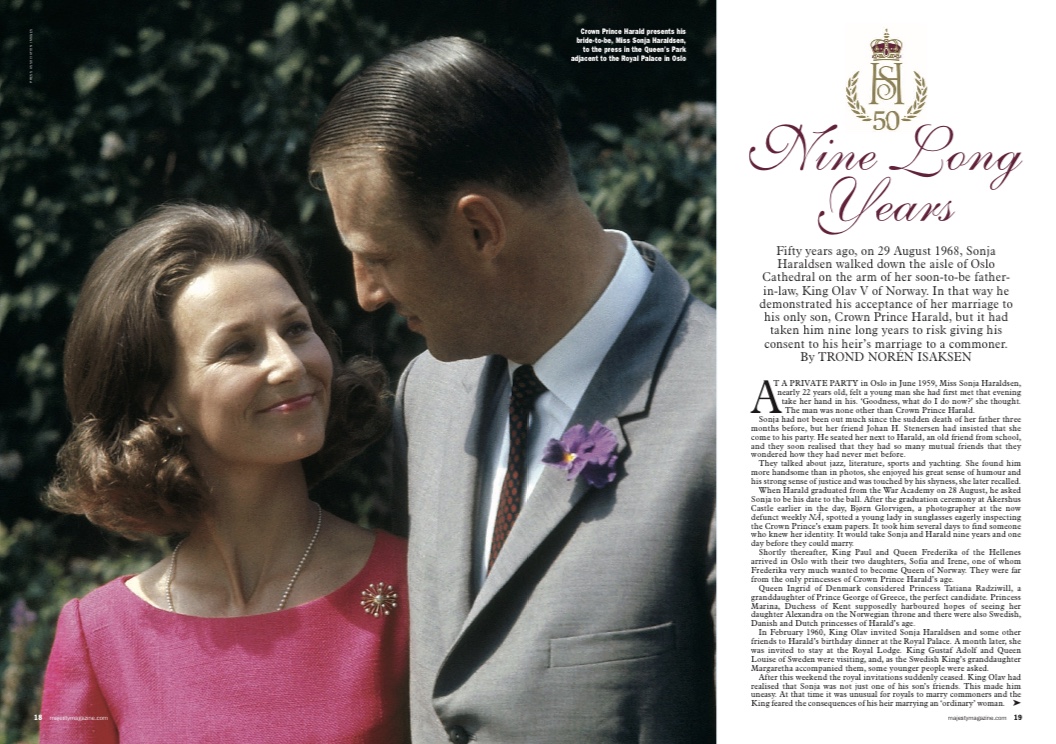
The August issue of Majesty (Vol. 39, No. 8) is now on sale and it appears I have written almost half of it. On the occasion of the King and Queen's golden wedding anniversary later this month I write about the nine difficult years they had to wait before King Olav eventually risked giving his consent to their marriage, which everyone seemed to think might spell the end of the monarchy.
I also write about the difficult, unhappy and frustrated Princess Victoria of Britain, the sister of Queen Maud and King George V, who was not allowed to marry the Liberal Prime Minister Lord Rosebery, whom her mother Queen Alexandra treated as her maid and who ended up as a rather bitter woman who often made life difficult for others.
Finally, there is also an article on the history of Swedish royal dukedoms, which were once semi-autonomous states within the states that could become power bases but are now just honorific titles given to the ever-growing number of members of the Swedish royal family.

Saturday, 30 July 2016

My latest articles: Silver jubilee and ex-Queen Anne-Marie

The August issue of Majesty (Vol. 37, No. 8) went on sale in Britain last week, and this month I have contributed a report on the King and Queen's silver jubilee, focusing on the celebrations in Trondheim last month, and an article on ex-Queen Anne-Marie of the Hellenes, who will turn seventy on 30 August.

Thursday, 30 June 2016

My latest articles: Empress Marie-Louise & Swedish royal dukedoms

The July issue of Majesty (Vol. 37, No. 7) went on sale in Britain last week and this month I have contributed an article on Empress Marie-Louise of the French, Napoléon I's second wife. In the eyes of posterity she has been overshadowed by her predecessor Joséphine, but she is fondly remembered in Parma, where she reigned as duchess from 1816 until her death in 1847 and where the bicentenary of her arrival is commemorated this year.
Also just out is Royalty Digest Quarterly no. 2 - 2016, in which I write about Swedish royal dukedoms - their origins, history and statistics - which might be of some interest these days, when new dukes and duchesses are born so frequently that many find it hard to keep track.

Friday, 13 June 2014

A lecture on Carl XIII

If anyone has some time to spare on Sunday I will be giving a lecture on Carl XIII, the first king of the Swedish-Norwegian union, at the Defence Museum at Akershus Fortress at 1 p.m. on Sunday (entrance is free).
Although his adopted son, the future Carl XIV Johan, was the architect of the union, Carl XIII became its first king 200 years ago this autumn. He has been overshadowed not only by Carl Johan, but also by his elder brother, Gustaf III, and his wife, the famous diarist Hedvig Elisabeth Charlotta, but the story of Carl XIII is not without interest, not only for the many intrigues he was involved in, but also because his sheer existence, although physically and mentally weak, seems to have had rather significant consequences for Norway and the union.

Saturday, 23 February 2013

My latest article: Carl XIII and the conquest of Fredrikstad

The approaching bicentenary of Norway’s independence is naturally inspiring interest in the events of 1814, and in today’s edition of Fredriksstad Blad I tell the story of one of the lesser-known episodes of that annus mirabilis, namely the only visit the first King of the Swedish-Norwegian union, Carl XIII, ever made to Norway. This happened during the short war in August 1814, when King Carl was present at the conquest of Fredrikstad.
Carl XIII had been appointed Lord High Admiral before he could even walk and was thus in nominal command of the Swedish fleet during the war with Russia in 1788-1790. The battle of Hogland, which ended in a stalemate, was spun as a major victory and the then Duke of Sudermannia hailed as a naval victor. This reputation and his pursuit of further military glory meant that he insisted on taking part in the campaign of 1814, although he was weak and aged beyond his 66 years and could barely walk.
Nevertheless, Carl XIII had the pleasure of watching the conquest of Fredrikstad and spending a night in the town, from where he proudly wrote Queen Hedvig Elisabeth Charlotta a letter “with a Norwegian pen and Norwegian ink”.
Following an armistice and negotiations the Norwegian Parliament voted in favour of union with Sweden three months later. However, King Carl’s weakening health meant that he was never able to carry out his intention of being crowned in Nidaros Cathedral, and indeed Fredrikstad was the only part of his new kingdom he would ever see.

Thursday, 27 September 2012

My latest article: Carl XIII, the first union king

If King Carl XIII of Sweden and of Norway (1748-1818) is remembered at all today, it is mostly either as the younger brother of Gustaf III, the adoptive father of Carl XIV Johan or as the husband of the diarist Queen Hedvig Elisabeth Charlotta. No complete biography of him has ever been published, but in this year’s third issue of Historie, which is on sale today, I have written a 25-page-article about his life.
Carl XIII was a weak man, who, during his regency for the minor Gustaf IV Adolf in 1792-1796, let his favourite Gustaf Adolf Reuterholm govern in his place. By the time he succeeded to the Swedish throne in 1809, he was too old and frail to play much of an active role, but in his younger years he was known as an intriguer, who, it has been alleged, probably had prior knowledge of the conspiracies which led to the assassination of Gustaf III in 1792 and the deposal of his nephew Gustaf IV Adolf in 1809.
In 1814 he became the first king of the Swedish-Norwegian union, but he only set foot on Norwegian soil once, during the war in August 1814, when he had not yet been acknowledged by the Norwegians as their king.
From 1810 the reins of power were in the hands of his adopted son, but Carl Johan came to experience, as Philippe d’Orléans and other regents before and since, that someone who was not himself the monarch did not have full freedom to go through with his own plans. This involved the amalgamation of the two kingdoms into one, something which the eminent historian Sverre Steen has argued was prevented by sheer existence of Carl XIII, to whom Carl Johan always showed deference. This would have been most easily accomplished in the early, insecure years of the union, but when Carl XIII died in 1818 and Carl XIV Johan himself became king, it was already too late.
The photo shows Erik Gustaf Göthe’s statue of Carl XIII in the Royal Garden in Stockholm, which was erected on the orders of Carl XIV Johan in 1822. It shows him with an anchor and crowned with a laurel wreath, recalling his supposed military glory. Created Admiral of the Fleet in his cradle, the then Prince Carl in 1788 presided over (but did not in fact lead) the battle with Russia at Hogland in the Gulf of Finland, which ended with an even draw, but was hailed as a splendid victory.
Today the statue is generally overlooked. As late as this summer I was approached by a man in the King’s Garden who asked if I knew who the man on the statue was; his colleagues having suggested Hjalmar Branting, the first Social Democratic Prime Minister.

Monday, 21 May 2012

New books: Swedish royal births and christenings

On the occasion of Crown Princess Victoria and Prince Daniel of Sweden’s wedding two years ago Lena Rangström, senior curator at the Royal Armoury, published a book on the weddings of Swedish monarchs since the sixteenth century. Now she has followed this up with a book on royal births and christenings, Kanonsalut och vaggor – Kungliga födslar och dop, published by Carlssons Bokförlag to coincide with the birth and christening of the Crown Princess’s first child, Princess Estelle.
I was quite critical of her book on weddings and am happy to say that her new book is much more satisfactory. Indeed the author has managed to avoid most of those weaknesses which spoilt her previous book.
The wedding book was chronologically arranged, allocating each wedding a chapter of its own and losing itself in endless tedious details. This book, on the contrary, is arranged thematically, which makes it far more readable and gives the author the opportunity to draw the long lines, show the development of traditions and identify when and how traditions changed (and this, rather than the accumulation of facts, is what history is really about). This time the book is not only more to the point, but there is also a useful chapter summing up the book’s findings.
There is no clearly defined timeframe to this book, but most of it deals with the Palatine, Holstein-Gottorp and Bernadotte dynasties (there were no children born to the short-lived House of Hesse). The author explores the ceremonial related to royal births and christenings, baby clothes, christening robes, wet-nurses, cradles, orders, regalia and the choice of names.
As a Norwegian historian I am naturally pleased to note that Rangström this time mostly remembers that the Bernadottes were also kings of Norway for nearly a century and that there were therefore Norwegian concerns to be taken into consideration.
The illustrations are many and well chosen and thus in themselves form part of the book’s attraction. Apart from some factual mistakes (for instance, 11 November 1882 is twice given as the date of Gustaf VI Adolf’s christening, although it was in fact his birthday) the greatest weaknesses of this book are the absence of some information of interest which Rangström would have found had she delved deeper into the source material, and that the author looks only at the main line of the royal family.
By excluding the junior branches she misses out on some developments which lead her to wrong conclusions. For instance, she states that Crown Princess Margareta was the first royal mother to attend her children’s christening, but overlooks the fact that Princess Ingeborg had done so some years earlier. She also wrongly states that Crown Princess Margareta was the first royal mother to breastfeed her children, which Queen Sophia had also done, although briefly, two generations earlier.
Thus, when Rangström reaches the concluding chapter, she ascribes too much importance to Crown Princess Margareta, whom she identifies as some sort of watershed as Margareta, unlike previous generations, gave birth in private, was the first royal mother to breastfeed her children and to attend their christenings, and (in 1910) the first to hold her own child at the font. But two of these four examples are in fact wrong, making Rangström’s assessment of Margareta seem somewhat overrated.
But despite these reservations, Kanonsalut och vaggor is a useful introduction to the traditions related to Swedish royal births and christenings and seems able to appeal to a wide readership.

Friday, 21 October 2011

New books: A princess of consequence

If Princess Sophia Albertina of Sweden and of Norway (1753-1829) is remembered today it is probably as little more than the lady who built the Hereditary Prince’s Mansion in Stockholm and whose name is inscribed on its façade. Unmarried, childless princesses tend to be considered as little more than that, but as the historian Carin Bergström, head of the Swedish Royal Collections, shows in her new book Självständig prinsessa – Sophia Albertina, 1753-1829, published by Atlantis this month, there was much of interest about the life story of the sister of Gustaf III and Carl XIII.
The book’s title translates as “Independent Princess” and Bergström takes the bold choice of starting not with the Princess’s birth, but with the death of her dominant mother, Queen Lovisa Ulrika, in 1782. The disadvantage of this approach is that we are left in the dark about the Princess’s formative years and perhaps in particular about the extent of her mother’s complex personality upon her.
The advantage is that it sharpens the book’s focus on how Sophia Albertina carved out a life of her own. Bergström briefly discusses the reasons why Sophia Albertina, who certainly had to be considered quite a match on the royal marriage market, never married. But the fact that a grand mansion was built for her, starting in 1783, must surely have meant that one had by then realised that she would not marry.
The mansion is in itself significant, the author argues. Gustaf III’s brother, Carl and Fredrik Adolf, were given apartments at the Royal Palace instead of mansions of their own. This underlines Sophia Albertina’s independence, but might also be a result of the fact that she as a woman could not challenge the monarch’s position in the way that the royal brothers might do.
Sophia Albertina was to live to be nearly 76, a great age in her days. She saw the coups carried out by Gustaf III in 1772 and 1789 respectively, the wars against Russia and the Napoleonic wars, the assassination of Gustaf III in 1792, the deposal of Gustaf IV Adolf and the elevation of her brother Carl XIII in 1809, the election of a new crown prince and his sudden death shortly thereafter, the election of a French marshal to crown prince in 1810, the formation of the union with Norway in 1814 and the accession of the Bernadotte dynasty in 1818. In 1826 it was she who brought Carl XIV Johan the news of the birth of his grandson (Carl XV), which secured the Bernadotte succession in the third generation. By the time of her death in 1829 she was the last surviving member of the House of Holstein-Gottorp in Sweden and in an age of growing nationalism she was, not entirely correctly, hailed as “the Vasa Princess”.
Sophia Albertina could be considered a survivor, but she was also an important link between past and future. Throughout the upheavals of the Gustavian and post-Gustavian era Sophia Albertina and her sister-in-law Hedvig Elisabeth Charlotta were unchangingly dignified in carrying out the royal duties and upholding the presence and visibility which were often neglected by other members of the royal house. (Indeed, following Hedvig Elisabeth Charlotta’s death in 1818, Sophia Albertina was the actual first lady until Queen Desideria could be bothered to move to Sweden five years later). For the upstarts Bernadottes she was obviously of great value in their legitimisation process.
Yet one of the great strengths of this biography is how it stresses that Sophia Albertina was more than simply a Swedish princess. In 1787 she became Abbess of the Protestant diocese Quedlinburg, a small city-state in what is now Saxe-Anhalt. This position has often been treated as little more than a piece of curiosa by Swedish writers, but Bergström stresses how it meant actual sovereignty over this small state and that this was something Sophia Albertina was serious about.
Unlike her predecessor as abbess Sophia Albertina came to spend considerable time in Quedlinburg (which also caused her to miss out on some important developments in Sweden, such as much of the Reuterholm regime). This meant that she had greater impact on her small realm than her predecessor, but also that she came in close proximity to her maternal relations in Germany, whose cultural interests may have had a certain influence on her.
By paying thorough attention to Sophia Albertina’s reign in Quedlinburg and her life in Germany (as well as her journey to Italy) Carin Bergström succeeds in putting her subject squarely into the international context in which she belongs and showing how her life was shaped by events outside Sweden.
In 1802 Quedlinburg was ceded by the Habsburg Emperor to the King of Prussia and subsequently secularised, but the latter allowed his first cousin Sophia Albertina to retain her residence and her income. However, five years later Quedlinburg was lost to France. Sophia Albertina daringly declared her intention to negotiate with Napoléon, but Quedlinburg was incorporated into his brother Jérôme’s Kingdom of Westphalia and the reign of Sophia Albertina came to an end.
One of the events of Sophia Albertina’s life which has caused most comment, both in her days and later, is her campaign to have her chambermaid Lolotte Forsberg recognised as the illegitimate daughter of King Adolf Fredrik, i.e. as her own half-sister. This severely strained her relationship with her brothers and was in the end unsuccessful, but Bergström launches the theory that the way the Princess allowed herself to be led to believe that Forsberg was indeed her sister might be seen as a result of Sophia Albertina’s longing for a family of her own.
Having married noble courtier, Countess Lolotte Stenbock (as she then became) was eventually appointed Sophia Albertina’s Mistress of the Robes and the Stenbock family came to fill the role as Sophia Albertina’s immediate family until her death, when most of her estate was left to them.
This was one of the books I had been looking most forward to this year and I was not disappointed in my expectations. Occasionally Bergström gets a year wrong, she misspells the name Désirée throughout and repeats the tenacious myth that Napoléon I proclaimed himself emperor, but she is mostly on safe ground and appears to have full command of her subject. The book is also well-written and insightful and adds greatly to our knowledge of its subject. Following the publication of this biography there can be no doubt that Sophia Albertina was much more than an insignificant appendage to the Gustavian court.

Tuesday, 23 August 2011

Title issues: Crown Princess Victoria’s firstborn

With the announcement of Crown Princess Victoria of Sweden’s pregnancy one may start to think about what titles the child will receive upon its birth in March 2012. As Sweden introduced gender-neutral succession in 1980 the child will be in direct line to the throne whether it is a boy or a girl. Thus Sweden will, for the first time since 1950, have two generations of direct heirs.
The position as heir apparent to the heir apparent does not in itself bring any particular title. Prince Gustaf Adolf, the father of the current King, who predeceased both his father and grandfather and thus never became Crown Prince, was occasionally referred to as “arvprins Gustaf Adolf” (Hereditary Prince), but this was simply an informal reference, probably used to separate more clearly between him and his father, whose name was also Gustaf Adolf.
The title “arvprins” (Hereditary Prince) does not exist in Sweden, so the child will quite simply be Prince or Princess of Sweden until its mother accession, when it will become Crown Prince or Crown Princess of Sweden.
The style Royal Highness has so far always gone with the title of Prince(ss) of Sweden. Whereas Britain limits the style HRH and the title Prince(ss) to the children of monarchs and the children of sons of monarchs and Denmark limits the style HRH to the children of monarchs and heirs apparent (other princes and princesses being styled Highness), Sweden has no such limits and it is thus up to the King to decide. It will be interesting to see whether the children of Prince Carl Philip and of Princess Madeleine will be HRHs and princ(ess)es, but there can be little doubt that the eldest child of the Crown Princess will be so.
Until 1982 there was also another title for princes in line of succession: that of “Sveriges arvfurste” (between 1814 and 1905 “Sveriges och Norges arvfurste”). There is no exact English translation of this title, nor is there any good English translation. Like “arvprins” it might be translated as “Hereditary Prince”, but whereas “arvprins” is used informally to designate the heir apparent to the heir apparent, “arvfurste” was an official title used for all princes of the royal house with succession rights, except the Crown Prince.
The current King’s father was for instance “HKH prins Gustaf Adolf, Sveriges arvfurste, hertig av Västerbotten”. The title was quietly abolished in 1982, probably in connection with the birth of Princess Madeleine. As gender-neutral succession had been introduced two years previously and her elder brother had been styled “arvfurste” since being deprived of the title Crown Prince, the alternative solution would obviously have had to be to introduce the new title “arvfurstinna” for princesses with succession rights. Instead “arvfurste” was abolished, making Prince Carl Philip and Prince Bertil the last princes in history to hold this title.

But the most interesting aspect of the child’s title will doubtless be which dukedom he/she will be granted by the King. There were dukes and earls in Sweden already in the twelfth century, but after the medieval age ducal titles was first introduced in the sixteenth century by King Gustaf I (“Gustaf Vasa”) for his sons. A significant difference between then and now is that the Vasa dukedoms were also actual duchies, i.e. partly autonomous regions over which the duke presided with certain powers. Occasionally princes would hold more than one dukedom (up to three) and some, most notably the future Carl IX, used their duchies to build up their own power base which could be used against the monarch. The last prince to hold such duchies was Carl Philip, the younger brother of Gustaf II Adolf, who died in 1622.
The title was revived by Queen Christina, who in 1651 created her uncle by marriage, Count Johan Kasimir of Pfalz-Zweibrücken, Duke of Stegeborg. Upon his death the following year he was succeeded by his son Carl Gustaf, who on his accession to the Swedish throne in 1654 ceded Stegeborg to his brother Adolf Kasimir, who held it until his death in 1689.
Thereafter ducal titles were only reintroduced by King Gustaf III, who had a somewhat romantic sense of history and was particularly enamoured by his distant relatives the Vasas. In 1772 he created his brothers Carl and Fredrik Adolf dukes of Sudermania and Ostrogothia respectively, but now these were not actual duchies but simply dukedoms, i.e. empty titles which did not accord the bearers any particular powers or privileges. This was probably a result of Sweden having changed in such a way since the days of Gustaf I that it was no longer possible for the King to accord his relatives power over parts of the kingdom, but probably Gustaf III also did not trust his brothers’ abilities and loyalties enough.
After 1772 every prince of the royal house has been granted a dukedom upon his birth, with the exception of Gustaf IV Adolf’s second son, who was made Grand Prince (storfurste) of Finland. However, crown princes were at first not given dukedoms – the future Gustaf IV Adolf did not receive any dukedom upon his birth in 1778, nor did his eldest son Gustaf in 1799, Carl August upon his election in 1809 or the future Carl XIV Johan upon his election in 1810.
Carl Johan’s son, Prince Oscar, was however created Duke of Sudermania in 1811 and retained that title when he became Crown Prince in 1818. The same was the case with the future Carl XV, Gustaf V, Gustaf VI Adolf and Carl XVI Gustaf, who as crown princes all held dukedoms granted them while they were still “only” princes. The first child to be born a crown prince and also given a dukedom was Carl Philip in 1979. When his sister Victoria replaced him as Crown Princess in 1980, she too was given a dukedom.
These days a ducal title is also held by the monarch, which is evident from the fact that the royal court insists that King Carl XVI Gustaf is still Duke of Jemtia. This was not the case in earlier reigns, but it is the King’s privilege to change this, which he has obviously chosen to do. That earlier kings did not retain their dukedoms after their accession is clear from the fact that Carl XIII in 1811 gave the dukedom of Sudermania, which he had himself been given by his brother Gustaf III in 1772, to Prince Oscar (later Oscar I).
On the other hand Princes Oscar, Lennart, Sigvard, Carl Jr and Carl Johan were stripped off their dukedoms when they forfeited their succession rights upon marrying commoners, as the ducal titles were clearly linked to their former positions as princes in line of the succession. It is however worth noting that none of these dukedoms were conferred on new-born royals in the lifetimes of their former holders.
The ducal titles are chosen from the provinces of Sweden, but while some provinces have had several dukes since 1772 others have had none. Those dukedoms used since 1772 are: Sudermannia (the future Carl XIII, the future Oscar I, Prince Carl Oscar, Prince Wilhelm), Ostrogothia (Prince Fredrik Adolf, the future Oscar II, Prince Carl Jr), Smolandia (Gustaf III’s second son Prince Carl Gustaf, Prince Lennart), Scania (the future Carl XV, the future Gustaf VI Adolf), Uplandia (Prince Gustaf, Prince Sigvard), Dalecarlia (Prince August, Prince Carl Johan), Wermlandia (the future Carl XIII’s son Carl Adolf, the future Gustaf V, Prince Carl Philip), Westrogothia (Prince Carl, Crown Princess Victoria), Gotlandia (Prince Oscar), Nericia (Prince Eugen), Vestmannia (Prince Erik), Vestrobothnia (Prince Gustaf Adolf), Jemtia (Carl XVI Gustaf), Hallandia (Prince Bertil), and Helsingia and Gestricia (Princess Madeleine).
In 1858 the future Gustaf V was Duke of Norrland for a few hours on the day of his birth, but only until the cabinet objected that Norrland was not a province, but an entire region made up of several provinces and that it was thus too great an honour. The title was changed to Wermlandia later in the day and it was only in 1906 that a dukedom was created in Norrland (that of Vestrobothnia for Prince Gustaf Adolf).
The granting of dukedoms to princesses is something which was only introduced in 1980, when the new Act of Succession came into force and made Princess Victoria Crown Princess, on which occasion she was also created Duchess of Westrogothia. Her sister Madeleine, born two years later, was – uniquely for the Bernadottes – granted two dukedoms, those of Helsingia and Gestricia. The introduction of gender-neutral succession now means that men who marry royal duchesses also become dukes – Prince Daniel is Duke of Westrogothia, while it was announced when Princess Madeleine became engaged to Jonas Bergström that he would become Duke of Helsingia and Gestricia.
The choice of dukedom for the newborn prince(ss) will be for the King to decide. While Sudermannia and Ostrogothia are those most frequently used and may therefore perhaps be considered the most prestigious I have the feeling that it will not be Sudermannia. This is because Stenhammar Palace was left to the royal family by Robert von Kraemer, who in his will decided that it should be made available to a prince of the royal house, preferably a Duke of Sudermnania. It thus became the home of Prince Wilhelm, but it is rather obvious that Prince Carl Philip is now being groomed for taking over Stenhammar when he eventually finishes his agricultural education. A Duke or Duchess of Sudermannia would thus have a better claim to Stenhammar than Prince Carl Philip.
As one has so far avoided recreating the dukedoms held by ex-princes in their lifetimes I also feel certain that the dukedom of Dalecarlia, which was held by Prince Carl Johan until 1946, will not be used given that he is still alive when the child is born. Nor is it likely that the dukedom of Hallandia will be chosen as Princess Lilian is Duchess of Hallandia – of course she is strictly speaking the Dowager Duchess, but the dukedom of Dalecarlia, which was held by Prince August until his death in 1873, was only recreated for Prince Carl Johan in 1916, two years after the death of Prince August’s widow.
Some have claimed to see a pattern in that princes have been accorded the dukedom which had most recently become available, but this is not the case – Prince Carl Philip was for instance created Duke of Wermlandia in 1979 although the dukedom which had most recently become available was that of Sudermannia (in 1965).
During the past 105 years one has on several occasions chosen dukedoms which have never been held earlier – Vestrobothnia (1906), Hallandia (1912), Jemtia (1946), Helsingia and Gestricia (1982) – so choosing one of those still “unduked” might be an option. In that case, the child would be Duke or Duchess of Blechingia, Dalia, Medelpadia, Angermannia, Bahusia or Olandia.
Given the current royals’ – and perhaps particularly Crown Princess Victoria’s – fondness for Olandia (Öland), where Solliden Palace is their much-cherished summer home, I would perhaps risk putting my money on Olandia if a new dukedom is to be used, although personal connections do not seem to have been considered relevant earlier. If they go for a traditional one, I would not be surprised if they chose Ostrogothia. Ostrogothia is not only one of the most frequently used dukedoms, but it would also go well with the parents’ dukedom of Westrogothia, which would furthermore correspond to the earlier situation where the Duke and Duchess of Westrogothia (Prince Carl and Princess Ingeborg) were the parents of the Duke of Ostrogothia (Prince Carl Jr).

Monday, 27 December 2010

New books: Drottningholm from Gustaf III to Carl XVI Gustaf

The first volume on Drottningholm Palace in the book series on the Swedish royal palaces, published in 2004, told the royal domain’s story from the 1660s, when Dowager Queen Hedvig Eleonora had the palace built, until 1777, when Dowager Queen Lovisa Ulrika ceded it to her son Gustaf III. Back then some critics said that if the time of Gustaf III had been included as well, one might have done with only one volume, suggesting that there is little to be said about Drottningholm after the 18th century. The second volume of Drottningholms slott, Från Gustav III till Carl XVI Gustaf, edited by Göran Alm and Rebecka Millhagen and published by Votum Förlag in Karlstad this autumn, shows that this indeed a misconception.
This is the seventh book in the series which was revived last year with a volume on Haga and it follows the same pattern as the earlier volumes. There are thematic chapters by various experts in their fields, the book is profusely illustrated and it is based on the latest research, although not academic in language or form.
It was as mentioned in 1777 that Dowager Queen Lovisa Ulrika, who as a young bride in 1744 had been given the right to use the palace by King Fredrik I, ceded it to her eldest son, King Gustaf III. But although it has often been said so in the literature the authors of this book show that Drottningholm was not actually owned by Gustaf III. It had by 1777 already become state property and it was only the disposal right as well as her private furniture and collections that Lovisa Ulrika sold to her son.
Gustaf III considered it “the only of my countryside retreats which has a royal appearance” and Stina Odlinder Haubo points out that except the Royal Palace in Stockholm, Drottningholm was the only palace available to Gustaf III which had actually been built as a royal palace which was thus also intended to be a manifestation of royal power – unlike what was the case in for instance Denmark, the Swedish royal country palaces tended to have belonged to noble families before being bought and remodelled by the royals.
There is a multitude of topics covered by this book. Göran Alm opens the book with a chapter on court life at Drottningholm in the 1770s, followed by Magnus Olausson on the garden and the park in the days of Gustaf III, before Stina Odlinder Haubo considers the interiors during Gustaf III. Inga Lewenhaupt writes about the world-famous theatre at Drottningholm, Ingrid Sjöström about the other buildings on the domain and its surroundings, Thomas Roth about the military presence at Drottningholm and Catharina Nolin about the 20th century restoration of the gardens, to mention only the major chapters.
If I should single out some contributions for praise it would be those by Eva-Lena Bengtsson and Britt-Inger Johansson. Bengtsson writes about the changes to the interiors made by King Oscar I and Queen Josephina, in particular the Hall of State, where Queen Josephina surrounded her husband’s portrait with those of his contemporaries among the sovereigns of Europe (portraits of the female consorts of some of them were collected in a smaller adjacent room).
The future Carl IX and Gustaf III had done something similar at Gripsholm Castle and Bengtsson points out that Carl IX, Gustaf III and Oscar I all belonged to the second generation of a new dynasty. This was obviously done to stress the upstart Bernadottes’ equal status to other European monarchs and it is interesting to note that the future Gustaf V’s christening took place in this hall at the time most of the portraits had arrived.
Bengtsson observes that there seems to be no formal precedence taken into account when the portraits were placed on the walls, but notes that Oscar I is at the centre flanked by Emperor Napoléon III of France and Queen Victoria of Britain, “representing the real great powers of Europe”. But here there is probably another point which Bengtsson has overlooked: the portrait of Oscar I is thus flanked by the monarchs of the two countries with which he had entered into the so-called November Treaty in 1855.
Britt-Inger Johansson considers the changes to the interiors which were made during the 19th century. She takes to task the oft-repeated myth that Carl XIV Johan showed no interest in Drottningholm and allowed it to fall into disrepair, pointing out that he ordered general inventories of all the palaces to be carried out when he succeeded to the thrones in 1818, but that Parliament rejected his request for funds for its renovation. There are indications that the King might have had plans for a renovation paid for out of his own funds and that these ideas remained in his mind until well into the 1820s, but Johansson suggests that the building works at the palaces Rosendal and Rosersberg eventually drew away the King’s attention and money. Johansson also points out how the 19th century’s fondness for history led to interiors being created to commemorate the reigns of Carl XII, Carl XIV Johan and Oscar II himself, adding to Drottningholm’s status as a historical monument.
Bo Vahlne and Göran Alm present the history of Drottningholm and its interiors during the Bernadottes. Following Oscar I’s death it remained primarily at the disposal of his widow Josephina until her death in 1876, meaning that Carl XV rarely stayed there, but since then it has been frequently used by all successive monarchs: Oscar II, Gustaf V, Gustaf VI Adolf and Carl XVI Gustaf.
In 1981 King Carl Gustaf and his family left the Royal Palace in Stockholm and made Drottningholm their permanent, all-year home. This has led to one part of the palace being set aside for the royal family’s private quarters, something which Göran Alm argues is in a way to go back to the roots. In the 17th century Dowager Queen Hedvig Eleonora had both official apartments and a more private section, whereas Lovisa Ulrika and Gustaf III, and to a great extent also the earlier Bernadottes, did not draw a strict line between private and official rooms. A tentative separation of the palace along such lines began with King Gustaf V and Queen Victoria.
In 1991 the Drottningholm domain was added to UNESCO’s World Heritage list – the first such site in Sweden. Here and there in the book we hear about the great tourist interest in Drottningholm ever since the advent of steamboats in the early 19th centuries – the first guidebook dates from 1796 – and it is also suggested that the huge numbers of visitors (today reckoned to be about 500,000 annually) may have influenced certain decisions concerning the presentation of the palace and the gardens. Yet Göran Alm’s chapter on Drottningholm as a tourist attraction runs to a mere two pages and this is something I think could well have been dealt with more thoroughly, while some other chapters in my opinion appear too long and detailed.
Another thing I miss – in this as well as in many other books on palaces – is more about life at the palace. As mentioned Göran Alm provides some glimpses of court life in the 1770s, but we learn comparatively less about life at Drottningholm during subsequent monarchs, although there must be a fair amount of material on this available (royals as well as courtiers tell about this in published diaries and memoirs).
But all in all this is a highly informative book which offers an insightful and comprehensive account of the lesser-known parts of Drottningholm’s history. There can no longer be any reason to claim that Drottningholm does not have a rich and interesting history even after the assassination of Gustaf III.
The next volume in the book series will be about Tullgarn, my personal favourite among the eleven royal palaces of Sweden.

Thursday, 1 April 2010

New books: Five centuries of Swedish royal weddings

Ahead of the Royal Armoury’s upcoming exhibition on Swedish royal weddings, Lena Rangström, who is a senior curator at the museum, has written the book En brud för kung och fosterland – Kungliga svenska bröllop från Gustav Vasa till Carl XVI Gustaf, which was published in cooperation with Bokförlaget Atlantis on 10 March. By the virtue of its sheer existence this monumental tome will be the standard work on the topic and it is therefore regrettable that, although based on many years of research, it leaves quite a lot to be desired.
To describe all Swedish royal weddings during the last 500 years would be almost impossible to do in one book, and the author has therefore chosen to include only the weddings of the monarchs who have reigned in Sweden since the end of the Kalmar Union (all of whom were married at least once, with the exceptions of Carl XII and Christina). She has composed the book as a marriage-by-marriage account, but not in a strictly chronological order. Rather than arranging the chapters by the years in which the weddings took place, she puts them in order following the line of monarchs, meaning that, for instance, the wedding of Gustaf IV Adolf in 1797 is dealt with before that of his uncle and successor, Carl XIII, in 1774.
With the chapters being arranged as they are the book would have benefited greatly from a final chapter summarising the development of traditions and drawing a larger picture. It might for instance have been interesting if a comparison had been made between the difficulties of the upstart Vasas and Bernadottes in finding royal brides or of how the ceremonial evolved through the centuries. Instead these things are scattered here and there throughout the book. Such a chapter might also have served as a counter-weight to the fact that Rangström’s prose is generally descriptive and very rarely reflective. For instance she observes that the royal crowns were placed next to the altar during the 1976 wedding, but she does not say that this had never happened before and neither does she reflect on what this invention of tradition might have signified. In general there is little reflection on the meaning of ceremonies or what they were manifestations of.
Limiting the scope to the monarchs alone has its advantages as well as its drawbacks. The monarchs are of course the main characters in the history of the Swedish monarchy and one may therefore assume that their weddings were the most important and note-worthy events. But among the consequences thereof are that none of the weddings covered between 1850 and 1976 took place in Sweden, but in the bride’s home country, and that some of the grandest royal weddings Sweden has seen, such as that of Princess Ingrid to Crown Prince Frederik of Denmark in 1935, are left out.
The author is also not always consistent when it comes to what to include and what to exclude. There is a chapter dealing with King Sigismund of Poland’s remarriage to Archduchess Constantia of Austria in 1605, several years after he had been deposed from the Swedish throne. When this marriage of a former Swedish king, which has no relevance to Sweden, is included, it would also seem natural if one had included the marriage of Prince Fredrik of Hesse-Cassel, who through his second marriage eventually became King of Sweden, to Princess Louise of Brandenburg in 1700, but this is left out.
While the author includes marital negotiations and plans for bachelor princes and kings which did not result in weddings, the similar stories about widowed monarchs are left out. Thus there is not a word on the widowed Carl XV’s plans to marry the Polish Countess Maria Krasinska, plans which had progressed quite far when the King died. The proposal Crown Prince Gustaf (VI) Adolf made to Princess Helena Victoria of Schleswig-Holstein following the death of his first wife but preceding his remarriage is mentioned, but not the two proposals he made after the death of his second wife.
Perhaps the most impressive aspect of this book is the illustrations. Here the author and publisher have been able to draw on the Royal Armoury’s international network to obtain a large number of different sorts of illustrations from a wide range of institutions at home and abroad. It is a pity that the same effort has not been put into the text.
With two royal weddings coming up in Sweden there should obviously be a market for a book on the history of royal weddings. But this is not a book for the general reader, and even I, who must be considered more than averagely interested in the topic, found it hard to get through this book.
Although Rangström has brought together much information I was left feeling someone should have reminded her along the way that although the assemblage of facts is all very well, the main purpose of a book is that it should be read. The readability of this book suffers greatly from the extreme obsession with details, which are far too frequently rendered in a rather dry manner. There are, particularly in the chapters on the 16th and 17th centuries, some long and detailed descriptions of ceremonies and celebrations and summaries of bridal inventories which are quite dreary.
The human beings at the centre of things are far too often lost in a flood of dry facts about meals eaten, the number of dresses brought along and the exact date on which Carl XV gave his wife’s wedding dress to the Royal Armoury. It takes the vivacious charm of the teenage bride Hedvig Elisabeth Charlotta to bring some life to the pages of this book and by then we have already reached page 282.
While many of the illustrations have been obtained from abroad, the same cannot be said about the sources for the text. With the exception of older German works and some British books on costume, there are hardly any books published outside Sweden included in the list of sources used and this book suffers from such a narrow perspective. We do for example hear about Lady Louise Mountbatten’s secret engagement to Prince Kristoforos of Greece, which is mentioned in Margit Fjellman’s Swedish biography, but Rangström is obviously unaware of her subsequent engagement to a man killed in World War I and thereafter to the artist Alexander Stuart-Hill, who was chased away by her father when it turned out he was gay. The stories of these engagements, told and documented in Hugo Vickers’s excellent biography of her sister, add much of interest and human touches to Louise’s life-story.
The very narrow Swedish perspective is also reflected in the way the union with Norway between 1814 and 1905 is dealt with. The union is often “forgotten” by Swedish writers, such as Eva Helen Ulvros, who in her biography of Oscar I accorded hardly a word to his Norwegian reign, leaving an otherwise excellent book very incomplete. Following the many events and publications five years ago commemorating the centennial of the union’s end, including a major exhibition at the museum where Rangström works, one might have hoped that this would finally have made Swedish writers realise that their royal family was for nearly a century also the royal family of another independent kingdom.
Rangström is aware of it, but generally fails to take the consequences thereof. Thus we too often read about “the Swedish Crown Prince”, “the Swedish envoy” or “the future Queen of Sweden” (she also consequently writes “English” and “England” where “British” and “Britain” would have been the correct terms).
When Crown Prince Gustaf married Victoria of Baden in 1881, the official celebrations of their arrival in Stockholm after the wedding in Karlsruhe were followed shortly thereafter by an official entrance into the Norwegian capitals and similar celebrations there, but this is not even mentioned. It is of course a book about Swedish royal weddings, but the fact that those parts of the celebrations held in Norway are entirely ignored leaves the picture incomplete.
With one single exception no Norwegian sources are consulted, meaning that much relevant information is left out. The events relating to the engagement and wedding of Prince Gustaf (VI) Adolf to Margaret of Britain took place during the union’s last hours, meaning that much of interest about the royal wedding may be found in the published and unpublished diaries of several Norwegian politicians, but these sources are not made use of here.
The author also ignores that there were Norwegian interests to consider in connection with at least some of the weddings described. For instance Rangström makes us believe that Joséphine of Leuchtenberg was number one on Carl XIV Johan’s list of desirable brides for his only son, but actually she was second to a Danish princess. As Norway had been part of the Danish monarchy until 1814, a marriage to one of Frederik VI’s daughters would have helped heal the wounds of that eventful year. The King also let his son know that such a marriage would be popular in Norway. All this is the topic of a separate chapter of Torvald T:son Höjer’s official, three-volume biography of King Carl Johan, a work which is not mentioned in Rangström’s bibliography.
There are also too many factual mistakes. Gustaf III succeeded to the throne not in 1772 but in 1771; Queen Désirée was not the daughter of a silk manufacturer (that her father was a silk merchant is an old myth, that he was a silk manufacturer appears to be a product of the author’s imagination); Bernadotte was not yet a marshal when he married; it is King Olav Haraldsson (St Olav) who is considered the patron saint of Norway, not his Swedish-born wife Astrid; Queen Sophia’s father was not Sovereign Prince of Nassau-Weilburg, but Duke of Nassau; and Prince Carl Oscar died at the age of 14 ½ months, not two years. She mixes up the Dutch kings Willem II and Willem III and although she knows perfectly well that Lovisa Ulrika was not Fredrik I’s daughter-in-law, she refers to her as such twice. She mixes up the legislative and executive powers when she states that Oscar II was deposed by the Norwegian government rather than the Parliament; and she establishes a dynastic link between the Bernadottes and the deposed Gustaf IV Adolf by making his wife Fredrika the aunt of Queen Josephina’s mother although no such link existed as Fredrika was in fact the sister of Josephina’s step-grandmother.
Rangström dedicates some space to jewellery, but does not always get it right. She tells us that the famous Leuchtenberg parure, arguably one of the most beautiful works of art and craftsmanship to be found among royal jewels, came to Sweden “through inheritance to Crown Princess Josefina”. Josephina had in fact been queen for several years when she inherited the parure upon the death of her mother.
The diamond tiara with hanging pearls now in the possession of the Danish Royal House is generally considered to have been inherited by Queen Lovisa from her mother, Princess Louise of the Netherlands, shortly before her own death and therefore most likely never worn by her before it passed on to her daughter in Denmark. Rangström claims that the tiara and other pieces of matching jewellery were parts of Lovisa’s trousseau already when she came to Sweden in 1850, but does not back it up with any sources. Thus it is not possible to know if this is a new discovery or simply a misunderstanding of Rangström’s.
There are also occasions when the book would have benefited from the author taking more time to look properly into the things she writes about. When Crown Prince Gustaf (VI) Adolf married Lady Louise Mountbatten in 1923, a professor of law raised the question about whether Louise’s status really complied with the Act of Succession’s provision that a prince could not marry “a private man’s daughter” without forfeiting his right to the throne. Rangström argues that George V’s consent to the engagement made Louise a member of the British royal house, that Queen Mary of Britain had a similar family background (!) and that George V told the wife of the Swedish ambassador that “what’s good enough for England is good enough for Sweden”, but these arguments are all utterly irrelevant and of no concern to the Act of Succession. The relevant arguments, namely Louise’s position in the British line of succession and that a British peer, as her father had been, was not a private man, go unmentioned.
Another weakness is that the closer we come to our own days, the more discreet Rangström becomes. The marriage of Gustaf V and Victoria is described as “a with the years increasingly unhappy marriage”, which is quite an understatement for Victoria’s extramarital affairs and suicide thoughts and the alleged homosexuality of King Gustaf, which goes entirely unmentioned – also when the author observes that there was apparently “not the slightest hint of any romance before he met Victoria”.
When the future Gustaf VI Adolf remarries Louise Mountbatten, we learn that the situation “naturally” felt “odd” for his five children, “but from the very beginning they could, with relief, note that ‘aunt’ Louise was kind”, Rangström enthuses. She does acknowledge that “it would be several years before the elder children fully accepted her”, but one need not have read much about the future Queen Ingrid of Denmark’s relationship with her stepmother to realise that this is an understatement. It is interesting to observe that Rangström as her source for this uses the memoirs of the youngest child, Carl Johan, who was only seven and has said he was probably the least affected of the siblings because he had no memories of his mother. The autobiography of his elder brother, Sigvard, is more informative and candid about the situation, but is not listed among Rangström’s sources.
Upon reaching the wedding of the current King and Queen, the author throws all restraint overboard and gives us a fawning ladies journal’s account of the wedding. “So then she comes, beautiful as a fairytale queen”, she gushes of the bride, having already assured us that “everybody at once liked her and fell for her wisdom, intelligence and charm”.
I had great expectations of this book, but sadly it did not live up to them. If I were a publisher and received this as a manuscript I would have returned it to the author with the comment that there was much of interest in it, but that she would need to work more on it in order to make it more readable, eliminate the factual mistakes and rethink her methodology. As it stands, En brud för kung och fosterland is one of those books of great promise whose strengths are undermined by its weaknesses.
Monday, 8 March 2010

New books: Monarchy in the Age of Liberty

“The Age of Liberty” is the name accorded in Swedish history to the period between the death of Carl XII in 1718 and Gustaf III’s first coup d’état in 1772. After the misfortunes brought on the country be the absolute monarch Carl XII, his sister Ulrika Eleonora was elected monarch in 1719 under a new constitution whereby the King was left virtually powerless.
This epoch is the topic of the historian Jonas Nordin’s interesting book Frihetstidens monarki – Konungamakt och offentlighet i 1700-talets Sverige (“Monarchy in the Age of Liberty: Royal Power and Public Life in Eighteenth-Century Sweden”), which was published by Atlantis at the end of 2009.
As the author states, this is “a book about an institution, not about individuals”, i.e. a book on the monarchy and not on the monarchs. Nordin asks what the function of the monarchy was when the King had none and argues that the ideas behind the concept of monarchy are most easily studied in an era when the monarchy was at its weakest.
Nordin stresses that although the King’s powers were taken from him, one never considered abolishing the monarchy. He points out that only the Constitution of 1809 stated explicitly that Sweden was a monarchy, which he sees as a sign that until then this was a given fact.
It is interesting to note that Nordin stresses how rarely a Swedish king on his death had been succeeded by an adult son. This is something which is often overlooked in Sweden and which paints a picture of a monarchy which was not particularly stable (in fact one may say that it was only the advent of the Bernadottes in 1810 which brought dynastic stability to the Sweden). Nordin also makes some interesting comparisons with the Danish monarchy, which was at the time absolute and where son followed father in an unbroken line.
Under the Constitutions of 1719 and 1720, the King of Sweden merely presided over the Council of the Realm, which held the political initiative together with the four estates. One of the best-remembered aspects of the monarchy in this epoch is that the Council had a royal signature stamp to use in place of the monarch’s signature. It is correct that this was occasionally used against the will of the King, but Nordin points out that it was actually introduced to ease the King’s burdens so that he did not have to sign every single document. The signature of the King, Nordin argues, was the only guarantee of governmental impartiality and therefore in reality, although not theoretically, indispensable.
The symbolic meaning of the monarchy was greatly enhanced, and Jonas Nordin shows how some of the most lavish royal rituals in Swedish history took place at a time when the monarchy held no real power. This might perhaps be interpreted as an empty spectacle covering up the fact that the King was not actually the one who ruled the country, but Nordin shows how the notion that the King was the ruler was maintained throughout the Age of Liberty, for instance in the public decrees that were read from church pulpits. On the other hand the newspapers, which showed an increasing interest in the doings of the royal family, gave a more nuanced picture.
An interesting part of the book is the chapter dedicated to the visual representation of the royals. While paintings and sculptures were generally available only to the great and the good, woodprints, and to a certain degree coins, were the portraits which most of the population had access to. Often these held so little resemblance to the actual persons, or old prints were simply “recycled” with altered inscriptions to represent other people, that it seems fair to say that they portrayed the attributes of monarchy, or “royalty” in general, rather than the royal individuals themselves.
One of the most difficult things about history is to find out what were the views of the general populace, as these are generally not well documented. Nordin has however found an original and interesting solution – he has studied the court records of all the 250 cases of lèse-majesté in the Age of Liberty. Thereby he has reached the conclusion that people seem to have been well informed of the fact that the actual power lay not with the King, but with the Council and the Four Estates, yet they accorded the monarchy a high degree of legitimacy and tended to blame injustice on the Council rather than on the King.
Jonas Nordin concludes that despite the constitutionally imposed limits, the King was “the country’s most powerful politician” and someone whom the political system’s legitimacy was dependent on.
The author, who is a researcher at the Royal Library in Stockholm, takes a very scholarly approach to his topic. His prose is analytical as the same time as it avoids being dull. But this is not a book for starters – the “framework” of historical events in this epoch is mostly left out, meaning that the reader will need to have at least some knowledge of the basic facts of Swedish history at the time. Jonas Nordin’s book is an interesting and valuable addition not only to the history of the Swedish monarchy, but also to the understanding of it.

Wednesday, 16 December 2009

Book news: Swedish royal weddings

I have been spending some days in Stockholm and while there I learnt about an upcoming book which seems interesting. Lena Rangström, who works at the Royal Armoury, has written En brud för kung och fosterland - Kungliga svenska bröllop från Gustav Vasa till Carl XVI Gustaf, which will be published by Atlantis in early March and run to 448 pages. The book deals with Swedish royal weddings since the 16th century and will look at both the political significance, the negotiations behind the marriages and the ceremonies in connection with the weddings.
The cover shows a detail of Per Krafft the Younger’s painting of the wedding of Crown Prince Oscar and Princess Joséphine of Leuchtenberg on 19 June 1823.
The book will be closely related to a major exhibiton at the Royal Armoury titled “Bröllop för kung och fosterland” (“Weddings for king and country”), which will include the museum’s unique collection of royal wedding dresses from the 17th, 18th and 19th centuries. The exhibition will be opened on 19 May, a month before the wedding of Crown Princess Victoria and Daniel Westling, and close on 3 October.

Saturday, 6 June 2009

On this date: Carl XIII elected King of Sweden


Today is Sweden’s National Day and 200 years ago today, on 6 June 1809, Prince Carl, Duke of Sudermania was elected King of Sweden by the four estates, assuming the name Carl XIII. The Swedish Constitution which remained in force until 1 January 1975 was dated 6 June 1809 and this, and the fact that Gustaf I was proclaimed King of Sweden on 6 June 1523, was the reason why one in 1916 started to celebrate 6 June as the Day of the Swedish Flag. It became the National Day of Sweden in 1983 and since 2005 it is also a public holiday.
Carl XIII came to the throne after the coup which toppled his nephew Gustaf IV Adolf in March 1809. The deposed King’s feeble-minded uncle was asked to be Protector of the Realm while a new constitution was being prepared by the four estates. The estates’ Constitutional Committee held its first meeting on 14 May and a week later the final editing began. Getting the estates to accept it was however more difficult. The peasants were understandably not happy about some of the privileges the new Constitution granted to the nobility, which meant that further burdens were shifted to the peasants.
It had been hoped that the Constitution could be passed on 5 June, so that Duke Carl could be proclaimed King on 6 June, the same date as Gustaf I. As 5 June dawned the peasants still refused to agree to the Constitution. The result was that the three other estates one by one went to the Royal Palace and asked the Duke to accept the Crown of Sweden.
Meanwhile the peasants were put under heavy pressure and at 5 p.m. too came to the Palace and offered the Crown to Duke Carl. But the issue of the controversial § 114 was still unresolved and the peasants had therefore not accepted the Constitution.
At a ceremony in the Hall of State at the Royal Palace on Tuesday 6 June 1809 Duke Carl accepted the four estates’ offer of the Crown of Sweden. He also recognised the new Constitution, but unlike the speakers of the other three estates the Speaker of the peasants’ estate had still not signed it. This they would not do until the second estate had agreed to remove § 114 about the noble privileges.
Their refusal meant that peace negotiations with Russia could not yet start, as Russia had demanded a lawful king and a lawful constitution before they would enter into negotiations with Sweden. It also meant that the new King’s coronation had to be postponed from 15 to 29 June.
In the end Georg Adlersparre, one of the leading men of the March revolution, put heavy pressure on the fourth estate and on 27 June they were commanded to come to the King at the Palace. There King Carl made a speech where he personally promised to negotiate in the issue of the noble privileges and guaranteed that those aspects of the question which were not dealt with during the ongoing assembly would be dealt with next time the four estates met. This finally cracked the peasants’ resistance and there and then the Speaker, Lars Olsson, added his signature to the Constitution, three weeks after the speakers of the other estates.
On 4 November 1814 Carl XIII was also elected King of newly independent Norway, but real power lay in the hands of his adopted son and heir, who succeeded him as King Carl XIV Johan when Carl XIII died in February 1818.
The bust by Johan Tobias Sergel shows a younger Carl XIII.

Monday, 6 April 2009

New books: Gustaf IV Adolf


On 13 March, the 200th anniversary of the deposal of King Gustaf IV Adolf of Sweden in a palace coup, Fischer & Co published a biography of the unfortunate monarch. The book is written by Mats Wickman and titled En kunglig tragedi – En biografi om Gustav IV Adolf.
This is the first proper biography of Gustaf IV Adolf since Professor Sten Carlsson’s Gustaf IV Adolf – En biografi was published in 1946. While the nickname “Galenpannan” (“The Madman”) gives a good lead to how writers of the 19th century tended to portray Gustaf IV Adolf, Carlsson was the first to give a more balanced portrayal of him. Mats Wickman follows closely in Professor Carlsson’s steps.

http://www.fischer-co.se/1100/1100.asp?id=3449

On Wednesday this week Bokförlaget Forum will release another book on Gustaf IV Adolf, I stormens öga - Gustaf IV Adolfs regeringstid och revolten 1809 by Christopher O’Regan, a prolific writer on the Gustavian era. The book will be a sequel to O’Regan’s earlier Ett märkvärdigt barn – Gustaf III:s son (2007), which dealt with the early years of Gustaf IV Adolf.

http://www.forum.se/Bocker/Bokpresentationssida/?Isbn=9789137133539

Saturday, 28 March 2009

New books: The Swedish revolution of 1809


This year marks the 200th anniversary of the momentous events of the Swedish revolution of 1809, when Sweden lost Finland to Russia, King Gustaf IV Adolf was deposed and succeeded by his uncle Carl XIII, and Sweden got the constitution which remained in force until 1975. The bicentenary has led to two new books on the events of 1809.
The journalist and author Börje Isakson was first out with his Två dygn som förändrade Sverige – 1809 års revolution, published in January by Natur och Kultur. The book is an easy read and deals chronologically with the events from the outbreak of the war with Russia in 1808 to the election of Marshal Bernadotte as Crown Prince of Sweden in August 1810.

http://www.nok.se/nok/allmanlitteratur/titlar-allmanlitt/t/Tva-dygn-som-forandrade-Sverige-ISBN-9789127117600/

Another journalist, Anders Isaksson, best known for his four-volume biography of Sweden’s wartime Prime Minister Per Albin Hansson, chose another approach in his book on the revolution, Kärlek och krig – Revolutionen 1809, published by Albert Bonniers Förlag earlier this month. Isaksson’s book is less chronological and focuses on one of the leading figures of the revolution, namely Georg Adlersparre, who led the Western Army in its insurrection and its march on Stockholm and found the love of his life on the way. Sadly Anders Isaksson died from a sudden heart attack shortly before the book was published.

http://www.albertbonniersforlag.se/Bocker-auto/Bokpresentationssida/?Isbn=9789100119027