Today Princess Christina, the youngest of King Carl XVI Gustaf of Sweden's four sisters, makes her literary debut with a book on Drottningholm Palace. Dagar på Drottningholm, which is co-authored by Carl Otto Werkelid and illustrated by the photographer Ralf Turander, is published by Bonnier Fakta and is also available in an English version titled Days at Drottningholm.
Drottningholm Palace, which is situated on an island just west of Stockholm, was built by the great baroque architects Nicodemus Tessin the Elder and the Younger for Dowager Queen Hedvig Eleonora, the widow of Carl X Gustaf, who was a great patron of the arts. Since 1981 it is the home of King Carl Gustaf and Queen Silvia and since 1991, the domain is part of the UNESCO World Heritage List. Princess Christina has celebrated all her Christmases there and always loved Drottningholm, which was also where her and Tord Magnuson's wedding dinner and dance was held in 1974. According to the publisher, she has been particularly fascinated by the strong women who have put their mark on Drottningholm and uses historical dates as starting points for bring to life "royal figures, rooms, details and memories".
The photo is a courtesy of Ralf Turander/Bonnier Fakta.
Showing posts with label Swedish literature. Show all posts
Wednesday, 20 April 2016
Monday, 27 January 2014
The best royal books of 2013
I did not have much time for writing book reviews on my blog in the past year, but 2013 saw the publication of several interesting works, so I thought I should at least give a brief survey of some of the best royal books of 2013 (in no particular order).
1. Jonas Nordin, Versailles: Slottet, parken, livet
Versailles, the ultimate royal palace, is done more than justice by the Swedish historian Jonas Nordin in his well-researched, insightful and readable account of the palace, the park and life at the French court. While most of the literature on Versailles focuses on the age of Louis XIV, Nordin takes the story through the reigns of Louis XV and Louis XVI, making this one of the most complete histories of Versailles.
2. Philip Murphy, Monarchy and the End of Empire: The House of Windsor, the British Government, and the Post-war Commonwealth
While the accession of Queen Elizabeth II of Britain 62 years ago was hailed by some as the dawn of a new Elizabethan age, the main link between Elizabeth I and Elizabeth II proved to be that while the foundations for the British Empire were laid during Elizabeth I, the Empire came to an end during Elizabeth II. Taking up Peter Hennessy’s and the late Ben Pimlott’s challenge to historians to explore the links between monarchy and politics, Professor Murphy shows how the British Empire has morphed into a Commonwealth of Nations and what has been the role of Elizabeth II and the monarchy in this process. This volume will take its place among the handful of the most important books on the reign of Elizabeth II written in her lifetime.
3. Jes Fabricius Møller, Dynastiet Glücksborg: En danmarkshistorie
While there is no dearth of Danish royal books there has until now been no book covering the history of the reign of the Glücksburg dynasty since it came to the Danish throne in 1863. The historian Jes Fabricius Møller puts this right by what may be called a “political history” of the Danish monarchy since 1863, where he charts the monarchy’s interaction with politics, the public and the media. Unlike many royal books this one approaches the royal family in an analytical rather than anecdotal manner. Yet it does so in an engaging way, so that the result is rewarding reading for general readers as well as for fellow historians.
4. Elena Woodacre, The Queens Regnant of Navarre: Succession, Politics, and Partnership, 1274-1512
While the Kingdom of Navarre is largely forgotten today, it commanded a strategically important position in the Pyrenean region and is also of interest as the kingdom where reigning queens first ceased being an anomaly. Between 1274 and 1512, when the major part of the realm was conquered by Castile, there were five queens regnant (a sixth queen ruled the rump kingdom later in the sixteenth century). In her ground-breaking volume, the historian Elena Woodacre investigates the challenges faced by these five female rulers and their way of governing, including the various modes of power-sharing with their husbands. As such this is a book which ought to be of interest to anyone interested in the issue of female rule in early modern Europe.
5. Poul Grinder-Hansen, Frederik 2.: Danmarks renæssancekonge King Frederik II, who reigned over the Dano-Norwegian realm between 1559 and 1577, has to a great extent been overshadowed by his popular, long-reigning son Christian IV and often been portrayed in a less than flattering manner. In this first biography of Frederik II, the historian Poul Grinder-Hansen sums up recent decades’ re-evaluation of Frederik II, showing how his policies were arguably far more successful than those of his son and demonstrating the cultural role played by Denmark-Norway’s first true renaissance monarch.
1. Jonas Nordin, Versailles: Slottet, parken, livet
Versailles, the ultimate royal palace, is done more than justice by the Swedish historian Jonas Nordin in his well-researched, insightful and readable account of the palace, the park and life at the French court. While most of the literature on Versailles focuses on the age of Louis XIV, Nordin takes the story through the reigns of Louis XV and Louis XVI, making this one of the most complete histories of Versailles.
2. Philip Murphy, Monarchy and the End of Empire: The House of Windsor, the British Government, and the Post-war Commonwealth
While the accession of Queen Elizabeth II of Britain 62 years ago was hailed by some as the dawn of a new Elizabethan age, the main link between Elizabeth I and Elizabeth II proved to be that while the foundations for the British Empire were laid during Elizabeth I, the Empire came to an end during Elizabeth II. Taking up Peter Hennessy’s and the late Ben Pimlott’s challenge to historians to explore the links between monarchy and politics, Professor Murphy shows how the British Empire has morphed into a Commonwealth of Nations and what has been the role of Elizabeth II and the monarchy in this process. This volume will take its place among the handful of the most important books on the reign of Elizabeth II written in her lifetime.
3. Jes Fabricius Møller, Dynastiet Glücksborg: En danmarkshistorie
While there is no dearth of Danish royal books there has until now been no book covering the history of the reign of the Glücksburg dynasty since it came to the Danish throne in 1863. The historian Jes Fabricius Møller puts this right by what may be called a “political history” of the Danish monarchy since 1863, where he charts the monarchy’s interaction with politics, the public and the media. Unlike many royal books this one approaches the royal family in an analytical rather than anecdotal manner. Yet it does so in an engaging way, so that the result is rewarding reading for general readers as well as for fellow historians.
4. Elena Woodacre, The Queens Regnant of Navarre: Succession, Politics, and Partnership, 1274-1512
While the Kingdom of Navarre is largely forgotten today, it commanded a strategically important position in the Pyrenean region and is also of interest as the kingdom where reigning queens first ceased being an anomaly. Between 1274 and 1512, when the major part of the realm was conquered by Castile, there were five queens regnant (a sixth queen ruled the rump kingdom later in the sixteenth century). In her ground-breaking volume, the historian Elena Woodacre investigates the challenges faced by these five female rulers and their way of governing, including the various modes of power-sharing with their husbands. As such this is a book which ought to be of interest to anyone interested in the issue of female rule in early modern Europe.
5. Poul Grinder-Hansen, Frederik 2.: Danmarks renæssancekonge King Frederik II, who reigned over the Dano-Norwegian realm between 1559 and 1577, has to a great extent been overshadowed by his popular, long-reigning son Christian IV and often been portrayed in a less than flattering manner. In this first biography of Frederik II, the historian Poul Grinder-Hansen sums up recent decades’ re-evaluation of Frederik II, showing how his policies were arguably far more successful than those of his son and demonstrating the cultural role played by Denmark-Norway’s first true renaissance monarch.
Labels:
books,
Bourbon,
Britain,
British literature,
Danish literature,
Denmark,
France,
Glücksburg,
history,
Navarre,
Oldenburg,
palaces,
royalty,
Swedish literature,
Versailles,
Windsor
Friday, 7 June 2013
New books: Madeleine on the surface
“This is a book about the world’s most beautiful princess”, states the Swedish journalist Daniel Nyhlén, former royal correspondent of Aftonbladet and Svensk Damtidning, in the preface to his first book, Prinsessan Madeleine, which was published by Lind & Co last week, just in time for the wedding of Princess Madeleine and Christopher O’Neill tomorrow.
And that is indeed what it is. But the author contradicts himself, for having written a paragraph of how beautiful, glamorous, hot and ravishing she is, he goes on to state that he has never cared much about the royals’ “glamorous and extravagant life style” and that there is something much more interesting about Princess Madeleine: the private person.
We are treated to 233 pages which mostly contain photos of Princess Madeleine since the age of nineteen, accompanied by brief texts about her graduation from high school, her friends, her partying, her family, her holidays, her dogs, her work, her public engagements, the Nobel banquets, her sister’s wedding, her beauty, celebrities she has met, her ex-boyfriends, her ex-fiancé, the media, her fiancé, New York and her engagement to the man she will marry tomorrow.
It can all be read in an afternoon, and occasionally it reads like a cheap novel – after Jonas Bergström proposed, “they kissed each other in the sunset over the beautiful-as-a-fairytale Bay of Naples”, we are assured, although neither of the two people present have ever said that they kissed or what time of the day it was. And the author repeatedly uses the word “literally” when he means practically, although I admit it would have been fun to see Princess Madeleine literally steal the show.
The photos are a mix of official portraits, photos from public engagements and paparazzi snapshots, some of them of very little interest. Focusing on Princess Madeleine’s looks, the author rarely gets beyond the surface, and therefore the book never really gets interesting. But Princess Madeleine is a very private person, and perhaps Nyhlén’s approach is at least better than that of Johan T. Lindwall of Expressen, who, in his so-called biographies of Princess Madeleine and Crown Princess Victoria, wants us to believe that he knows the members of the royal family so well that he can even tell us what they thought and did when alone in a room. And I am sure many “royalty fans” will buy this book, which is probably also the main reason why it has been written and published.
And that is indeed what it is. But the author contradicts himself, for having written a paragraph of how beautiful, glamorous, hot and ravishing she is, he goes on to state that he has never cared much about the royals’ “glamorous and extravagant life style” and that there is something much more interesting about Princess Madeleine: the private person.
We are treated to 233 pages which mostly contain photos of Princess Madeleine since the age of nineteen, accompanied by brief texts about her graduation from high school, her friends, her partying, her family, her holidays, her dogs, her work, her public engagements, the Nobel banquets, her sister’s wedding, her beauty, celebrities she has met, her ex-boyfriends, her ex-fiancé, the media, her fiancé, New York and her engagement to the man she will marry tomorrow.
It can all be read in an afternoon, and occasionally it reads like a cheap novel – after Jonas Bergström proposed, “they kissed each other in the sunset over the beautiful-as-a-fairytale Bay of Naples”, we are assured, although neither of the two people present have ever said that they kissed or what time of the day it was. And the author repeatedly uses the word “literally” when he means practically, although I admit it would have been fun to see Princess Madeleine literally steal the show.
The photos are a mix of official portraits, photos from public engagements and paparazzi snapshots, some of them of very little interest. Focusing on Princess Madeleine’s looks, the author rarely gets beyond the surface, and therefore the book never really gets interesting. But Princess Madeleine is a very private person, and perhaps Nyhlén’s approach is at least better than that of Johan T. Lindwall of Expressen, who, in his so-called biographies of Princess Madeleine and Crown Princess Victoria, wants us to believe that he knows the members of the royal family so well that he can even tell us what they thought and did when alone in a room. And I am sure many “royalty fans” will buy this book, which is probably also the main reason why it has been written and published.
Labels:
Bernadotte,
books,
reviews,
royalty,
Sweden,
Swedish literature
Tuesday, 27 November 2012
New books: The decline of monarchy in Sweden
The Swedish monarchy is today the most powerless of all the European monarchies. While other monarchs still have a constitutional role, the current Swedish Constitution, which came into force on 1 January 1975, has left the monarch with representative duties only, virtually introducing a republic while retaining the King. How this came about is the topic of the historian Jan Berggren’s interesting new book Från härskare till estradörer – Bernadotternas fall och demokratins seger, published by Carlsson Bokförlag, which charts the decline of monarchy in Sweden since the mid-nineteenth century.
The book opens with a 50-page introduction to the development of royal power from the reign of Gustaf V in the sixteenth century to Oscar I. However, the majority of the book concerns the developments since Carl XV, who came to the throne in 1859 and whose reign marks the beginning of the decline. Berggren’s analyses of the significant events and developments which led to the King’s powers’ continuous decline are very sharp. To those not too familiar with the story of the decline of monarchical power in Sweden this book will probably be an enlightening eye-opener.
The chapter on Carl XV is admirable, clearly setting out why his reign was a turning-point and summing up the key events which inflicted defeats on the King’s power from which it never recovered. The process continued through the turbulent reigns of Oscar II and Gustaf V into the rather more peaceful years of the old and generally beloved Gustaf VI Adolf, whose reign ended with the so-called Torekov agreement of 1971, whereby the monarch was confined to a symbolic role. Berggren proves to be an expert guide through the political events of this century of monarchical decline and retains a sharp eye for the turning points. About the reign of the current King, however, he has little to say (indeed he contends that it is wrong to say that Carl XVI Gustaf “reigns” at all).
Unlike most Swedish authors Berggren takes into account the crucial fact that the first four Bernadotte monarchs were also kings of Norway, which was in a personal union with Sweden from 1814 to 1905. Swedish writers tend to leave out Norwegian issues and to treat the kings as Swedish monarchs only, which means that much of vital importance is ignored. Berggren does not make this mistake, and is to be commended for his ability to present the often complex and entangled political strives of the late nineteenth century, which eventually led to the dissolution of the union, in a clear and accessible prose.
However, one might wish that Berggren would have seen the developments in the two kingdoms more in relation to each other. For instance, one of the main reason why Oscar II, following his deposal as King of Norway in 1905, declined the offer of the Norwegian crown for a Bernadotte prince, was concern that such a move might undermine the standing of the monarchy in Sweden as well as in Norway, and diaries and memoirs suggest a certain Swedish discontent with the royal family in the wake of the union’s dissolution. But how events in one country influenced the monarchy in the other is a topic Berggren avoids.
The book’s greatest weakness is indeed its lack of context. While Berggren’s survey of the political events which led to the decline of monarchical powers is in itself excellent, he does not say more than a few words about the ideas and currents of the time, which were surely the preconditions for the political developments influencing the role of the monarchy.
The author also demonstrates an interest in the monarchs’ sex lives which does not really belong in such a book. Furthermore there are some errors and over-simplifications. For instance the author writes that the famous signature stamp of the Age of Liberty was to prevent the King from refusing to give assent, but, as Jonas Nordin has shown in his excellent book Frihetstidens monarki, the main reason for acquiring this stamp was to save the King from the burden of having to sign everything by hand and it was only rarely used to stamp his signature onto documents he was unwilling to sign. He misspells the name of the leader of the Left throughout (“Svedrup” rather than Sverdrup) and that his claim that the Norwegian Parliament altered the wording of Oscar II’s refusal to give the royal assent to the consular bill of 1905 is nonsense. His claim that Queen Victoria’s behaviour during World War I bordered on the treasonous seems exaggerated given that Sweden was not actually at war.
The last chapter is not worthy of the high standard of the rest of the book. It is indeed a curious chapter, a mix of various topics, much of it consisting of polemics against various books on the monarchy and the royal family published between 2006 and 2010. For instance, there are several pages about the very well-known story of how Jean-Baptiste Bernadotte became Crown Prince of Sweden in 1810, all of it in order to argue that the word “we” used in the subtitle of the notoriously unreliable author and tabloid journalist Herman Lindqvist’s book on Carl XIV Johan, “The Man We Elected”, is misplaced.
What makes this chapter even more confused and confusing is that it was obviously written in 2010 and only very lightly updated since then. And given the events of the past two years, which have seen the standing of King Carl Gustaf dramatically undermined, much of this chapter is no longer relevant – in particular what Berggren considers the deference shown to the royal family by the media.
The book opens with a 50-page introduction to the development of royal power from the reign of Gustaf V in the sixteenth century to Oscar I. However, the majority of the book concerns the developments since Carl XV, who came to the throne in 1859 and whose reign marks the beginning of the decline. Berggren’s analyses of the significant events and developments which led to the King’s powers’ continuous decline are very sharp. To those not too familiar with the story of the decline of monarchical power in Sweden this book will probably be an enlightening eye-opener.
The chapter on Carl XV is admirable, clearly setting out why his reign was a turning-point and summing up the key events which inflicted defeats on the King’s power from which it never recovered. The process continued through the turbulent reigns of Oscar II and Gustaf V into the rather more peaceful years of the old and generally beloved Gustaf VI Adolf, whose reign ended with the so-called Torekov agreement of 1971, whereby the monarch was confined to a symbolic role. Berggren proves to be an expert guide through the political events of this century of monarchical decline and retains a sharp eye for the turning points. About the reign of the current King, however, he has little to say (indeed he contends that it is wrong to say that Carl XVI Gustaf “reigns” at all).
Unlike most Swedish authors Berggren takes into account the crucial fact that the first four Bernadotte monarchs were also kings of Norway, which was in a personal union with Sweden from 1814 to 1905. Swedish writers tend to leave out Norwegian issues and to treat the kings as Swedish monarchs only, which means that much of vital importance is ignored. Berggren does not make this mistake, and is to be commended for his ability to present the often complex and entangled political strives of the late nineteenth century, which eventually led to the dissolution of the union, in a clear and accessible prose.
However, one might wish that Berggren would have seen the developments in the two kingdoms more in relation to each other. For instance, one of the main reason why Oscar II, following his deposal as King of Norway in 1905, declined the offer of the Norwegian crown for a Bernadotte prince, was concern that such a move might undermine the standing of the monarchy in Sweden as well as in Norway, and diaries and memoirs suggest a certain Swedish discontent with the royal family in the wake of the union’s dissolution. But how events in one country influenced the monarchy in the other is a topic Berggren avoids.
The book’s greatest weakness is indeed its lack of context. While Berggren’s survey of the political events which led to the decline of monarchical powers is in itself excellent, he does not say more than a few words about the ideas and currents of the time, which were surely the preconditions for the political developments influencing the role of the monarchy.
The author also demonstrates an interest in the monarchs’ sex lives which does not really belong in such a book. Furthermore there are some errors and over-simplifications. For instance the author writes that the famous signature stamp of the Age of Liberty was to prevent the King from refusing to give assent, but, as Jonas Nordin has shown in his excellent book Frihetstidens monarki, the main reason for acquiring this stamp was to save the King from the burden of having to sign everything by hand and it was only rarely used to stamp his signature onto documents he was unwilling to sign. He misspells the name of the leader of the Left throughout (“Svedrup” rather than Sverdrup) and that his claim that the Norwegian Parliament altered the wording of Oscar II’s refusal to give the royal assent to the consular bill of 1905 is nonsense. His claim that Queen Victoria’s behaviour during World War I bordered on the treasonous seems exaggerated given that Sweden was not actually at war.
The last chapter is not worthy of the high standard of the rest of the book. It is indeed a curious chapter, a mix of various topics, much of it consisting of polemics against various books on the monarchy and the royal family published between 2006 and 2010. For instance, there are several pages about the very well-known story of how Jean-Baptiste Bernadotte became Crown Prince of Sweden in 1810, all of it in order to argue that the word “we” used in the subtitle of the notoriously unreliable author and tabloid journalist Herman Lindqvist’s book on Carl XIV Johan, “The Man We Elected”, is misplaced.
What makes this chapter even more confused and confusing is that it was obviously written in 2010 and only very lightly updated since then. And given the events of the past two years, which have seen the standing of King Carl Gustaf dramatically undermined, much of this chapter is no longer relevant – in particular what Berggren considers the deference shown to the royal family by the media.
Labels:
1905,
Bernadotte,
books,
history,
Norway,
politics,
reviews,
royalty,
Sweden,
Swedish literature
Monday, 21 May 2012
New books: Swedish royal births and christenings
On the occasion of Crown Princess Victoria and Prince Daniel of Sweden’s wedding two years ago Lena Rangström, senior curator at the Royal Armoury, published a book on the weddings of Swedish monarchs since the sixteenth century. Now she has followed this up with a book on royal births and christenings, Kanonsalut och vaggor – Kungliga födslar och dop, published by Carlssons Bokförlag to coincide with the birth and christening of the Crown Princess’s first child, Princess Estelle.
I was quite critical of her book on weddings and am happy to say that her new book is much more satisfactory. Indeed the author has managed to avoid most of those weaknesses which spoilt her previous book.
The wedding book was chronologically arranged, allocating each wedding a chapter of its own and losing itself in endless tedious details. This book, on the contrary, is arranged thematically, which makes it far more readable and gives the author the opportunity to draw the long lines, show the development of traditions and identify when and how traditions changed (and this, rather than the accumulation of facts, is what history is really about). This time the book is not only more to the point, but there is also a useful chapter summing up the book’s findings.
There is no clearly defined timeframe to this book, but most of it deals with the Palatine, Holstein-Gottorp and Bernadotte dynasties (there were no children born to the short-lived House of Hesse). The author explores the ceremonial related to royal births and christenings, baby clothes, christening robes, wet-nurses, cradles, orders, regalia and the choice of names.
As a Norwegian historian I am naturally pleased to note that Rangström this time mostly remembers that the Bernadottes were also kings of Norway for nearly a century and that there were therefore Norwegian concerns to be taken into consideration.
The illustrations are many and well chosen and thus in themselves form part of the book’s attraction. Apart from some factual mistakes (for instance, 11 November 1882 is twice given as the date of Gustaf VI Adolf’s christening, although it was in fact his birthday) the greatest weaknesses of this book are the absence of some information of interest which Rangström would have found had she delved deeper into the source material, and that the author looks only at the main line of the royal family.
By excluding the junior branches she misses out on some developments which lead her to wrong conclusions. For instance, she states that Crown Princess Margareta was the first royal mother to attend her children’s christening, but overlooks the fact that Princess Ingeborg had done so some years earlier. She also wrongly states that Crown Princess Margareta was the first royal mother to breastfeed her children, which Queen Sophia had also done, although briefly, two generations earlier.
Thus, when Rangström reaches the concluding chapter, she ascribes too much importance to Crown Princess Margareta, whom she identifies as some sort of watershed as Margareta, unlike previous generations, gave birth in private, was the first royal mother to breastfeed her children and to attend their christenings, and (in 1910) the first to hold her own child at the font. But two of these four examples are in fact wrong, making Rangström’s assessment of Margareta seem somewhat overrated.
But despite these reservations, Kanonsalut och vaggor is a useful introduction to the traditions related to Swedish royal births and christenings and seems able to appeal to a wide readership.
I was quite critical of her book on weddings and am happy to say that her new book is much more satisfactory. Indeed the author has managed to avoid most of those weaknesses which spoilt her previous book.
The wedding book was chronologically arranged, allocating each wedding a chapter of its own and losing itself in endless tedious details. This book, on the contrary, is arranged thematically, which makes it far more readable and gives the author the opportunity to draw the long lines, show the development of traditions and identify when and how traditions changed (and this, rather than the accumulation of facts, is what history is really about). This time the book is not only more to the point, but there is also a useful chapter summing up the book’s findings.
There is no clearly defined timeframe to this book, but most of it deals with the Palatine, Holstein-Gottorp and Bernadotte dynasties (there were no children born to the short-lived House of Hesse). The author explores the ceremonial related to royal births and christenings, baby clothes, christening robes, wet-nurses, cradles, orders, regalia and the choice of names.
As a Norwegian historian I am naturally pleased to note that Rangström this time mostly remembers that the Bernadottes were also kings of Norway for nearly a century and that there were therefore Norwegian concerns to be taken into consideration.
The illustrations are many and well chosen and thus in themselves form part of the book’s attraction. Apart from some factual mistakes (for instance, 11 November 1882 is twice given as the date of Gustaf VI Adolf’s christening, although it was in fact his birthday) the greatest weaknesses of this book are the absence of some information of interest which Rangström would have found had she delved deeper into the source material, and that the author looks only at the main line of the royal family.
By excluding the junior branches she misses out on some developments which lead her to wrong conclusions. For instance, she states that Crown Princess Margareta was the first royal mother to attend her children’s christening, but overlooks the fact that Princess Ingeborg had done so some years earlier. She also wrongly states that Crown Princess Margareta was the first royal mother to breastfeed her children, which Queen Sophia had also done, although briefly, two generations earlier.
Thus, when Rangström reaches the concluding chapter, she ascribes too much importance to Crown Princess Margareta, whom she identifies as some sort of watershed as Margareta, unlike previous generations, gave birth in private, was the first royal mother to breastfeed her children and to attend their christenings, and (in 1910) the first to hold her own child at the font. But two of these four examples are in fact wrong, making Rangström’s assessment of Margareta seem somewhat overrated.
But despite these reservations, Kanonsalut och vaggor is a useful introduction to the traditions related to Swedish royal births and christenings and seems able to appeal to a wide readership.
Labels:
Bernadotte,
books,
Holstein-Gottorp,
reviews,
royalty,
Sweden,
Swedish literature
Friday, 21 October 2011
New books: A princess of consequence
If Princess Sophia Albertina of Sweden and of Norway (1753-1829) is remembered today it is probably as little more than the lady who built the Hereditary Prince’s Mansion in Stockholm and whose name is inscribed on its façade. Unmarried, childless princesses tend to be considered as little more than that, but as the historian Carin Bergström, head of the Swedish Royal Collections, shows in her new book Självständig prinsessa – Sophia Albertina, 1753-1829, published by Atlantis this month, there was much of interest about the life story of the sister of Gustaf III and Carl XIII.
The book’s title translates as “Independent Princess” and Bergström takes the bold choice of starting not with the Princess’s birth, but with the death of her dominant mother, Queen Lovisa Ulrika, in 1782. The disadvantage of this approach is that we are left in the dark about the Princess’s formative years and perhaps in particular about the extent of her mother’s complex personality upon her.
The advantage is that it sharpens the book’s focus on how Sophia Albertina carved out a life of her own. Bergström briefly discusses the reasons why Sophia Albertina, who certainly had to be considered quite a match on the royal marriage market, never married. But the fact that a grand mansion was built for her, starting in 1783, must surely have meant that one had by then realised that she would not marry.
The mansion is in itself significant, the author argues. Gustaf III’s brother, Carl and Fredrik Adolf, were given apartments at the Royal Palace instead of mansions of their own. This underlines Sophia Albertina’s independence, but might also be a result of the fact that she as a woman could not challenge the monarch’s position in the way that the royal brothers might do.
Sophia Albertina was to live to be nearly 76, a great age in her days. She saw the coups carried out by Gustaf III in 1772 and 1789 respectively, the wars against Russia and the Napoleonic wars, the assassination of Gustaf III in 1792, the deposal of Gustaf IV Adolf and the elevation of her brother Carl XIII in 1809, the election of a new crown prince and his sudden death shortly thereafter, the election of a French marshal to crown prince in 1810, the formation of the union with Norway in 1814 and the accession of the Bernadotte dynasty in 1818. In 1826 it was she who brought Carl XIV Johan the news of the birth of his grandson (Carl XV), which secured the Bernadotte succession in the third generation. By the time of her death in 1829 she was the last surviving member of the House of Holstein-Gottorp in Sweden and in an age of growing nationalism she was, not entirely correctly, hailed as “the Vasa Princess”.
Sophia Albertina could be considered a survivor, but she was also an important link between past and future. Throughout the upheavals of the Gustavian and post-Gustavian era Sophia Albertina and her sister-in-law Hedvig Elisabeth Charlotta were unchangingly dignified in carrying out the royal duties and upholding the presence and visibility which were often neglected by other members of the royal house. (Indeed, following Hedvig Elisabeth Charlotta’s death in 1818, Sophia Albertina was the actual first lady until Queen Desideria could be bothered to move to Sweden five years later). For the upstarts Bernadottes she was obviously of great value in their legitimisation process.
Yet one of the great strengths of this biography is how it stresses that Sophia Albertina was more than simply a Swedish princess. In 1787 she became Abbess of the Protestant diocese Quedlinburg, a small city-state in what is now Saxe-Anhalt. This position has often been treated as little more than a piece of curiosa by Swedish writers, but Bergström stresses how it meant actual sovereignty over this small state and that this was something Sophia Albertina was serious about.
Unlike her predecessor as abbess Sophia Albertina came to spend considerable time in Quedlinburg (which also caused her to miss out on some important developments in Sweden, such as much of the Reuterholm regime). This meant that she had greater impact on her small realm than her predecessor, but also that she came in close proximity to her maternal relations in Germany, whose cultural interests may have had a certain influence on her.
By paying thorough attention to Sophia Albertina’s reign in Quedlinburg and her life in Germany (as well as her journey to Italy) Carin Bergström succeeds in putting her subject squarely into the international context in which she belongs and showing how her life was shaped by events outside Sweden.
In 1802 Quedlinburg was ceded by the Habsburg Emperor to the King of Prussia and subsequently secularised, but the latter allowed his first cousin Sophia Albertina to retain her residence and her income. However, five years later Quedlinburg was lost to France. Sophia Albertina daringly declared her intention to negotiate with Napoléon, but Quedlinburg was incorporated into his brother Jérôme’s Kingdom of Westphalia and the reign of Sophia Albertina came to an end.
One of the events of Sophia Albertina’s life which has caused most comment, both in her days and later, is her campaign to have her chambermaid Lolotte Forsberg recognised as the illegitimate daughter of King Adolf Fredrik, i.e. as her own half-sister. This severely strained her relationship with her brothers and was in the end unsuccessful, but Bergström launches the theory that the way the Princess allowed herself to be led to believe that Forsberg was indeed her sister might be seen as a result of Sophia Albertina’s longing for a family of her own.
Having married noble courtier, Countess Lolotte Stenbock (as she then became) was eventually appointed Sophia Albertina’s Mistress of the Robes and the Stenbock family came to fill the role as Sophia Albertina’s immediate family until her death, when most of her estate was left to them.
This was one of the books I had been looking most forward to this year and I was not disappointed in my expectations. Occasionally Bergström gets a year wrong, she misspells the name Désirée throughout and repeats the tenacious myth that Napoléon I proclaimed himself emperor, but she is mostly on safe ground and appears to have full command of her subject. The book is also well-written and insightful and adds greatly to our knowledge of its subject. Following the publication of this biography there can be no doubt that Sophia Albertina was much more than an insignificant appendage to the Gustavian court.
The book’s title translates as “Independent Princess” and Bergström takes the bold choice of starting not with the Princess’s birth, but with the death of her dominant mother, Queen Lovisa Ulrika, in 1782. The disadvantage of this approach is that we are left in the dark about the Princess’s formative years and perhaps in particular about the extent of her mother’s complex personality upon her.
The advantage is that it sharpens the book’s focus on how Sophia Albertina carved out a life of her own. Bergström briefly discusses the reasons why Sophia Albertina, who certainly had to be considered quite a match on the royal marriage market, never married. But the fact that a grand mansion was built for her, starting in 1783, must surely have meant that one had by then realised that she would not marry.
The mansion is in itself significant, the author argues. Gustaf III’s brother, Carl and Fredrik Adolf, were given apartments at the Royal Palace instead of mansions of their own. This underlines Sophia Albertina’s independence, but might also be a result of the fact that she as a woman could not challenge the monarch’s position in the way that the royal brothers might do.
Sophia Albertina was to live to be nearly 76, a great age in her days. She saw the coups carried out by Gustaf III in 1772 and 1789 respectively, the wars against Russia and the Napoleonic wars, the assassination of Gustaf III in 1792, the deposal of Gustaf IV Adolf and the elevation of her brother Carl XIII in 1809, the election of a new crown prince and his sudden death shortly thereafter, the election of a French marshal to crown prince in 1810, the formation of the union with Norway in 1814 and the accession of the Bernadotte dynasty in 1818. In 1826 it was she who brought Carl XIV Johan the news of the birth of his grandson (Carl XV), which secured the Bernadotte succession in the third generation. By the time of her death in 1829 she was the last surviving member of the House of Holstein-Gottorp in Sweden and in an age of growing nationalism she was, not entirely correctly, hailed as “the Vasa Princess”.
Sophia Albertina could be considered a survivor, but she was also an important link between past and future. Throughout the upheavals of the Gustavian and post-Gustavian era Sophia Albertina and her sister-in-law Hedvig Elisabeth Charlotta were unchangingly dignified in carrying out the royal duties and upholding the presence and visibility which were often neglected by other members of the royal house. (Indeed, following Hedvig Elisabeth Charlotta’s death in 1818, Sophia Albertina was the actual first lady until Queen Desideria could be bothered to move to Sweden five years later). For the upstarts Bernadottes she was obviously of great value in their legitimisation process.
Yet one of the great strengths of this biography is how it stresses that Sophia Albertina was more than simply a Swedish princess. In 1787 she became Abbess of the Protestant diocese Quedlinburg, a small city-state in what is now Saxe-Anhalt. This position has often been treated as little more than a piece of curiosa by Swedish writers, but Bergström stresses how it meant actual sovereignty over this small state and that this was something Sophia Albertina was serious about.
Unlike her predecessor as abbess Sophia Albertina came to spend considerable time in Quedlinburg (which also caused her to miss out on some important developments in Sweden, such as much of the Reuterholm regime). This meant that she had greater impact on her small realm than her predecessor, but also that she came in close proximity to her maternal relations in Germany, whose cultural interests may have had a certain influence on her.
By paying thorough attention to Sophia Albertina’s reign in Quedlinburg and her life in Germany (as well as her journey to Italy) Carin Bergström succeeds in putting her subject squarely into the international context in which she belongs and showing how her life was shaped by events outside Sweden.
In 1802 Quedlinburg was ceded by the Habsburg Emperor to the King of Prussia and subsequently secularised, but the latter allowed his first cousin Sophia Albertina to retain her residence and her income. However, five years later Quedlinburg was lost to France. Sophia Albertina daringly declared her intention to negotiate with Napoléon, but Quedlinburg was incorporated into his brother Jérôme’s Kingdom of Westphalia and the reign of Sophia Albertina came to an end.
One of the events of Sophia Albertina’s life which has caused most comment, both in her days and later, is her campaign to have her chambermaid Lolotte Forsberg recognised as the illegitimate daughter of King Adolf Fredrik, i.e. as her own half-sister. This severely strained her relationship with her brothers and was in the end unsuccessful, but Bergström launches the theory that the way the Princess allowed herself to be led to believe that Forsberg was indeed her sister might be seen as a result of Sophia Albertina’s longing for a family of her own.
Having married noble courtier, Countess Lolotte Stenbock (as she then became) was eventually appointed Sophia Albertina’s Mistress of the Robes and the Stenbock family came to fill the role as Sophia Albertina’s immediate family until her death, when most of her estate was left to them.
This was one of the books I had been looking most forward to this year and I was not disappointed in my expectations. Occasionally Bergström gets a year wrong, she misspells the name Désirée throughout and repeats the tenacious myth that Napoléon I proclaimed himself emperor, but she is mostly on safe ground and appears to have full command of her subject. The book is also well-written and insightful and adds greatly to our knowledge of its subject. Following the publication of this biography there can be no doubt that Sophia Albertina was much more than an insignificant appendage to the Gustavian court.
Labels:
books,
Germany,
history,
Holstein-Gottorp,
Norway,
reviews,
royalty,
Sweden,
Swedish literature
Thursday, 6 October 2011
Nobel Prize in Literature for Tomas Tranströmer
The Swedish Academy today awarded this year’s Nobel Prize in Literature to the 80-year-old Swedish poet Tomas Tranströmer, with the citation that “through his condensed, translucent images, he gives us fresh access to reality”.
Tranströmer is the seventh Swede to be awarded the Literature Prize, following Selma Lagerlöf in 1909, Verner von Heidenstam in 1916, Erik Axel Karlfeldt in 1931, Pär Lagerkvist in 1951, and Eyvind Johnson and Harry Martinson jointly in 1974 (eighth if Nelly Sachs (1966) is counted as Swedish).
Thus Sweden may be said to be well represented among the laureates, but it is noteworthy that it is now 37 years since the last time a Swede received the Prize. The award of the 1974 prize to Johnson and Martinson caused controversy as both of them were members of the Swedish Academy and truth to be said they are not really outstanding figures in the history of literature.
But of the Swedish laureates through history Tranströmer is in fact only the second not to be a member of the Swedish Academy at the time of receiving the Prize, the only previous laureate being Selma Lagerlöf, who later became the first female member of the Academy.
This year’s recipient of the most prestigious of all the Nobel Prizes, the Peace Prize, will be announced in Oslo at 1 p.m. tomorrow. A record number of candidates have been nominated and speculation has centred on the Arab spring, but from the various hints dropped by the Norwegian Nobel Committee’s leader, Thorbjørn Jagland, I will not be surprised if the Peace Prize is awarded to the EU.
Tranströmer is the seventh Swede to be awarded the Literature Prize, following Selma Lagerlöf in 1909, Verner von Heidenstam in 1916, Erik Axel Karlfeldt in 1931, Pär Lagerkvist in 1951, and Eyvind Johnson and Harry Martinson jointly in 1974 (eighth if Nelly Sachs (1966) is counted as Swedish).
Thus Sweden may be said to be well represented among the laureates, but it is noteworthy that it is now 37 years since the last time a Swede received the Prize. The award of the 1974 prize to Johnson and Martinson caused controversy as both of them were members of the Swedish Academy and truth to be said they are not really outstanding figures in the history of literature.
But of the Swedish laureates through history Tranströmer is in fact only the second not to be a member of the Swedish Academy at the time of receiving the Prize, the only previous laureate being Selma Lagerlöf, who later became the first female member of the Academy.
This year’s recipient of the most prestigious of all the Nobel Prizes, the Peace Prize, will be announced in Oslo at 1 p.m. tomorrow. A record number of candidates have been nominated and speculation has centred on the Arab spring, but from the various hints dropped by the Norwegian Nobel Committee’s leader, Thorbjørn Jagland, I will not be surprised if the Peace Prize is awarded to the EU.
Labels:
history of literature,
Nobel Prize,
Sweden,
Swedish literature
Sunday, 3 July 2011
New books: The woman who was king
As there is certainly no dearth of books on Queen Christina of Sweden one may wonder what are the historian Erik Petersson’s reasons for having written yet another one, titled Maktspelerskan – Drottning Kristinas revolt and published by Natur & Kultur a few months ago. Petersson explains that he believes too many writers have explained Queen Christina’s abdication solely with her conversion to Catholicism. Instead he wants to focus on Christina as a political being and her approach to power and concludes that she abandoned her throne when she found it impossible to reconcile her role as a monarch with the role of a woman.
Christina, her father’s only child, was not yet six years old when King Gustaf II Adolf was killed at the Battle of Lützen in 1632. Thus it was a regency council, whose leading figure was the Chancellor of the Realm, Axel Oxenstierna, who ruled in her name until she reached her majority. The author shows how Christina gradually came to assert her independence from the regency council and even challenge them.
Her father, the “hero king”, had in wartime been replaced by a child, a child who was something so unusual in seventeenth century Europe as a female head of state. Petersson charts Christina’s upbringing, pointing out that she was raised as if she were a boy as she, unlike other girls of her times, had to learn how to be obeyed rather than how to obey. At her coronation she was proclaimed “King of Sweden”.
The author highlights the Queen’s growing discomfort with her position and how she realised that her position as monarch, considered male by nature, could hardly be reconciled with her role as a woman. As a married woman she would have had to subject herself to her husband, which would have been humiliating for her as a monarch. If forced into a marriage she would also have lost what she valued the most, her freedom, Petersson argues, and therefore she had to transform herself into something else than Queen of Sweden.
Already in 1651 she informed the State Council of her intention to abdicate, which she did in 1654, having in the meantime driven through the election of her cousin and rejected suitor Carl Gustaf as heir to the throne.
This is the author’s third book, which is particularly impressive considering that he is still only 26. For a long time Swedish historians tended to lock themselves away in their university offices in Uppsala or Lund and write books which were read by few outside academic circles, thus leaving the general public with an in interest in historical books to unreliable amateurs such as Herman Lindqvist. Erik Petersson takes his place among those modern historians who know how to present history to a wide readership in an accessible manner without relinquishing professional standards.
Monday, 14 March 2011
New books: The election of a crown prince
The story of how Jean-Baptiste Bernadotte, Marshal of the French Empire and Sovereign Prince of Pontecorvo, became Crown Prince of Sweden in 1810 is one of those stories which seem almost too fantastic to be true. Thus it is no wonder that it has been told many times. In connection with last year’s bicentenary the Swedish Parliament chose to tell the story in a new way, i.e. by publishing the primary sources themselves in the book När svenskarna valde tronföljare – Handlingar från riksdagen i Örebro 1810, edited by Nina Sjöberg.Following the loss of Finland in 1809, Gustaf IV Adolf had been deposed and sent into exile and his childless, frail uncle, Carl XIII, had been elected king. Prince Christian August of Schleswig-Holstein-Sonderburg-Augustenburg was elected heir to the throne, but had barely arrived in Sweden before dying suddenly in May 1810. The Four Estates thus had to be called together once again, this time in the small provincial town of Örebro, partly because of the unrest in Stockholm which had reached its climax with the public slaying of the Marshal of the Realm, Axel von Fersen, during the Crown Prince’s funeral, and partly out of fear of Russian attacks on Stockholm or other cities on the east coast.
Most of this book is made up of source material, but there are also short chapters on the background, how the Four Estates worked and about the main players. There is also a presentation of the main candidates for the Swedish throne: ex-Crown Prince Gustaf, the son of the deposed Gustaf IV Adolf, who was favoured by the Gustavians and by Queen Hedvig Elisabeth Charlotta; Duke Frederik Christian of Augustenburg, the brother of the late Crown Prince; King Frederik VI of Denmark, who offered himself as a candidate and whom Napoléon I would have liked to see elected; Marshal Bernadotte; and Prince Regent Peter of Oldenburg, who was Carl XIII’s first cousin and could thus be said to be the next male in line of the House of Holstein-Gottorp (Peter is misidentified in this book as Duke of Oldenburg, a Danish duke and the brother-in-law of the Emperor of Russia; he was in fact not yet Duke of Oldenburg, but “administrator” of the duchy in place of his mentally incapacitated cousin, he was German and it was his second son who was Alexander I of Russia’s brother-in-law). Prince Christian Frederik of Denmark, who was seen by some as a more acceptable alternative to Frederik VI, is not included in the list of candidates here.
Through the documents reproduced in this book one sees how King Carl XIII and the cabinet early on agreed on the Duke of Augustenburg and how eleven of the twelve members of the parliamentary committee dealing with the issue voted in favour of the Duke on 8 August (the twelfth member voted for Peter of Oldenburg).
What turned everything around was that the young lieutenant Carl Otto Mörner, one of the messengers sent to Emperor Napoléon I in Paris to inform him formally of the Crown Prince’s death and to request the most powerful man on earth’s advice on who should be the new heir, took it upon himself to ask Marshal Bernadotte to stand for election.
Three days after the parliamentary committee had agreed upon the Duke of Augustenburg, the former French Vice-Consul in Gothenburg, Jean-Antoine Fournier (grandfather of Edouard Manet), arrived in Örebro and presented himself as a representative of Bernadotte, carrying no formal authorisation to act on his behalf but possessing a toothpick case with miniature portraits of Bernadotte’s wife and son which was considered proof of his attachment to Bernadotte. Fournier was able to convince the Swedes that Bernadotte was Napoléon’s favoured candidate (which he was in fact not) and that he was able to offer Sweden significant financial benefits.
This changed the minds of the Swedes and the documents show how one now managed to convince oneself that the Duke of Augustenburg might turn down the offer if elected in order not to upset his brother-in-law King Frederik VI. There were reservations about Bernadotte’s religion (he eventually converted in Denmark just before crossing Øresund to Sweden) and his inability to master the Swedish language (which he never learnt to speak), but in a remarkably short time the Swedish parliamentarians turned around entirely, rejected Duke Frederik Christian and on 21 August voted unanimously for Bernadotte and eventually passed the Act of Succession which remained in force until 1980.
Throughout most of this book the documents, which are transcribed in their entirety (and translated if originally in French), are allowed to speak for themselves, which is an interesting way to read the story as it gives an insight into the views held by and the arguments used by the main actors. By having made these primary sources readily available as a book the Swedish Parliament has made a valuable addition to the literature on the Swedish monarchy, the House of Bernadotte and the history of nineteenth-century Sweden.
Labels:
Bernadotte,
Bernadotte bicentenary,
books,
history,
Örebro,
politics,
reviews,
royalty,
Sweden,
Swedish literature
Saturday, 12 March 2011
New books: Bernadottes in Helsingborg and Scania
“Scania is not a province, it is a kingdom”, Carl XIV Johan is supposed to have said. Many Scanians would probably agree with him and Scania (Skåne), the southernmost county of Sweden, has played a rather prominent role in the history of the dynasty which Carl Johan founded.On 20 October last year his Swedish and Danish descendants gathered in Helsingborg to commemorate the bicentenary of their ancestor’s stepping ashore in that town two months after his election to Crown Prince of Sweden. The links between the dynasty and the city were later strengthened when the future King Oscar II and Queen Sophia built their summer palace Sofiero on the outskirts of Helsingborg, which was also where their grandson Gustaf VI Adolf came to spend his summers for nearly seventy years. (Gustaf VI Adolf, like his great-uncle Carl XV, had been Duke of Scania and both kings eventually died in that county).
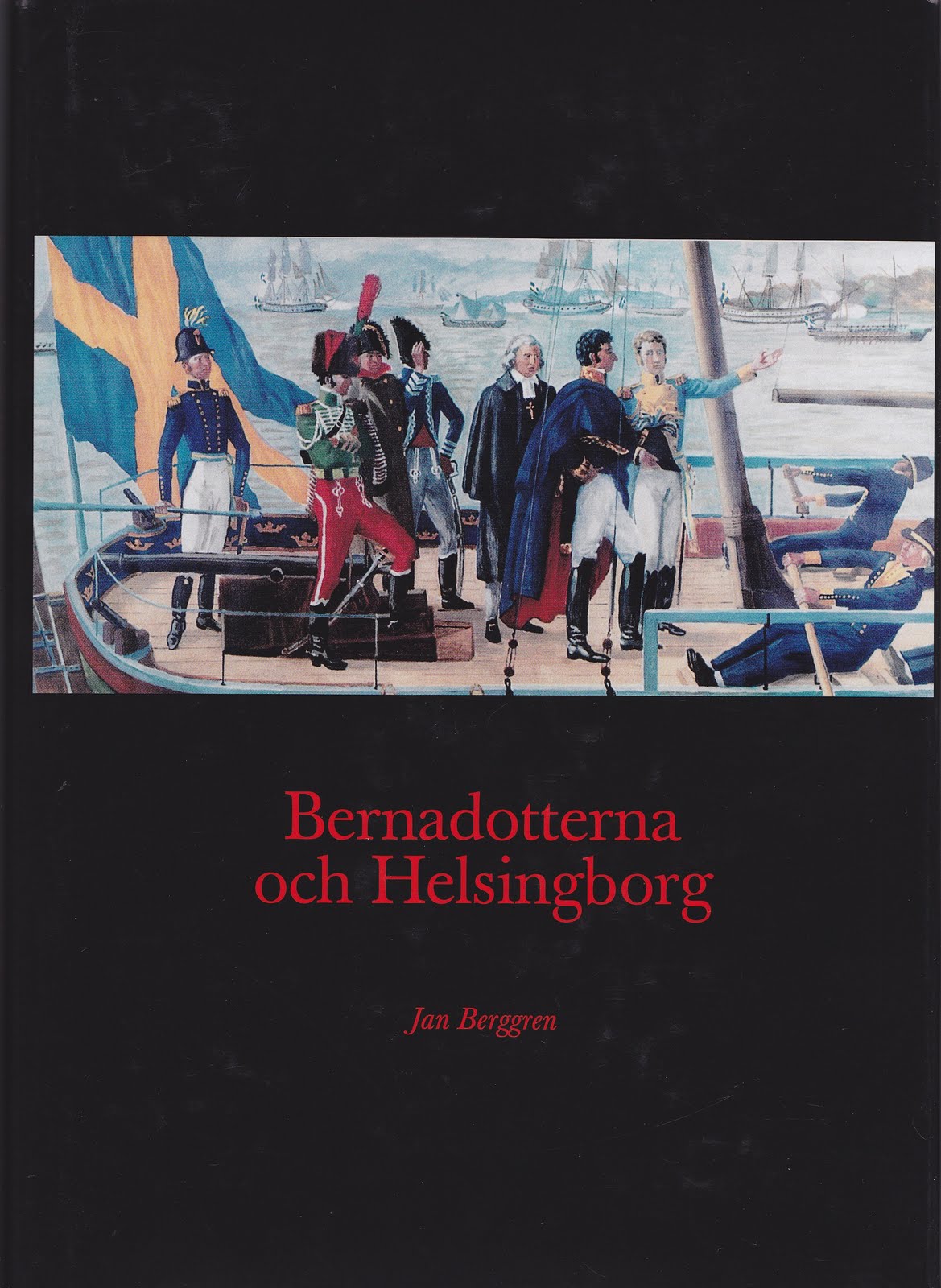
As part of the bicentenary celebrations the City of Helsingborg commissioned the historian Jan Berggren (the husband of the city’s Director of Communications, which caused some controversy) to write the book Bernadotterna och Helsingborg – 200 år sedan Karl XIV Johan landsteg i Helsingborg. Although the links between the Bernadottes and Helsingborg are at the centre of the book, the author has also chosen to include the county of Scania at large.
He relates the background for the events which led to Jean-Baptiste Bernadotte, Sovereign Prince of Pontecorvo and Marshal of the French Empire, being elected heir to the Swedish throne and tells of his arrival in Helsingborg in 1810, at that time a small town of a few thousand inhabitants.
In 1824 the local newspaper Helsingborgs Posten claimed that the King planned to build a summer palace outside Helsingborg, but although this never happened Carl Johan came quite frequently to Scania in the years following his arrival in Sweden (1816, 1819, 1820, 1821, 1824, 1832 and 1837). To a certain extent this can be explained by military manoeuvres taking place in the county, but Berggren also sees the frequent visits in the early years as a sign of Carl Johan’s distrust of the Scanians – the county had after all only been part of Sweden for some 150 years at that time and the King was, according to Berggren, suspicious of Danish sympathies still to be found in Scania.
The proximity to Denmark also meant that Helsingborg came to play a small role in what is called Scandinavianism, the popular movement which in the mid-19th century aimed at a closer association between the three Scandinavian kingdoms, perhaps even a union. In 1846 the Swedish-Norwegian royal family hosted King Christian VIII and the extended Danish royal family in Helsingborg, a visit which Berggren sees in relation to Scandinavianism but also in relation to the need for repairing relations between the two royal houses, who had been at war as recently as 1814. It was after all Christian VIII himself who had led the Norwegian rebellion that year and been elected King of Norway before being ousted by Carl Johan, whose widow Desideria he now encountered in Helsingborg.
The book is at its best in its first half, where Berggren weaves together the story of tje links between the Bernadottes and Scania with the greater picture and thus succeeds in putting the events in the relevant context. The second half tastes a little more of local history, focusing on summers at Sofiero and listing several notable visitors to the summer palace and Helsingborg (but not the visit paid to Sofiero by Prince Carl and Princess Maud of Denmark as late as 5 October 1905, slightly more than a month before they were elected King and Queen of Norway in succession to the deposed Oscar II).
There is also a chapter on Folke Bernadotte and his White Busses action, whereby thousands of prisoners were rescued from the concentration camps (transit was through Helsingborg) and traces of the Bernadottes in Helsingborg (artworks, names of streets, monuments, etc) before the book is rounded off with a brief interview with Count Carl Johan Bernadotte af Wisborg, the 94-year-old former prince who lives in nearby Båstad. Carl Johan Bernadotte tells two brief anecdotes of no greater significance and one could perhaps be forgiven for thinking that the author might have done more out of this interview, for example by letting the Count talk about his memories from Sofiero and incorporating such fresh recollections into the text rather than repeating what he wrote in his memoirs nearly thirty years ago.
Some factual mistakes might also be pointed out, such as King Haakon VII and Queen Maud being described as “the first King and Queen of independent Norway” or the claim of King Carl XIV Johan arriving in Scania “from the continent” for one of the visits during his reign, which is impossible given that the King never set his foot outside Sweden and Norway after 1814.
But all in all this is a good overview of the role Helsingborg and Scania have played in the history of the Bernadottes and the role the Bernadottes have played in Helsingborg and Scania.
Labels:
Bernadotte,
Bernadotte bicentenary,
books,
Helsingborg,
history,
reviews,
royalty,
Sweden,
Swedish literature
Wednesday, 9 February 2011
New books: Marie-Antoinette and Axel von Fersen once more
The story of Queen Marie-Antoinette of France and the Count Axel von Fersen has been told many times. The reason why the Swedish author Margareta Beckman has chosen to do so again in her new book Axel von Fersen och drottning Marie-Antoinette is that she, unlike other writers, has had privileged access to their correspondence in original in the French National Archives. However, this does not enable her to reach any new conclusions. The letters between the French Queen and the Swedish nobleman were first published by the latter’s great-nephew Rudolf von Klinckowström in 1877, but with several words and sentences replaced by dots (..........). The originals, which turned up in 1982 and ended in the National Archives in Paris, are also heavily censored and despite repeated attempts by various means it has proven impossible to reveal what is behind the black ink. Beckman has also been unable to solve the riddle.
In her book, Beckman tells the story from beginning to end – the main protagonist’s respective backgrounds, Marie-Antoinette’s teenage marriage and the marriage which remained unconsummated for years, the meetings and the correspondence between the Queen and Count von Fersen, the affair of the necklace, the growing criticism of the Queen, the revolution and the royal family’s attempted escape in which Fersen played a leading role. There are also rather long digressions to tell the entire history of the regiment Royal Suédois up until Fersen joined it (Beckman has earlier written a book about the regiment) and the fates of Marie-Antoinette’s two surviving children. All this is well-known from a mountain of previous books.
The Queen of France was in Beckman’s words “the great love of his [Axel von Fersen’s] life”, which seems a reasonable conclusion based on what he wrote in his letters to his sister Sophie Piper: “I cannot belong to the only person I want to [belong to], the only one who really loves me; thus I will not belong to anyone”. “She who was my happiness, she for whom I lived, yes my gentle Sophie, I have never ceased loving her, no! [...] she whom I loved so much, for whose sake I would be willing to sacrifice a thousand lives, she is no more!” “It was the day when I lost the person who loved me most in the whole world and who really loved me”.
Although aristocrats of the late eighteenth century tended to be effusive in their expressions of affection and used the word “love” more liberally and generously than we do today, it seems fair to conclude that Fersen did indeed love Marie-Antoinette. But we have no letters in which the Queen expresses similar feelings for Axel von Fersen.
The closest thing is a letter she wrote to Fersen after the royal family had been captured in Varennes during their attempted escape, in which Fersen had been instrumental in trying to save the French royals. “Farewell, the most beloved and most loving among men. I embrace you of all my heart”, the Queen’s letter ends.
This, Beckman points out, is the only one of the letters which has not been censored and she concludes that it must mean that the other letters were certainly not censored “for political reasons, as it has been claimed”. But drawing conclusions about what has been censored in other letters based solely on the contents of one uncensored letter is a risky business and not really very conclusive.
Indeed Beckman occasionally shows a willingness to jump to conclusions. For instance, Madame Campan later claimed that Fersen had been in Marie-Antoinette’s bedroom when Versailles was stormed, but Beckman interjects that Madame Campan herself was apparently not at Versailles that night and that her story is thus not a primary source. The claim that Fersen was in the Queen’s bedroom “can thus with the greatest certainty be completely rejected”, Beckman writes rather bombastically. But this is really to go too far – that an unproved piece of information comes from a secondary source does not automatically mean that it can be “completely rejected” with “the greatest certainty”.
It is really quite difficult to know what Beckman’s aim is or indeed what her view is about whether or not there was an affair between the Queen and the Count. It seems she wants to convince the reader that they did love each other, yet when she quotes Lady Holland’s memoirs describing Fersen as “the unfortunate Queen’s lover”, Beckman inserts an indignant “[sic!]” and she mentions the claim that he had been Marie-Antoinette’s lover as “worst of all” the accusations against him. Yet she does not refrain from indicating that Fersen might have been the father of Marie-Antoinette’s second son, Louis-Charles, based on Louis XVI writing in his diary about the boy’s birth that everything happened “in the same way as when my son was born”. (Beckman adds italics to the word “my” when she repeats the quote).
The book is generally well-written, the author mostly manages to avoid getting carried away sentimentally and there are not too many factual mistakes, but it does not provide any answers or any new information. Occasionally one feels a bit talked down to as the author finds it necessary to explain in brackets that “l’ancien régime” means the French monarchy before the revolution or that “Bruxelles” is the same as Brussels. But if one has never read anything about Queen Marie-Antoinette or Axel von Fersen this book might be a good introduction to their story.
Labels:
aristocracy,
books,
Bourbon,
France,
history,
reviews,
royalty,
Sweden,
Swedish literature
Tuesday, 25 January 2011
New books: Biography gone wild
Few if any books caused such headlines in Sweden last year as the unauthorised biography of the King, Carl XVI Gustaf – Den motvillige monarken by Thomas Sjöberg with Deanne Rauscher and Tove Meyer, which made some rather scandalous suggestions about the monarch’s private life. Now that I have at last wasted some time on reading it, I find it first and foremost a very peculiar book. It has two parts which bear little relation to each other.The first part, which fills some 2/3 of the book, deals with King Carl Gustaf’s life until he became king. It opens with a chapter on the days in which he succeeded to the throne – the illness and death of his grandfather and the ceremonies surrounding his accession and Gustaf VI Adolf’s funeral. These events are described in great detail, with official documents in antiquated legalese (or perhaps rather officialese) quoted in their full length, which eventually becomes rather tiresome but which nevertheless offers an idea of the rather old-fashioned system which the 27-year-old monarch came to preside over. This might have set the stage for an interesting contrast between the system the young king inherited and how he adapted to it or adapted the system to suit his ideas and his time. But no such reflections are made in this book.
Instead we go on to hear about his upbringing, which is well enough, but which brings little we have not already heard. The exception might be the chapter on the case against his maternal grandfather, Duke Carl Eduard of Saxe-Coburg and Gotha, for crimes against humanity following World War II, which the authors seem to have done proper research on in German archives and which nuances the picture in an interesting way.
Having been through the future King’s education and military service we reach a chapter on what happened in Torekov in the summer of 1971, i.e. when one reached the compromise whereby the monarchy was retained in the new constitution but the monarch was deprived of almost his entire constitutional role. This is a very interesting topic and again this chapter might have served as a backdrop for what one would expect to find in the second part of a biography of the King, namely how this shaped his role and how he has related to it.
But then the book changes into something completely else. The remaining 120 pages or so do not deal with the reign or with the King’s life after his accession or the development of the monarchy in those 37 years. No single person has been more important to all those three aspects than Queen Silvia and it is perhaps symptomatic that she is mentioned only three times in the second part of the book.
What we now get instead is a loose and rather thin account of parties, extramarital affairs, visits to strip clubs etc in which the King and/or his friends are alleged to have taken part. But we are also treated to long and detailed digressions about the life stories of various other people linked to these claims.
Much of these chapters are made up of interviews, often in verbatim form. Some of those interviewed seem unable to utter a complete sentence (“But, he ... that one ... I don’t understand because he has never been near... I have never had any grip on him... never had... more than said hello to the guy... I don’t understand what he has...”) and some of them do not remember much at all. A waitress at an American strip club King Carl Gustaf is alleged to have visited fourteen years earlier has, among other things, this to tell the interviewer:
“Did he tip you?
Yes absolutely, normally...a couple of thousand dollars.
So he gave you two thousand dollars?
Probably, yes.
What happened when he left?
I don’t know.
Do you remember that he left?
I don’t know, I don’t remember seeing him leave”.
And so on and so forth, seemingly without any bells ringing to the authors suggesting that this might not exactly be what one calls and eyewitness to history. There is a foreword dedicated to the sources, where we are assured that the tale told by a notorious gangster must be reliable because co-author Deanne Rauscher “has heard him tell the same things again and again”. But is it really so that something must be true simply because it has been repeated?
At the end of the book the authors try to make a case for why this gossip about King Carl Gustaf and his friends is important – it has to do with no lesser issues than the constitution, democracy and indeed the security of the realm.
An unauthorised biography of King Carl Gustaf might in itself have been an interesting thing as most books on living members of the Swedish royal family have been written by, in cooperation with or under the supervision of the Royal Court’s Information and Press Department and are thus quite one-sided and frequently dull. But as biography this book is an utter failure simply because it does not tell the story of the main protagonist’s life. Instead it relates the first 27 years of his life and then descends into an orgy of gossip about peripheral events and various people’s sex lives.
Labels:
Bernadotte,
books,
reviews,
royalty,
Sweden,
Swedish literature
Monday, 24 January 2011
New books: War and war
The revolutionary and Napoleonic age was certainly a defining moment in the development of the Nordic region; the events of the years 1792-1815 caused the map of the region to be entirely redrawn. At the outset there were two conglomerate states, of which one consisted of the Kingdoms of Denmark and Norway, the Duchies of Schleswig and Holstein, the Norwegian dependencies Iceland, Greenland and the Faeroes, and colonies in Africa, Asia and the Caribbean; the other of Sweden including Finland, which had been an integrated part of the realm for centuries, and Swedish Pomerania. At the end of the epoch Sweden had been reduced to its present borders, Finland had become a partly autonomous Grand Duchy under the Russian Emperor, Denmark had lost Norway but gained the small Duchy of Lauenburg, and Norway had become an independent kingdom in a union of crowns with Sweden.
In his new book Omvälvningarnas tid – Norden och Europa under revolutions- och Napoleonkrigen, published by Norstedts, the Swedish historian Martin Hårdstedt sets himself the ambitious zeal of telling the story of that momentous era both from the Nordic perspective and from the greater European perspective while at the same time stressing how Nordic and continental events interlocked. It is an ambition which he only partially succeeds in fulfilling.
For while the book begins well with the author drawing up the background for the events that were to follow he soon narrows his tale down to the military aspects. This is mostly well-told and informative and the author makes some interesting points and analyses, but he presents the wars too isolated and not in the political and diplomatic context of which they were results and on which they depended. Hårdstedt himself implicitly points the finger at this fact when he writes, following Waterloo, that “[w]hat was determining in the end was that Napoléon did not have any political support”.
The book starts out well, but I became less enthusiastic as I read on and was treated to detailed analyses of battle formations, military strategies and army logistics. Without the larger context the wars do not really make any sense and the reader is left with only one aspect of a many-faceted story.
It is perhaps symptomatic for how military matters are allowed almost entirely to eclipse their political and diplomatic context that a man like Talleyrand makes his first appearance only on pages 165-166, when the story has reached the summit at Tilsit in 1807 and we are informed that Talleyrand thereafter lost much of his influence.
Unfortunately it is also rather obvious that although the author knows his way around the battlefield, he has a weaker grasp on non-military aspects of the story, such as political and constitutional issues.
For instance he writes that “[w]hen Napoléon reached Paris on 20 March [1815] it was again dictatorship that awaited [France]”, without writing a word on Napoléon’s unsuccessful attempt at introducing a “liberal empire” during the Hundred Days. And when it comes to the union of crowns between Sweden and Norway it is not correct that the King of Sweden was the commander-in-chief of the Norwegian army (the King of Sweden and the King of Norway were the same man, but in his capacity as King of Sweden he had no powers over the Norwegian army), nor is it correct that the King according to the Norwegian Constitution shared the legislative power with Parliament.
Further, the Norwegian rebellion of 1814 did not “lay […] a foundation for its future independence”. It is unclear when Hårdstedt thinks Norway did actually become independent, but that was in fact what happened in 1814. Perhaps this might be considered a result of the historical mythology nurtured by many Swedes that Norway was subject to Sweden rather than its equal in the union.
There are also far too many factual mistakes. Friedrich Wilhelm II was not the son of Friedrich the Great and Queen Hedvig Elisabeth Charlotta was not her husband’s aunt. Both Franz II, Napoléon I and Gustaf IV Adolf are referred to as “future” emperor or king well after they had succeeded to their respective thrones, while we learn that Maximilian Joseph of Bavaria had just been deposed when he had on the contrary been promoted from elector to king. Viscounts become counts and counts become dukes, while princes are demoted to dukes, and “the Mecklenburgian Princess Fredrika of Baden” is obviously an impossibility. When it comes to the arts it was not the empire style in itself which was called Biedermeier in Germany.
And then there are some rather far-fetched simplifications and exaggerations. I very much doubt Queen Marie-Antoinette could “determine people’s lives” simply by “a shrug of her shoulder” and mentioning Désirée Bernadotte together with Madame de Staël as an example of “women […] who did not simply live in the shadows of various men” borders on the ludicrous.
In my opinion Martin Hårdstedt would have done better if he had decided to write a book on the military history of the era between 1792 and 1815. That is a story he seems to master and know how to tell. But when this is presented as a history of the entire era, the attempt falls short because the military aspects are seen almost isolated and without the political and diplomatic context which determined the question of war and peace.
Labels:
books,
history,
Napoleonic wars,
reviews,
Swedish literature
Friday, 31 December 2010
New books: The emergence of a national museum
Before 2010 ends I should take the opportunity to post a final review of a book published in 2009. In his doctoral dissertation Från kungligt galleri till nationellt museum – Aktörer, praktik och argument i svensk konstmuseal diskurs ca 1814-1845 (“From Royal Art Gallery to National Museum: Actors, Practices and Arguments within Swedish Art Museum Discourse ca 1814-1845”), published as a book by Gidlunds Förlag, Per Widén looks not at the history of the National Museum in itself, but on the process which led to the establishment of a national museum of fine arts in Sweden. Unlike earlier chroniclers of the Swedish National Museum, Widén sees no direct line between the Royal Museum, set up by the Regent (later Carl XIII) following the assassination of Gustaf III in 1792, and the National Museum. The museum was housed in a few small rooms at the Royal Palace, but significant parts of the state art collection were in the royal apartments where they were only accessible to the public when the royals were not in residence.
Many thus realised that one needed a national museum of art located in a building of its onw, yet this did not happen until 1866, when the museum moved into a building at Blasieholmen opposite the Palace which had cost 2,270,877 riksdaler, making it the most expensive building to be erected in Stockholm since the Palace itself.
Widén sets out to investigate how it came about that the state invested such an astronomic sun of money in making its art collection accessible, who were the most important advocates of such a museum, how they went about it and what visions for the museum were formulated.
He identifies a group of approximately thirty advocates for a museum, seven of whom he considers most central: Gustaf Anckarsvärd, Axel Nyström, Fredrik Boije, Hugo Hamilton, Lars Jakob von Röök, Johan Way and Johan Henrik Schröder, all of them continuously active for a long time. Widén also looks at the relations between these actors and what arenas they operated on.
The most important meeting place, and the focal point of this group, was the royal court. But it was not the court as such or the royal family who ran the process, which Widén sees in relation to the changes in society during the 18th and 19th centuries which had seen civil society gain strength at the cost of the royals and the court. This also led to a new national discourse taking place in new public arena.
There was at first no organised or formalised group running this process, but overlapping groups of people who in different ways made their livings through the arts. Eventually they came together and in 1832 they established Stockholms allmänna konstförening (Stockholm Public Society of Art), which had the establishment of a national museum as its aim. Widén argues that the establishment of the society should be seen as a consequence of Parliament having voted down a proposition about a museum in 1832.
Acting as an organised group naturally made them stronger than when operating as individuals. They did not seek to influence public opinion through a press debate, but through hands-on work with art exhibitions and art museums wherever possible, thus setting a “practicable and non-confrontational” example.
The press, it seems to Widén, saw the need for an art museum as “self-evident”, which explains why there were no principle-based discussions about state responsibility in artistic matters. Parliament was the only arena where this consensus was challenged.
The issue was first raised in Parliament in 1817-1818 and voted down without any debate. Another proposition by Court Marshal Fredrik Philip Klingspor (probably written by Axel Nyström and Fredrik Boije) was rejected in 1828. Six years later Jacob Wilhelm Sprengtporten included a suggestion for a building for a national museum and library in a proposition about a number of new public buildings in the capital, but the museum question was mostly lost in a wider debate on other issues. Yet another proposition in 1840 received a somewhat warmer welcome and in 1844 it was decided, with a majority of two votes, to build a museum – which would nevertheless not open for a further 22 years.
As can be seen from this list of dates little happened during the 1830s. Widén sees this as a consequence of King Carl XIV Johan being about to solve the issue on his own. With his background in Napoleonic circles, the King could not possibly be unfamiliar with the great importance accorded to the arts and museums of art during the French First Empire, Widén argues.
The King had commissioned his favourite architect Fredrik Blom to design a building for an art museum next to his new summer palace Rosendal. Work began in 1834 and it has been a commonly held perception that the museum building was intended to house the King’s private art collection, but Widén argues that the plans were at some stage altered and has figured out that approximately half of the state’s art collection could have been fitted into the projected building.
Widén admits that he has found no contemporary sources supporting such a theory, but it seems feasible that the absence of any museum propositions in Parliament during the 1830s – except the one which included a museum in a more general construction plan – might be linked to the King’s ongoing project. And it is only after work on the unfinished museum at Rosendal stopped in 1838 that the issue again reappears in Parliament.
Widén also sees the emergence of a Swedish national museum in an international context. He points out how palaces as well as museums around 1800 began to attract new groups of visitors from other segments of the population than earlier, something which caused the museum to present their collections in a different way as one could no longer count on the visitors to be well-informed in advance. Whereas one had earlier hung the same motif from different schools of paintings together to highlight the differences between the schools one now began to arrange them as a “pedagogical illustration of the history of art”.
For comparison Widén looks at museums in Rome, Vienna, Paris, Munich, Berlin, London, St Petersburg and Copenhagen. As a Norwegian reader one cannot avoid noticing that there is not a word about the situation in Norway at the same time, even though Widén stresses the importance for the Swedish situation of the fact that similar museums were appearing in other European countries.
The author observes that when the issue was first raised in Parliament in 1828 there were few great art museums in Europe, but when the issue reappeared in 1840 the situation had changed radically in that major museums had opened in Berlin, Munich and London, while the Louvre was growing and the Hermitage expanding. The small Royal Museum in Stockholm thus did not stand well in comparison with other European capitals.
Widén mentions the art museum at the second Christiansborg Palace in Copenhagen in 1829 and the work on the New Hermitage in St Petersburg beginning in 1839 as examples from Stockholm’s neighbourhood, but ignores Christiania (now Oslo) although Sweden and Norway were at the time in a union of crowns (although both independent kingdoms).
A Norwegian national museum of art had first been proposed to the Norwegian Parliament by Hans Riddervold in April 1836 and the motion was passed in late December that year. 28 paintings were bought for the museum in May 1837 and in 1841 the National Museum opened in some rooms of the still not completed Royal Palace.
The swift establishment of a national museum in the country with which Sweden was in a union might have been an interesting contrast to look at for comparison. What took 25 years in Sweden took eight months in Norway and one must wonder if the issue being so speedily solved in Norway may not have influenced or at least played some sort of role for the changing attitudes in the Swedish Parliament.
A glance to the west would also have modified Widén’s statement that “the great art museums of the 19th century, with the exception of the National Gallery in Britain, all have their origins in princely collections transferred to state ownership”. The Norwegian National Museum is another example of that not being the case.
Despite this final reservation on my part the main impression is that Per Widén has delivered an insightful and convincing account of the long process which led to the establishment of the institution that is the National Museum of Sweden, the actors which ran the process and the ideas of the day about museums’ purposes and functions. As such it is a valuable addition to the literature on the history of the National Museum.
Labels:
Bernadotte,
books,
history,
museums,
reviews,
Sweden,
Swedish literature
Monday, 27 December 2010
New books: Drottningholm from Gustaf III to Carl XVI Gustaf
The first volume on Drottningholm Palace in the book series on the Swedish royal palaces, published in 2004, told the royal domain’s story from the 1660s, when Dowager Queen Hedvig Eleonora had the palace built, until 1777, when Dowager Queen Lovisa Ulrika ceded it to her son Gustaf III. Back then some critics said that if the time of Gustaf III had been included as well, one might have done with only one volume, suggesting that there is little to be said about Drottningholm after the 18th century. The second volume of Drottningholms slott, Från Gustav III till Carl XVI Gustaf, edited by Göran Alm and Rebecka Millhagen and published by Votum Förlag in Karlstad this autumn, shows that this indeed a misconception.This is the seventh book in the series which was revived last year with a volume on Haga and it follows the same pattern as the earlier volumes. There are thematic chapters by various experts in their fields, the book is profusely illustrated and it is based on the latest research, although not academic in language or form.
It was as mentioned in 1777 that Dowager Queen Lovisa Ulrika, who as a young bride in 1744 had been given the right to use the palace by King Fredrik I, ceded it to her eldest son, King Gustaf III. But although it has often been said so in the literature the authors of this book show that Drottningholm was not actually owned by Gustaf III. It had by 1777 already become state property and it was only the disposal right as well as her private furniture and collections that Lovisa Ulrika sold to her son.
Gustaf III considered it “the only of my countryside retreats which has a royal appearance” and Stina Odlinder Haubo points out that except the Royal Palace in Stockholm, Drottningholm was the only palace available to Gustaf III which had actually been built as a royal palace which was thus also intended to be a manifestation of royal power – unlike what was the case in for instance Denmark, the Swedish royal country palaces tended to have belonged to noble families before being bought and remodelled by the royals.
There is a multitude of topics covered by this book. Göran Alm opens the book with a chapter on court life at Drottningholm in the 1770s, followed by Magnus Olausson on the garden and the park in the days of Gustaf III, before Stina Odlinder Haubo considers the interiors during Gustaf III. Inga Lewenhaupt writes about the world-famous theatre at Drottningholm, Ingrid Sjöström about the other buildings on the domain and its surroundings, Thomas Roth about the military presence at Drottningholm and Catharina Nolin about the 20th century restoration of the gardens, to mention only the major chapters.
If I should single out some contributions for praise it would be those by Eva-Lena Bengtsson and Britt-Inger Johansson. Bengtsson writes about the changes to the interiors made by King Oscar I and Queen Josephina, in particular the Hall of State, where Queen Josephina surrounded her husband’s portrait with those of his contemporaries among the sovereigns of Europe (portraits of the female consorts of some of them were collected in a smaller adjacent room).
The future Carl IX and Gustaf III had done something similar at Gripsholm Castle and Bengtsson points out that Carl IX, Gustaf III and Oscar I all belonged to the second generation of a new dynasty. This was obviously done to stress the upstart Bernadottes’ equal status to other European monarchs and it is interesting to note that the future Gustaf V’s christening took place in this hall at the time most of the portraits had arrived.
Bengtsson observes that there seems to be no formal precedence taken into account when the portraits were placed on the walls, but notes that Oscar I is at the centre flanked by Emperor Napoléon III of France and Queen Victoria of Britain, “representing the real great powers of Europe”. But here there is probably another point which Bengtsson has overlooked: the portrait of Oscar I is thus flanked by the monarchs of the two countries with which he had entered into the so-called November Treaty in 1855.
Britt-Inger Johansson considers the changes to the interiors which were made during the 19th century. She takes to task the oft-repeated myth that Carl XIV Johan showed no interest in Drottningholm and allowed it to fall into disrepair, pointing out that he ordered general inventories of all the palaces to be carried out when he succeeded to the thrones in 1818, but that Parliament rejected his request for funds for its renovation. There are indications that the King might have had plans for a renovation paid for out of his own funds and that these ideas remained in his mind until well into the 1820s, but Johansson suggests that the building works at the palaces Rosendal and Rosersberg eventually drew away the King’s attention and money. Johansson also points out how the 19th century’s fondness for history led to interiors being created to commemorate the reigns of Carl XII, Carl XIV Johan and Oscar II himself, adding to Drottningholm’s status as a historical monument.
Bo Vahlne and Göran Alm present the history of Drottningholm and its interiors during the Bernadottes. Following Oscar I’s death it remained primarily at the disposal of his widow Josephina until her death in 1876, meaning that Carl XV rarely stayed there, but since then it has been frequently used by all successive monarchs: Oscar II, Gustaf V, Gustaf VI Adolf and Carl XVI Gustaf.
In 1981 King Carl Gustaf and his family left the Royal Palace in Stockholm and made Drottningholm their permanent, all-year home. This has led to one part of the palace being set aside for the royal family’s private quarters, something which Göran Alm argues is in a way to go back to the roots. In the 17th century Dowager Queen Hedvig Eleonora had both official apartments and a more private section, whereas Lovisa Ulrika and Gustaf III, and to a great extent also the earlier Bernadottes, did not draw a strict line between private and official rooms. A tentative separation of the palace along such lines began with King Gustaf V and Queen Victoria.
In 1991 the Drottningholm domain was added to UNESCO’s World Heritage list – the first such site in Sweden. Here and there in the book we hear about the great tourist interest in Drottningholm ever since the advent of steamboats in the early 19th centuries – the first guidebook dates from 1796 – and it is also suggested that the huge numbers of visitors (today reckoned to be about 500,000 annually) may have influenced certain decisions concerning the presentation of the palace and the gardens. Yet Göran Alm’s chapter on Drottningholm as a tourist attraction runs to a mere two pages and this is something I think could well have been dealt with more thoroughly, while some other chapters in my opinion appear too long and detailed.
Another thing I miss – in this as well as in many other books on palaces – is more about life at the palace. As mentioned Göran Alm provides some glimpses of court life in the 1770s, but we learn comparatively less about life at Drottningholm during subsequent monarchs, although there must be a fair amount of material on this available (royals as well as courtiers tell about this in published diaries and memoirs).
But all in all this is a highly informative book which offers an insightful and comprehensive account of the lesser-known parts of Drottningholm’s history. There can no longer be any reason to claim that Drottningholm does not have a rich and interesting history even after the assassination of Gustaf III.
The next volume in the book series will be about Tullgarn, my personal favourite among the eleven royal palaces of Sweden.
Labels:
architecture,
Baroque,
Bernadotte,
books,
Holstein-Gottorp,
palaces,
reviews,
royalty,
Sweden,
Swedish literature,
world heritage
Sunday, 5 December 2010
New books: Establishing the Bernadotte dynasty
In connection with the bicentenary of the Bernadotte dynasty’s arrival in Sweden the jubilee foundation of the National Bank of Sweden has financed an interdisciplinary research project titled “The Making of a Dynasty”. As previously mentioned the project released its second publication in June, a book titled En dynasti blir till – Medier, myter och makt kring Karl XIV Johan och familjen Bernadotte, edited by Nils Ekedahl and published by Norstedts.The book, like the project, aims to investigate by which means one made Carl XIV Johan and his family known to the people and how one created an imagined community between the people and the new dynasty. This should be seen as a multimedia show, the authors argue, where the variety of media used strengthened the message. Music, architecture, poetry and painting are the art forms considered by the authors contributing to this book, to which are added investigations of the use of ceremonial and the press.
I shall not dwell upon each and every chapter, but, as with all anthologies, some contributions are more interesting than others. Among those I found most interesting is the chapter by the historian Mikael Alm, who looks at the ceremonial which unfolded in connection with key events in the life of Carl Johan. The events were not only staged as “plays”, he argues, thus giving spectators the chance to observe and take part, but detailed accounts of the ceremonial were printed and distributed around the country so that the population outside the capital could also take part. Similarly, Nils Ekedahl, associate professor of rhetoric, looks at the panegyrics dedicated to the royals, which were also often printed in the newspapers and spread throughout the country.
The art historian Solfrid Söderlind, Director General of the National Museum, deals with those personages to whom Carl Johan felt it natural to compare himself. Of his predecessors on the Swedish throne, Gustaf II Adolf was the obvious choice, as both of them could be said to have led Sweden in playing a major role in events on the Continent. Napoléon I was obviously another ruler to whom it was natural to compare Carl Johan and Söderlind argues that Carl Johan’s famous words on his deathbed, “No-one has fulfilled a career comparable to mine”, was directed directly at his adversary.
Among the most interesting contributions to this anthology is also the art historian Britt-Inger Johansson’s chapter on Carl Johan’s physical environments, i.e. the palaces in which he lived and their importance for the staging of the new dynasty. In this Johansson is able to offer some interesting new interpretations. It has been rather common to say that Carl Johan showed little interest in the older Swedish palaces, except the Royal Palace itself. On the contrary Johansson shows that he gave orders for general inventories to be carried out for all of them, but that the Swedish Parliament was not willing to grant the funds he requested for renovating them.
However, in this chapter I miss a more thorough consideration of the Royal Palace in Oslo, which was the only major palace Carl Johan had the chance to build from scratch, a process in which he played an active and significant role. Despite being arguably the most important building created by Carl Johan, Oslo Palace is accorded only a short paragraph (in which there are four factual mistakes) and Johansson thus fails to use the opportunity given her to look at Carl Johan in the role as builder of a palace.
As I have commented on on several occasions it is an unfortunate trend that Swedish writers almost entirely tend to ignore the Norwegian side of the history of the Bernadottes. Sweden and Norway were indeed two independent countries in a personal union, but as the royal family was mutual (and in fact the only mutual institution besides the Foreign Service) it means that one misses out on half the story when only one of the countries is considered. In this case it means that the book gives an incomplete picture of the reception of the new dynasty.
Henrik Wergeland is the sole Norwegian mentioned in Nils Ekedahl’s chapter on panegyrics, while Cecilia Rosengren does not offer the Norwegian media a single thought in her chapter on the press. Considering the successful Swedish-Norwegian history project “Project 1905” a few years ago it is altogether more surprising that one has chosen to make this project an entirely Swedish one. Among the contributors to this book the historian Per Sandin comes closest to subjecting Norway to an equally thorough treatment as Sweden.
Sandin is currently about to complete his doctoral dissertation on the first two generations of the dynasty’s relations to civilian society and in his chapter, based on his coming dissertation, he argues that the usual image of an old, reactionary king ruling his kingdoms from his bedchamber has blocked posterity’s understanding of the interaction between monarchy and society. Sandin finds that Carl XIV Johan, particularly when compared to other contemporary monarchs, appears to have been a monarch with an unusually benevolent attitude to civil associations, which members of the royal family in several cases actively supported.
The too narrow Swedish approach is a drawback for this book, but its strength is that it brings together leading scholars in different fields who are able to offer new insights and new interpretations, which in combination give the reader a better understanding of why and by which means the Bernadottes succeeded in establishing themselves as a new dynasty. 200 years after their arrival in Sweden and 192 years after Carl XIV Johan’s accession to the throne they are the longest reigning dynasty in the country’s history. Certainly few would have expected that when Jean-Baptiste Bernadotte, Sovereign Prince of Pontecorvo and Marshal of the French Empire, was surprisingly elected Crown Prince by the General Estates in August 1810.
Labels:
Bernadotte,
Bernadotte bicentenary,
books,
history,
media,
Norway,
reviews,
royalty,
Sweden,
Swedish literature
Friday, 19 November 2010
New books: The complete works of Prince Eugen
The museum Prince Eugen’s Waldemarsudde in Stockholm has just brought out a 637-page-book which catalogues all Prince Eugen’s paintings and sketches – altogether 3,169 works. Despite his royal background Prince Eugen, the youngest son of King Oscar II and Queen Sophia of Sweden and Norway, was able to make a name for himself as a landscape painter, but was also a generous collector of other artists’ works, which were displayed together with his own works in the gallery he had built adjacent to his villa at Waldemarsudde in Stockholm. All of it was left to the state at the time of the childless prince’s death in 1947 and opened as a museum the following year.
In 1939 Gustaf Lindgren published a catalogue of Prince Eugen’s art collection, but this did not include the Prince’s own works. In 1998 Hans Henrik Brummer, the then director general of the museum, took the initiative to publish a catalogue of Prince Eugen’s works, a task which has now been completed by a project group consisting of Elsebeth Welander-Berggren, the current director general; Christina G. Wistman, who was until recently in charge of the art collections at Waldemarsudde; and Anna Meister, the museum’s archivist and librarian.
The book, titled Prins Eugen – Målningar och skisser – En beståndskatalog has thus been twelve years in the working, meaning that the illustrations were scanned in black and white at a time when colour reproductions were much more expensive than today. This is an unfortunate result of the long production time, but it is somewhat compensated by some seventy colour plates at the beginning of the book.
There are two introductory essays by Christina G. Wistman and Hans Henrik Brummer, followed by the works themselves arranged partly chronologically and partly topographically.
Seeing Prince Eugen’s entire production together for the first time is interesting from many perspectives. One may see how a work developed from a simple sketch through more detailed sketches and early versions into the finished work. And it struck me for the first time how much architecture he painted, including many of the royal palaces. He is known for having painted mostly landscapes, but here one may also see the handful of portraits he did – among them his mother Queen Sophia and his niece Crown Princess Märtha.
At the end of the book there is a section devoted to the works stolen or lost since his death.
This book will be followed by a second catalogue dealing with the works of applied arts at Waldemarsudde and a third volume on Prince Eugen’s art collection.
Labels:
art,
Bernadotte,
books,
reviews,
royalty,
Sweden,
Swedish literature
Sunday, 14 November 2010
New books: Berlin united and divided
The ever-changing city of Berlin is today one of the most interesting capitals in Europe and has one of the most dramatic histories. This history is not particularly long – the town that would eventually become Berlin was first mentioned in 1237 – but it continues to fascinate.The Swedish journalist Folke Schimanski tells the history of this pulsating metropolis in his new book Berlin – En stads historia, published by Historiska Media. Schimanski was himself born in Berlin in 1936, to a Swedish mother and a German father, but escaped to Sweden in February 1945. However, his own story is only mentioned in passing where it seems relevant.
Medieval Berlin is quickly dealt with in this book, while the 17th and 18th centuries are accorded somewhat more space. However, the focus is mostly on the 19th and 20th centuries and Schimanski manages to touch on a multitude of issues – politics, science, literature, film, architecture, art, the press, social conditions, etc.
The picture he paints of “the golden 1920s”, when Berlin overtook Paris as the most dynamic and modern capital in Europe, is particularly fetching. The Berlin of the 1920s had a pulsating nightlife, was a focal point of the art world and had by 1928 one hundred political daily newspapers and altogether 2,633 newspapers and periodicals.
How this was followed by what Schimanski calls “the double destruction of Berlin”, is a prime example of what he sees as characteristic of the history of a city which has been ever-changing, not through organic processes, but by seismic shifts.
Another recurring point is how Berlin has had to fight for its position as capital against non-Berliners questioning its status. Schimanski argues that Berlin was not an obvious choice for capital in 1871 and that Bismarck ten years later suggested moving the capital to Cassel, while Wilhelm I argued the case for Potsdam and others suggested Frankfurt or Leipzig. The decision to return the capital to Berlin after reunification was reached with a narrow majority and even today plans for a reunification memorial in Berlin are met with demands that part of the sum allocated should be set aside for a memorial in Leipzig.
The vastness of Schimanski’s tale means that most stories are told somewhat fragmentary and he gets some of his facts wrong (Pyotr III of Russia was not the son of Empress Elizaveta; Christian Krohg did not spell his surname Krogh and was not Danish, but Norwegian; Helmut Kohl did attend the 20th anniversary of the fall of the Berlin Wall last year; Margaret Thatcher has not, at least not officially, been diagnosed with Alzheimer’s). At the beginning of the book we learn that Charlottenburg Palace was not destroyed during World War II; towards the end of the book we hear that it was.
One or two explanations are perhaps a bit too simple, such as the idea that World War I might never have happened if Friedrich III had lived longer – although this seems to be a pet idea of certain amateur historians, it is almost as far-fetched as suggestions that the Great War would never have happened if Archduke Franz Ferdinand had not been shot in Sarajevo.
One might also object that the author might at times have tried to be a bit more objective. In particular he seems to have an unresolved issue with the architecture of the late 19th century, which is consequently referred to in terms such as “ugly”, “uglier” and “tastelessness”. Art historians – and, I think, the general public – have long since come to a more nuanced view and appreciation of the eclecticism of the late 19th century.
Each chapter ends with a box of related sights worth visiting and suggestions for further reading and begins with a black and white illustration of low quality. The limited number and low quality of the illustrations do not do justice to this book, which all in all is a readable and informative account of the many aspects of the history of the fascinating city that is Berlin.
Labels:
Berlin,
books,
cities,
Germany,
history,
Hohenzollern,
reviews,
Swedish literature
Friday, 12 November 2010
New books: Fredrik Reinfeldt so far
Ahead of the Swedish general election this year Bonniers published a box of paperback biographies of the 22 men who have been prime minister since 1905. The final volume in the series is naturally about the current Prime Minister, Fredrik Reinfeldt, and has been written by Björn Elmbrant, who was for many years a well-known political journalist and is also the author of biographies of the former prime ministers Olof Palme and Thorbjörn Fälldin. Elmbrant’s task has been a bit different from that of the other authors in this series in that he was the only one not to write about a finished premiership. At the time the book went to press it was an open question whether or not Reinfeldt would be re-elected and thus whether the four years described in the book would be his entire premiership or just the first half (or beginning). Now we do of course know the outcome of the election – Reinfeldt lost his parliamentary majority, but remains in office as the leader of the largest block in Parliament.
The book begins with the election night in 2006, when Reinfeldt, his conservative Moderate Party and their centre-right coalition partners wrested power from Göran Persson and the Social Democrats, but then goes on to chart Reinfeldt’s background and early political career.
He was not always a favourite of the party leadership, particularly not after he co-authored a book which, following the party’s electoral defeat in 1994, was seen as a personal attack on Carl Bildt, the party leader and outgoing prime minister, an incident which caused Bildt to give Reinfeldt a sound verbal whipping at a meeting of the parliamentary group (Bildt is now foreign minister in Reinfeldt’s cabinet).
Following the disastrous election result of 2002 – the Moderate Party received only 15.2 % - Reinfeldt was elected leader of the party, which he in Blairish fashion rebranded “the New Moderates”. Elmbrant sees this as the break-through of PR politics and states that this has caused “the ability to communicate” to become at least as important in politics as content and economic possibilities.
Elmbrant considers the election victory in 2006 the result of good preparations and hard work, but is apparently not much impressed with Reinfeldt’s early leadership. Two of his ministers were forced to resign within a week after their appointment and were shortly thereafter followed by a state secretary who was one of the Prime Minister’s key advisers.
Reinfeldt did not handle the scandals very well, which Elmbrant in part ascribes to the fact that he had declined the opportunity a new government has to postpone the budget in order to push through his wide-reaching reforms as soon as possible and that this gave him little time to handle the ministerial crises. Three weeks after the government took over it lost its majority in the opinion polls to the opposition.
The following two years were beset with problems and difficulties for the government. Elmbrant considers the handling of the controversial FRA law, which gives the authorities wide powers to control telephone and Internet traffic and which was pushed through in Parliament by a narrow margin, particularly bad. This he sees as an example of how Reinfeldt has not been able to create political agreements across the blocks on big issues, which has been something of a tradition in Swedish politics.
(Interestingly, Reinfeldt has in the past weeks shown himself to be more adept at this since losing his majority and by brokering a deal over Afghanistan with the Social Democrats and the Green Party managed to reach a compromise at the same time as the right-wing extremists the Sweden Democrats were kept away from any influence and the three so-called red-green opposition parties and their formalised cooperation were split apart as the Left Party did not wish to support the compromise).
Elmbrant also considers Reinfeldt’s professed commitment to climate issues quite hollow when held against the government’s actual politics, but accords him credit for having stood up for his politics when he pushed through the very unpopular limitations in social security. And he points out that the government has actually made good of most of their electoral promises from 2006 and not fallen apart, which is in itself an achievement when one considers the history of previous coalition governments.
Elmbrant’s assessment of Fredrik Reinfeldt and his premiership seems mostly fair, although one can read behind the lines that the author is no supporter of the current government. And although he mostly tries to be constructive in his criticism there is at least one statement which reflects badly on the author himself. “Most of them are born in the seventies, many come from the PR profession, and can be suspected of favouring fast, shallow results rather than wise, practical and juridically waterproof reforms”, he writes about the government’s political advisors. This seems like an elderly man’s sweeping generalisation of an entire generation.
Labels:
books,
politics,
reviews,
Sweden,
Swedish literature
Subscribe to:
Posts (Atom)