Showing posts with label Britain. Show all posts

Sunday, 24 February 2019

My latest article: Olav and Märtha's unknown love story & Roosevelt and the Kings

In the March issue of Majesty (Vol. 40, No. 3), which was published on Thursday, I have written an article about the wedding of Crown Prince Olav of Norway and Princess Märtha of Sweden ninety years ago, in which I can for the first time reveal not only that King Haakon and Queen Maud were in fact against their son marrying Märtha but also the reason why and who they wanted him to marry instead of Märtha.
In the same issue I conclude my article series on Theodore Roosevelt's grand tour of the courts of Europe in 1910. In this third instalment the former US President visits Emperor Wilhelm II in Berlin and goes to London for the funeral of King Edward VII, where the kings of Europe flock around him and he observes King George V's failure to understand why his youngest son, Prince John, was not like his other children.

Thursday, 2 August 2018

My latest articles: Norwegian golden wedding, Swedish royal dukedoms and Princess Victoria of Britain

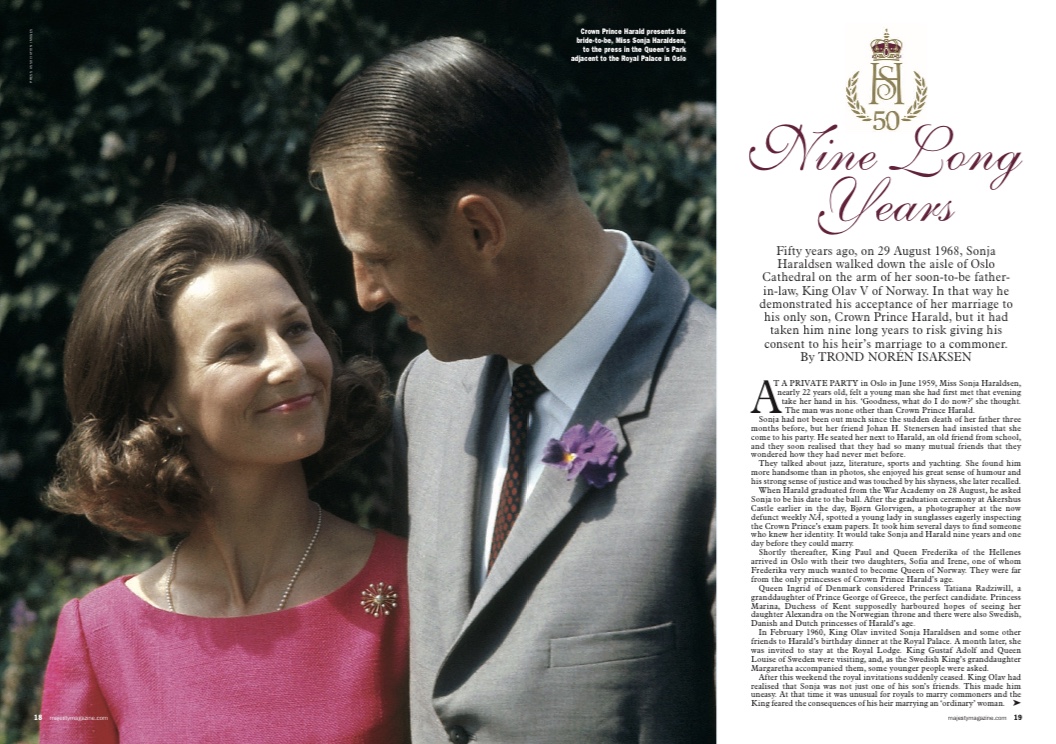
The August issue of Majesty (Vol. 39, No. 8) is now on sale and it appears I have written almost half of it. On the occasion of the King and Queen's golden wedding anniversary later this month I write about the nine difficult years they had to wait before King Olav eventually risked giving his consent to their marriage, which everyone seemed to think might spell the end of the monarchy.
I also write about the difficult, unhappy and frustrated Princess Victoria of Britain, the sister of Queen Maud and King George V, who was not allowed to marry the Liberal Prime Minister Lord Rosebery, whom her mother Queen Alexandra treated as her maid and who ended up as a rather bitter woman who often made life difficult for others.
Finally, there is also an article on the history of Swedish royal dukedoms, which were once semi-autonomous states within the states that could become power bases but are now just honorific titles given to the ever-growing number of members of the Swedish royal family.

Thursday, 8 March 2018

My latest articles: Gustaf VI Adolf & Hélène of Aosta

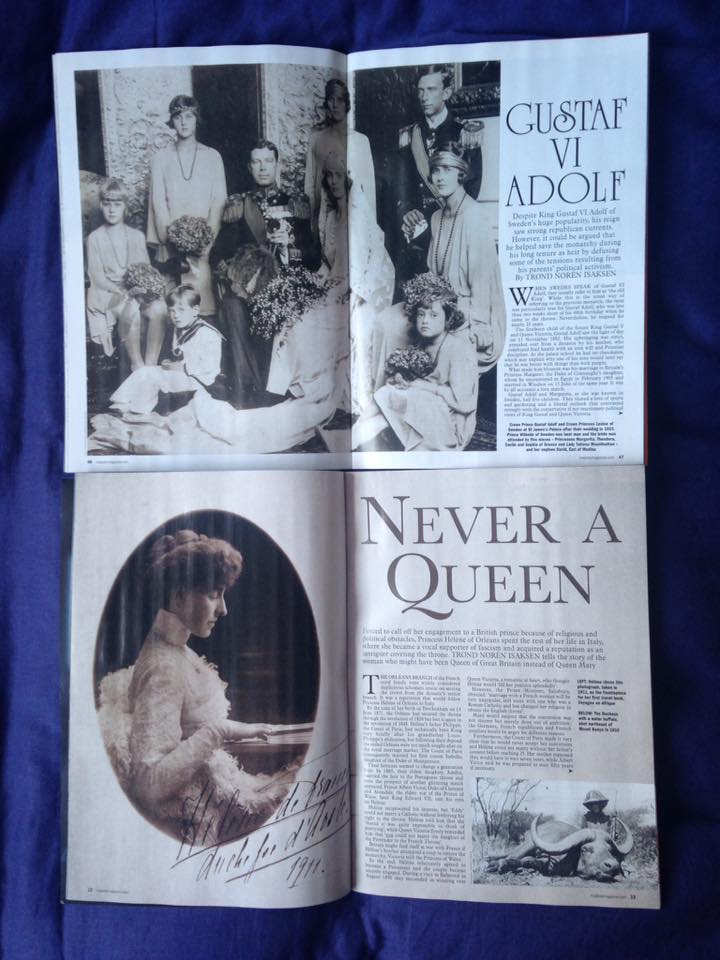
In the March issue of Majesty (Vol. 39, No. 3), which has been on sale in Britain for two weeks and is on sale in Norway from today, I write about the life of King Gustaf VI Adolf of Sweden, who is often credited with the survival of the Swedish monarchy. I also write about the French-born Princess Hélène, Duchess of Aosta, who was engaged to Prince Albert Victor, heir to the British throne (Queen Maud's brother), but married into the Italian royal family, became an enthusiastic fascist and was widely suspected of coveting the throne for her husband and sons.
In the same issue there is also a report on Prince William and Kate's official visit to Sweden and Norway, a report on the engagement of Princess Eugenie of Britain and Jack Brooksbank and a profile of Meghan Markle (who is also on the cover).
The magazine was already being printed when Prince Henrik of Denmark died, so my obituary of him will appear in the next issue, alongside an article on King Christian IX of Denmark, who was born 200 years ago in April 1818.

Tuesday, 22 August 2017

My latest article: The troubled history of kings consort

Earlier this month, Prince Henrik of Denmark caused quite an uproar when he announced that he no longer wants to be buried together with his wife of fifty years, Queen Margrethe II. In a series of interviews he also launched a personal attack on his wife, who he claimed makes a fool of him, and stated that he would be willing to reconsider the decision about his burial place if she would agree to make him King Consort.
It was explained that the Prince’s decision was made because of his dissatisfaction with his title and function, something a spokeswoman said had become more and more important for him in recent years. It is far from the first time Prince Henrik raises the issue of his title and the fact that he believes that as the wife of a king is queen, a queen’s husband ought to be king (i.e. king consort and not, as some ill-informed people have claimed, take over as monarch).
Many seem to think that this is an idea Prince Henrik has grasped out of thin air, but in a long article in today’s issue of the broadsheet Politiken (external link) I recount the history of kings consort, which began in the crusader Kingdom of Jerusalem in the twelfth century and soon spread to Naples, Spain, Navarre, Portugal, Poland, England, Scotland and Cyprus. In fact, the husbands of queens regnant were actually usually (although not always) styled kings and many of them took part in the governance of the realm. The so far last king consort in Europe died as recently as 1902, and it is only during the last century and a half that it has become more common for male consorts not to be called kings. Thus, although Prince Henrik may have history and principles on his side, it seems highly unlikely that he will ever achieve his dream of becoming King Consort of Denmark.

Sunday, 29 January 2017

My latest articles: The King and Princess Astrid & the artistic Princess Louise

The February issue of Majesty (Vol. 38, No. 2) has been on sale since last week and as February will see the King's 80th birthday as well as Princess Astrid's 85th I have written an article on the two siblings and the close relationship they have enjoyed since childhood.
In the same issue I also write about Queen Victoria of Britain's daughter Princess Louise, Duchess of Argyll who broke with conventions by becoming an accomplished sculptor and by marrying a commoner, something which caused quite a lot of problems for him.

Wednesday, 21 December 2016

Book news: The soft power of royal heirs

In August last year I participated in a conference on the soft power of royal heirs at the University of St Andrews, and now Palgrave Macmillan has gathered the lectures given at this conference in a book titled Royal Heirs and the Uses of Soft Power in Nineteenth-Century Europe, edited by Frank Lorenz Müller and Heidi Mehrkens and published earlier this month. I write about how the Bernadottes during the Swedish-Norwegian union of crowns tried to create a Norwegian identity for the heirs, particularly by the power of presence, education and the office of Viceroy, while Maria-Christina Marchi deals with Italy, Kristina Widestedt with Sweden, Erik Goldstein with the United States, Milinda Banerjee with the Bengal, Janet Ridley, Imke Polland and Edward Owens, with Britain, Alma Hannig with Austria-Hungary, Richard Meyer Forsting with Spain, Miriam Schneider with Greece, Jeroen Koch with the Netherlands and Frederik Frank Sterkenburgh with Prussia, and Frank Lorenz Müller, Monika Wienfort and Heidi Mehrkens provide more general overviews of the topic.

Friday, 10 June 2016

Duchess of Cornwall and Duke of Cambridge join Privy Council

Queen Elizabeth II of Britain held a meeting of the Privy Council at Buckingham Palace yesterday afternoon, at which her daughter-in-law Camilla, the Duchess of Cornwall, and her grandson Prince William, the Duke of Cambridge, were made members of the Privy Council. While this is standard procedure for a future monarch - Prince Charles was made a Privy Councillor in 1977 and the then Princess Elizabeth in 1951 - this is an unusual honour for the Duchess of Cornwall, who becomes the first female member of the royal family to join the Privy Council since Princess Elizabeth in 1951. Indeed, while the consorts of female monarchs - Prince George of Denmark, Prince Albert and Prince Philip - have all been Privy Councillors, no consorts of male monarchs or heirs have been admitted to the council until yesterday,

Sunday, 24 April 2016

My latest article: Crown-wearings

The May issue of the British monthly magazine Majesty (Vol. 37, No. 5) was published on Thursday, the ninetieth birthday of Europe's only crowned monarch, and contains and article by me about crown-wearings. Nowadays the British State Opening of Parliament, which this year will take place on 18 May, is the only time apart from a coronation when a crown is actually worn and Queen Elizabeth II puts on the crown as if it were a hat, but in the middle ages, crown-wearings were in themselves a solemn ritual. Kings wore crowns on the great religious feast days to stress not only their power and sacred elevation but their likeness to Jesus and crowns were placed on the monarchs' heads by high prelates in a ritual based on coronations. The article explores the roots of crown-wearings, how the ritual fell into abeyance and how the tradition of wearing a crown to Parliament was revived by King George V in 1913.

Saturday, 2 April 2016

My latest article: Retired monarchs and King Carl Gustaf at 70

The April issue of Majesty (Vol. 37, No. 4), which is now out, is an unusually large issue of 84 pages, much of it marking the upcoming 90th birthday of Queen Elizabeth II of Britain on 21 April. My contributions are an article looking at how her four European counterparts who have chosen to take things easier in old age, i.e. Grand Duke Jean of Luxembourg, Queen Beatrix of the Netherlands, King Albert of the Belgians and King Juan Carlos of Spain, are faring in their retirement, and a profile of this month's other birthday boy, King Carl XVI Gustaf of Sweden, who will turn seventy on 30 April.
While Queen Elizabeth's official birthday celebrations have been postponed until June, King Carl Gustaf will mark his milestone with a series of events at the end of this month, starting with a performance at the Royal Dramatic Theatre on the 25th and a concert by the army's orchestra in the Palace Church the next day. On the 28th and 29th, the King will receive congratulatory deputations and on the 29th King Carl Gustaf will also present scholarships at the Royal Opera and attend a concert at the Nordic Museum.
On his actual birthday, Saturday 30 April, there will be a service of thanksgiving in the Palace Church before the customary military event at the Palace's Outer Courtyard, which is held every year. Thereafter, the King will be serenaded by a multitude of singers on the northern side of the Palace and thereafter travel by carriage to a lunch in the City Hall before receiving well-wishers from Parliament, the government and the county governors at the Palace. In the evening there will be a banquet in the Palace's Hall of State. (Fans of the Swedish court's penchant for "glitter" may perhaps be disappointed to hear that the dresscode for the latter is black tie).

Tuesday, 22 December 2015

My latest articles: Norwegian silver jubilee and Waterloo bicentenary

It is still 2015, but the January 2016 issue of Majesty (Vol. 37, No. 1), which contains two articles by me, is now on sale. On 17 January, the King and Queen will celebrate their silver jubilee and in the first article I look back at the events of 1991: the death and funeral of King Olav V, the accession of King Harald V, his and Queen Sonja's solemn blessing and the challenges that faced the new King and Queen. In the second article, I report on this year's bicentenary of the Battle of Waterloo, starting with the death of the 99-year-old 8th Duke of Wellington on the very last day of 2014 and ending with Prince Napoléon receiving the Freedom of the City of London at the end of November.

Tuesday, 27 October 2015

My latest articles: Princess Esmeralda on her father & Edward VII and Norway

The November issue of Majesty (Vol. 36, No. 11) went on sale in Britain on Thursday and this month I have contributed two articles.
There is the second part of my interview with the writer and climate change activist Princess Esmeralda of Belgium, who this time shares her fond memories of her father, King Léopold III of the Belgians, and talks about how he rebuilt his life after his more or less forced abdication after the Second World War and how she carries on part of his work. While the first part of the interview, which appeared in the October issue, dealt with her grandparents King Albert I and Queen Elisabeth, the third and final part, which will appear in the December issue, will be devoted to her controversial mother, Princess Lilian.
As November marks the 110th anniversary of King Haakon VII's arrival in Norway, my second article investigates the role played by King Edward VII of Britain in securing the Norwegian crown for his daughter and son-in-law.

Thursday, 1 October 2015

My latest articles: Princess Esmeralda on her grandparents, Queen Charlotte and Ludwig II's bride

I used to post updates here about articles I write, but in the final months of work on my new book there was no time for that, but now that the book is done I will try to resume that habit, starting with the October issue of Majesty, which went on sale in Britain last Thursday and will soon reach other countries too.
In this issue (Vol. 36, No. 10, October 2015) you will find the first part of an interview I recently did with the author and climate change activist Princess Esmeralda of Belgium, the youngest daughter of King Léopold III. This time she speaks about her grandparents, King Albert I and Queen Elisabeth, who are the topic of a book she and Christophe Vachaudez co-authored last year. In the second part of the interview, which will appear in the November issue, Princess Esmeralda will talk about her father, his downfall and how he built a new life for himself after his abdication, and in the third and final part, in the December issue, she will share her memories of her controversial mother, Princess Lilian. All three parts will include several unusual photos.
In the October issue I have also written an article on Queen Charlotte of Britain, the long-suffering consort of "mad" King George III, who was often severely tested by misfortune, but who, in spite of everything, managed to maintain her sanity.
I have written no less than three articles in this issue, and the last of them deals with Duchess Sophie in Bavaria, the younger sister of Empress Elisabeth of Austria, who was engaged to the legendary, eccentric King Ludwig II of Bavaria, fell in love with a photographer, married a French Prince, was locked away in a mental asylum when she fell in love with her doctor and died a horrible death. Hers was surely one of the most dramatic and tragic of royal life stories.

Sunday, 5 July 2015

Princess Charlotte of Britain christened

The christening of Princess Charlotte of Britain, the daughter of the Duke and Duchess of Cambridge (Prince William and his wife Catherine), took place in St Mary Magdalene Church at Sandringham in Norfolk today. The godparents were Prince William's first cousin Laura Fellowes (daughter of Princess Diana's eldest sister Jane and Queen Elizabeth's former Private Secretary Robert Fellowes), the Duchess of Cambridge's first cousin Adam Middleton (son of her father's brother Richard), and three friends of the parents: Sophie Carter, James Meade and Thomas van Straubenzee.
The Princess wore a christening dress from 2007 which is a replica of one first worn by Queen Victoria's eldest daughter, Victoria, later German Empress, in 1841. The so-called Lily Font, a silver gilt baptismal font made for the same occasion, had been brought to Sandringham from the Tower of London, where it is usually displayed together with the Crown Jewels (sparking silly stories in the media about "the Crown Jewels leaving London for the first time").
Princess Charlotte was baptised by the Archbishop of Canterbury, Justin Welby. The only invited guests, except from her parents and elder brother George, were her great-grandparents, Queen Elizabeth II and Prince Philip; her grandfather Prince Charles and his wife Camilla; her grandparents Michael and Carole Middleton; her uncle James Middleton; her aunt Philippa ("Pippa") Middleton; and the five godparents, four of them accompanied by their spouses.
St Mary Magdalene Church is located at the royal Sandringham estate in northeastern England, where the parents of Princess Charlotte nowadays have their primary home at Anmer Hall. The church has also been the venue of the christenings of, among others, the future King George VI of Britain in 1896, the future King Olav V of Norway in 1903, and Princess Charlotte's grandmother Diana, the future Princess of Wales, in 1961.

Friday, 5 June 2015

Princess Charlotte to be christened at Sandringham

It was announced today that the christening of Princess Charlotte of Britain will take place in St Mary Magdalene Church at Sandringham on 5 July. Her brother, Prince George, was christened in the Chapel Royal at St James's Palace, London, but the parents are now living primarily at their country home Anmer Hall on the Sandringham estate, which makes the local church seem a natural choice of venue.
Among other royals baptised in St Mary Magdalene Church are the baby's late grandmother Diana, Princess of Wales, who was born in Park House on the Sandringham estate and christened in the local church on 30 August 1961, Princess Eugenie, who was christened there on 23 December 1990, and the future King Olav V of Norway, who was born at Appleton House, also on the Sandringham estate, and baptised on 11 August 1903.
Like her brother, Princess Charlotte will be christened by the Archbishop of Canterbury.

Thursday, 26 March 2015

New British act of succession comes into force

Today is an historic day for the British monarchy as the Succession of the Crown Act 2013, which introduces gender neutral succession in Britain and the other fifteen realms of which Elizabeth II is head of state, comes into force. The prime minister of the sixteen kingdoms agreed upon these changes at the Commonwealth Heads of Government meeting in Perth on 28 October 2011 and although it passed its final reading in the British Parliament and received the royal assent in April 2013 it has not come into force before now as it needed to be passed by the all the realms, which has been a rather complicated process. In the end Australia, Barbados, Britain, Canada, New Zealand, St Kitts and Nevis and St Vincent and the Grenadines have passed legislation to amend the succession, while Antigua and Barbuda, Bahamas, Belize, Grenada, Jamaica, Papua New Guinea, St Lucia, the Solomon Islands and Tuvalu concluded that it was not necessary to pass legislation, apparently because the succession was not codified in suc detail. For instance, the constitution of Tuvalu appears to say that whoever is monarch of Britain is monarch of Tuvalu.
While younger brothers have until now bypassed elder sisters in the act of succession, the first-born will now be the heir regardless of its gender. This change will be retroactive, but only for those born after 28 October 2011. Thus Princess Anne is still behind her younger brothers and their children in the line of succession, and Prince Edward's son is still ahead of his older sister, while Senna Lewis, a granddaughter of the Duke of Gloucester, overtakes her younger brother Tane, who was born after that date.
The new Succession to the Crown Act also means that people who marry to Catholics are no longer barred from ascending the throne, while Catholics themselves are still excluded as the monarch is required to be Anglican. This change is retroactive, so that the Earl of St Andrews (the Duke of Kent's oldest son), Prince Michael and several others are now back in the line of succession (while Lord St Andrews' children and his brother Lord Nicholas Windsor, who are themselves Catholics, are still excluded).
The new act also repeals the Royal Marriages Act of 1772, scrapping the requirement for anyone in line of succession to seek the monarch's permission to marry. This will now only apply to the first six people in line to the throne. Currently those six are Prince Charles, Prince William, Prince George, Prince Harry, Prince Andrew and Princess Beatrice, which means that Prince Andrew's eldest daughter needs permission while her sister does not (the birth of Prince William's second child, which is expected in the second half of April, will however push Princess Beatrice out of the top six).
Of the seven European kingdoms, Spain is now the only one left where sons still take precedence over daughters in the order of succession. Gender neutral succession was first introduced in Sweden in 1980, followed by the Netherlands in 1983, Norway in 1990, Belgium in 1991 and Denmark in 2009.

Tuesday, 24 March 2015

Barbados to abolish monarchy

In a speech to party supporters, the Prime Minister of Barbados, Freundel Stuart of the Democratic Labour Party, has announced that the country will "move from a monarchical system to a republican form of government in the very near future". Legislation to transform the Kingdom of Barbados into a republic will be put to Parliament to mark the fiftieth anniversary of Barbados's independence next year and will, according to the Democratic Labour Party's Secretary General George Pilgrim (quoted in The Times today) "move the country through to the next major step in the process of nationhood". Pilgrim does not "expect any opposition" to the change.
Barbados is currently one of fifteen countries of which the British monarch is head of state, the others including Canada, Australia and New Zealand, but the Queen of Barbados has only visited five times and has not set foot in the country for 26 years. Her youngest son, Prince Edward, Earl of Wessex and his wife Sophie did however visit Barbados a year ago.
Like many other countries who have removed the British monarch from the position of head of state, Bahamas intends to remain a member of the Commonwealth. It is interesting to note that Prime Minister Stuart said that they "respect [Queen Elizabeth] very highly as head of the Commonwealth and accept that she and all of her successors will continue to be at the apex of our political understanding". These words are interesting as the headship of the Commonwealth is not hereditary; thus Prince Charles will not automatically become its head when Queen Elizabeth dies.

Thursday, 1 January 2015

At the road's end: The 8th Duke of Wellington (1915-2014)

Ever since the 1st Duke of Wellington was one of the victors in the Battle of Waterloo on 18 June 1815 it has been a tradition that the current Duke of Wellington goes to Windsor Castle on the anniversary of the battle to present the British monarch with a French flag as a token rent for the estate the 1st Duke was granted by the nation in recognition of his victory over Emperor Napoléon I of the French. It would have been wonderful if the 8th Duke of Wellington, who was born two weeks after the centenary of the battle, had been able to present the flag to Queen Elizabeth II on the bicentenary this year, but sadly he died on the last day of 2014, aged 99.
The son of the diplomat and architect Lord Gerald Wellesley, Arthur Valerian Wellesley was born in Rome on 2 July 1915 and was quite naturally named for his great ancestor. However, he was at that time not expected to succeed to the dukedom, but the death of his childless cousin Henry, the 6th Duke, from wounds received in action in Italy in 1943, made his father the 7th Duke and himself the heir apparent to the dukedom, which he inherited - together with a number of other British, Dutch, Spanish and Portuguese titles, including Prince of Waterloo, on the death of his father in 1972.
The 8th Duke was a career soldier, who served in the Middle East and Italy during the Second World War and was awarded the Military Cross in 1941. He retired from the British army in 1968 with the rank of brigadier. He was made a Knight of the Garter in 1990.
During the war he married Diana McConnel, who worked in military intelligence, in Jerusalem on 28 January 1944. The Duchess died in 2010. The couple had five children, of whom the eldest, Charles, a former MEP who is married to Princess Antonia of Prussia, succeeds to his father's titles (although it is customary in Britain that the heir to a title does not start using it until after the funeral of the previous holder). Their only daughter, Lady Jane Wellesley, is a TV producer, was at one stage advocated by Lord Mountbatten as a possible bride for King Carl XVI Gustaf of Sweden, but a certain Silvia Sommerlath came in the way of what might have been a grand alliance between the descendants of two of the victors of the Napoleonic Wars.
The 8th Duke of Wellington was last seen in public when he and Lady Jane attended the memorial service for Lady Soames, Winston Churchill's daughter, in Westminster Abbey on 20 November 2014.

Thursday, 18 December 2014

Book news: The male consorts of female monarchs

While much has been written about female monarchs, there has until now been no study of the roles and challenges of the men who were in the unusual position of consorts to female rulers. Therefore I am glad to be one of the contributors to the new book The Man Behind the Queen: Male Consorts in History, edited by Charles Beem and Miles Taylor, which has just been published by Palgrave Macmillan of New York.
My contribution is a chapter on Prince Consort Henrik of Denmark and his struggle for recognition of the role he has tried to carve out through his more than four decades as the first ever male consort of a Danish monarch. But this is only the last chapter of a book that covers a number of male consorts in Navarre, Spain, England/Britain, Sweden, Russia, Austria, Portugal, Brazil, India, the Netherlands and Denmark from the end of the thirteenth century till today.
The table of contents:

Introduction: The Man Behind the Queen; Charles Beem and Miles Taylor
1. The King Consorts of Navarre, 1284-1512; Elena Crislyn Woodacre
2. Ferdinand the Catholic: King and Consort; David Abufalia
3. "He to be Entitled Kinge": King Philip and the Anglo-Spanish Court; Sarah Duncan
4. Why Prince George of Denmark Did Not Become a King of England; Charles Beem
5. From Ruler in the Shadows to Shadow King: Frederick I of Sweden; Fabian Persson
6. Count Ernst Johann Bühren and the Russian Court of Anna Ioannova; Michael Bitter
7. Francis Stephen: Duke, Regent and Emperor; Derek Beales
8. Prince Albert; The Creative Consort; Karina Urbach
9. Commemorating the Consort in Colonial Bombay; Simin Patel
10. Ferdinand II of Portugal: A Conciliator King in a Turmoil Kingdom; Daniel Alves
11. Gaston d'Orléans, Comte d'Eu: Prince Consort to Princess Isabel of Brazil; Roderick Barman
12. The Rise and Fall of Siddiq Hasan, Male Consort of Shah Jahan of Bhopal; Caroline Keen
13. Royalty, Rank, and Masculinity: Three Dutch Princes Consort in the Twentieth Century; Maria Grever and Jeroen Van Zanten
14. Prince Philip: Sportsman and Youth Leader; Ina Zweiniger-Bargielowska
15. The Prince Who Would Be King: Henrik of Denmark's Struggle for Recognition; Trond Norén Isaksen

Wednesday, 17 December 2014

My latest article: Churchill and his monarchs

Because of Christmas the January 2015 issue of Majesty (Vol. 36, No. 1) goes on sale already today and to commemorate the fiftieth anniversary of Winston Churchill's death on 24 January 1965 I have written an article about his relations with the British monarchs throughout his political career, which began when he was elected to Parliament in the reign of Queen Victoria and ended with his second term as Prime Minister in the reign of her great-great-granddaughter, Queen Elizabeth II. Churchill was, according to his wife, "the last believer in the divine rights of kings", but his relations with the royal family were not always smooth, particularly not with George V.
This issue was sent to the printers a few hours before the death of Queen Fabiola of the Belgians was announced, so my obituary of her will appear in the February issue, which will be out in a month and where I will also write about Hereditary Prince Knud and his loss of the Danish crown.

Thursday, 11 September 2014

Elizabeth, Queen of independent Scotland?

In a week from today, the Scots will vote over whether Scotland should become an independent country. While the no campaign has had a clear lead for months, the opinion polls are now so close that the dissolution of the United Kingdom of Great Britain and Northern Ireland is a real possibility. If a majority of the Scots votes yes, Scotland will become independent on 24 March 2016. If they vote no, we have now been told that Scotland will immediately be offered greater autonomy within the United Kingdom.
A yes vote will obviously have great consequences, so it is rather surprising that many crucial issues remain unclear, most significantly the financial issue. While the Scottish government insists that Scotland will maintain the pound as its currency, the leaders of the three main British parties have insisted Scotland will not be allowed to do so, and should they change their mind a currency union between Scotland and Britain would clearly involve some sovereignty being ceded. It is also quite surprising that the British government insist they have no plans for what will happen if Scotland votes yes.
The question of what will happen to the monarchy has on the other hand been settled, although it includes unanswered questions. The referendum is about the dissolution of the parliamentary union of 1707, not the union of crowns of 1603. Therefore a vote in favour of independence means that Scotland and the remainder of Britain will revert to the previous arrangement, i.e. a personal union between two independent states. This is roughly the same arrangement as the union between Britain and Hanover between 1714 and 1837 and the union between Norway and Sweden between 1814 and 1905.
This means that Elizabeth II will become Queen of Scotland or of Scots, the latter (and, I believe, older) title apparently being favoured by the Scots. She will obviously drop the numeral in Scotland, as she is the first Scottish monarch of that name. This will put Scotland in the same position as Australia, Canada and numerous other kingdoms of which Elizabeth II is queen, i.e. of having a monarch resident abroad, although I can imagine the Scots will expect her to come to Scotland more frequently. As Queen of an independent Scotland Queen Elizabeth would be bound to take constitutional advice from the Scottish government, which may mean that she could at some stage receive conflicting advice from the Scottish and British governments in her roles as head of state of both countries (the union kings of Norway and of Sweden would have had much to say about such a scenario). One possibility is that her functions as Queen of Scotland is delegated to a governor general or a similar office when she is not in residence in Scotland, as is the case in her other kingdoms, but this has not been officially discussed.
There is also the issue of how long such a personal union would last. A YouGov poll conducted on 2-5 September found 54 % to be in favour of keeping the British monarch as head of state in the event of independence, while 31 % favoured an elected head of state and 15 % were undecided.
The same opinion poll found, for the first time, a majority to be in favour of independence, which has unleashed what seems like panic in London and some rather desperate calls for Queen Elizabeth to intervene and speak out in favour of the union. At the time of her silver jubilee in 1977, when a referendum on devolution of powers within the United Kingdom was coming up, the Queen for once indicated her personal opinion in an address to the Houses of Parliament, saying: "I number Kings and Queens of England and of Scotland, and Princes of Wales among my ancestors and so I can readily understand these aspirations. But I cannot forget that I was crowned Queen of the United Kingdom of Great Britain and Northern Ireland. Perhaps this Jubilee is a time to remind ourselves of the benefits which union has conferred, at home and in our international dealings, on the inhabitants of all parts of this United Kingdom".
On Tuesday the conservative Daily Telegraph used its editorial to call on Queen Elizabeth to speak out in favour of the union. This was rejected outright by a spokesperson who insisted: "The sovereign's constitutional impartiality is an established principle of our democracy and one which the Queen has demonstrated throughout her reign. As such the monarch is above politics and those in political office have a duty to ensure that this remains the case. Any suggestion that the Queen would wish to influence the outcome of the current referendum campaign is categorically wrong. Her Majesty is firmly of the view that this is a matter for the people of Scotland". It would in my opinion have been unwise if she had indeed intervened. It would have jeopardised the monarchy's political neutrality, and might also have alienated it from roughly half the Scottish people. It would also have undermined the Queen's standing, as it would have made a yes vote a personal defeat for Elizabeth II.