It has been a long time since I have had the time to update this blog, which is because I have been working literally day and night on my sixth book, but now I am pleased to announce that the book has been published. Kronprinsessens krig – Den sanne historien om kronprinsesse Märtha og Franklin D. Roosevelt, which translates as “The Crown Princess’s War: The True Story of Crown Princess Märtha and Franklin D. Roosevelt”, tells the story of Crown Princess Märtha of Norway during the Second World War, when the exiled first lady became part of US President Franklin D. Roosevelt’s inner circle and played a significant political, diplomatic and humanitarian role in wartime Washington.
Indeed, there were hardly anyone President Roosevelt saw more of during the Second World War than Crown Princess Märtha, but her role has generally not been understood. Many authors have written her off as just some sort of insignificant companion or perhaps the President’s mistress, but they have been unaware of the fact that the Crown Princess had a secret political mission that she was able to fulfil through her unlimited access to the President of the United States of America.
Thanks to a unique combination of sources from many countries, I am able to show how Crown Princess Märtha operated behind the scenes and utilised her network of influential friends and acquaintances to promote the interests of her country and how she became an important source of information for President Franklin D. Roosevelt.
Like my three latest books, this one is published by Historie & Kultur. It will be available in most bookshops, and may also be ordered from online booksellers such as Norli, Haugen Bok, Ark, Adlibris, Tanum and Platekompaniet (all external links).
Showing posts with label Norway. Show all posts
Monday, 7 October 2019
Sunday, 24 February 2019
My latest article: Olav and Märtha's unknown love story & Roosevelt and the Kings
In the March issue of Majesty (Vol. 40, No. 3), which was published on Thursday, I have written an article about the wedding of Crown Prince Olav of Norway and Princess Märtha of Sweden ninety years ago, in which I can for the first time reveal not only that King Haakon and Queen Maud were in fact against their son marrying Märtha but also the reason why and who they wanted him to marry instead of Märtha.
In the same issue I conclude my article series on Theodore Roosevelt's grand tour of the courts of Europe in 1910. In this third instalment the former US President visits Emperor Wilhelm II in Berlin and goes to London for the funeral of King Edward VII, where the kings of Europe flock around him and he observes King George V's failure to understand why his youngest son, Prince John, was not like his other children.
Labels:
Bernadotte,
Britain,
Germany,
Glücksburg,
history,
Hohenzollern,
Norway,
Roosevelt,
royalty,
Sweden,
USA,
Windsor
Thursday, 24 January 2019
My latest articles: Theodore Roosevelt at court & the last Queen of Bavaria
In the February issue of Majesty (Vol. 40, No. 2), which is out in Britain today, I continue my series on Theodore Roosevelt and the royals. In this second of three article, the former US President visits the courts of Brussels, The Hague, Copenhagen, Oslo and Stockholm, where he takes a strong dislike to one monarch, forms a lasting friendship with another and is smitten with an unhappy princess.
In the same magazine I also write about the life of Marie Therese, the last Queen of Bavaria (and Jacobite claimant to the British throne), who died 100 years ago in February 1919 while fleeing the revolution in Munich that had brought down the ancient Wittelsbach dynasty.
Labels:
Bavaria,
Belgium,
Bernadotte,
Denmark,
Germany,
Glücksburg,
Habsburg,
history,
Norway,
Orange,
Roosevelt,
royalty,
Sweden,
the Netherlands,
USA,
Wittelsbach
Tuesday, 22 January 2019
My latest article: The Norwegian crusaders
In today's issue of Aftenposten, Norway's largest newspaper, I have an article (external link) on King Sigurd the Jerusalemite, who was the first European king to go on a crusade to the Holy Land, and why the Norwegian contribution to the crusades and the conqeust of the city of Sidon (now Saida in Lebanon) was of greater significance than historians have realised until now. The article is based on my lastest book, Korsfareren - Sigurd Jorsalfare og hans verden, the first biography of the first crusader king.
Thursday, 27 September 2018
My new book: Sigurd the Jerusalemite and the Norwegian crusaders
Today marks the publication of my fifth book, Korsfareren - Sigurd Jorsalfare og hans verden ("The Crusader: Sigurd the Jerusalemite and His World"), which is the first ever biography of King Sigurd the Jerusalemite, who reigned in Norway from 1103 till 1130 and was the first European king to go on a crusade to Jerusalem.
While the crusades have been one of the most popular topics in international historiography in recent decades, most Norwegian historians have ignored the crusades and failed to understand this movement, which was at the heart of international affairs in the twelfth century. Thus they have mostly considered Sigurd a Viking, but in fact Sigurd broke abruptly with his father's Viking policies and dedicated his life to promoting Christianity.
His crusade of 1108-1110, which saw him fight in the Iberian Peninsula, the Balearics and the Holy Land, won him great fame, but the authors of the Norse sagas failed to grasp the larger international context of his crusade. By seeing the Norwegian and Icelandic sources in relation to the Latin, Arab, Byzantine and English sources, I have been able to recreate this context and thereby to give Sigurd his rightful place in the crusading movement. He arrived in the Holy Land at a critical time for the crusader states, which were surrounded by enemies on all sides, just as the Muslims were at last attempting to unite their forces in jihad against the Christians and just as the Byzantine Emperor had finally had enough of the crusaders and conspired with Muslim rulers to drive them out of the Middle East.
In order to survive, the crusader states needed to take control of the ports along the Mediterranean coast, for which they needed naval help from abroad. In all but one case did this help come from Venice, Genoa and Pisa; the sole exception being Sidon (modern Saida in Lebanon), which was conquered with the help of the Norwegians. Such was the significance of the conquest of Sidon that it led to riots in Baghdad.
Later, Sigurd would go on yet another crusade and work to promote the ideas of the papal reform movement in his realms. Eventually he went mad and left behind a kingdom that was soon consumed by a civil war that would last for a century and was turned into a holy war when the crusading ideas were imported to Norway and applied to the struggle for the crown.
The book is published by Historie & Kultur and may be bought in regular bookshops or ordered from online booksellers such as adlibris.no, haugenbok.no, norli.no, tanum.no, ark.no or platekompaniet.no
While the crusades have been one of the most popular topics in international historiography in recent decades, most Norwegian historians have ignored the crusades and failed to understand this movement, which was at the heart of international affairs in the twelfth century. Thus they have mostly considered Sigurd a Viking, but in fact Sigurd broke abruptly with his father's Viking policies and dedicated his life to promoting Christianity.
His crusade of 1108-1110, which saw him fight in the Iberian Peninsula, the Balearics and the Holy Land, won him great fame, but the authors of the Norse sagas failed to grasp the larger international context of his crusade. By seeing the Norwegian and Icelandic sources in relation to the Latin, Arab, Byzantine and English sources, I have been able to recreate this context and thereby to give Sigurd his rightful place in the crusading movement. He arrived in the Holy Land at a critical time for the crusader states, which were surrounded by enemies on all sides, just as the Muslims were at last attempting to unite their forces in jihad against the Christians and just as the Byzantine Emperor had finally had enough of the crusaders and conspired with Muslim rulers to drive them out of the Middle East.
In order to survive, the crusader states needed to take control of the ports along the Mediterranean coast, for which they needed naval help from abroad. In all but one case did this help come from Venice, Genoa and Pisa; the sole exception being Sidon (modern Saida in Lebanon), which was conquered with the help of the Norwegians. Such was the significance of the conquest of Sidon that it led to riots in Baghdad.
Later, Sigurd would go on yet another crusade and work to promote the ideas of the papal reform movement in his realms. Eventually he went mad and left behind a kingdom that was soon consumed by a civil war that would last for a century and was turned into a holy war when the crusading ideas were imported to Norway and applied to the struggle for the crown.
The book is published by Historie & Kultur and may be bought in regular bookshops or ordered from online booksellers such as adlibris.no, haugenbok.no, norli.no, tanum.no, ark.no or platekompaniet.no
Friday, 7 September 2018
My latest article: Carl XIV Johan's coronation 200 years ago
200 years ago today, Carl XIV Johan was crowned King of Norway in Nidaros Cathedral in Trondheim, which was, for many reasons, a remarkable event. For one thing, Carl Johan, the former revolutionary general Jean-Baptiste Bernadotte, did not have a drop of blue blood in his vein. Carl Johan did nothing to deny this and rather based his legitimacy on his military deeds, which had paved his way to the thrones of Norway and Sweden. In the new issue of Aftenposten Historie (no 8 - 2018), Norway's largest history magazine, I write about how this came to be expressed at his coronation and in the crown jewels Carl Johan commissioned for his coronation, including the sword he had carried in the battle where he helped defeat his great rival Napoléon.
Labels:
1814,
Bernadotte,
Bonaparte,
ceremonies,
coronations,
First Empire,
history,
Napoleonic wars,
Norway,
regalia,
royalty,
Sweden,
Trondheim
Wednesday, 29 August 2018
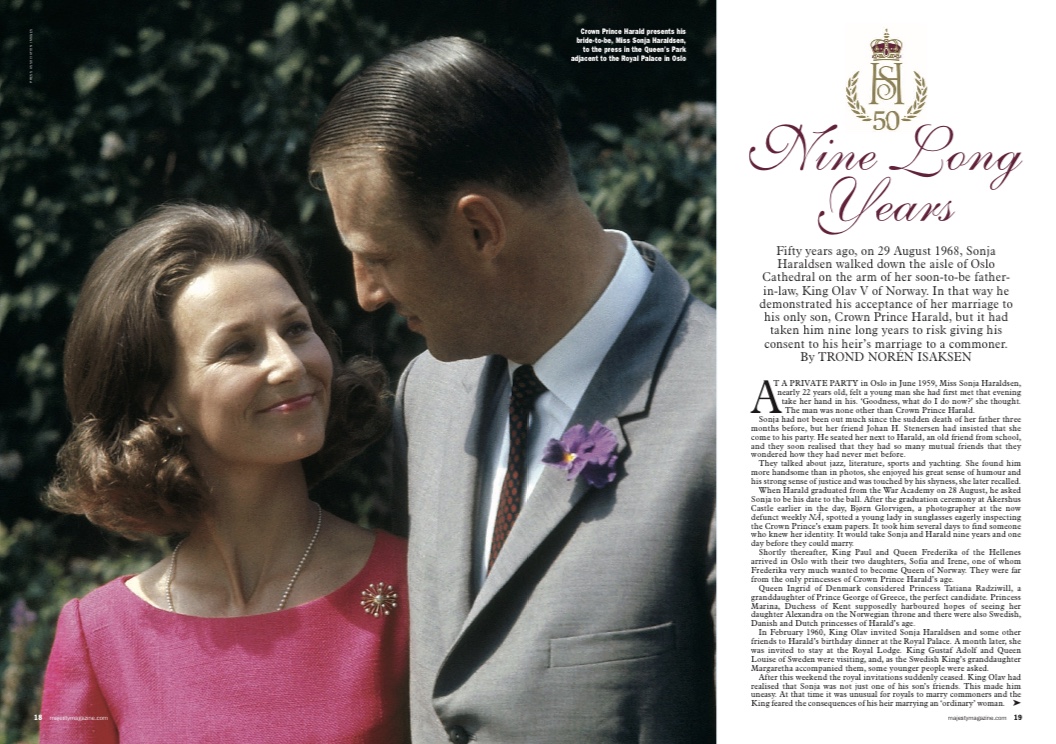
On this date: King and Queen's golden wedding anniversary
This afternoon the King and Queen drove to the Cathedral of Oslo in the same open-top Lincoln limousine which took them there fifty years ago to attend a service of thanksgiving. The Crown Prince and Crown Princess, Princess Ingrid Alexandra, Prince Sverre Magnus, Princess Märtha Louise and her daughters Maud, Emma and Leah Behn and Princess Astrid were also in attendance. Back at the Royal Palace afterwards, the King and Queen made an unannounced balcony appearance with their children, daughter-in-law and grandchildren.
Labels:
anniversaries,
Glücksburg,
golden weddings,
Norway,
royalty
Thursday, 2 August 2018
My latest articles: Norwegian golden wedding, Swedish royal dukedoms and Princess Victoria of Britain
The August issue of Majesty (Vol. 39, No. 8) is now on sale and it appears I have written almost half of it. On the occasion of the King and Queen's golden wedding anniversary later this month I write about the nine difficult years they had to wait before King Olav eventually risked giving his consent to their marriage, which everyone seemed to think might spell the end of the monarchy.
I also write about the difficult, unhappy and frustrated Princess Victoria of Britain, the sister of Queen Maud and King George V, who was not allowed to marry the Liberal Prime Minister Lord Rosebery, whom her mother Queen Alexandra treated as her maid and who ended up as a rather bitter woman who often made life difficult for others.
Finally, there is also an article on the history of Swedish royal dukedoms, which were once semi-autonomous states within the states that could become power bases but are now just honorific titles given to the ever-growing number of members of the Swedish royal family.
I also write about the difficult, unhappy and frustrated Princess Victoria of Britain, the sister of Queen Maud and King George V, who was not allowed to marry the Liberal Prime Minister Lord Rosebery, whom her mother Queen Alexandra treated as her maid and who ended up as a rather bitter woman who often made life difficult for others.
Finally, there is also an article on the history of Swedish royal dukedoms, which were once semi-autonomous states within the states that could become power bases but are now just honorific titles given to the ever-growing number of members of the Swedish royal family.
Labels:
Bernadotte,
Britain,
Glücksburg,
golden weddings,
history,
Holstein-Gottorp,
Norway,
royalty,
Sweden,
titles,
Vasa,
Windsor
Saturday, 14 April 2018
Royal jewels: Princess Ingeborg's Fabergé brooch - sold during WWII?
A Fabergé brooch (external link) which was given by the King's maternal grandfather, Prince Carl of Sweden, to Princess Ingeborg on the occasion of their fifteenth wedding anniversary in 1912 was sold by the auction house Coutau-Bégarie in Paris this week.
Several people have asked me about this and the auctioneer's claim that the brooch was sold by Crown Princess Märtha out of necessity during the Second World War. I do not know what is the auction house's source, but to me this seems like a misunderstanding or a supposition.
As I was able to reveal in my 2007 biography of Princess Astrid, Kvinne blant konger, the emerald parure now worn by the Queen was given to Crown Princess Märtha by Princess Ingeborg at the Central Station in Stockholm when she departed for the USA in the summer of 1940. Princess Ingeborg's intention was that her daughter could sell the emeralds if she never returned to Norway (which must have seemed a likely outcome in 1940), but the daring rescue of that the Bank of Norway's gold reserve meant that the Norwegian government-in-exile (unlike others) was able to provide for itself throughout the war and that the royal family did not have to sell their possessions in order to survive.
It therefore seems highly unlikely that Crown Princess Märtha sold the Fabergé brooch out of necessity during WWII.
Several people have asked me about this and the auctioneer's claim that the brooch was sold by Crown Princess Märtha out of necessity during the Second World War. I do not know what is the auction house's source, but to me this seems like a misunderstanding or a supposition.
As I was able to reveal in my 2007 biography of Princess Astrid, Kvinne blant konger, the emerald parure now worn by the Queen was given to Crown Princess Märtha by Princess Ingeborg at the Central Station in Stockholm when she departed for the USA in the summer of 1940. Princess Ingeborg's intention was that her daughter could sell the emeralds if she never returned to Norway (which must have seemed a likely outcome in 1940), but the daring rescue of that the Bank of Norway's gold reserve meant that the Norwegian government-in-exile (unlike others) was able to provide for itself throughout the war and that the royal family did not have to sell their possessions in order to survive.
It therefore seems highly unlikely that Crown Princess Märtha sold the Fabergé brooch out of necessity during WWII.
Labels:
Bernadotte,
Glücksburg,
history,
Jewels,
Norway,
royalty,
Sweden,
WWII
Monday, 9 April 2018
My latest article: The viceroyalty of Norway
One of the forgotten institutions in Norwegian history is the viceroyalty, which existed between 1814 and 1891, when the Crown Prince or his eldest son could be appointed Viceroy of Norway and exercise the King's functions when the King was in Sweden. This is a unique example of an independent kingdom being governed by a viceroy, but it gave the heir to the throne the chance to get to know Norwegian affairs. Although this was warmly welcomed at first, the viceroyalty eventually became very unpopular.
Until now nothing has been written about the Viceroys of Norway, but on pages 10-17 in the new issue of the Swedish royal history magazine Royalty Digest Quarterly (no 1 - 2018) you may find my article "From Patriotic Desire to Colonial Stigma: The Viceroyalty of Norway, 1814-1891", which is a revised version of a lecture I gave at the conference "Courts and Viceroys: Viceregal Courts in Comparative Perspectives" at New York University in London in 2015.
Labels:
Bernadotte,
history,
Norway,
politics,
royalty
Monday, 18 December 2017
My latest article: Erling Wryneck's holy wars
Erling Wryneck (c. 1115-1179) was one of the most feared, gifted and ruthless men to rule Norway. In the early 1150s he travelled in the footpaths of his father-in-law, King Sigurd the Crusader, on a crusade to Jerusalem, and after he gained power in 1161 as regent for his son, King Magnus Erlingsson, he transferred the crusading ideas to the war for the Norwegian throne. It thus became a holy war in which pretenders had to conquer or die and with biblical zeal Erling exterminated all those of his son's real and potential rivals he could lay his hands on, including his own stepson. In the December issue of Aftenposten Historie, Norway's largest history magazine, which is on sale from today, I write about Erling Wryneck and his holy wars, and he is also one of the main protagonists of my new book, Hellig krig om Norges krone - Tronstrid, borgerkrig og korstog fra Sigurd Jorsalfare til kong Sverre ("Holy War for the Crown of Norway: Wars of Succession, Civil Wars and Crusades from Sigurd the Crusader to King Sverre").
Labels:
civil war,
history,
medieval history,
Norway,
royalty
Thursday, 14 December 2017
My latest article: The Crusader's daughter
One of the most interesting women in medieval Norwegian history was Kristin Sigurdsdatter (c. 1125-178). After he father, King Sigurd the Crusader, had gone mad and died in 1130 and her brother, King Magnus the Blind, had been blinded, castrated and mutilated by their uncle Harald Gilchrist and later killed she was the only one left of the crusader's family, but eventually her son, Magnus Erlingsson, won the crown back from Harald Gilchrist's line. On several occasions Kristin herself took an active part in the wars for the throne, for instance when she spied on King Håkon the Broadshouldered and thereby revealed his schemes and paved her own son's way to the throne, or when she went to Denmark to negotiate a peace treaty with her cousin, King Valdemar the Great. Kristin also travelled to Constantinople and possibly to Jerusalem, and she lived to see that her husband, Erling Wryneck, executed her illegitimate son so that he would not challenge his half-brother for the throne. This interesting woman's life is the topic of an article I have written for the yearbook of Etne Historical Society (the village where she lived as a married woman), which may be ordered from www.etnesogelag.no (external link). She also features in my new book, Hellig krig om Norges krone - Tronstrid, borgerkrig og korstog fra Sigurd Jorsalfare til kong Sverre ("Holy War for the Crown of Norway: Wars of Succession, Civil Wars and Crusades from Sigurd the Crusader to King Sverre").
Labels:
civil war,
history,
medieval history,
Norway,
royalty
Thursday, 7 December 2017
My latest article: Margaretha the matriarch
In the December issue of the British monthly magazine Majesty (Vol. 38, No. 12) I write about Princess Margaretha of Denmark (1899-1977), who may have been less famous than her sisters, Crown Princess Märtha of Norway and Queen Astrid of the Belgians, but outlived them both by far to become (in the words of her niece, Princess Astrid of Norway) the female head of the family, the person who held the family together, one of King Olav's few confidantes and a valued adviser to younger relatives. The magazine is already out in Britain and from today also in Norway.
Labels:
Bernadotte,
Denmark,
Glücksburg,
Norway,
royalty,
Sweden
Tuesday, 21 November 2017
My latest article: Norway's holy war
In today's edition of Aftenposten, Norway's largest newspaper, I have an essay on how the crusading ideas influenced the 12th century war for the Norwegian throne, which they turned into a holy war in which pretenders had to win or die. It is, as the newspaper's chosen headline says, the real-life equivalent to Game of Thrones. The article is based on my new book, Hellig krig for Norges krone - Tronstrid, borgerkrig og korstog fra Sigurd Jorsalfare til kong Sverre, and may be read here (external link).
Tuesday, 10 October 2017
My new book is out today: Holy War for the Crown of Norway
My fourth book, Hellig krig om Norges krone – Tronstrid, borgerkrig og korstog fra Sigurd Jorsalfare til kong Sverre (i.e. “Holy War for the Crown of Norway: Wars of Succession, Civil Wars and Crusades from Sigurd the Crusader to King Sverre”), has been published today by Forlaget Historie & Kultur.
The book deals with the 12th century wars for the Norwegian throne (the Norwegian answer to the War of the Roses – or Games of Thrones, except that this story is true) and how the influence from crusading ideas turned them into a holy war. It starts with the crusade of King Sigurd the Crusader in 1108-1111 and ends with the Battle of Fimreite in 1184. By looking at how the wars for the Norwegian throne became intertwined with the Danish civil wars and the conflict between the Holy Roman Emperor and the Pope the book also attempts to place them in a Scandinavian and European context rather than the narrow Norwegian context they are usually seen in.
The main protagonists are the much-loved King Magnus Erlingsson, who while still a child became the first Norwegian King to be crowned; his talented father Erling Wryneck, who with biblical fervour exterminated his son’s rivals; his grandfather Sigurd the Crusader, who was the first European King to go on a crusade to Jerusalem; and the friendly but ambitious King Inge the Hunchback.
On the way from Jerusalem to Fimreite we also meet Kristin Sigurdsdatter, one of the most significant women of medieval Norway; “the devil’s priest” King Sverre and his Birchlegs; the castrated monk Magnus the Blind; the immigrant King Harald Gilchrist; the power broker Queen Ingerid Ragnvaldsdatter and her many men; the last Viking King Øystein Haraldssen; the rapist King Sigurd the Mouth; the mighty Margareta Fredkolla, who became Queen twice; Valdemar the Great, who made Denmark a great power; the reforming Popes Hadrian IV and Alexander III and their bellicose opponent, Emperor Friedrich Barbarossa; the church builder Archbishop Øystein Erlendsson; the rejected child bride Queen Kristin Knudsdatter; and St Olav, the eternal King of Norway.
The book deals with the 12th century wars for the Norwegian throne (the Norwegian answer to the War of the Roses – or Games of Thrones, except that this story is true) and how the influence from crusading ideas turned them into a holy war. It starts with the crusade of King Sigurd the Crusader in 1108-1111 and ends with the Battle of Fimreite in 1184. By looking at how the wars for the Norwegian throne became intertwined with the Danish civil wars and the conflict between the Holy Roman Emperor and the Pope the book also attempts to place them in a Scandinavian and European context rather than the narrow Norwegian context they are usually seen in.
The main protagonists are the much-loved King Magnus Erlingsson, who while still a child became the first Norwegian King to be crowned; his talented father Erling Wryneck, who with biblical fervour exterminated his son’s rivals; his grandfather Sigurd the Crusader, who was the first European King to go on a crusade to Jerusalem; and the friendly but ambitious King Inge the Hunchback.
On the way from Jerusalem to Fimreite we also meet Kristin Sigurdsdatter, one of the most significant women of medieval Norway; “the devil’s priest” King Sverre and his Birchlegs; the castrated monk Magnus the Blind; the immigrant King Harald Gilchrist; the power broker Queen Ingerid Ragnvaldsdatter and her many men; the last Viking King Øystein Haraldssen; the rapist King Sigurd the Mouth; the mighty Margareta Fredkolla, who became Queen twice; Valdemar the Great, who made Denmark a great power; the reforming Popes Hadrian IV and Alexander III and their bellicose opponent, Emperor Friedrich Barbarossa; the church builder Archbishop Øystein Erlendsson; the rejected child bride Queen Kristin Knudsdatter; and St Olav, the eternal King of Norway.
Labels:
civil war,
crusades,
history,
medieval history,
Norway,
Norwegian literature,
religion,
royalty,
succession
Monday, 2 October 2017
My latest articles: Norwegian crown jewels and Mohammed bin Salman
Court intrigues are always fun, and in the October issue of Majesty (Vol. 38, No. 10) I write about the latest developments in the ongoing struggle for the Saudi succession and the new Crown Prince, 32-year-old Mohammed bin Salman, who ousted his cousin Mohammed bin Nayef in what amounted to a palace coup this summer and now seems set to rule the world's most powerful monarchy for perhaps fifty years or more.
In the same issue my series on crown jewels continues with an article on the Norwegian ones, which, although mostly made in Sweden, have been symbols of Norway's independence for nearly two centuries.
The magazine is already on sale in Britain and will hit the shops in Norway on Thursday of this week.
In the same issue my series on crown jewels continues with an article on the Norwegian ones, which, although mostly made in Sweden, have been symbols of Norway's independence for nearly two centuries.
The magazine is already on sale in Britain and will hit the shops in Norway on Thursday of this week.
Labels:
Bernadotte,
history,
Jewels,
Norway,
politics,
regalia,
royalty,
Saudi Arabia,
succession
Saturday, 16 September 2017
My latest article: Innocent IV, the Pope who legitimised the House of Sverre
In today’s issue of the newspaper Klassekampen I write about Pope Innocent IV and his role in Norwegian history, inspired by a recent archaeological find. In connection with railway construction work in Oslo’s old town, archaeologists discovered something as rare as a medieval Papal seal. The seal was found folded, but on Wednesday an attempt was made to open it. This was abandoned because of the risk of breaking it, but the examination revealed that it was Pope Innocent IV who had sent the letter to which the seal was once affixed.
This was an interesting find because this Pope, who reigned from 1243 to 1254, played a small but interesting part in Norwegian history as the Pope who eventually gave permission for Håkon Håkonsson, the illegitimate grandson of the excommunicated usurper King Sverre, to be crowned. Thereby he brought the conflict between the church and the so-called Birchlegs to its conclusion and legitimised the House of Sverre as Norway’s rightful royal house, apparently in the hope that Håkon would go on a crusade and help recover Jerusalem, which had been lost to the Muslims in 1244.
Labels:
archaeology,
coronations,
history,
medieval history,
Norway,
popes,
royalty
Tuesday, 5 September 2017
My fourth book: Holy War for the Crown of Norway
Today I am pleased to announce the upcoming publication of my fourth book, Hellig krig om Norges krone – Tronstrid, borgerkrig og korstog fra Sigurd Jorsalfare til kong Sverre (i.e. “Holy War for the Crown of Norway: Wars of Succession, Civil Wars and Crusades from Sigurd the Crusader to King Sverre”), which will be published by Forlaget Historie & Kultur in early October.
The book deals with the 12th century wars for the Norwegian throne (the Norwegian answer to the War of the Roses – or Games of Thrones, except that this story is true) and how the influence from crusading ideas turned them into a holy war. It starts with the crusade of King Sigurd the Crusader in 1108-1111 and ends with the Battle of Fimreite in 1184. By looking at how the wars for the Norwegian throne became intertwined with the Danish civil wars and the conflict between the Holy Roman Emperor and the Pope the book also attempts to place them in a Scandinavian and European context rather than the narrow Norwegian context they are usually seen in.
The main protagonists are much-loved King Magnus Erlingsson, who while still a child became the first Norwegian King to be crowned; his talented father Erling Wryneck, who with biblical fervour exterminated his son’s rivals; his grandfather Sigurd the Crusader, who was the first European King to go on a crusade to Jerusalem; and the friendly but ambitious King Inge the Hunchback.
On the way from Jerusalem to Fimreite we also meet Kristin Sigurdsdatter, one of the most significant women of medieval Norway; “the devil’s priest” King Sverre and his Birchlegs; the castrated monk Magnus the Blind; the immigrant King Harald Gilchrist; the power broker Queen Ingerid Ragnvaldsdatter and her many men; the last Viking King Øystein Haraldssen; the rapist King Sigurd the Mouth; the mighty Margareta Fredkolla, who became Queen twice; Valdemar the Great, who made Denmark a great power; the reforming Popes Hadrian IV and Alexander III and their bellicose opponent, Emperor Friedrich Barbarossa; the church builder Archbishop Øystein Erlendsson; the rejected child bride Queen Kristin Knudsdatter; and St Olav, the eternal King of Norway.
The book deals with the 12th century wars for the Norwegian throne (the Norwegian answer to the War of the Roses – or Games of Thrones, except that this story is true) and how the influence from crusading ideas turned them into a holy war. It starts with the crusade of King Sigurd the Crusader in 1108-1111 and ends with the Battle of Fimreite in 1184. By looking at how the wars for the Norwegian throne became intertwined with the Danish civil wars and the conflict between the Holy Roman Emperor and the Pope the book also attempts to place them in a Scandinavian and European context rather than the narrow Norwegian context they are usually seen in.
The main protagonists are much-loved King Magnus Erlingsson, who while still a child became the first Norwegian King to be crowned; his talented father Erling Wryneck, who with biblical fervour exterminated his son’s rivals; his grandfather Sigurd the Crusader, who was the first European King to go on a crusade to Jerusalem; and the friendly but ambitious King Inge the Hunchback.
On the way from Jerusalem to Fimreite we also meet Kristin Sigurdsdatter, one of the most significant women of medieval Norway; “the devil’s priest” King Sverre and his Birchlegs; the castrated monk Magnus the Blind; the immigrant King Harald Gilchrist; the power broker Queen Ingerid Ragnvaldsdatter and her many men; the last Viking King Øystein Haraldssen; the rapist King Sigurd the Mouth; the mighty Margareta Fredkolla, who became Queen twice; Valdemar the Great, who made Denmark a great power; the reforming Popes Hadrian IV and Alexander III and their bellicose opponent, Emperor Friedrich Barbarossa; the church builder Archbishop Øystein Erlendsson; the rejected child bride Queen Kristin Knudsdatter; and St Olav, the eternal King of Norway.
Labels:
civil war,
crusades,
history,
medieval history,
Norway,
religion,
royalty,
succession
Tuesday, 4 July 2017
My latest article: A thousand years of queens
Today is the Queen's eightieth birthday and to mark the occasion I have written an essay on the history of Norwegian queens (external link) which appears in Aftenposten, the country's largest newspaper, today.
When Sonja became Queen in 1991, the position had been vacant for 52 years following the death of Queen Maud and therefore she had to carve out the role anew. However, Norwegian history is full of interesting and influential queens, such as Ælfgifu, Astrid Olavsdatter, Margareta Fredkolla, Ingerid Ragnvaldsdatter, Ingeborg Eriksdatter, Margareta Valdemarsdatter, Philippa of England, Blanca of Namur, Dorothea of Brandenburg, Josephine of Leuchtenberg and Sophie of Nassau.
Labels:
Bernadotte,
Glücksburg,
history,
medieval history,
Norway,
royalty
Monday, 3 July 2017
My latest article: The Queen at 80
The Queen will be eighty years old tomorrow (or so her birth certificate claims), which I mark with an article in the July issue of Majesty (Vol. 38, No. 7) that looks at her struggle to carve out a role that had been vacant for 52 years. The article also contains a photo report from the King and Queen's official birthday celebrations in May. The magazine is already on sale in Britain and will be available in Norway on Thursday.
Subscribe to:
Posts (Atom)