Today the Queen makes her public debut as an artist when the exhibition “Under stort press” (“Under Great Pressure”) opens at Dunkers kulturhus in Helsingborg. The Queen is among the eighty European artists exhibiting more than 1,000 graphic works.
In cooperation with the artists Kjell Nupen and Ørnulf Opdahl the Queen has transformed photos from a journey to Svalbard in 2006 into graphic prints and a series of 24 of them, titled “Tre reiser, tre landskap” (“Three journeys, three landscapes”), will be shown at the exhibition in Helsingborg.
The proceeds of the sale of fifty portfolios containing eight prints by the Queen, eight by Nupen and eight by Opdahl will in its entirety be used to fund “Her Majesty Queen Sonja’s Scholarship for Artists”, which every second year will award a scholarship to a young graphic artist from one of the Nordic countries and will surely be among the art-loving Queen’s most important legacies.
The Queen’s works may all be viewed at the royal website (external link) and in an article on Dagbladet’s website (external link). They will also be exhibited at Henie Onstad Art Centre in Bærum next summer.
The Queen will be present for the vernissage in Helsingborg today, which will also be attended by the King, the Crown Prince and the Queen of Sweden.
Showing posts with label Helsingborg. Show all posts
Showing posts with label Helsingborg. Show all posts
Thursday, 10 November 2011

Saturday, 25 June 2011
The Queen to exhibit own works of art to fund scholarship for young artists
 In an interview with Fædrelandsvennen (also published in Aftenposten today) the Queen announces that her own works of art will be exhibited for the first time. The Queen says that she has long wanted to establish a scholarship for young artists, but has not had the funds needed to do so. In cooperation with the artists Kjell Nupen and Ørnulf Opdahl she is currently working on transforming photos from a journey to Svalbard in 2006 into graphic prints and a series of 24 of them, titled “Tre reiser, tre landskap” (“Three journeys, three landscapes”) will be exhibited at Dunkers kulturhus in Helsingborg this autumn and at Henie Onstad Art Centre in Bærum outside Oslo next summer.
 There will be fifty copies of the series, each consisting of a portfolio containing eight prints by the Queen, eight by Nupen and eight by Opdahl, and the proceeds from the sale will in its entirety go towards the new foundation “Her Majesty Queen Sonja’s Scholarship for Artists”, which every second year will award a scholarship to a young graphic artist from one of the Nordic countries. Most of the fifty portfolios have already been sold, assuring the foundation of a capital stock of more than 5 million NOK. The first scholarship will be awarded on 14 June 2012 in connection with the opening of the exhibition at Henie Onstad Art Centre.
The Queen, whose passion for contemporary art goes a long way back, has a significant private art collection, which was exhibited at Henie Onstad when the King and Queen moved from Skaugum to the Royal Palace in the summer of 2001. On the occasion of the Queen’s 75th birthday next summer Henie Onstad will also host another exhibition with works from her private collection.
Saturday, 12 March 2011
New books: Bernadottes in Helsingborg and Scania
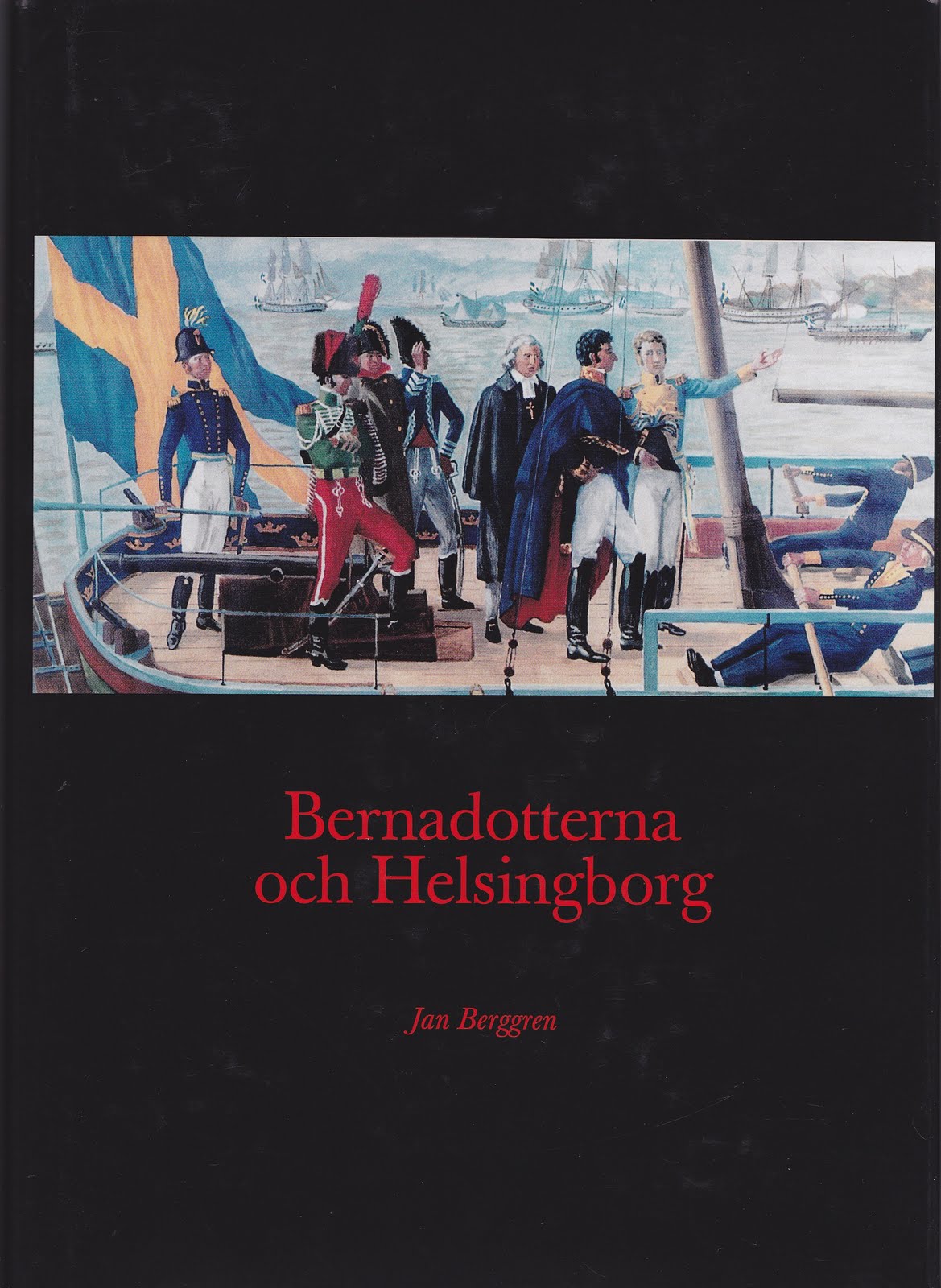 “Scania is not a province, it is a kingdom”, Carl XIV Johan is supposed to have said. Many Scanians would probably agree with him and Scania (Skåne), the southernmost county of Sweden, has played a rather prominent role in the history of the dynasty which Carl Johan founded.
On 20 October last year his Swedish and Danish descendants gathered in Helsingborg to commemorate the bicentenary of their ancestor’s stepping ashore in that town two months after his election to Crown Prince of Sweden. The links between the dynasty and the city were later strengthened when the future King Oscar II and Queen Sophia built their summer palace Sofiero on the outskirts of Helsingborg, which was also where their grandson Gustaf VI Adolf came to spend his summers for nearly seventy years. (Gustaf VI Adolf, like his great-uncle Carl XV, had been Duke of Scania and both kings eventually died in that county).
As part of the bicentenary celebrations the City of Helsingborg commissioned the historian Jan Berggren (the husband of the city’s Director of Communications, which caused some controversy) to write the book Bernadotterna och Helsingborg – 200 år sedan Karl XIV Johan landsteg i Helsingborg. Although the links between the Bernadottes and Helsingborg are at the centre of the book, the author has also chosen to include the county of Scania at large.
He relates the background for the events which led to Jean-Baptiste Bernadotte, Sovereign Prince of Pontecorvo and Marshal of the French Empire, being elected heir to the Swedish throne and tells of his arrival in Helsingborg in 1810, at that time a small town of a few thousand inhabitants.
In 1824 the local newspaper Helsingborgs Posten claimed that the King planned to build a summer palace outside Helsingborg, but although this never happened Carl Johan came quite frequently to Scania in the years following his arrival in Sweden (1816, 1819, 1820, 1821, 1824, 1832 and 1837). To a certain extent this can be explained by military manoeuvres taking place in the county, but Berggren also sees the frequent visits in the early years as a sign of Carl Johan’s distrust of the Scanians – the county had after all only been part of Sweden for some 150 years at that time and the King was, according to Berggren, suspicious of Danish sympathies still to be found in Scania.
The proximity to Denmark also meant that Helsingborg came to play a small role in what is called Scandinavianism, the popular movement which in the mid-19th century aimed at a closer association between the three Scandinavian kingdoms, perhaps even a union. In 1846 the Swedish-Norwegian royal family hosted King Christian VIII and the extended Danish royal family in Helsingborg, a visit which Berggren sees in relation to Scandinavianism but also in relation to the need for repairing relations between the two royal houses, who had been at war as recently as 1814. It was after all Christian VIII himself who had led the Norwegian rebellion that year and been elected King of Norway before being ousted by Carl Johan, whose widow Desideria he now encountered in Helsingborg.
The book is at its best in its first half, where Berggren weaves together the story of tje links between the Bernadottes and Scania with the greater picture and thus succeeds in putting the events in the relevant context. The second half tastes a little more of local history, focusing on summers at Sofiero and listing several notable visitors to the summer palace and Helsingborg (but not the visit paid to Sofiero by Prince Carl and Princess Maud of Denmark as late as 5 October 1905, slightly more than a month before they were elected King and Queen of Norway in succession to the deposed Oscar II).
There is also a chapter on Folke Bernadotte and his White Busses action, whereby thousands of prisoners were rescued from the concentration camps (transit was through Helsingborg) and traces of the Bernadottes in Helsingborg (artworks, names of streets, monuments, etc) before the book is rounded off with a brief interview with Count Carl Johan Bernadotte af Wisborg, the 94-year-old former prince who lives in nearby Båstad. Carl Johan Bernadotte tells two brief anecdotes of no greater significance and one could perhaps be forgiven for thinking that the author might have done more out of this interview, for example by letting the Count talk about his memories from Sofiero and incorporating such fresh recollections into the text rather than repeating what he wrote in his memoirs nearly thirty years ago.
Some factual mistakes might also be pointed out, such as King Haakon VII and Queen Maud being described as “the first King and Queen of independent Norway” or the claim of King Carl XIV Johan arriving in Scania “from the continent” for one of the visits during his reign, which is impossible given that the King never set his foot outside Sweden and Norway after 1814.
But all in all this is a good overview of the role Helsingborg and Scania have played in the history of the Bernadottes and the role the Bernadottes have played in Helsingborg and Scania.
Subscribe to:
Posts (Atom)


