Showing posts with label Sweden. Show all posts

Sunday, 24 February 2019

My latest article: Olav and Märtha's unknown love story & Roosevelt and the Kings

In the March issue of Majesty (Vol. 40, No. 3), which was published on Thursday, I have written an article about the wedding of Crown Prince Olav of Norway and Princess Märtha of Sweden ninety years ago, in which I can for the first time reveal not only that King Haakon and Queen Maud were in fact against their son marrying Märtha but also the reason why and who they wanted him to marry instead of Märtha.
In the same issue I conclude my article series on Theodore Roosevelt's grand tour of the courts of Europe in 1910. In this third instalment the former US President visits Emperor Wilhelm II in Berlin and goes to London for the funeral of King Edward VII, where the kings of Europe flock around him and he observes King George V's failure to understand why his youngest son, Prince John, was not like his other children.

Thursday, 24 January 2019

My latest articles: Theodore Roosevelt at court & the last Queen of Bavaria

In the February issue of Majesty (Vol. 40, No. 2), which is out in Britain today, I continue my series on Theodore Roosevelt and the royals. In this second of three article, the former US President visits the courts of Brussels, The Hague, Copenhagen, Oslo and Stockholm, where he takes a strong dislike to one monarch, forms a lasting friendship with another and is smitten with an unhappy princess.
In the same magazine I also write about the life of Marie Therese, the last Queen of Bavaria (and Jacobite claimant to the British throne), who died 100 years ago in February 1919 while fleeing the revolution in Munich that had brought down the ancient Wittelsbach dynasty.

Thursday, 15 November 2018

At the road's end: Count Oscar Bernadotte af Wisborg (1921-2018)

The second oldest member of the extended Swedish royal family, Count Oscar Bernadotte af Wisborg, died on 3 November, aged 97.
Generally known as "Oscis", Count Oscar Carl Emanuel Bernadotte af Wisborg was the third child born to Count Carl Bernadotte af Wisborg in his first marriage to Baroness Marianne de Geer af Leufsta, and thus a grandson of Prince Oscar Bernadotte, the second son of King Oscar II of Sweden and of Norway, who lost his rights of succession when he married his sister-in-law's former lady-in-waiting in 1888. Count Oscar was thereby a second cousin of King Carl XVI Gustaf's father as well as of King Harald V of Norway, Kings Baudouin I and Albert II of the Belgians and the late Queen Ingrid of Denmark.
His mother was the heir to the de Geers' estate, Frötuna near Norrtälje, but after she divorced Count Carl and married Marcus Wallenberg, one of Sweden's richest men, Carl ran the estate on Oscar's behalf. This was where Crown Princess Märtha of Norway and her three children were in hiding for nearly two weeks after the German invasion of Norway in April 1940.
Count Oscar Bernadotte served in the Swedish navy, but later took over the running of Frötuna, which is now run by his only son, Carl. In 1944, Count Oscar married Baroness Ebba Gyllenkrook, with whom he had a daughter, but the marriage ended in divorce. He later married the dentist Gertrud Ollén, who died in 1999, who bore him a son and two daughters. In his eighties Oscar Bernadotte found love again in the person of the art historian Margot Ekelund, who had first been his girlfriend when they were both twenty. They remained a couple until her death in October last year.
I had the pleasure of meeting Count Oscar Bernadotte af Wisborg on three occasions and remember him as a very friendly and rather straight-forward old gentleman with a keen interest in his family's history. Like many Bernadottes (including his older sister, Dagmar von Arbin, who is now 102), he remained sprightly and active into old age and he had just returned from a trip to France when he fell ill and was taken to the Academic Hospital in Uppsala, where he died. His funeral will take place in Rasbo Church on 2 December.

Friday, 7 September 2018

My latest article: Carl XIV Johan's coronation 200 years ago

200 years ago today, Carl XIV Johan was crowned King of Norway in Nidaros Cathedral in Trondheim, which was, for many reasons, a remarkable event. For one thing, Carl Johan, the former revolutionary general Jean-Baptiste Bernadotte, did not have a drop of blue blood in his vein. Carl Johan did nothing to deny this and rather based his legitimacy on his military deeds, which had paved his way to the thrones of Norway and Sweden.
In the new issue of Aftenposten Historie (no 8 - 2018), Norway's largest history magazine, I write about how this came to be expressed at his coronation and in the crown jewels Carl Johan commissioned for his coronation, including the sword he had carried in the battle where he helped defeat his great rival Napoléon.

Friday, 3 August 2018

On this date: Princess Christina turns 75 and retires from royal duties

Princess Christina, the youngest of the King of Sweden's four elder sisters, celebrates her 75th birthday today and has used the occasion to announce her retirement from royal duties.
Princess Christina became first lady of Sweden when her mother, Princess Sibylla, died in 1972, a position she retained until King Carl Gustaf married Queen Silvia in 1976. Since then she, unlike her three elder sisters, has continued to carry out many public engagements, but after her recent battle with leukemia she has now decided to prioritise herself and her family.
Princess Christina, who is widely considered the brainiest of the siblings, held an unpaid position as President of the Swedish Red Cross from 1992 to 2003 and is the author of an interesting book on Drottningholm Palace, Dagar på Drottningholm, which is also available in English, titled Days at Drottningholm.

Thursday, 2 August 2018

My latest articles: Norwegian golden wedding, Swedish royal dukedoms and Princess Victoria of Britain

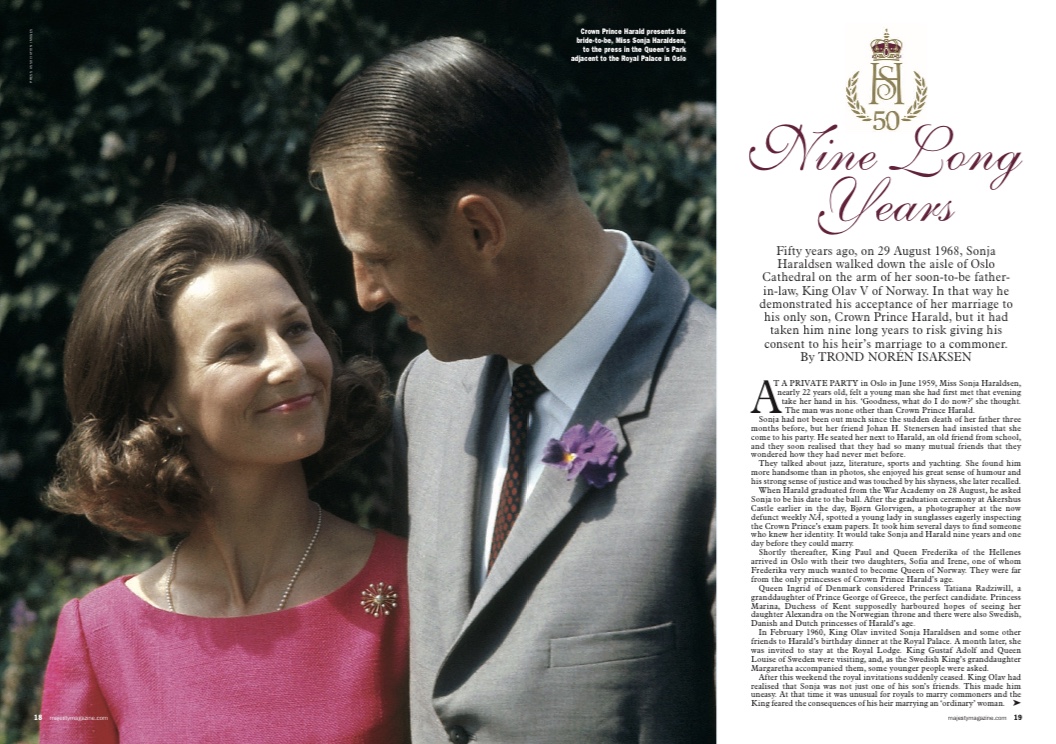
The August issue of Majesty (Vol. 39, No. 8) is now on sale and it appears I have written almost half of it. On the occasion of the King and Queen's golden wedding anniversary later this month I write about the nine difficult years they had to wait before King Olav eventually risked giving his consent to their marriage, which everyone seemed to think might spell the end of the monarchy.
I also write about the difficult, unhappy and frustrated Princess Victoria of Britain, the sister of Queen Maud and King George V, who was not allowed to marry the Liberal Prime Minister Lord Rosebery, whom her mother Queen Alexandra treated as her maid and who ended up as a rather bitter woman who often made life difficult for others.
Finally, there is also an article on the history of Swedish royal dukedoms, which were once semi-autonomous states within the states that could become power bases but are now just honorific titles given to the ever-growing number of members of the Swedish royal family.

Monday, 11 June 2018

My latest article: Victoria's secret

I have forgotten to mention the publication of the June issue of Majesty (vol. 39, no. 6), which contains my article on the love story of Queen Victoria of Sweden and Axel Munthe. Locked in a desperately unhappy marriage to King Gustaf V, the ailing Victoria found true love with her doctor, Axel Munthe, author of the international bestseller "The Story of San Michele". In the article I relate the story of their secret love, from their first meeting in 1891 to Victoria's death nearly four decades later and how they were torn apart for several years.

Friday, 11 May 2018

On this date: Carl XIV Johan's Swedish coronation

200 years ago today, Carl XIV Johan was crowned King of Sweden in the Great Church in Stockholm. To the days thirty years before, he had been appointed Sergeant Major in the French army, the highest rank a non-noble could reach before the Revolution swept away noble privileges. It was said in the days of Napoléon that every soldier carried a marshal's baton in his knapsack. In Sergeant Major Bernadotte's knapsack there was not only a marshal's baton but also two royal crowns.
His Norwegian coronation took place in Nidaros Cathedral in Trondheim on 7 September 1818. You may read about his coronation and the crown jewels aquired on that occasion and how they reflect his unusual career in my book Norges krone - Kroninger, signinger og maktkamper fra sagatid til nåtid (2015).
The picture is a detail of Pehr Krafft the Younger's monumental coronation painting, which hangs in the Royal Palace in Stockholm.

Tuesday, 1 May 2018

My latest article(s): Crown Prince Frederik at 50 & Rosendal Palace

The May issue of Majesty (Vol. 39, No. 5) is now on sale, and while most of it is understandably dedicated to the upcoming wedding of Prince Harry of Britain and Meghan Markle, I write about Crown Prince Frederik of Denmark, who will turn 50 in May, and how the once troubled young heir found himself.
In the same issue there is also a new instalment of my occasional series on palaces, this time about Rosendal, the small but exquisite Empire style palace which Carl XIV Johan built at Djurgården in Stockholm.

Tuesday, 24 April 2018

Carl XVI Gustaf becomes longest-reigning Swedish monarch ever

One of these days, Carl XVI Gustaf becomes the longest reigning monarch in Swedish history.
The previous record holder was Magnus Eriksson, who at the age of three was acclaimed King of Sweden on 8 July 1319. His father, Erik Magnusson, Duke of Södermanland, was the younger brother of King Birger Magnusson, who in 1317 imprisoned both his brothers (Erik and Valdemar). The brothers were either killed in captivity or left to starve to death. His brutal treatment of his brothers led to a rebellion, which forced King Birger to flee to Denmark and placed the young Magnus Eriksson on the Swedish throne.
He was already King of Norway, having inherited the Norwegian crown from his maternal grandfather two months previously, but in 1343 the personal union was dissolved when Magnus ceded Norway to his second son, Håkon VI, while his eldest son Erik was declared heir to Sweden.
In 1357, Erik became co-monarch of Sweden, but following his death two years later Magnus Eriksson was again the sole ruler of Sweden until February 1362, when Håkon was elected co-ruler. Magnus and Håkon were both deposed as Swedish kings in February 1364. As the exact date of this event is unknown, it is impossible to say for sure exactly how long Magnus’s reign lasted and therefore also to calculate on which date Carl XVI Gustaf overtakes him, but it is one of these days.
King Carl Gustaf came to the Swedish throne at the age of 27 when his grandfather, King Gustaf VI Adolf, died at 8.35 p.m. on 15 September 1973. (His father, Prince Gustaf Adolf, had died in a plane crash in 1947).
There will be no official celebrations of this milestone. King Carl Gustaf himself, accompanied by Queen Silvia, is on an official visit to Japan these days.

UPDATE: After consultations with the National Archives, the royal court chose to mark the occasion on 26 April, claiming that this was the day Carl XVI Gustaf had been on the throne a day longer than Magnus Eriksson. However, this is based on the date Magnus's successor, Albrecht of Mecklenburg, was acclaimed king, which was not necessarily the same day as Magnus was deposed. In other words, the exact date remains unknown.

Saturday, 14 April 2018

Royal jewels: Princess Ingeborg's Fabergé brooch - sold during WWII?

A Fabergé brooch (external link) which was given by the King's maternal grandfather, Prince Carl of Sweden, to Princess Ingeborg on the occasion of their fifteenth wedding anniversary in 1912 was sold by the auction house Coutau-Bégarie in Paris this week.
Several people have asked me about this and the auctioneer's claim that the brooch was sold by Crown Princess Märtha out of necessity during the Second World War. I do not know what is the auction house's source, but to me this seems like a misunderstanding or a supposition.
As I was able to reveal in my 2007 biography of Princess Astrid, Kvinne blant konger, the emerald parure now worn by the Queen was given to Crown Princess Märtha by Princess Ingeborg at the Central Station in Stockholm when she departed for the USA in the summer of 1940. Princess Ingeborg's intention was that her daughter could sell the emeralds if she never returned to Norway (which must have seemed a likely outcome in 1940), but the daring rescue of that the Bank of Norway's gold reserve meant that the Norwegian government-in-exile (unlike others) was able to provide for itself throughout the war and that the royal family did not have to sell their possessions in order to survive.
It therefore seems highly unlikely that Crown Princess Märtha sold the Fabergé brooch out of necessity during WWII.

Thursday, 8 March 2018

My latest articles: Gustaf VI Adolf & Hélène of Aosta

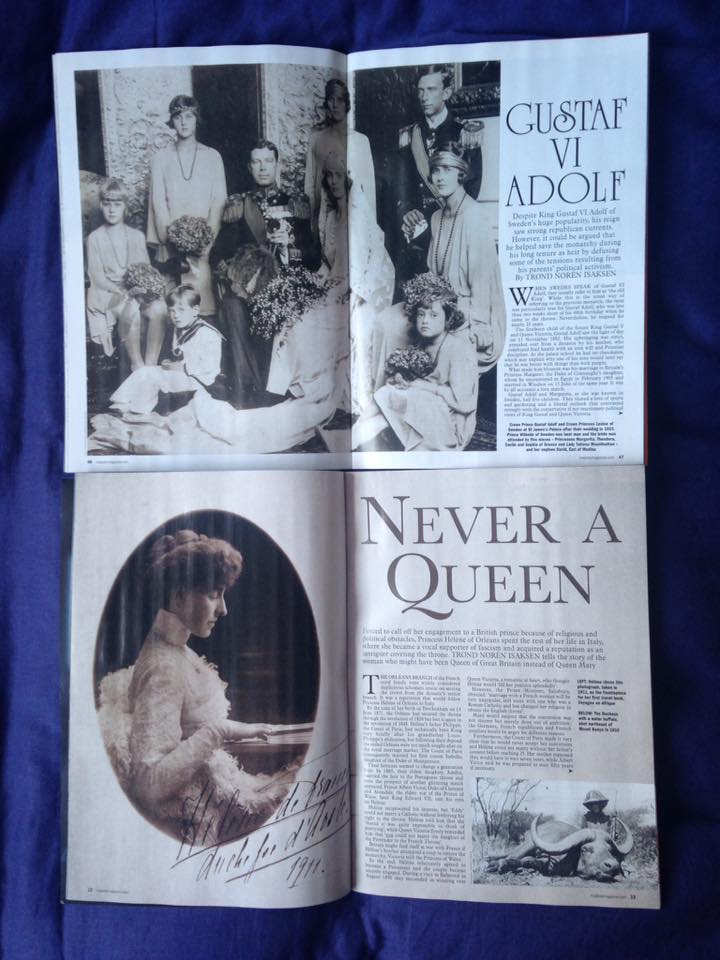
In the March issue of Majesty (Vol. 39, No. 3), which has been on sale in Britain for two weeks and is on sale in Norway from today, I write about the life of King Gustaf VI Adolf of Sweden, who is often credited with the survival of the Swedish monarchy. I also write about the French-born Princess Hélène, Duchess of Aosta, who was engaged to Prince Albert Victor, heir to the British throne (Queen Maud's brother), but married into the Italian royal family, became an enthusiastic fascist and was widely suspected of coveting the throne for her husband and sons.
In the same issue there is also a report on Prince William and Kate's official visit to Sweden and Norway, a report on the engagement of Princess Eugenie of Britain and Jack Brooksbank and a profile of Meghan Markle (who is also on the cover).
The magazine was already being printed when Prince Henrik of Denmark died, so my obituary of him will appear in the next issue, alongside an article on King Christian IX of Denmark, who was born 200 years ago in April 1818.

Wednesday, 31 January 2018

My latest article: 200 years of Bernadottes & the last King of Bavaria

On 5 February the Bernadottes have sat on the Swedish throne for 200 years, so in the February issue of Majesty (Vol. 39, No. 2), which was published in Britain a while ago and will be on sale in Norway tomorrow, I recount the history of this dynasty, which originated in revoltuionary and Napoleonic France, and how it has survived against the odds, including some of the occasions when it might have fallen.
In the same issue I write about a monarch who did fall: King Ludwig III of Bavaria, the cousin of the more famous "mad" King Ludwig II, who seized the crown from another mad cousin, King Otto, in 1913. Although the Bavarians were traditionally attached to their dynasty, Ludwig III was the first monarch to fall when a wave of revolutions swept across Germany in 1918, bringing to an end the 738-year rule of the House of Wittelsbach.
In the same issue there are also articles by other writers on, among other topics, the Duchess of Cambridge's jewels, the gradual transition from Queen Elizabeth of Britain to Prince Charles, the funeral of ex-King Mihai of Romania and the Royal Academy of Arts's new exhibition "Charles I: King and Collector".

Thursday, 7 December 2017

My latest article: Margaretha the matriarch

In the December issue of the British monthly magazine Majesty (Vol. 38, No. 12) I write about Princess Margaretha of Denmark (1899-1977), who may have been less famous than her sisters, Crown Princess Märtha of Norway and Queen Astrid of the Belgians, but outlived them both by far to become (in the words of her niece, Princess Astrid of Norway) the female head of the family, the person who held the family together, one of King Olav's few confidantes and a valued adviser to younger relatives. The magazine is already out in Britain and from today also in Norway.

Wednesday, 4 October 2017

My latest article: The end of Swedish coronations

My new book is just around the corner, but meanwhile I have turned some surplus material from my previous book, Norges krone - Kroninger, signinger og maktkamper fra sagatid til nåtid, into an article for the Swedish English-language royal history magazine Royalty Digest Quarterly (no 3 - 2017), which is now out. The article looks at how and why the Swedish kings stopped having coronations at the death of Oscar II in 1907, by which time coronations had come under increasing criticism for several decades (in sharp contrast to what was the case in neighbouring Norway).

Monday, 4 September 2017

HRH Prince Gabriel Carl Walther of Sweden, Duke of Dalecarlia

In a Council of State at the Royal Palace in Stockholm at 11.15 a.m., King Carl XVI Gustaf officially informed the cabinet of the birth of Prince Carl Philip's and Princess Sofia's second child, a son who saw the light of day at Danderyd Hospital on Thursday 31 August at 11.24 a.m. The newborn has received the name Gabriel Carl Walther and the titles Prince of Sweden and Duke of Dalecarlia (Dalarna in Swedish).
From what Prime Minister Stefan Löfven said, it seems the parents have chosen the name Gabriel, which has no royal traditions in Sweden, because they believe it fits their newborn baby. The name Carl, on the other hand, is perhaps the most frequently used male name in Swedish royal history, borne by, among many others, the child's father and paternal grandfather, as well as nine Swedish kings before him (although he is called Carl XVI Gustaf, the first six Carls never existed). Walther is clearly in memory of Queen Silvia's father, the German businessman Walther Sommerlath, and the name is also borne by one of her brothers.
Many had guessed that the newborn baby would receive the dukedom of Dalecarlia, as that is the province from which Princess Sofia hails, but it is actually the first time that such personal connections are taken into consideration for the choice of dukedom. The dukedom of Dalecarlia was last held by King Carl Gustaf's youngest uncle, Prince Carl Johan, who received it at the time of his birth in 1916, but forfeited it when he married a commoner in 1946. Before that it was held by King Oscar I's youngest son, Prince August (1831-1873), whose widow Teresia, the Dowager Duchess of Dalecarlia, died only two years before the dukedom was created anew for Prince Carl Johan.
Prince Gabriel is King Carl Gustaf's and Queen Silvia's sixth grandchild and also sixth in line to the Swedish throne, following Crown Princess Victoria, Princess Estelle, Prince Oscar, Prince Carl Philip and Prince Alexander. However, the family will continue to grow in the near future, as it was announced only four days before Prince Gabriel's birth that Princess Madeleine and Chris O'Neill are expecting their third child in March.

Sunday, 3 September 2017

My lastest article: Swedish crown jewels and the mother-in-law of Europe

In the September issue of Majesty I embark on a new series on crown jewels, starting with the exquisite Swedish ones, which are the oldest of an extant monarchy. The series will continue next month with the Norwegian crown jewels.
In the same issue I also write about Queen Louise of Denmark, the consort of King Christian IX, an influential lady who arranged dynastic marriages in the mistaken belief that they would prevent wars. Known as "the mother-in-law of Europe", she was also the mother-in-law from hell, at least for her daughter-in-law Louise.
The magazine is already in sale in Britain and will go on sale in Norway on the coming Thursday, which happens to be the bicentenary of Queen Louise's birth.

Tuesday, 11 April 2017

At the road's end: Baron Niclas Silfverschiöld (1934-2017), landowner and royal brother-in-law

The court of Stockholm has announced the death of King Carl Gustaf's brother-in-law, Baron Niclas Silfverschiöld, the husband of Princess Désirée, at the age of 82. Princess Désirée was at his side.
The son of Baron Carl-Otto Silfverschiöld and his wife Madeleine Bennich, Baron Nils-August Otto Carl Niclas Silfverschiöld was born on 31 May 1934. He married Princess Désirée, the third of the present King's four elder sisters, in the Cathedral of Stockholm on 5 June 1964 and had three children: Carl, Christina and Hélène.
The couple kept a very low profile and rarely figured in the press. In recent years Niclas Silfverschiöld suffered from cancer and therefore missed several royal family events. The couple lived at Koberg Palace near Sollebrunn in Västergötland, a 40-room-palace surrounded by 20 000 acres of land which had come into the noble Silfverschiöld family through female inheritance in 1776. King Carl Gustaf as well as the King of Norway have been regular visitors to Koberg during the shooting season.
In a statement released by the royal court, King Carl Gustaf says that he and the rest of the royal family have received the news of Niclas Silfverschiöld's passing with deep grief and their thoughts are with Princess Désirée and her family.
Niclas Silfverschiöld's death comes thirteen months after the death of Princess Birgitta's husband, Prince Johann Georg of Hohenzollern, while Princess Margaretha's estranged husband, John Ambler, passed away in 2008. The fourth sister, Princess Christina, who is battling leukemia, remains married to Tord Magnuson.

Wednesday, 21 December 2016

Book news: The soft power of royal heirs

In August last year I participated in a conference on the soft power of royal heirs at the University of St Andrews, and now Palgrave Macmillan has gathered the lectures given at this conference in a book titled Royal Heirs and the Uses of Soft Power in Nineteenth-Century Europe, edited by Frank Lorenz Müller and Heidi Mehrkens and published earlier this month. I write about how the Bernadottes during the Swedish-Norwegian union of crowns tried to create a Norwegian identity for the heirs, particularly by the power of presence, education and the office of Viceroy, while Maria-Christina Marchi deals with Italy, Kristina Widestedt with Sweden, Erik Goldstein with the United States, Milinda Banerjee with the Bengal, Janet Ridley, Imke Polland and Edward Owens, with Britain, Alma Hannig with Austria-Hungary, Richard Meyer Forsting with Spain, Miriam Schneider with Greece, Jeroen Koch with the Netherlands and Frederik Frank Sterkenburgh with Prussia, and Frank Lorenz Müller, Monika Wienfort and Heidi Mehrkens provide more general overviews of the topic.

Tuesday, 20 December 2016

My latest articles: Mountbatten in Sweden & Trondheim as coronation city

This year's last issue of the Swedish royal magazine Kungliga magasinet (no 7 - 2016) went on sale a couple of weeks ago, and to this issue I have contributed an article on how Earl Mountbatten of Burma, the éminence grise of the British royal family, tried to play the role of the power behind the throne in Sweden, where his sister Louise was Queen, including attempts at making Gustaf VI Adolf abdicate and marrying off the young King Carl Gustaf, for whose future Mountbatten often feared. (A shorter version of the article appeared in English in Majesty Vol. 36, No. 12 a year ago).
Also out is Trondhjemske Samlinger 2016, the yearbook of Trondhjems Historiske Forening (the Historical Association of Trondheim), where I mark the 25th anniversary of the King and Queen's solemn blessing with an article on Trondheim as coronation city in the middle ages and in modern times, based on a lecture I gave in Trondheim in connection with the jubilee in June, which was again based on my latest book Norges krone - Kroninger, signinger og maktkamper fra sagatid til nåtid. The yearbook may be purchased from one of the larger bookstores in Trondheim (for instance Ark Bruns or Norli at Nordre gate) or ordered from the historical association.