Showing posts with label titles. Show all posts

Thursday, 2 August 2018

My latest articles: Norwegian golden wedding, Swedish royal dukedoms and Princess Victoria of Britain

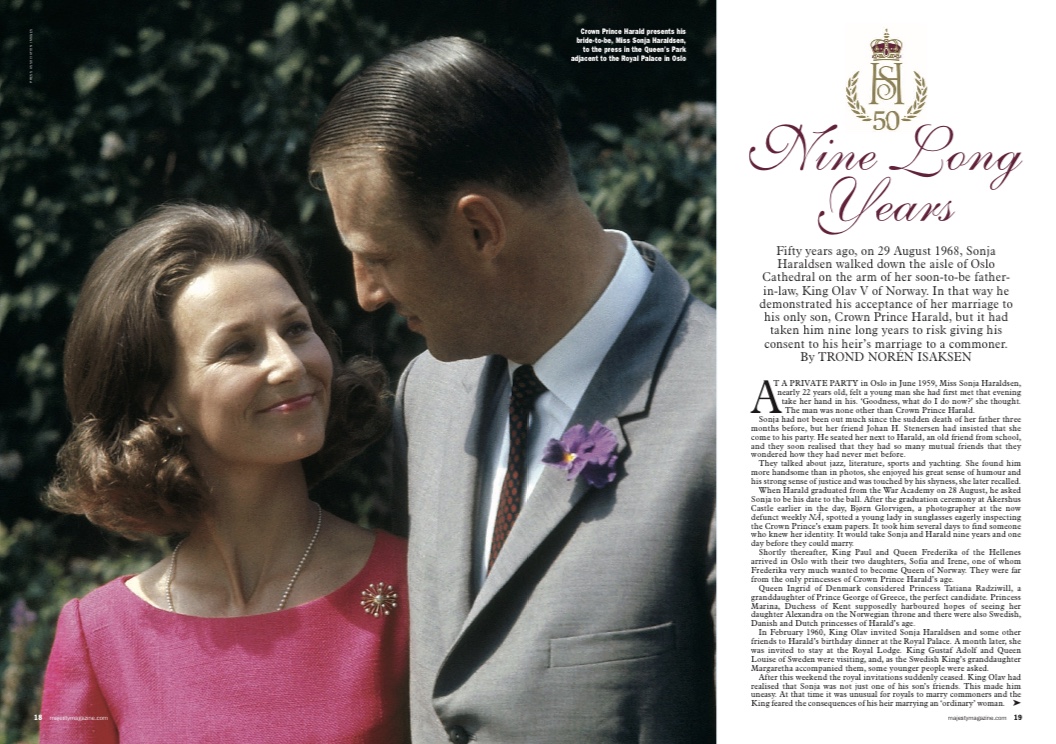
The August issue of Majesty (Vol. 39, No. 8) is now on sale and it appears I have written almost half of it. On the occasion of the King and Queen's golden wedding anniversary later this month I write about the nine difficult years they had to wait before King Olav eventually risked giving his consent to their marriage, which everyone seemed to think might spell the end of the monarchy.
I also write about the difficult, unhappy and frustrated Princess Victoria of Britain, the sister of Queen Maud and King George V, who was not allowed to marry the Liberal Prime Minister Lord Rosebery, whom her mother Queen Alexandra treated as her maid and who ended up as a rather bitter woman who often made life difficult for others.
Finally, there is also an article on the history of Swedish royal dukedoms, which were once semi-autonomous states within the states that could become power bases but are now just honorific titles given to the ever-growing number of members of the Swedish royal family.

Friday, 3 November 2017

My latest articles: Danish crown jewels and Prince Henrik's travails

My article series about crown jewels continues in the November issue of Majesty (Vol. 38, No. 11), which is now on sale in Norway as well as in Britain. The third and final installment of the series deals with the Danish crown jewels, and in the same issue I also look at this summer's great royal "scandal", when Prince Henrik of Denmark, shortly before he was diagnosed with senile dementia, announced his refusal to be buried with his wife of fifty years, Queen Margrethe II, in Roskilde Cathedral unless she makes him King Consort. I also look at the historical background for his demand for the title of King Consort, which is actually not so far-fetched as many seem to believe, nor is it the idea of a demented mind.

Monday, 4 September 2017

HRH Prince Gabriel Carl Walther of Sweden, Duke of Dalecarlia

In a Council of State at the Royal Palace in Stockholm at 11.15 a.m., King Carl XVI Gustaf officially informed the cabinet of the birth of Prince Carl Philip's and Princess Sofia's second child, a son who saw the light of day at Danderyd Hospital on Thursday 31 August at 11.24 a.m. The newborn has received the name Gabriel Carl Walther and the titles Prince of Sweden and Duke of Dalecarlia (Dalarna in Swedish).
From what Prime Minister Stefan Löfven said, it seems the parents have chosen the name Gabriel, which has no royal traditions in Sweden, because they believe it fits their newborn baby. The name Carl, on the other hand, is perhaps the most frequently used male name in Swedish royal history, borne by, among many others, the child's father and paternal grandfather, as well as nine Swedish kings before him (although he is called Carl XVI Gustaf, the first six Carls never existed). Walther is clearly in memory of Queen Silvia's father, the German businessman Walther Sommerlath, and the name is also borne by one of her brothers.
Many had guessed that the newborn baby would receive the dukedom of Dalecarlia, as that is the province from which Princess Sofia hails, but it is actually the first time that such personal connections are taken into consideration for the choice of dukedom. The dukedom of Dalecarlia was last held by King Carl Gustaf's youngest uncle, Prince Carl Johan, who received it at the time of his birth in 1916, but forfeited it when he married a commoner in 1946. Before that it was held by King Oscar I's youngest son, Prince August (1831-1873), whose widow Teresia, the Dowager Duchess of Dalecarlia, died only two years before the dukedom was created anew for Prince Carl Johan.
Prince Gabriel is King Carl Gustaf's and Queen Silvia's sixth grandchild and also sixth in line to the Swedish throne, following Crown Princess Victoria, Princess Estelle, Prince Oscar, Prince Carl Philip and Prince Alexander. However, the family will continue to grow in the near future, as it was announced only four days before Prince Gabriel's birth that Princess Madeleine and Chris O'Neill are expecting their third child in March.

Tuesday, 22 August 2017

My latest article: The troubled history of kings consort

Earlier this month, Prince Henrik of Denmark caused quite an uproar when he announced that he no longer wants to be buried together with his wife of fifty years, Queen Margrethe II. In a series of interviews he also launched a personal attack on his wife, who he claimed makes a fool of him, and stated that he would be willing to reconsider the decision about his burial place if she would agree to make him King Consort.
It was explained that the Prince’s decision was made because of his dissatisfaction with his title and function, something a spokeswoman said had become more and more important for him in recent years. It is far from the first time Prince Henrik raises the issue of his title and the fact that he believes that as the wife of a king is queen, a queen’s husband ought to be king (i.e. king consort and not, as some ill-informed people have claimed, take over as monarch).
Many seem to think that this is an idea Prince Henrik has grasped out of thin air, but in a long article in today’s issue of the broadsheet Politiken (external link) I recount the history of kings consort, which began in the crusader Kingdom of Jerusalem in the twelfth century and soon spread to Naples, Spain, Navarre, Portugal, Poland, England, Scotland and Cyprus. In fact, the husbands of queens regnant were actually usually (although not always) styled kings and many of them took part in the governance of the realm. The so far last king consort in Europe died as recently as 1902, and it is only during the last century and a half that it has become more common for male consorts not to be called kings. Thus, although Prince Henrik may have history and principles on his side, it seems highly unlikely that he will ever achieve his dream of becoming King Consort of Denmark.

Saturday, 30 July 2016

My latest articles: Silver jubilee and ex-Queen Anne-Marie

The August issue of Majesty (Vol. 37, No. 8) went on sale in Britain last week, and this month I have contributed a report on the King and Queen's silver jubilee, focusing on the celebrations in Trondheim last month, and an article on ex-Queen Anne-Marie of the Hellenes, who will turn seventy on 30 August.

Thursday, 30 June 2016

My latest articles: Empress Marie-Louise & Swedish royal dukedoms

The July issue of Majesty (Vol. 37, No. 7) went on sale in Britain last week and this month I have contributed an article on Empress Marie-Louise of the French, Napoléon I's second wife. In the eyes of posterity she has been overshadowed by her predecessor Joséphine, but she is fondly remembered in Parma, where she reigned as duchess from 1816 until her death in 1847 and where the bicentenary of her arrival is commemorated this year.
Also just out is Royalty Digest Quarterly no. 2 - 2016, in which I write about Swedish royal dukedoms - their origins, history and statistics - which might be of some interest these days, when new dukes and duchesses are born so frequently that many find it hard to keep track.

Thursday, 21 April 2016

HRH Prince Alexander Erik Hubertus Bertil of Sweden, Duke of Sudermania

In a formal meeting with the cabinet at the Royal Palace in Stockholm, King Carl XVI Gustaf of Sweden has just announced that his newborn grandson will be named Alexander Erik Hubertus Bertil and be a Prince of Sweden and Duke of Sudermania (Södermanland). Prince Alexander, the first child of Prince Carl Philip and Princess Sofia, was born at Danderyd Hospital on Tuesday evening.
Alexander is of course a very royal name, but has not previously been used by the Swedish royal family, except that Queen Christina after her abdication and conversion to Catholicism added Alexandra to her name in honour of Pope Alexander VII.
Erik is on the other hand a name with a long royal tradition in Sweden, although it has been little used in recent years. The first King Erik was Erik the Victorious, who reigned from about 970 to 995. Very little is known about early medieval Sweden, which was deeply divided between warring factions, but around 1067 there were two rival kings, both named Erik, who were both killed around that year. In the twelfth century, two rival dynasties who have later come to be known as the Sverker and Erik families, fought each other. The latter drew its name from Erik Jedvardsson, who was King of a part of Sweden around 1158 and died a violent death a year or two later. He was subsequently considered a saint, although never officially canonised, and although the cult was for a long time only local, he was eventually promoted into Sweden's national saint. The promotion of St Erik's cult also meant that his name became rather popular among Swedish royals.
The next Erik was his grandson, Erik Knutsson, who reigned from 1208 to 1216 and was the first Swedish King known to have been crowned. His son, uncharitably known as Erik the Lisp and Lame, won back the crown from the rival Sverkers and reigned from 1222 to 1229 and from 1234 to 1250. The next Erik was Erik Magnusson, who challenged his father Magnus Eriksson in 1356 and reigned as joint monarch for a few months before his death in 1359.
His sister-in-law, Margareta Valdemarsdatter, who succeeded in uniting all three Scandinavian realms and being elected monarch, adopted her great-nephew Bugislav of Pomerania and had him made King of Denmark, Sweden and Norway under the name Erik. He was elected King of Sweden in 1396 and crowned in Kalmar the following year, the event which is traditionally held to mark the foundation of the so-called Kalmar Union, but his reign was conflict-filled and he was eventually deposed in 1439.
Thereafter, the name did not reappear until King Gustaf I, the founder of the Vasa dynasty, named his eldest son Erik. Erik succeeded his father upon his death in 1560 and assumed the name Erik XIV (a number of fictional Eriks were inventend to make the line of Swedish kings look longer and more prestigious). He was deposed by his brother, Johan III, in 1568 and poisoned nine years later.
Since then, there seems to have been some sort of stigma related to the name borne by at least two unfortunate monarchs, but the Bernadottes revived it in 1889, when the future King Gustaf V and Queen Victoria became the parents of their third son. However, this prince was another unfortunate Erik. He was mentally challenged and lived most of his life away from his family and the public eye, dying from the Spanish flu at the age of 29 in 1918.
A more recent connection is Prince Alexander's maternal grandfather, Erik Hellqvist. Hubertus derives from his other grandfather, Carl Gustaf Folke Hubertus, who received the name in honour of his mother's brother, Prince Hubertus of Saxe-Coburg and Gotha, who was killed fighting for Nazi Germany in 1943. Bertil is in honour of the King's late uncle, Prince Bertil, to whom Prince Carl Philip was very close.
As for the dukedom, Sudermania is often seen as one of the more prestigious ducal titles. It was most recently held by Prince Wilhelm, the second son of King Gustaf V. Prince Wilhelm resided at Stenhammar Palace in Flen, which was left to the state by the courtier Robert von Kraemer, who willed that it should be made available to a prince of the royal house, preferably a Duke of Sudermania (the province in which the estate is located). Since Prince Wilhelm's death in 1965 it has been used by King Carl Gustaf, but Prince Carl Philip has been groomed to take it over and it was therefore no surprise that the dukedom connected to it was given to his firstborn.

Thursday, 14 April 2016

Title issues: Prince Henrik renounces Prince Consort title

Yet another chapter was added to the ongoing saga of the title of the husband of Queen Margrethe II of Denmark during yesterday's state banquet for the President of Mexico at Fredensborg Palace. Several television viewers noticed that the Queen in her speech referred to her husband not as "the Prince Consort" but as "Prince Henrik", and today the royal court confirmed that he has renounced the title of Prince Consort. This comes as a consequence of his decision to more or less retire from royal duties, which was announced by the Queen in her New Year's Speech on 31 December last year. The court's head of communication, Lene Balleby, told the tabloid Ekstra Bladet that "It is His Royal Highness's own decision to alter his title to the less formal Prince Henrik. Prince Henrik finds this more fitting for his present situation after his retirement".
When he married the then Heiress to the Throne in 1967, Henri de Laborde de Monpezat received the title "His Royal Highness Prince Henrik of Denmark". When his wife succeeded to the throne in 1972, it was considered creating him Duke of Fredensborg, but this idea was dropped and he was thereafter officially referred to as "the Prince" and informally as "Prince Henrik". However, in 2005, the Queen let it be known that he would from now on be known as "the Prince Consort". He subsequently claimed that this was his own decision and that he had taken the new title as being just "Prince Henrik" or "the Prince" obscured the fact that he held a special position and was not just a prince like one of his young grandsons but the monarch's consort. He has, however, on many occassions voiced his opinion that he ought to be King Consort as the wives of kings are always queens. Now he is back where he started as plain "Prince Henrik".
The court has not given any date for when the change of title happened, but the last time he was referred to as "the Prince Consort" on the royal website seems to have been on 22 March in a press release stating that "HM the Queen and HRH the Prince Consort" had sent their condolences to the King and Queen of the Belgians following the terrorist attacks on Brussels (in the Danish version, they are however referred to as "Regentparret", i.e. "the Regent Couple" - which is in itself a very quaint term as Queen Margrethe is not regent but monarch). He was, however, still called "the Prince Consort" on the wreath the Queen and he sent to the funeral of former Prime Minister Anker Jørgensen on 2 April.

Thursday, 3 March 2016

HRH Prince Oscar Carl Olof of Sweden, Duke of Scania

In a State Council at the Royal Palace in Stockholm today, King Carl XVI Gustaf informed the government that the son Crown Princess Victoria gave birth to last night will be named Oscar Carl Olof and that his dukedom will be that of Scania (Skåne). The King also notified the government of the death of his brother-in-law, Prince Johann Georg of Hohenzollern, which also occurred yesterday.
In keeping with tradition, the newborn was "inspected" by the Speaker of Parliament, Urban Ahlin, the Prime Minister, Urban Ahlin, the Marshal of the Realm, Svante Lindqvist, and the Mistress of the Robes, Kristine von Blixen-Finecke (who succeeded Countess Alice Trolle-Wachtmeister in that position in November). The Prince's birth was marked by a 21-gun salute and a service of thanksgivings in the Palace Church, which was attended by, among others, King Carl Gustaf and Queen Silvia, Prince Daniel, Princess Estelle, Prince Carl Philip and Princess Sofia, Princess Madeleine and Chris O'Neill, Princess Christina and Tord Magnuson, the King's aunt by marriage Countess Marianne Bernadotte and two of his father's second cousins, Count Bertil Bernadotte af Wisborg and Dagmar von Arbin (who will celebrate her 100th birthday next month) and Prince Daniel's parents, sister and brother-in-law.
The dukedom of Scania was last held by the future King Gustaf VI Adolf from his birth in 1882 to his accession in 1950, and before that by the future King Carl XV from his birth in 1826 to his accession in 1859.
The name Oscar arrived in Sweden with Oscar Bernadotte, the only child of the imperial French Marshal Jean-Baptiste Bernadotte, who was elected Crown Prince in 1810. While Jean-Baptiste changed his name to Carl Johan, Oscar kept his foreign name also after he ascended the thrones of Sweden and Norway in 1844 (although his wife wanted him to reign under his two other names, Frans Joseph). His third son was given the same name and eventually came to the thrones in 1872 as Oscar II. Oscar II's second son was another Oscar, while Carl XV's only son, who died in infancy, was named Carl Oscar. It has also been among the names of Kings Gustaf V and Gustaf VI Adolf and of Princes Gustaf Adolf, Sigvard, Bertil, Carl, and Carl Junior. It has, however, not been used in the royal family since 1912, but these days it is one of the most popular boys' names in Sweden.
Unlike his elder sister, Princess Estelle Silvia Ewa Mary, Prince Oscar has thus received a name firmly anchored in Swedish royal history - indeed three names firmly anchored in Swedish royal history. The name Carl is of course borne by his grandfather King Carl XVI Gustaf and his uncle Prince Carl Philip, and has been borne by ten Swedish kings: Karl Sverkersson, Karl II Knutsson, Carl IX, Carl X Gustaf, Carl XI, Carl XII, Carl XIII, Carl XIV Johan, Carl XV and Carl XVI Gustaf. (Some may wonder why the list jumps from Karl II to Carl IX; the answer is that the six first Karls were invented in the sixteenth century). There have also been almost countless Swedish princes named Carl, among them the third son of Oscar II.
Olof is the first name of the newborn's father (Olof Daniel) and of the first Christian Swedish king, known as Olof Skötkonung, who reigned from about 995 to 1022. It is also the Swedish name of the perhaps most popular saint in medieval Sweden, the martyred Norwegian king Olav Haraldsson, who died in the Battle of Stiklestad in or around 1030 and was declared a saint a year later and whose cult was as great in Sweden as in Norway.

Thursday, 12 November 2015

My latest article: Kings consort

In a recent interview with the French newspaper Le Figaro, the Prince Consort of Denmark once again stated that in his opinion he ought to be King Consort rather than Prince Consort as the wives of kings are always styled Queen. This is far from the first time he has raised this issue, which he apparently considers a matter of principles and gender equality - by Berlingske's count (external link) it is in fact the eighth time - and it usually subjects him to criticism by the Danish media.
It has been claimed that there is hardly any precedence for the husband of a queen regnant being styled King, but in an article in the newspaper Kristeligt Dagblad today (external link) I point out that until the mid-nineteenth century it was in fact the norm rather than the exception that the husbands of queens regnant became kings. Examples may be found in Navarre, England, Scotland, Spain, Portugal, Naples and Poland, and in many cases these kings by marriage also excercised power. But although the Prince Consort has historical precendence on his side, I also suggest that it might be wise not to keep insisting on a wish he must know that will never be granted.

Thursday, 15 October 2015

Princess Sofia is pregnant

The court of Stockholm has just announced that Princess Sofia, who married Prince Carl Philip four months ago, is pregnant. The couple's first child will be born in April 2016. In accordance with King Carl Gustaf's decision to bestow royal titles on all his grandchildren, the child will be a Prince or Princess of Sweden and a Royal Highness and receive a royal dukedom.
The birth will follow shortly after the birth of Crown Princess Victoria's second child, which is expected in March. Thus, Prince Carl Philip's and Princess Sofia's child will at the time of its birth be fifth in line of succession to the Swedish throne.

Thursday, 18 June 2015

Prince Nicolas Paul Gustaf of Sweden, Duke of Ångermanland

At 1.45 p.m. on Monday 15 June, less than 48 hours after the wedding of her brother Prince Carl Philip and Sofia Hellqvist, Princess Madeleine of Sweden gave birth to a son at Danderyd Hospital in Danderyd outside Stockholm, and in a council meeting with the government earlier today King Carl XVI Gustaf announced that his grandson's name and titles will be Nicolas Paul Gustaf, Prince of Sweden and Duke of Ångermanland.
The name Nicolas has not been used in the Swedish royal family before, except in the version Nicolaus. In 1831, the fourth son of the future King Oscar I and Queen Josephine received the name Nicolaus August, the first of them in honour of Emperor Nikolaj I of Russia, but when the Emperor shortly thereafter cracked down on the Polish uprising the reactions in Sweden were so strong that it was apparently felt safest to let the newborn prince be known by his second name, August.
Paul is obviously in honour of Prince Nicolas's paternal grandfather, the late Paul O'Neill, while Gustaf is a name with deep roots in Swedish royal history and of course also the second name of the current King, the baby's maternal grandfather.
All three names were also used in 1909, when the only child of Prince Wilhelm and his Russian-born wife Maria Pavlovna was named Gustaf Lennart Nicolaus Paul, although he was always known as Lennart.
The dukedom, on the other hand, is without precedent. Since Gustaf III re-introduced dukedoms in 1772 these have been derived from the provinces of Sweden. Some have been used more often than others, while some have never been used for dukedoms. Until today, Ångermanland was one of the latter.
The newborn Prince is sixth (and last) in the order of succession to the Swedish throne. He is the second child of Princess Madeleine and her husband Christopher O'Neill, following Princess Leonore, who was born on 20 February 2014.

Monday, 18 May 2015

Title issues: Sofia Hellqvist to become a princess and a duchess

With less than a month to go before the wedding of Prince Carl Philip of Sweden and Sofia Hellqvist on 13 June, the banns of marriage were published in connection with a service in the Palace Church in Stockholm on Sunday. This is no longer mandatory, but the Swedish royal family upholds the tradition and uses it as an occasion for the presentation of wedding gifts.
King Carl Gustaf also took the opportunity to announce his decision that Sofia Hellqvist will receive the titles Princess of Sweden and Duchess of Wermlandia as well as the style Royal Highness. This is not automatic, but decisions about titles for members of the royal family are the King's prerogative. As a logical consequence of the introducing of gender-neutral succession, King Carl Gustaf decided to treat the issue of princesses in the same way as the issue of princes, which means bestowing royal titles upon the children of Princess Madeleine. However, he seems to have changed his mind when it comes to the titles of his younger children's spouses.
When Princess Madeleine became engaged to Jonas Bergström in 2009, it was announced that her future husband would become Duke of Helsingia and Gastricia, i.e. of his wife's dukedom, but not a prince. On the other hand, her marriage to Christopher O'Neill in 2013 was preceeded by an announcement that her husband would become neither a prince nor a duke since he would not become a Swedish citizen and was not willing to give up his business interests, which suggests that the title of prince had been offered in addition to that of duke, as is now the case with the future wife of Prince Carl Philip.
The service in the Palace Church, which was followed by a lunch and reception, was attended by among others King Carl XVI Gustaf and Queen Silvia, Crown Princess Victoria and Prince Daniel with Princess Estelle, Princess Madeleine and Chris O'Neill with Princess Leonore, Princess Christina's son Gustaf Magnuson and his wife Vicky Andrén, the King's aunt by marriage Countess Marianne Bernadotte af Wisborg, and Sofia Hellqvist's parents Erik and Marie Hellqvist as well as her sisters Lina and Sara with their boyfriends Jonas Frejd and Oskar Bergman.

Monday, 8 September 2014

Duchess of Cambridge pregnant with second child

The British royal court has announced that the Duke and Duchess of Cambridge, aka Prince William of Britain and his wife Catherine, are expecting their second child. The announcement seems to come because the Duchess, as last time, suffers from severe morning sickness and therefore had to bow out from a visit to Oxford today. The announcement does not say when the child is expected.
The child will be fourth in line to the British throne and will hold the style of title of Royal Highness and Prince(ss) of the United Kingdom of Great Britain and Northern Ireland (styled "HRH Prince(ss) _____ of Cambridge" within Britain). This follows from Queen Elizabeth II's decision of 31 December 2012 to alter the previous rules under which the royal title was restricted to the eldest son of the eldest son of the Prince of Wales .

Saturday, 28 June 2014

Prince Carl Philip and Sofia Hellqvist to marry next summer

Last evening the Swedish royal court announced the engagement of Prince Carl Philip to his longtime girlfriend Sofia Hellqvist. The wedding will take place next summer, but there has not yet been time to make any decisions about the date or the place, what title(s) she will receive or where they will live.
At 5 p.m. the Prince and his fiancée met the press in the small garden of the Royal Palace in Stockholm, where they revealed that the Prince had taken her by surprise by going down on one knee at their country house in the morning. Praising each other’s qualities they spoke about the immediate attraction they felt upon their first meeting. Sofia Hellqvist seemed very at ease with the press and it was noticeable that Prince Carl Philip also appeared more assured and relaxed with the press than usual.
The daughter of Erik Hellqvist and Marie Rothmann, Sofia Kristina Hellqvist was born on 6 December 1984 in Täby, just north of Stockholm. At the age of five or six she moved north to Älvdalen, where she grew up.
After finishing school at the age of eighteen she moved to Stockholm, where she worked as a waitress and glamour model, sometimes posing nude, but mostly in bikinis. Having posed for the lads’ mag Slitz in 2004, she was voted “Miss Slitz” and went on to take part in the reality show “Paradise Hotel”, where scantily clad twenty-somethings pass the time in a tropical resort with partying, intrigues and romancing (no, she was not among the participants having sex on television).
Sofia Hellqvist gradually seems to have made a break with her past after she moved to New York, where she trained to become a certified yoga instructor and attended the New York Institute of English and Business.
In 2009 she did volunteer work at an orphanage and women’s centre in Ghana and in 2010 she and a friend founded Project Playground, an organisation which provides aid to less fortunate children and youngsters in South Africa.
In January 2010 the media revealed that Prince Carl Philip was in a relationship with Sofia Hellqvist and they soon moved in together. In recent years they have shared an apartment in one of the many houses owned by the King at Djurgården in Stockholm.
A Prince marrying a former bikini model may seem like a scandal to some, but it seems it is not considered as such in Sweden, except by dedicated royalists. This is probably partly due to the fact that the Swedes have had several years to get used to the idea as Sofia Hellqvist has gradually become a regular presence and royal events, and partly due to the Swedes’ not taking the royal family as seriously, if it can be put that way, as for instance their Norwegian neighbours do. In Sweden, which has had its own king since 1523 and which remained at peace throughout both world war, the royal family seem to be taken more for granted and the fact that the monarchy was deprived of its constitutional functions forty years ago may also have contributed to how many ordinary Swedes seem to view the royal family primarily as the country’s most famous celebrities, which makes Sofia Hellqvist an interesting addition to the cast.
And it should not be forgotten that more than one royal bride who have been deemed “unsuitable” have eventually turned out to be an asset to the royal family. There was much opposition in 2000-2001 against Crown Prince Haakon of Norway’s choice of Mette-Marit Tjessem Høiby, but after the wedding that was quickly forgotten and Crown Princess Mette-Marit is today fully accepted as a member of the royal family (except by some republicans, the haters who thrive in online discussion groups, the Swedish media and some people more royalist than the King) and widely respected for the often innovative ways she uses her role to try and make a difference rather than just cutting ribbons. Another example could be Princess Lilian of Sweden, whose background as a divorced former model, actress and nightclub hostess made her completely unacceptable as a bride for Prince Bertil in the 1940s, but who, after their eventual marriage in 1976, proved to be the perfect princess.
There is no talk in Sweden about Prince Carl Philip having to renounce his title or succession rights because of this marriage; indeed, as both King Carl Gustaf and the government have given their consent today he will retain both.
It remains to be seen what title his wife will receive. As she is heir apparent, Crown Princess Victoria’s husband obviously became a Royal Highness, Prince of Sweden and Duke of Westrogothia, but the spouses of the King’s younger children are in a different position. When Princess Madeleine became engaged to Jonas Bergström in 2009 it was announced that he would become Duke of Helsingia and Gastricia (her dukedom), but not a Prince of Sweden. However, upon her marriage to Christopher O’Neill last year it was stated that his not becoming a Swedish citizen and his business interests meant that it would not be appropriate for him to become either a prince or a duke, which seems to suggest that the King since 2009 may have changed his mind about the princely title, which was also extended to Princess Madeleine’s and Chris O’Neill’s daughter Leonore earlier this year. Thus it seems certain that Sofia Hellqvist will at least become Duchess of Wermlandia (her fiancé’s dukedom) and very possibly also a Princess of Sweden, and that the children they may have will also receive princely titles and dukedoms.
Saturday, 14 June 2014

Title issues: King Juan Carlos to keep royal title

On Friday the Spanish government approved an amendment to the decree of 6 November 1987 on royal titles, so that King Juan Carlos and Queen Sofía will retain the titles of King and Queen after his abdication. They will also retain the style of Majesty, but, interestingly, will rank after the descendants of the new King and Queen. This is, according to the government, done partly as a mark of respect for King Juan Carlos's and Queen Sofía's services to Spain, but also in keeping with historical precedents and customs in other monarchies.
Indeed I believe both King Carlos IV and Queen Isabel II retained their royal titles after their abdications. This is also how things have been done in Belgium and Luxembourg. Currently King Albert II of the Belgians, who abdicated in 2013, and Grand Duke Jean of Luxembourg, who abdicated in 2000, retain their titles, as did their parents, King Léopold III, who abdicated in 1951, and Grand Duchess Charlotte, who abdicated in 1964.
Britain and the Netherlands have chosen another solution. When King Edward VIII renounced the British crown in 1936 it was decided that his ceasing to be king meant that he reverted to being a prince, and he was granted the dukedom of Windsor in addition. Queen Wilhelmina of the Netherlands, who abdicated in 1948, argued that her abdication was constitutionally equal to her death and reverted to being Princess Wilhelmina. This precedent was followed by her daughter, Queen Juliana, when she abdicated in 1980, and again by her granddaughter, Queen Beatrix, who renounced the Dutch crown last year.

Wednesday, 26 February 2014

HRH Princess Leonore Lilian Maria of Sweden, Duchess of Gotlandia

Her Royal Highness Princess Leonore Lilian Maria of Sweden, Duchess of Gotlandia. Those are the names and titles of the newborn daughter of Princess Madeleine of Sweden and Christopher O'Neill, the King of Sweden just announced in a council meeting with the cabinet held at the Royal Palace in Stockholm. She will be called Leonore.
The choice of name includes some surprises, primarily that the father only a few days ago said that there would be five names. There have been four Swedish queens with another version of the name: Maria Eleonora, the consort of King Gustaf II Adolf and mother of Queen Christina; Hedvig Eleonora, the consort of King Carl X Gustaf, who acted as regent for her son Carl XI, was a great patron of arts and built Drottningholm Palace, where Princess Madeleine was born; Ulrika Eleonora the Elder, the wife of Carl XI; and Ulrika Eleonora the Younger, who in 1719 succeeded her brother Carl XII as Swedish monarch, but abdicated a year later in favour of her husband, Fredrik I.
It is not the first time that the Swedish royal family chooses a foreign version of a name from Swedish royal history; Madeleine is the French version of Magdalena, while the consort of Gustaf III was Queen Sophia Magdalena.
The name Leonor is known from Spanish royal history, including a reigning queen of Navarre and the eldest daughter of the current Prince of Asturias. Princess Eléonore of Belgium is the youngest child of King Philippe and Queen Mathilde of the Belgians, while Countess Leonore of Orange-Nassau is the daughter of Prince Constantijn of the Netherlands.
Lilian is obviously in honour of Princess Madeleine's beloved great-aunt and substitute grandmother, Princess Lilian, who died almost exactly a year ago.
Maria is the middle name of the child's paternal grandmother and apparently of other female members of that family. It is also known from Swedish royal history. Maria Eleonora has already been mentioned and in the Bernadotte family it can be found in the person of Countess Maria Bernadotte af Wisborg (1889-1974), a granddaughter of King Oscar II. There might also have been a Bernadotte queen of that name, as only the final illness and death of Carl XV in 1872 prevented him from marrying Countess Maria Krasinska after the death of Queen Lovisa. Maria is probably the most used queenly name in history, and in Catholic mythology the virgin Mary is accorded the status of queen of heaven (the child's father is a Catholic).
Since 1772 Swedish princes with succession rights have been granted dukedoms, a practice which was also extended to princesses when gender-neutral succesion was introduced in 1980. There has been one previous Duke of Gotlandia, namely Prince Oscar, the second son of King Oscar II (and father of the aforementioned Countess Maria). However, Prince Oscar renounced his ducal title along with his succession rights when he married a commoner, the former lady-in-waiting Ebba Munck af Fulkila, in 1888. Another royal connection to Gotland is that Princess Eugénie, the daughter of King Oscar I, had a summer house, Fridhem, on the island, about which Princess Madeleine wrote a paper when in university.
Following the council there was a press conference with the Marshal of the Realm, the Speaker of Parliament, the Prime Minister and the Mistress of Robes. Nothing of particular interest was said there, except that the Marshal of the Realm, Svante Lindqvist, stated that they have interpreted the Act of Succession's rather vague requirement for royal children to be brought up in Sweden to mean from approximately the age of six. The Princess will be christened in the Church of Sweden, and the christening will take place in Sweden in early summer.
The photo is a press handout by Princess Madeleine/kungahuset.se.

Monday, 24 February 2014

The legal status of Princess Madeleine’s daughter

Following the birth of a daughter to Princess Madeleine of Sweden in New York on Thursday (local time) I have observed that there has been some confusion about the child’s status.
This even involves the acting director of the royal court’s information and press department, Annika Sönnerberg, who told the newspaper Dagens Nyheter (external link) that it was not clear whether the child would be a Swedish citizen and thereby in line to the throne, obviously assuming that the child this far is only a US citizen.
This must be a case of the press department having insufficient information. The Act of Succession of 1810 (revised in 1980) does not say anything about citizenship; in other words there is no constitutional requirement for Swedish citizenship in order to be in line of succession (and this can only be altered by a decision of Parliament, not by the King or the royal court’s information and press department). Consequently, the child is fifth in the order of succession.
Furthermore, there is no doubt that the newborn child is a Swedish citizen. This is made quite clear by the website of the Swedish Migration Board (external link), which says: “The child of a Swedish mother will always become a Swedish citizen”. The Swedish version of the website makes this even clearer by adding: “It does not matter whether the child is born in Sweden or abroad”. Consequently, the newborn child is a Swedish citizen by birth.
Some have also claimed that the child will not or cannot be a princess, some arguing that this is not possible because her father is not a prince or because this would be contrary to Swedish laws. Firstly, there are no such laws; the titles of the members of the royal family are decided by the King. Secondly, the father’s status is irrelevant in this context. Since gender-neutral succession was introduced in Sweden in 1980, princes and princesses have equal rights, but it has not been given how this would influence the titles of King Carl Gustaf’s grandchildren. However, in September Axel Calissendorff, lawyer to the King of Sweden and legal adviser to the royal court, stated in an interview that Princess Madeleine’s children would be princes and princesses of Sweden with the style Royal Highness.
Since Gustaf III reintroduced ducal titles in 1772 all princes in line of succession have been granted a dukedom (except those born as crown prince until 1979, when King Carl Gustaf granted a dukedom to the then Crown Prince Carl Philip). Since the introduction of gender-neutral succession in 1980 this has also been extended to princesses. Thus it seems highly likely that the newborn princess will also receive a dukedom. Her names and titles will be announced by the King in a meeting with the members of the cabinet. This is normally held immediately after the birth, but as King Carl Gustaf and Queen Silvia have gone to New York to visit their newborn granddaughter the council will not be held until the King has returned to Sweden, although I suppose this delay is not strictly necessary as the Crown Princess could hold the council in her father’s absence abroad.

Friday, 13 September 2013

Title issues: Princess Madeleine’s children to be princ(ess)es

This week’s issue of Svensk Damtidning has a short interview with Axel Calissendorff, lawyer to the King of Sweden and legal adviser to the royal court, who states that Princess Madeleine’s children will bear the title Prince or Princess of Sweden and be styled Royal Highness.
It is up to the King to decide about titles for members of the royal family, but this is of particular interest since the child Princess Madeleine and her husband Christopher O’Neill are expecting in March will be the first to be born to a junior prince or princess (i.e. not direct heir) since the introduction of gender neutral succession in 1980. Until then the title of prince or princess was given to all children descending from King Carl XIV Johan in the male line and born of approved marriages. Since 1980 there has been no reason why the children of a princess with succession rights should be treated differently from the children of a prince with succession rights and it has consequently been some anticipation about how the children of Prince Carl Philip and Princess Madeleine would be styled.
Calissendorff does not say so, but I suppose that King Carl Gustaf’s decision means that the children of his younger children will also receive dukedoms, as has all princes with succession rights since 1772 and all princesses with succession rights since 1980.
Calissendorff also adds that the child must be raised in the Lutheran faith and be brought up in Sweden to retain his or her succession rights. Article 4 of the Act of Succession is somewhat ambigious about this, stating that princes and princesses of the royal house must be brought up in the Lutheran faith and within the realm, but then adding that those members of the royal family who do not profess that faith are excluded from the succession. However, the consequences of being brought up abroad are not explicitly stated, but it does in my opinion seem a reasonable interpretation that the same “penalty” applies in both cases.
As Princess Madeleine moved to the USA in 2010 this is obviously of great significance in this case, but neither Calissendorff nor the Act of Succession specifies any age by which the child must have settled in Sweden to be able to claim a place in the order of succession.

Friday, 16 August 2013

First grandchild for Prince Michael of Britain

Prince Michael of Britain, a first cousin of Queen Elizabeth II, has become a grandfather for the first time. His son, Lord Frederick Windsor, and daughter-in-law, Sophie Winkleman (Lady Frederick Windsor), yesterday became the parents of a girl, who has received the names Maud Elizabeth Daphne Marina. Their daughter was born at the Ronald Reagan UCLA Medical Centre in Los Angeles, where Sophie Winkleman works as an actress.
The child will be fortieth in line to the British throne, although she is incorrectly listed as number 42 on the British royal website, which erroneously includes the sons of Lord Nicholas Windsor, Albert and Leopold Windsor (mistakenly referred to as Honourables, a style they do not hold), who were baptised as Catholics and are therefore not in line for the throne at the time of writing.
Maud Windsor will have no style or title other than Miss. In 1917, King George V restricted the title of Prince(ss) and the style of Royal Highness to children and male-line grandchildren of the monarch, as well as the eldest son of the eldest son of the Prince of Wales (in 2012 Queen Elizabeth II changed the last part to include all children of the eldest son of the Prince of Wales). However, so that children of a prince should not be born as plain Mr or Miss, it was decided that children of princes should be styled Lord/Lady Firstname Windsor, as are the children of dukes and marquesses. Grandchildren, on the other hand, receive no such titles (except for the eldest son of the eldest son of a prince who also has a peerage, who may use one of the subsidary titles as a courtesy title).