The very terse press announcement from the Luxembourgian grand ducal court concerning the changes to the succession caused some confusion by its lack of details. While it said that the changes applied to the descendants of Grand Duke Henri, it was not clear whether the changes were retroactive, as one newspaper claimed.
However, I have now been informed by the grand ducal court that the changes are “from 20th June 2011, therefore it is not retroactive” and that the “succession order remains unchanged”.
Again this is not quite clear. The most obvious, literal interpretation would be that the changes will only apply to those descendants of Grand Duke Henri who are born after 20 June 2011 and that his daughter Princess Alexandra is thus still not in line to the throne.
Wednesday, 29 June 2011

More guests for Monegasque wedding
With only two days to go before the wedding of Sovereign Prince Albert II of Monaco and Charlene Wittstock most of Europe’s royal houses have announced who will be their representatives.
The Swedes will apparently be the only royal family out in force by sending King Carl Gustaf, Queen Silvia, Crown Princess Victoria, Prince Daniel, Prince Carl Philip and Princess Madeleine. The Bernadottes have a quite strong connection to the French Riviera, where the King owns a summer house in Sainte-Maxime, which earlier belonged to his late uncle Prince Bertil. The Swedish royals have therefore been rather frequent visitors to the principality and Prince Bertil and Princess Lilian were among the few foreign royals who attended the wedding of Princess Caroline and Philippe Junot in 1978. The late Sovereign Prince Rainier III was even a Knight of the Seraphim, an order which had been given him as far back as 1949, shortly after his accession to the throne, by King Gustaf V, who used to holiday on the Riviera.
The ties between the Norwegian royal family and the Monegasque princely family are of a more recent date, but as earlier mentioned Crown Prince Haakon and Crown Princess Mette-Marit will represent their country.
Crown Prince Frederik of Denmark is, like the groom, a member of the IOC and will be joined in Monaco by Crown Princess Mary and his brother and sister-in-law, Prince Joachim and Princess Marie.
The Luxembourgian grand ducal court has confirmed that Grand Duke Henri, Grand Duchess Maria Teresa and Hereditary Grand Duke Guillaume will be present (at least at the religious blessing on Saturday). The Dutch royal website does not say anything about Dutch attendance, but obviously Queen Beatrix will not be present as she has engagements in the Netherlands on Friday and Saturday.
King Albert II of the Belgians is mentioned on the incomplete list released by the Monegasque court on 24 June, and I suppose this means that Queen Paola will also be in attendance.
I have not been able to find any official confirmation about British guests. Princess Anne might be an obvious choice as she is also a member of the IOC, but the Daily Telegraph claims to know that the Earl and Countess of Wessex will represent Britain in Monaco (they also did so at the enthronement ceremonies in 2005).
The Spanish royal family will not be represented as King Juan Carlos has declined his invitation, giving as his reason that he is still recovering from a knee operation. The King of Spain never attends royal weddings abroad anyway, but usually sends Queen Sofía and/or the Prince and Princess of Asturias to represent him. However, it seems he will send no representative this time. Relations between the King of Spain and his Monegasque counterpart are said to be cold after Madrid’s failed bid for the 2016 Olympics.
Several non-royal heads of state will also be present, headed by President Nicolas Sarkozy of France, President Mary McAleese of Ireland, President Christian Wulff of Germany and President Michel Suleiman of Lebanon. They will be joined by other VIPs, including José Manuel Barroso, the President of the European Commission, and Count Jacques Rogge, the President of the International Olympic Committee.
The celebrations will begin tomorrow morning with a concert by the Eagles in the Louis II Stadium. The civil wedding, which is the legally valid one, will take place in the Throne Room at the Princely Palace at 5 p.m. on Friday, followed by a buffet in the Palace Square and a reception and concert on the Port.
On Saturday the religious blessing of the marriage will take place in the Courtyard of the Palace, before the Prince and Princess depart to leave the bridal bouquet at the Sainte Dévote Church. In the evening there will be a dinner and a ball at the Opera.
The Swedes will apparently be the only royal family out in force by sending King Carl Gustaf, Queen Silvia, Crown Princess Victoria, Prince Daniel, Prince Carl Philip and Princess Madeleine. The Bernadottes have a quite strong connection to the French Riviera, where the King owns a summer house in Sainte-Maxime, which earlier belonged to his late uncle Prince Bertil. The Swedish royals have therefore been rather frequent visitors to the principality and Prince Bertil and Princess Lilian were among the few foreign royals who attended the wedding of Princess Caroline and Philippe Junot in 1978. The late Sovereign Prince Rainier III was even a Knight of the Seraphim, an order which had been given him as far back as 1949, shortly after his accession to the throne, by King Gustaf V, who used to holiday on the Riviera.
The ties between the Norwegian royal family and the Monegasque princely family are of a more recent date, but as earlier mentioned Crown Prince Haakon and Crown Princess Mette-Marit will represent their country.
Crown Prince Frederik of Denmark is, like the groom, a member of the IOC and will be joined in Monaco by Crown Princess Mary and his brother and sister-in-law, Prince Joachim and Princess Marie.
The Luxembourgian grand ducal court has confirmed that Grand Duke Henri, Grand Duchess Maria Teresa and Hereditary Grand Duke Guillaume will be present (at least at the religious blessing on Saturday). The Dutch royal website does not say anything about Dutch attendance, but obviously Queen Beatrix will not be present as she has engagements in the Netherlands on Friday and Saturday.
King Albert II of the Belgians is mentioned on the incomplete list released by the Monegasque court on 24 June, and I suppose this means that Queen Paola will also be in attendance.
I have not been able to find any official confirmation about British guests. Princess Anne might be an obvious choice as she is also a member of the IOC, but the Daily Telegraph claims to know that the Earl and Countess of Wessex will represent Britain in Monaco (they also did so at the enthronement ceremonies in 2005).
The Spanish royal family will not be represented as King Juan Carlos has declined his invitation, giving as his reason that he is still recovering from a knee operation. The King of Spain never attends royal weddings abroad anyway, but usually sends Queen Sofía and/or the Prince and Princess of Asturias to represent him. However, it seems he will send no representative this time. Relations between the King of Spain and his Monegasque counterpart are said to be cold after Madrid’s failed bid for the 2016 Olympics.
Several non-royal heads of state will also be present, headed by President Nicolas Sarkozy of France, President Mary McAleese of Ireland, President Christian Wulff of Germany and President Michel Suleiman of Lebanon. They will be joined by other VIPs, including José Manuel Barroso, the President of the European Commission, and Count Jacques Rogge, the President of the International Olympic Committee.
The celebrations will begin tomorrow morning with a concert by the Eagles in the Louis II Stadium. The civil wedding, which is the legally valid one, will take place in the Throne Room at the Princely Palace at 5 p.m. on Friday, followed by a buffet in the Palace Square and a reception and concert on the Port.
On Saturday the religious blessing of the marriage will take place in the Courtyard of the Palace, before the Prince and Princess depart to leave the bridal bouquet at the Sainte Dévote Church. In the evening there will be a dinner and a ball at the Opera.
Saturday, 25 June 2011
The Queen to exhibit own works of art to fund scholarship for young artists
 In an interview with Fædrelandsvennen (also published in Aftenposten today) the Queen announces that her own works of art will be exhibited for the first time. The Queen says that she has long wanted to establish a scholarship for young artists, but has not had the funds needed to do so. In cooperation with the artists Kjell Nupen and Ørnulf Opdahl she is currently working on transforming photos from a journey to Svalbard in 2006 into graphic prints and a series of 24 of them, titled “Tre reiser, tre landskap” (“Three journeys, three landscapes”) will be exhibited at Dunkers kulturhus in Helsingborg this autumn and at Henie Onstad Art Centre in Bærum outside Oslo next summer.
 There will be fifty copies of the series, each consisting of a portfolio containing eight prints by the Queen, eight by Nupen and eight by Opdahl, and the proceeds from the sale will in its entirety go towards the new foundation “Her Majesty Queen Sonja’s Scholarship for Artists”, which every second year will award a scholarship to a young graphic artist from one of the Nordic countries. Most of the fifty portfolios have already been sold, assuring the foundation of a capital stock of more than 5 million NOK. The first scholarship will be awarded on 14 June 2012 in connection with the opening of the exhibition at Henie Onstad Art Centre.
The Queen, whose passion for contemporary art goes a long way back, has a significant private art collection, which was exhibited at Henie Onstad when the King and Queen moved from Skaugum to the Royal Palace in the summer of 2001. On the occasion of the Queen’s 75th birthday next summer Henie Onstad will also host another exhibition with works from her private collection.
Friday, 24 June 2011
Scandinavian guests at Monegasque wedding
The Danish royal court has now announced that Crown Prince Frederik, Crown Princess Mary, Prince Joachim and Princess Marie will all attend the wedding of Sovereign Prince Albert II of Monaco and Charlene Wittstock next weekend.
It has earlier been confirmed that Crown Prince Haakon and Crown Princess Mette-Marit will represent Norway, while the Swedish royal family will be out in force: King Carl Gustaf, Queen Silvia, Crown Princess Victoria, Prince Daniel, Prince Carl Philip and Princess Madeleine.
It is interesting to note that neither of the three Scandinavian royal websites has managed to give the groom his correct title. On the Norwegian he is called “H.F.H. Prins Albert ll av Monaco”, ignoring the fact that he succeeded to the throne six years ago and is thus now “fyrst Albert II”; on the Danish website he is called “H.K.H. Fyrst Albert II av Monaco”, making him a Royal Highness rather than a Serene Highness; while the Swedish website, which initially referred to him as “H.S.H. Prins Albert II av Monaco” (again it should have been "furst Albert" and the prefix HSH does not exist in Swedish), has since changed that to “H.H. Furst Albert II av Monaco”, promoting him from a Serene Highness to a Highness.
It has earlier been confirmed that Crown Prince Haakon and Crown Princess Mette-Marit will represent Norway, while the Swedish royal family will be out in force: King Carl Gustaf, Queen Silvia, Crown Princess Victoria, Prince Daniel, Prince Carl Philip and Princess Madeleine.
It is interesting to note that neither of the three Scandinavian royal websites has managed to give the groom his correct title. On the Norwegian he is called “H.F.H. Prins Albert ll av Monaco”, ignoring the fact that he succeeded to the throne six years ago and is thus now “fyrst Albert II”; on the Danish website he is called “H.K.H. Fyrst Albert II av Monaco”, making him a Royal Highness rather than a Serene Highness; while the Swedish website, which initially referred to him as “H.S.H. Prins Albert II av Monaco” (again it should have been "furst Albert" and the prefix HSH does not exist in Swedish), has since changed that to “H.H. Furst Albert II av Monaco”, promoting him from a Serene Highness to a Highness.
Wednesday, 22 June 2011
Grand Duke Henri changes rules of succession
 The grand ducal court of Luxembourg yesterday announced that Grand Duke Henri on 16 September last year changed the rules of succession laid down in the Family Pact of 1783 so that gender neutral succession will apply to his descendants. The press release does not say explicitly whether this change is retroactive, but if so the Grand Duke’s only daughter, Princess Alexandra, overtakes her younger brother in the succession. Apparently the old rules will continue to apply to those in line of succession who do not descend from Grand Duke Henri.
However, according to the newspaper Wort (external link) the Luxembourgian parliament is due to pass a reform whereby succession to the throne will hereafter be a strictly constitutional issue and no longer regulated by the Family Pact, thus in reality rendering Grand Duke Henri’s reform superfluous.
With these changes introduced in Luxembourg, gender neutral succession now applies in Sweden (1980), the Netherlands (1983), Norway (1990), Belgium (1991), Denmark (2009) and Luxembourg (2011). In Britain, Spain and Monaco sons still come before daughters, whereas Liechtenstein is alone in excluding women altogether from the succession.
That rule once also applied in Luxembourg and was the reason why the union between the Netherlands and Luxembourg was dissolved in 1890, when King/Grand Duke Willem III died and was succeeded on the Dutch throne by his daughter Wilhelmina and on the Luxembourgian throne by his distant cousin Adolph, former Duke of Nassau. However, Grand Duke Adolphe’s son, Guillaume IV, fathered six daughters but no sons, which caused the rules of succession to be changed in 1907 so that women would be allowed to succeed if there were no male members of the dynasty. This means that until now Princess Alexandra would only become have been able to inherit the throne if there were no male male-line descendants (of approved marriages) of any of the six daughters of Guillaume IV, whereas the new rules (given that they are in fact retroactive) make her third in line of succession following her elder brothers Guillaume and Félix.
See also
29 June 2011: Clarification regarding Luxembourgian succession: Changes not retroactive
and
11 July 2011: Update on the Luxembourgian succession: Princess Alexandra IS in line to the throne
Sunday, 19 June 2011
Royal jewels: The Egyptian diadem
 This weekend saw the religious blessing of the marriage of Princess Nathalie of Sayn-Wittgenstein-Berleburg and Alexander Johannsmann, who married on 27 May last year. For this event Princess Nathalie wore the bridal veil of her great-grandmother, Crown Princess Margareta of Sweden, which was also worn by her grandmother Queen Ingrid of Denmark and subsequently by all Queen Ingrid’s daughters and granddaughters as well as Crown Princess Mary.
 The diamond tiara worn by Princess Nathalie has a similar story. It was a wedding present from Abbas II, the last Khedive of Egypt and Sudan, to Princess Margaret of Britain when she married Prince Gustaf Adolf of Sweden in Windsor on 15 June 1905, in the middle of the drama brought on by Norway’s unilateral dissolution of the personal union with Sweden eight days earlier.
Princess Margaret, the eldest daughter of the Duke of Connaught, had met the heir to the Swedish and Norwegian thrones while in Egypt with her parents. It had been thought that her younger sister Patricia might be a suitable wife for Prince Gustaf Adolf, but he preferred Margaret and became engaged to her while still in Egypt. Thus it was probably only natural that the Khedive presented his “guest” with an opulent wedding gift when she married a few months later.
The diamond tiara was made by Cartier and can also be worn as a corsage. I cannot recall having seen it worn in that manner, but Crown Princess Margareta does so in a portrait by Axel Jungstedt which hangs in Prince Bertil’s (now unused) apartment at the Royal Palace in Stockholm.
After Crown Princess Margareta’s untimely death at the age of 38 in 1920, the Egyptian diadem was inherited by her only daughter Ingrid, here pictured wearing it as a young Princess of Sweden around 1930. She took it with her to Denmark when she married the future King Frederik IX in 1935 and wore it frequently throughout her life.
Queen Ingrid was generous in lending jewellery to relatives and allowed her youngest daughter, Princess Anne-Marie, to wear the Egyptian diadem for her wedding to the then King Konstantinos II of the Hellenes in 1964. Her eldest daughter, Princess Margrethe, likewise wore it as a bride in 1967 and so did the middle daughter, Princess Benedikte, in 1968.
Thus one might say they had established a tradition for female descendants of Queen Ingrid to wear it as brides. Queen Ingrid again lent it to her granddaughters, Princess Alexandra of Sayn-Wittgenstein-Berleburg and Princess Alexia of Greece, for their weddings in 1998 and 1999 respectively.
Following Queen Ingrid’s death in 2000 the Egyptian diadem was inherited by ex-Queen Anne-Marie of the Hellenes, who yesterday lent it to her niece Nathalie. Princess Theodora of Greece is now Queen Ingrid’s only unmarried granddaughter and while she will probably also wear the Egyptian diadem when/if she marries, it remains to be seen whether the tradition will be picked up by Queen Ingrid’s great-granddaughters (of whom the eldest is only fifteen and the youngest was born earlier this year).
Thursday, 16 June 2011
Book news: First book on Princess Madeleine
 Tomorrow the first book ever written about Princess Madeleine of Sweden, Prinsessa Madeleine by the journalist Laura Ala, is due to be published by Helsinki-Kirjat. The book will be in Finnish and I do not yet know if there are plans for it to be translated into Swedish.
The Princess herself has not contributed to the book, says the author in an interview with Hufvudstadsbladet (external link). Among those she has interviewed she mentions Mona Abou-Jeib Broshammar from the Republican Assocation, the Princess’s former riding teacher Ann Liwing, the tabloid journalists Herman Lindqvist (a notoriously unreliable man who apparently finds it hard to separate between facts and his own vivid imagination) and Daniel Nyhlén, which somehow gives the impression that no-one close to the Princess has been willing to be interviewed.
Wednesday, 15 June 2011
Queen Elizabeth II knights son-in-law
According to the Court Circular Queen Elizabeth II of Britain yesterday received Vice Admiral Timothy Laurence at Windsor Castle, “when Her Majesty invested him with the Insignia of a Knight Commander of the Royal Victorian Order”, an order which is in the monarch’s gift and used to reward services rendered to the royal family. Thus the Vice Admiral is now Sir Timothy Laurence.
Laurence was equerry to Queen Elizabeth from 1986 to 1989 and was made a Member of the Royal Victorian Order upon his retirement from that position. Since 2004 he is a personal aide-de-camp to the Queen, whose son-in-law he has been since marrying her only daughter Anne in 1992.
Whereas Princess Alexandra after her late husband, the Hon. Angus Ogilvy, was knighted in 1988 has been styled “Princess Alexandra, the Hon. Lady Ogilvy”, Princess Anne will not be styled “the Princess Anne, Lady Laurence” as her official title is “the Princess Royal”, a title which can only be given to the monarch’s only daughter. On the other hand she was known as “the Princess Anne, Mrs Mark Phillips” from the time of her first marriage to Captain Mark Phillips in 1973 until she was accorded the title Princess Royal in 1987.
Laurence was equerry to Queen Elizabeth from 1986 to 1989 and was made a Member of the Royal Victorian Order upon his retirement from that position. Since 2004 he is a personal aide-de-camp to the Queen, whose son-in-law he has been since marrying her only daughter Anne in 1992.
Whereas Princess Alexandra after her late husband, the Hon. Angus Ogilvy, was knighted in 1988 has been styled “Princess Alexandra, the Hon. Lady Ogilvy”, Princess Anne will not be styled “the Princess Anne, Lady Laurence” as her official title is “the Princess Royal”, a title which can only be given to the monarch’s only daughter. On the other hand she was known as “the Princess Anne, Mrs Mark Phillips” from the time of her first marriage to Captain Mark Phillips in 1973 until she was accorded the title Princess Royal in 1987.
Tuesday, 14 June 2011
New books: St James’s Palace
 The engagement photos of Prince William of Britain and Kate Middleton provided the public with some rare views of the inside of St James’s Palace, the only of the British royal palaces which is not open to the public (except for the chapels and for Clarence House, which is attached to it).
Those wishing to get better acquainted with this palace may therefore welcome the recent publication of the book St James’s Palace: A History by Kenneth Scott, a former diplomat and courtier who has himself lived in an apartment at St James’s.
Built on the site of what was originally a lepers’ hospital, St James’s Palace has been home to seventeen generations of British royals. Scott charts the Palace and its inhabitants from the sixteenth century to the present day, arguing that the reason why Henry VIII, who already had enough palaces, acquired it most likely was that it should serve as the residence of the heir to the throne.
Indeed, this is what is has often been – and in a way still is, given that the current Prince of Wales is residing in Clarence House – but it was also the monarch’s main official residence in London from Whitehall Palace burned down in 1698 till Buckingham Palace was completed in 1837.
Through the centuries it has also provided living quarters for a great number of serving and retired courtiers – the 1841 Census shows 174 people living at St James’s Palace – but today only five members of the Royal Household are allowed to rent apartments there. The State Apartments are frequently used for receptions and official entertaining, while the rest of it has mostly become offices, except for apartments utilised by the princesses Anne, Beatrice and Alexandra.
Kenneth Scott’s book is lavishly illustrated with historical paintings and drawings as well as with contemporary photographs of the current state of the Palace. He charts the history of the palace complex and also the alterations made to it through the centuries. However, I do wish he had been a little more specific about the architecture.
Occasionally the author gets lost in the royal genealogy, particularly concerning the Hanoverians, where there are several misidentifications, but the text is well-written and, while primarily aiming at the general public, Scott succeeds in providing hiss readers with an informative and engaging survey of the history of the palace which still lends it name to the British court.
Friday, 10 June 2011
Prince Carl Philip moves in with Sofia Hellqvist
According to the magazine Svensk Damtidning, Bertil Ternert, head of the Swedish royal court’s Information and Press Department, has confirmed to them that Prince Carl Philip has moved to an apartment in a house at Djurgården and that his girlfriend, the former bikini/nude model and reality show contestant Sofia Hellqvist, will be living with him.
The Prince has until now been living in an apartment at Slottsbacken 2, just opposite the Royal Palace in Stockholm. He will one day inherit Villa Solbacken, also at Djurgården, which was left him by his great-uncle Prince Bertil, but remains the home of Princess Lilian, soon to be 96. Most likely Prince Carl Philip will in the future also be given the use of Stenhammar Palace in Flen.
The Prince has until now been living in an apartment at Slottsbacken 2, just opposite the Royal Palace in Stockholm. He will one day inherit Villa Solbacken, also at Djurgården, which was left him by his great-uncle Prince Bertil, but remains the home of Princess Lilian, soon to be 96. Most likely Prince Carl Philip will in the future also be given the use of Stenhammar Palace in Flen.
On this date: Prince Philip’s 90th birthday
Ninety years ago today, at 10 a.m. on 10 June 1921, Prince Philippos of Greece and Denmark was born on a dining room table at Corfu. In February 1947 he became a British citizen with the name Philip Mountbatten and in November the same year he was created Duke of Edinburgh when he married the future Queen Elizabeth II of Britain. In 1957 he was granted the title of Prince of the United Kingdom.
Two years ago he overtook Queen Charlotte as the longest-serving consort in British history, but he still has nearly twelve years to go to beat his mother-in-law to the title of the longest-living consort. However, given that his health seems to be remarkably good for a nonagenarian, it does not seem altogether impossible that he might still be around for several more years to come.
While some of the British newspapers today publish tributes to the Duke, who was also praised in Parliament two days ago, public opinion about whether he has been an asset or a liability to the royal family seems to remain divided. It will be interesting to see what will be history’s judgement on the man whom Queen Elizabeth II has described as “quite simply my strength and stay all these years”. While appearing to be conservative in many ways, the Duke of Edinburgh has in other ways also made his mark as a reformer, which in itself speaks about his complex character.
The outspokenness of Prince Philip, whose sense of humour has much too often been misinterpreted as rudeness, is legendary and while his wife has never given an interview the Duke of Edinburgh has sat down for two in connection with his birthday. In the interview with the BBC, which was broadcast in Britain last night, the Prince said that he would now reduce his workload in order to “enjoy myself for a bit now, with less responsibility, less rushing about, less preparation, less trying to think of something to say”. He also admitted that his memory is no longer as good as it used to be and that he has trouble remembering names.
He gave up some of his patronages last autumn, but remains involved with some 800 organisations and charities. On this his ninetieth birthday his schedule contains two official engagements and tomorrow he will take attend Trooping the Colour. However, since a few years back he does no longer ride behind Queen Elizabeth’s carriage, but drives with her to Horse Guards Parade. This year his grandson Prince William will on the other hand ride behind the carriage for the first time, reflecting his recent appointment as Colonel of the Irish Guards. The Duchess of Cambridge is also expected to attend the parade for the first time.
While tomorrow is the monarch’s official birthday (the actual one is of course 21 April), the celebrations of the consort entering his tenth decade have been postponed until Sunday, when the royal family will attend a service at St George’s Chapel in Windsor, followed by a reception and family lunch. A large number of the descendants of his four sisters are also expected to attend.
Today the actual birthday was marked by the usual gun salutes in London and “Happy Birthday” was played at the changing of the guard at Buckingham Palace. The Prince, who served in the British navy with distinction during World War II, was also honoured by his wife, who made him Lord High Admiral, i.e. the titular head of the Royal Navy.
Two years ago he overtook Queen Charlotte as the longest-serving consort in British history, but he still has nearly twelve years to go to beat his mother-in-law to the title of the longest-living consort. However, given that his health seems to be remarkably good for a nonagenarian, it does not seem altogether impossible that he might still be around for several more years to come.
While some of the British newspapers today publish tributes to the Duke, who was also praised in Parliament two days ago, public opinion about whether he has been an asset or a liability to the royal family seems to remain divided. It will be interesting to see what will be history’s judgement on the man whom Queen Elizabeth II has described as “quite simply my strength and stay all these years”. While appearing to be conservative in many ways, the Duke of Edinburgh has in other ways also made his mark as a reformer, which in itself speaks about his complex character.
The outspokenness of Prince Philip, whose sense of humour has much too often been misinterpreted as rudeness, is legendary and while his wife has never given an interview the Duke of Edinburgh has sat down for two in connection with his birthday. In the interview with the BBC, which was broadcast in Britain last night, the Prince said that he would now reduce his workload in order to “enjoy myself for a bit now, with less responsibility, less rushing about, less preparation, less trying to think of something to say”. He also admitted that his memory is no longer as good as it used to be and that he has trouble remembering names.
He gave up some of his patronages last autumn, but remains involved with some 800 organisations and charities. On this his ninetieth birthday his schedule contains two official engagements and tomorrow he will take attend Trooping the Colour. However, since a few years back he does no longer ride behind Queen Elizabeth’s carriage, but drives with her to Horse Guards Parade. This year his grandson Prince William will on the other hand ride behind the carriage for the first time, reflecting his recent appointment as Colonel of the Irish Guards. The Duchess of Cambridge is also expected to attend the parade for the first time.
While tomorrow is the monarch’s official birthday (the actual one is of course 21 April), the celebrations of the consort entering his tenth decade have been postponed until Sunday, when the royal family will attend a service at St George’s Chapel in Windsor, followed by a reception and family lunch. A large number of the descendants of his four sisters are also expected to attend.
Today the actual birthday was marked by the usual gun salutes in London and “Happy Birthday” was played at the changing of the guard at Buckingham Palace. The Prince, who served in the British navy with distinction during World War II, was also honoured by his wife, who made him Lord High Admiral, i.e. the titular head of the Royal Navy.
Wednesday, 8 June 2011
Some photos from Sweden’s National Day
 Flags at the Northern Bridge, viewed from the Royal Palace
 The Life Guards leading the royal carriage procession
 King Carl Gustaf and Queen Silvia
 Princess Madeleine and Prince Carl Philip
 Princess Madeleine
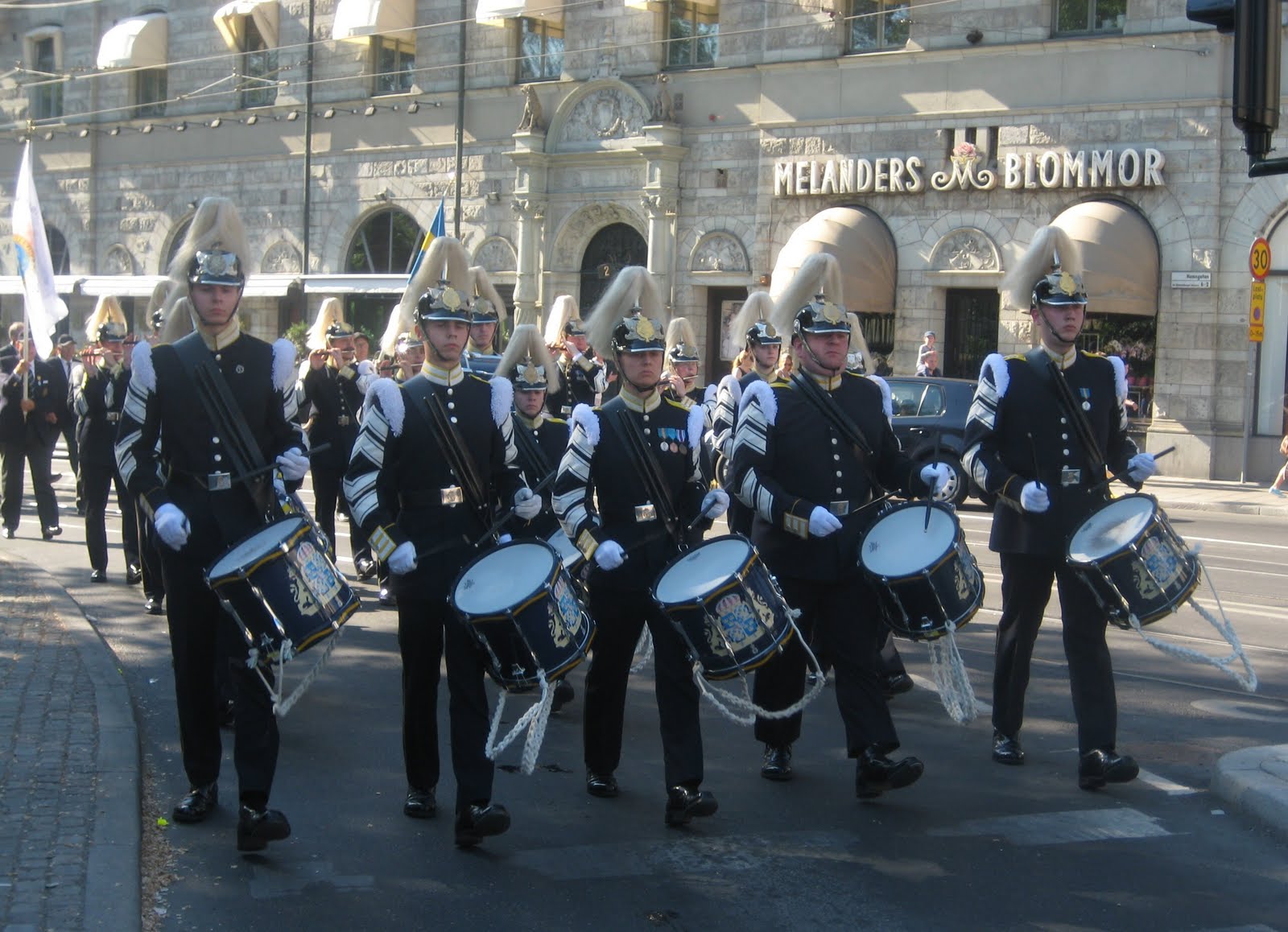 The Army Band
On this date: Golden wedding of the Duke and Duchess of Kent
Today is the golden wedding anniversary of the Duke and Duchess of Kent. Prince Edward of Britain, Duke of Kent – a grandson of King George V and thus a first cousin of Queen Elizabeth II – met Katharine Worsley – a member of the local gentry – when he was posted to North Yorkshire on military service in 1956.
They were married in York Minster on 8 June 1961 and went on to have three children: George, Earl of St Andrews in 1962, Lady Helen in 1964 and Lord Nicholas in 1970. These days the Duke and Duchess of Kent live in Wren House at Kensington Palace in London, but it is generally believed that they have been living separate lives for several years.
The Duchess of Kent, who is 78, was for many years one of the greatest assets to the British royal family, but has now retired from public life. However, the 75-year-old Duke of Kent continues to carry out a large number of royal engagements. The Duke and Duchess of Kent were last seen together at the wedding of the Duke and Duchess of Cambridge on 29 April.
As the 1960s saw a wave of royal weddings one can count on a number of royal golden weddings in the years to come, provided that everyone stays alive and married. Princess Astrid of Norway and Johan Martin Ferner celebrated their golden wedding in January this year, followed by Princess Birgitta of Sweden and Prince Johann Georg of Hohenzollern last month. Between 2012 and 2018 there are expected to be golden weddings in the royal families of Spain, Sweden, Denmark, the Netherlands and Norway.
They were married in York Minster on 8 June 1961 and went on to have three children: George, Earl of St Andrews in 1962, Lady Helen in 1964 and Lord Nicholas in 1970. These days the Duke and Duchess of Kent live in Wren House at Kensington Palace in London, but it is generally believed that they have been living separate lives for several years.
The Duchess of Kent, who is 78, was for many years one of the greatest assets to the British royal family, but has now retired from public life. However, the 75-year-old Duke of Kent continues to carry out a large number of royal engagements. The Duke and Duchess of Kent were last seen together at the wedding of the Duke and Duchess of Cambridge on 29 April.
As the 1960s saw a wave of royal weddings one can count on a number of royal golden weddings in the years to come, provided that everyone stays alive and married. Princess Astrid of Norway and Johan Martin Ferner celebrated their golden wedding in January this year, followed by Princess Birgitta of Sweden and Prince Johann Georg of Hohenzollern last month. Between 2012 and 2018 there are expected to be golden weddings in the royal families of Spain, Sweden, Denmark, the Netherlands and Norway.
Monday, 6 June 2011
On this date: Sweden’s National Day
 Today is the National Day of Sweden and the royal family – including Princess Madeleine, just back from the USA – will as usual take part in the celebrations in Stockholm and elsewhere.
6 June was the date in 1523 when Gustaf Eriksson (Vasa) was elected King of Sweden following the secession from the pan-Nordic Kalmar Union and also the date in 1809 when Prince Carl, Duke of Sudermania was offered the Crown. The Constitution of 1809 was consequently dated 6 June although it was only on 27 June that the Constitution was accepted by the Fourth Estate.
In the twentieth century 6 June came to be celebrated as the Day of the Swedish Flag and it was officially proclaimed the National Day in 1983. Since 2006 it is also a public holiday.
Sunday, 5 June 2011
Duke and Duchess of Cambridge to live at Kensington Palace
 The British court yesterday announced that “a property at Kensington Palace” will become the official London residence of the Duke and Duchess of Cambridge, but only as a temporary solution. Prince William and his wife Catherine will continue to live on Anglesey until his stint as a RAF search and rescue pilot is over in 2013 and their office will remain at St James’s Palace.
The court says that a “number of options for longer-term solutions are still being considered” but that “[n]o suitable properties are currently available". Buckingham Palace is generally not considered a place anyone would care to live permanently, while the royal family have long ago given up the right of disposal of Marlborough House, which has earlier served as the official residence of heirs or dowager queens. Clarence House will remain the residence of the Prince of Wales and the Duchess of Cornwall until they ascend the throne. York House, a wing of St James’s Palace which has earlier housed members of the royal family, has now been turned into offices for the Royal Collection.
Prince William grew up at Kensington Palace, which became the official residence of his parents following their marriage in 1981. After they separated in 1992 and divorced in 1996, Diana, Princess of Wales remained at Kensington Palace until her death in 1997. Her apartment is now being used for offices and storage facilities.
Kensington Palace used to be known as “the aunt heap” because of the number of elderly royal relatives living there. Today Queen Elizabeth II’s cousins, the Duke of Gloucester, the Duke of Kent and Prince Michael with their wives, all have apartments at the Palace, while the spacious apartment which was the home of Princess Margaret until her death in 2002 is being turned into exhibition space.
Thursday, 2 June 2011
British diamond jubilee to be celebrated on 2-5 June 2012
Today, on the anniversary of her coronation, Buckingham Palace has announced the plans for the celebrations of the diamond jubilee of Queen Elizabeth II. Although she succeeded to the British throne on 6 February 1952, the celebrations will - as usual for such events - take place in early summer, i.e. from 2 to 5 June 2012.
Among the highlights of the celebrations will be a “Diamond Jubilee Pageant” on the Thames on Sunday 3 June, in which Queen Elizabeth will travel down the Thames in the Royal Barge at the head of a flotilla. The following day there will be a BBC concert at Buckingham Palace and on Tuesday 5 June there will be a carriage procession to St Paul’s Cathedral, where a service of thanksgiving will take place.
Among the highlights of the celebrations will be a “Diamond Jubilee Pageant” on the Thames on Sunday 3 June, in which Queen Elizabeth will travel down the Thames in the Royal Barge at the head of a flotilla. The following day there will be a BBC concert at Buckingham Palace and on Tuesday 5 June there will be a carriage procession to St Paul’s Cathedral, where a service of thanksgiving will take place.
Tuesday, 31 May 2011
Count Edward Bernadotte weds Nathalie Frediani
Svensk Damtidning (external link) has a short report - with what looks like a selection of paparazzi photos - from the wedding of Count Edward Bernadotte af Wisborg and Nathalie Frediani, which took place in Villa Rusconi-Clerici in Verbania in Italy last weekend. The bride seems to have worn the bridal crown of her husband’s family.
Edward Bernadotte is the son of Count Bertil Bernadotte and his second wife Jill; the grandson of the famous Count Folke Bernadotte, the great-grandson of Prince Oscar Bernadotte and the great-great-grandson of King Oscar II of Sweden and Norway. He is not in line to the Swedish throne, nor is he a member of the royal family.
Edward Bernadotte is the son of Count Bertil Bernadotte and his second wife Jill; the grandson of the famous Count Folke Bernadotte, the great-grandson of Prince Oscar Bernadotte and the great-great-grandson of King Oscar II of Sweden and Norway. He is not in line to the Swedish throne, nor is he a member of the royal family.
Carl XVI Gustaf denies allegations about his private life
The reign of Carl XVI Gustaf reached its lowest point ever yesterday when the King of Sweden felt obliged to grant the news agency TT an interview to talk about the scandalous allegations about his private life which have recently undermined his position rather seriously.
The journalist Tomas Bengtsson asked the King about the claims made in the book Carl XVI Gustaf - Den motvillige monarken that he supposedly had visited strip clubs in Atlanta in 1996 and Bratislava in 2008, which the King clearly denies. When asked if he has ever visited strip clubs or sex clubs he is rather vague, replying that it is a matter of definition and that there are several restaurants were the waitresses are scantily clad, like at the German Oktoberfest. He is again very clear when he denies explicitly that he has ever visited clubs where illegal activities take place.
He does not know if he has ever taken part in parties with criminals, arguing that he cannot possibly be familiar with the backgrounds of every single guest at every event he has attended. This, he says, is an issue for the hosts, as are the so-called “coffee girls”.
When it comes to the allegedly compromising photos his friend Anders Lettström recently tried to buy from a gangster, the King states that there cannot possibly exist any such photos.
The King is not willing to comment on the allegations made in the aforementioned book last year and rejects the idea that he has put himself in a position to be blackmailed. His possible abdication is not a relevant question. He did not know anything about Anders Lettström’s contacts with gangsters, he insists, and has now cut all ties to Lettström, one of his oldest friends. He has neither met nor spoken on the telephone to those other of his friends who appear in the book after its publication last autumn.
He acknowledges that these allegations hurt the people’s confidence in him and in the monarchy and even Sweden, which he vows to repair by working twice as hard in the future.
King Carl Gustaf appeared to be clearly uncomfortable during the interview, which is understandable given that no monarch before him has ever had to sit down to such an interview to answer allegations about his private life. He did not always speak very clearly and at times seemed to be confused about what he had earlier commented on or not.
For instance he seemed to think he had commented on the “coffee girls” when he addressed the press pack in connection with a hunt last autumn, but this is not the case. Back then he only said that he had spoken with the Queen and his family and now wanted to “turn the page”, which many took as a confirmation that the claims made in the book were actually correct but that the King now wanted to move on.
Generally one can say that when King Carl Gustaf is so absolutely sure that he has never set in these clubs he might well have said so in November and saved himself and the monarchy from half a year of speculation. One may also wonder why his friend was willing to enter into negotiations with criminals to buy compromising photos if it is absolutely impossible that any such pictures exist.
Now that the King has explicitly denied the allegations he may hope that the story will die away. However, he has also himself upped the ante and if there should now appear photos or other proof which go against his assurances he will have a real problem. Thomas Sjöberg, the main author of the “biography” has already called the King a bad liar and somehow I have the feeling that this story is not yet over.
The journalist Tomas Bengtsson asked the King about the claims made in the book Carl XVI Gustaf - Den motvillige monarken that he supposedly had visited strip clubs in Atlanta in 1996 and Bratislava in 2008, which the King clearly denies. When asked if he has ever visited strip clubs or sex clubs he is rather vague, replying that it is a matter of definition and that there are several restaurants were the waitresses are scantily clad, like at the German Oktoberfest. He is again very clear when he denies explicitly that he has ever visited clubs where illegal activities take place.
He does not know if he has ever taken part in parties with criminals, arguing that he cannot possibly be familiar with the backgrounds of every single guest at every event he has attended. This, he says, is an issue for the hosts, as are the so-called “coffee girls”.
When it comes to the allegedly compromising photos his friend Anders Lettström recently tried to buy from a gangster, the King states that there cannot possibly exist any such photos.
The King is not willing to comment on the allegations made in the aforementioned book last year and rejects the idea that he has put himself in a position to be blackmailed. His possible abdication is not a relevant question. He did not know anything about Anders Lettström’s contacts with gangsters, he insists, and has now cut all ties to Lettström, one of his oldest friends. He has neither met nor spoken on the telephone to those other of his friends who appear in the book after its publication last autumn.
He acknowledges that these allegations hurt the people’s confidence in him and in the monarchy and even Sweden, which he vows to repair by working twice as hard in the future.
King Carl Gustaf appeared to be clearly uncomfortable during the interview, which is understandable given that no monarch before him has ever had to sit down to such an interview to answer allegations about his private life. He did not always speak very clearly and at times seemed to be confused about what he had earlier commented on or not.
For instance he seemed to think he had commented on the “coffee girls” when he addressed the press pack in connection with a hunt last autumn, but this is not the case. Back then he only said that he had spoken with the Queen and his family and now wanted to “turn the page”, which many took as a confirmation that the claims made in the book were actually correct but that the King now wanted to move on.
Generally one can say that when King Carl Gustaf is so absolutely sure that he has never set in these clubs he might well have said so in November and saved himself and the monarchy from half a year of speculation. One may also wonder why his friend was willing to enter into negotiations with criminals to buy compromising photos if it is absolutely impossible that any such pictures exist.
Now that the King has explicitly denied the allegations he may hope that the story will die away. However, he has also himself upped the ante and if there should now appear photos or other proof which go against his assurances he will have a real problem. Thomas Sjöberg, the main author of the “biography” has already called the King a bad liar and somehow I have the feeling that this story is not yet over.
Monday, 30 May 2011
Luxembourgian royals welcomed in Oslo


 Today the Grand Duke and Grand Duchess of Luxembourg began a three-day state visit to Norway, where they were welcomed by the King and Queen at the usual ceremony in the Palace Square. Grand Duke Henri later laid a wreath at the National Monument at Akershus Fortress and called on the Prime Minister at the Government Building as well as the Speaker of Parliament. Tonight there is a state banquet at the Royal Palace.
During the day the Queen has also accompanied the Grand Duchess on visits to Oscarshall Palace and the nearby Queen’s Chalet (Sæterhytten) at Bygdøy, which was inaugurated in the presence of three mutual ancestors of the King and the Grand Duke in 1862 (Queen Lovisa, her daughter Princess Lovisa and her mother Princess Louise of the Netherlands) and has recently reopened after restoration works. On Wednesday the grand ducal couple, accompanied by the King and Queen, will travel to Trondheim, where Nidaros Cathedral is among the sites to be visited. However, the Grand Duchess may cut short the visit as her brother is reported to be in a coma in a hospital in Florida.
The Grand Duke has been awarded the Collar of the Grand Cross of the Order of St Olav (he already had the Grand Cross), while Crown Prince Haakon, Crown Princess Mette-Marit and Princess Märtha Louise have been given the Grand Cross of the Order of Adolphe of Nassau.
The Norwegian and Luxembourgian royal families are closely related and the ties between the two families have long been close. Grand Duke Adolphe, the first monarch of Luxembourg following the secession from the union with the Netherlands, was the older half-brother of Queen Sophia and something of a father figure to her.
Furthermore, the current Grand Duke’s mother, the Belgian-born Grand Duchess Joséphine-Charlotte, was a first cousin of King Harald. This means that Grand Duke Henri is the European monarch most closely related to King Harald except for the King of the Belgians, who is King Harald’s first cousin and Grand Duke Henri’s uncle.
Grand Duchess Joséphine-Charlotte, who lost her mother, Queen Astrid of the Belgians, when she was only eight years old and had a rather traumatic childhood during World War II, was always close to her Scandinavian relatives and rarely missed a family event. The death of this regal, yet charming lady in 2005 was much regretted by the Norwegian royals.
Grand Duke Henri and Grand Duchess Maria Teresa have themselves paid a number of visits to Norway following their accession to the throne in 2000, attending several family occasions and also a skiing event some years ago.
There have on the other hand been rather few state visits between the two countries and, coincidentally, none of them has ever been returned. King Olav made a state visit to Grand Duchess Charlotte and Prince Félix in 1964, shortly before her abdication. In 1990 Grand Duke Jean and Grand Duchess Joséphine-Charlotte became the last to pay a state visit to King Olav, who was taken seriously ill later that spring and never resumed the reins of government before his death in January 1991. In 1996 King Harald and Queen Sonja paid a state visit to Grand Duke Jean and Grand Duchess Joséphine-Charlotte, which they again did not return before Grand Duke Jean’s abdication in favour of his son Henri in October 2000.
This week’s state visit will by the way be the last to Norway by a reigning European monarch for the foreseeable future. The Queen of Denmark was here in 1992, the King of Sweden in 1993, the King of the Belgians in 1997, the Queen of Britain in 2001, the King of Spain in 2006 and the Queen of the Netherlands in 2010, while the sovereign princes of Liechtenstein and Monaco do not habitually pay state visits. As it is customary for monarchs to pay only one state visit to each country per reign the next state visit from a reigning European monarch will probably not be until a new reign has begun in at least one of the European monarchies.
Sunday, 29 May 2011
Another scandal causes support for King Carl Gustaf to continue to fall
Last autumn the publication of a biography of King Carl Gustaf which contained a series of scandalous allegations about his private life caused support for the King to fall. This was seen as something of a nadir of his reign and along with other events, such as the break-up of Princess Madeleine’s and Jonas Bergström’s engagement after a kiss-and-tell interview, Prince Carl Philip’s relationship with a former bikini/nude model and reality show contestant, and the revelations of the true extent of Queen Silvia’s father’s involvement with Nazism, it meant that 2010 despite the bicentenary of the dynasty and the wedding of the Crown Princess was something of an annus horribilis for the Swedish royal family.
During the last two weeks the situation has become even worse through the publication of another book, this time about an infamous serial criminal, in which it is claimed that one of the King’s closest friends since childhood, Anders Lettström, had contacted a gangster in order to try and buy compromising photos of the King.
In a farcial turn of events a reporter from TV4 was shown interviewing one of the gangsters, who in the course of the interview showed him two photos, which were not shown on air. According to the reporter the photos showed King Carl Gustaf, at first identified as “a very famous person”, at a strip club watching two women performing a sexual act (such shows are illegal in Sweden, but these photos were apparently taken abroad).
The price reportedly demanded for the photos – 50 million SEK, i.e. almost € 5 million – was apparently too high for Lettström as well as for the media, which has led to the absurd situation that while this story has been much written about in the past two weeks, no-one except TV4’s journalist has seen the photos. Thus one only has the journalist’s word for it that it is the King who appears in the photos, and, as the head of the royal court’s Information and Press Department, Bertil Ternert, has said, this makes it virtually impossible to comment on the story. TV4 has on the other hand refused to comply with Ternert’s demand that they ought to publish the photos so that one may see what the allegations are actually about.
Meanwhile Anders Lettström has issued a press statement in which he takes full responsibility and all the blame for contacting the criminals, stressing that the King has had nothing to do with this. The King has restricted himself to issuing a press statement in which he said absolutely nothing.
Nevertheless this latest scandal has caused support for King Carl Gustaf to fall dramatically. A week ago an opinion poll published in Expressen and carried out by Demoskop showed that 59 % think the King should abdicate in favour of Crown Princess Victoria within the next decade, while only 29 % supported the idea of his remaining on the throne until his death, which is what he indicated he will do in an interview in connection with his 65th birthday last month. The same opinion poll also showed that a mere 39 % say they have strong confidence in the King, while 73 % feel so for the Crown Princess.
This finding is confirmed by a similar opinion poll conducted by Novus for TV4, which shows that 72 % have great or fairly great confidence in Crown Princess Victoria, while 40 % say the same about the King. In this poll 59 % say they support the monarchy, while 29 % want to abolish it.
A third opinion poll, carried out by Synovate and published in Dagens Nyheter yesterday, show that 44 % want the King to remain on the throne, while 41 % express the opinion that he should abdicate in favour of the Crown Princess. This is a marked difference from when Synovate did the same poll in February 2010 and found that 64 % wished to see the King remaining on the throne and only 17 % thought he should hand over to Crown Princess Victoria. Synovate finds that 66 % want to retain the monarchy, as compared to 70 % in November 2010 and 74 % in February 2010.
While opinion polls may be considered nothing more than a fairly accurate indication of public opinion at any given moment, this does indicate that King Carl Gustaf, whatever the truth of the allegations, faces a serious challenge in winning back the confidence of his people. It might be said that these scandals have come at an unfortunate time for him, as the last years had seen him win a form of popularity which had not always been easily available to him. His beautiful, heartfelt speech following the 2004 tsunami won him many hearts and now would have been the time that he, after nearly forty years on the throne, should have settled into the role of some sort of elder statesman/“father of the nation”.
At the same time it ought to be remembered that the calls for his abdication are probably augmented by the enormous popularity enjoyed by his fantastically charming heiress – which in itself does of course bode well for the future of the monarchy after all. Yet this also reminds us that the monarchy today, perhaps particularly in Sweden, is more than ever before dependent on the personal qualities of the royals themselves.
During the last two weeks the situation has become even worse through the publication of another book, this time about an infamous serial criminal, in which it is claimed that one of the King’s closest friends since childhood, Anders Lettström, had contacted a gangster in order to try and buy compromising photos of the King.
In a farcial turn of events a reporter from TV4 was shown interviewing one of the gangsters, who in the course of the interview showed him two photos, which were not shown on air. According to the reporter the photos showed King Carl Gustaf, at first identified as “a very famous person”, at a strip club watching two women performing a sexual act (such shows are illegal in Sweden, but these photos were apparently taken abroad).
The price reportedly demanded for the photos – 50 million SEK, i.e. almost € 5 million – was apparently too high for Lettström as well as for the media, which has led to the absurd situation that while this story has been much written about in the past two weeks, no-one except TV4’s journalist has seen the photos. Thus one only has the journalist’s word for it that it is the King who appears in the photos, and, as the head of the royal court’s Information and Press Department, Bertil Ternert, has said, this makes it virtually impossible to comment on the story. TV4 has on the other hand refused to comply with Ternert’s demand that they ought to publish the photos so that one may see what the allegations are actually about.
Meanwhile Anders Lettström has issued a press statement in which he takes full responsibility and all the blame for contacting the criminals, stressing that the King has had nothing to do with this. The King has restricted himself to issuing a press statement in which he said absolutely nothing.
Nevertheless this latest scandal has caused support for King Carl Gustaf to fall dramatically. A week ago an opinion poll published in Expressen and carried out by Demoskop showed that 59 % think the King should abdicate in favour of Crown Princess Victoria within the next decade, while only 29 % supported the idea of his remaining on the throne until his death, which is what he indicated he will do in an interview in connection with his 65th birthday last month. The same opinion poll also showed that a mere 39 % say they have strong confidence in the King, while 73 % feel so for the Crown Princess.
This finding is confirmed by a similar opinion poll conducted by Novus for TV4, which shows that 72 % have great or fairly great confidence in Crown Princess Victoria, while 40 % say the same about the King. In this poll 59 % say they support the monarchy, while 29 % want to abolish it.
A third opinion poll, carried out by Synovate and published in Dagens Nyheter yesterday, show that 44 % want the King to remain on the throne, while 41 % express the opinion that he should abdicate in favour of the Crown Princess. This is a marked difference from when Synovate did the same poll in February 2010 and found that 64 % wished to see the King remaining on the throne and only 17 % thought he should hand over to Crown Princess Victoria. Synovate finds that 66 % want to retain the monarchy, as compared to 70 % in November 2010 and 74 % in February 2010.
While opinion polls may be considered nothing more than a fairly accurate indication of public opinion at any given moment, this does indicate that King Carl Gustaf, whatever the truth of the allegations, faces a serious challenge in winning back the confidence of his people. It might be said that these scandals have come at an unfortunate time for him, as the last years had seen him win a form of popularity which had not always been easily available to him. His beautiful, heartfelt speech following the 2004 tsunami won him many hearts and now would have been the time that he, after nearly forty years on the throne, should have settled into the role of some sort of elder statesman/“father of the nation”.
At the same time it ought to be remembered that the calls for his abdication are probably augmented by the enormous popularity enjoyed by his fantastically charming heiress – which in itself does of course bode well for the future of the monarchy after all. Yet this also reminds us that the monarchy today, perhaps particularly in Sweden, is more than ever before dependent on the personal qualities of the royals themselves.
Subscribe to:
Posts (Atom)


