It has been a long time since I have had the time to update this blog, which is because I have been working literally day and night on my sixth book, but now I am pleased to announce that the book has been published. Kronprinsessens krig – Den sanne historien om kronprinsesse Märtha og Franklin D. Roosevelt, which translates as “The Crown Princess’s War: The True Story of Crown Princess Märtha and Franklin D. Roosevelt”, tells the story of Crown Princess Märtha of Norway during the Second World War, when the exiled first lady became part of US President Franklin D. Roosevelt’s inner circle and played a significant political, diplomatic and humanitarian role in wartime Washington.
Indeed, there were hardly anyone President Roosevelt saw more of during the Second World War than Crown Princess Märtha, but her role has generally not been understood. Many authors have written her off as just some sort of insignificant companion or perhaps the President’s mistress, but they have been unaware of the fact that the Crown Princess had a secret political mission that she was able to fulfil through her unlimited access to the President of the United States of America.
Thanks to a unique combination of sources from many countries, I am able to show how Crown Princess Märtha operated behind the scenes and utilised her network of influential friends and acquaintances to promote the interests of her country and how she became an important source of information for President Franklin D. Roosevelt.
Like my three latest books, this one is published by Historie & Kultur. It will be available in most bookshops, and may also be ordered from online booksellers such as Norli, Haugen Bok, Ark, Adlibris, Tanum and Platekompaniet (all external links).
Showing posts with label Glücksburg. Show all posts
Monday, 7 October 2019
Sunday, 24 February 2019
My latest article: Olav and Märtha's unknown love story & Roosevelt and the Kings
In the March issue of Majesty (Vol. 40, No. 3), which was published on Thursday, I have written an article about the wedding of Crown Prince Olav of Norway and Princess Märtha of Sweden ninety years ago, in which I can for the first time reveal not only that King Haakon and Queen Maud were in fact against their son marrying Märtha but also the reason why and who they wanted him to marry instead of Märtha.
In the same issue I conclude my article series on Theodore Roosevelt's grand tour of the courts of Europe in 1910. In this third instalment the former US President visits Emperor Wilhelm II in Berlin and goes to London for the funeral of King Edward VII, where the kings of Europe flock around him and he observes King George V's failure to understand why his youngest son, Prince John, was not like his other children.
Labels:
Bernadotte,
Britain,
Germany,
Glücksburg,
history,
Hohenzollern,
Norway,
Roosevelt,
royalty,
Sweden,
USA,
Windsor
Thursday, 24 January 2019
My latest articles: Theodore Roosevelt at court & the last Queen of Bavaria
In the February issue of Majesty (Vol. 40, No. 2), which is out in Britain today, I continue my series on Theodore Roosevelt and the royals. In this second of three article, the former US President visits the courts of Brussels, The Hague, Copenhagen, Oslo and Stockholm, where he takes a strong dislike to one monarch, forms a lasting friendship with another and is smitten with an unhappy princess.
In the same magazine I also write about the life of Marie Therese, the last Queen of Bavaria (and Jacobite claimant to the British throne), who died 100 years ago in February 1919 while fleeing the revolution in Munich that had brought down the ancient Wittelsbach dynasty.
Labels:
Bavaria,
Belgium,
Bernadotte,
Denmark,
Germany,
Glücksburg,
Habsburg,
history,
Norway,
Orange,
Roosevelt,
royalty,
Sweden,
the Netherlands,
USA,
Wittelsbach
Monday, 10 September 2018
My latest articles: Princess Elisabeth of Denmark and Palermo
I have forgotten to mention the publication of the September issue of Majesty (Vol. 38, No. 9), in which you may read my obituary of Princess Elisabeth of Denmark, a first cousin of Queen Margrethe who died earlier this summer, and my report on the splendid royal sights of the wonderful, historic city of Palermo, which is situated at the crossroads of Europe, Africa and the Middle East.
Wednesday, 29 August 2018
On this date: King and Queen's golden wedding anniversary
This afternoon the King and Queen drove to the Cathedral of Oslo in the same open-top Lincoln limousine which took them there fifty years ago to attend a service of thanksgiving. The Crown Prince and Crown Princess, Princess Ingrid Alexandra, Prince Sverre Magnus, Princess Märtha Louise and her daughters Maud, Emma and Leah Behn and Princess Astrid were also in attendance. Back at the Royal Palace afterwards, the King and Queen made an unannounced balcony appearance with their children, daughter-in-law and grandchildren.
Labels:
anniversaries,
Glücksburg,
golden weddings,
Norway,
royalty
Thursday, 2 August 2018
My latest articles: Norwegian golden wedding, Swedish royal dukedoms and Princess Victoria of Britain
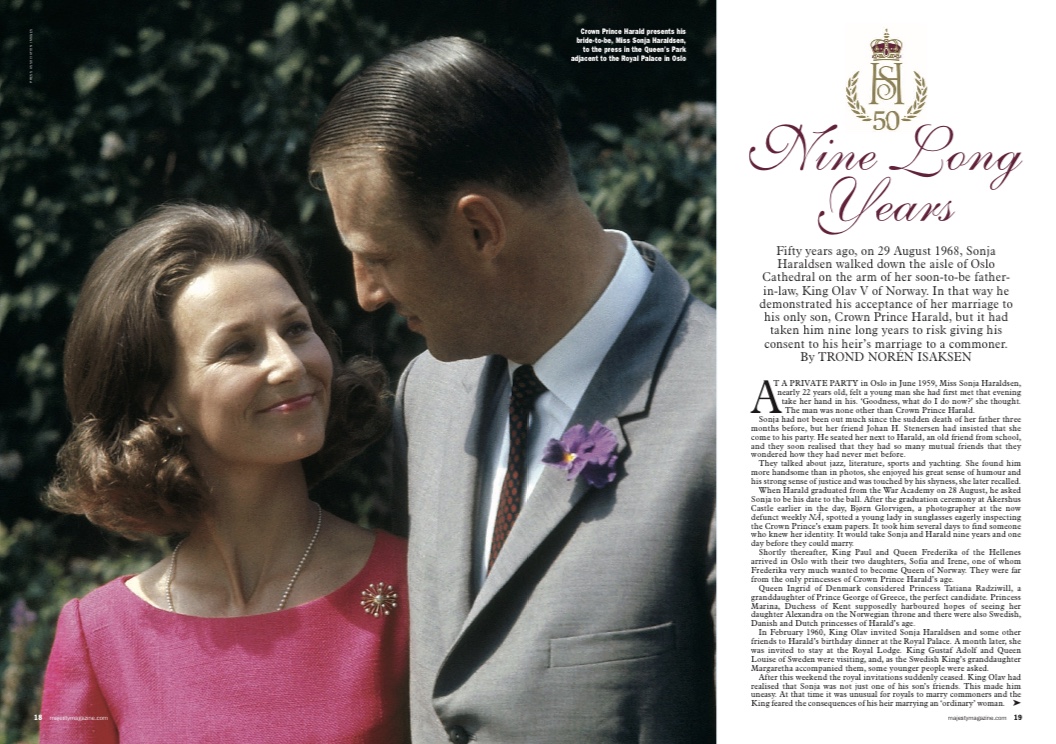
The August issue of Majesty (Vol. 39, No. 8) is now on sale and it appears I have written almost half of it. On the occasion of the King and Queen's golden wedding anniversary later this month I write about the nine difficult years they had to wait before King Olav eventually risked giving his consent to their marriage, which everyone seemed to think might spell the end of the monarchy.
I also write about the difficult, unhappy and frustrated Princess Victoria of Britain, the sister of Queen Maud and King George V, who was not allowed to marry the Liberal Prime Minister Lord Rosebery, whom her mother Queen Alexandra treated as her maid and who ended up as a rather bitter woman who often made life difficult for others.
Finally, there is also an article on the history of Swedish royal dukedoms, which were once semi-autonomous states within the states that could become power bases but are now just honorific titles given to the ever-growing number of members of the Swedish royal family.
I also write about the difficult, unhappy and frustrated Princess Victoria of Britain, the sister of Queen Maud and King George V, who was not allowed to marry the Liberal Prime Minister Lord Rosebery, whom her mother Queen Alexandra treated as her maid and who ended up as a rather bitter woman who often made life difficult for others.
Finally, there is also an article on the history of Swedish royal dukedoms, which were once semi-autonomous states within the states that could become power bases but are now just honorific titles given to the ever-growing number of members of the Swedish royal family.
Labels:
Bernadotte,
Britain,
Glücksburg,
golden weddings,
history,
Holstein-Gottorp,
Norway,
royalty,
Sweden,
titles,
Vasa,
Windsor
Wednesday, 20 June 2018
At the road's end: Princess Elisabeth of Denmark (1935-2018)
The Danish royal court has announced that Princess Elisabeth, a first cousin of Queen Margrethe II, passed away at 6.15 p.m. yesterday, at the age of 83.
Her Highness Princess Elisabeth Caroline-Mathilde Alexandrine Helena Olga Thyra Feodora Estrid Margrethe Désirée of Denmark was born on 8 May 1935 as the first-born child of Hereditary Prince Knud (the youngest son of King Christian X) and Hereditary Princess Caroline-Mathilde (a first cousin of her husband). She later had two brothers, Ingolf and Christian, but this line of the family was "disinherited" in 1953, when a new Act of Succession introduced female succession and Princess Margrethe replaced her uncle Knud as heir to the throne, causing some bitterness within the family. At the time of her death, Princess Elisabeth was twelfth in the order of succession.
The Princess made a career in the Ministry of Foreign Affairs, where she worked from 1956 until her retirement in 2001. For twenty years she lived with the film director Claus Hermansen, but the ever outspoken Princess explained that they never married as she did not want to lose her royal title and did not want children anyway.
The Princess' funeral will take place in Lyngby Church (the date has not yet been announced) and her ashes will be buried next to Claus Hermansen, who died in 1997.
I will write a longer obituary of the Princess in a forthcoming issue of Majesty.
Her Highness Princess Elisabeth Caroline-Mathilde Alexandrine Helena Olga Thyra Feodora Estrid Margrethe Désirée of Denmark was born on 8 May 1935 as the first-born child of Hereditary Prince Knud (the youngest son of King Christian X) and Hereditary Princess Caroline-Mathilde (a first cousin of her husband). She later had two brothers, Ingolf and Christian, but this line of the family was "disinherited" in 1953, when a new Act of Succession introduced female succession and Princess Margrethe replaced her uncle Knud as heir to the throne, causing some bitterness within the family. At the time of her death, Princess Elisabeth was twelfth in the order of succession.
The Princess made a career in the Ministry of Foreign Affairs, where she worked from 1956 until her retirement in 2001. For twenty years she lived with the film director Claus Hermansen, but the ever outspoken Princess explained that they never married as she did not want to lose her royal title and did not want children anyway.
The Princess' funeral will take place in Lyngby Church (the date has not yet been announced) and her ashes will be buried next to Claus Hermansen, who died in 1997.
I will write a longer obituary of the Princess in a forthcoming issue of Majesty.
Labels:
Denmark,
Glücksburg,
obituaries,
royalty
Tuesday, 1 May 2018
My latest article(s): Crown Prince Frederik at 50 & Rosendal Palace
The May issue of Majesty (Vol. 39, No. 5) is now on sale, and while most of it is understandably dedicated to the upcoming wedding of Prince Harry of Britain and Meghan Markle, I write about Crown Prince Frederik of Denmark, who will turn 50 in May, and how the once troubled young heir found himself.
In the same issue there is also a new instalment of my occasional series on palaces, this time about Rosendal, the small but exquisite Empire style palace which Carl XIV Johan built at Djurgården in Stockholm.
Labels:
architecture,
Bernadotte,
Denmark,
Glücksburg,
neoclassicism,
palaces,
royalty,
Sweden
Saturday, 14 April 2018
Royal jewels: Princess Ingeborg's Fabergé brooch - sold during WWII?
A Fabergé brooch (external link) which was given by the King's maternal grandfather, Prince Carl of Sweden, to Princess Ingeborg on the occasion of their fifteenth wedding anniversary in 1912 was sold by the auction house Coutau-Bégarie in Paris this week.
Several people have asked me about this and the auctioneer's claim that the brooch was sold by Crown Princess Märtha out of necessity during the Second World War. I do not know what is the auction house's source, but to me this seems like a misunderstanding or a supposition.
As I was able to reveal in my 2007 biography of Princess Astrid, Kvinne blant konger, the emerald parure now worn by the Queen was given to Crown Princess Märtha by Princess Ingeborg at the Central Station in Stockholm when she departed for the USA in the summer of 1940. Princess Ingeborg's intention was that her daughter could sell the emeralds if she never returned to Norway (which must have seemed a likely outcome in 1940), but the daring rescue of that the Bank of Norway's gold reserve meant that the Norwegian government-in-exile (unlike others) was able to provide for itself throughout the war and that the royal family did not have to sell their possessions in order to survive.
It therefore seems highly unlikely that Crown Princess Märtha sold the Fabergé brooch out of necessity during WWII.
Several people have asked me about this and the auctioneer's claim that the brooch was sold by Crown Princess Märtha out of necessity during the Second World War. I do not know what is the auction house's source, but to me this seems like a misunderstanding or a supposition.
As I was able to reveal in my 2007 biography of Princess Astrid, Kvinne blant konger, the emerald parure now worn by the Queen was given to Crown Princess Märtha by Princess Ingeborg at the Central Station in Stockholm when she departed for the USA in the summer of 1940. Princess Ingeborg's intention was that her daughter could sell the emeralds if she never returned to Norway (which must have seemed a likely outcome in 1940), but the daring rescue of that the Bank of Norway's gold reserve meant that the Norwegian government-in-exile (unlike others) was able to provide for itself throughout the war and that the royal family did not have to sell their possessions in order to survive.
It therefore seems highly unlikely that Crown Princess Märtha sold the Fabergé brooch out of necessity during WWII.
Labels:
Bernadotte,
Glücksburg,
history,
Jewels,
Norway,
royalty,
Sweden,
WWII
Friday, 6 April 2018
My latest articles: Prince Henrik & Christian IX
In the April issue of the British monthly magazine Majesty (Vol. 39, No 4) you may read my obituary of Prince Henrik of Denmark, a man of many talents who was, in my opinion, one of the most interesting and colourful royals of Europe.
In the same issue I also write about King Christian IX of Denmark, who was born 200 years ago on 8 April 1818. Known in his later years as "the father-in-law of Europe", he was also for a long time a highly controversial figure because of his role as conservative party king during the struggle for parliamentary democracy.
Also in this issue: Ian Lloyd writes about Queen Elizabeth II of Britain and the Commonwealth, Lucinda Gosling on historic royal fashion, Ingrid Seward on royal childbirth in Britain and Paul F. Cockburn on Queen Elizabeth the Queen Mother's Scottish retreat, the Castle of Mey.
In the same issue I also write about King Christian IX of Denmark, who was born 200 years ago on 8 April 1818. Known in his later years as "the father-in-law of Europe", he was also for a long time a highly controversial figure because of his role as conservative party king during the struggle for parliamentary democracy.
Also in this issue: Ian Lloyd writes about Queen Elizabeth II of Britain and the Commonwealth, Lucinda Gosling on historic royal fashion, Ingrid Seward on royal childbirth in Britain and Paul F. Cockburn on Queen Elizabeth the Queen Mother's Scottish retreat, the Castle of Mey.
Labels:
Denmark,
Glücksburg,
history,
politics,
royalty
Tuesday, 20 February 2018
My latest article: A poet among princes
In 45 minutes the funeral of Prince Henrik of Denmark, who died on 13 February, will take place in Christiansborg Palace Church in Copenhagen, and today Aftenposten, Norway's largest newspaper, publishes my obituary of this man of many talents, who during his life could call himself Prince Consort, poet, winegrower, soldier, sculptor and diplomat, but never King. The obituary may be read here (external link).
Thursday, 7 December 2017
My latest article: Margaretha the matriarch
In the December issue of the British monthly magazine Majesty (Vol. 38, No. 12) I write about Princess Margaretha of Denmark (1899-1977), who may have been less famous than her sisters, Crown Princess Märtha of Norway and Queen Astrid of the Belgians, but outlived them both by far to become (in the words of her niece, Princess Astrid of Norway) the female head of the family, the person who held the family together, one of King Olav's few confidantes and a valued adviser to younger relatives. The magazine is already out in Britain and from today also in Norway.
Labels:
Bernadotte,
Denmark,
Glücksburg,
Norway,
royalty,
Sweden
Friday, 3 November 2017
My latest articles: Danish crown jewels and Prince Henrik's travails
My article series about crown jewels continues in the November issue of Majesty (Vol. 38, No. 11), which is now on sale in Norway as well as in Britain. The third and final installment of the series deals with the Danish crown jewels, and in the same issue I also look at this summer's great royal "scandal", when Prince Henrik of Denmark, shortly before he was diagnosed with senile dementia, announced his refusal to be buried with his wife of fifty years, Queen Margrethe II, in Roskilde Cathedral unless she makes him King Consort. I also look at the historical background for his demand for the title of King Consort, which is actually not so far-fetched as many seem to believe, nor is it the idea of a demented mind.
Labels:
Denmark,
Glücksburg,
history,
Oldenburg,
regalia,
royalty,
title issues,
titles
Sunday, 3 September 2017
My lastest article: Swedish crown jewels and the mother-in-law of Europe
In the September issue of Majesty I embark on a new series on crown jewels, starting with the exquisite Swedish ones, which are the oldest of an extant monarchy. The series will continue next month with the Norwegian crown jewels.
In the same issue I also write about Queen Louise of Denmark, the consort of King Christian IX, an influential lady who arranged dynastic marriages in the mistaken belief that they would prevent wars. Known as "the mother-in-law of Europe", she was also the mother-in-law from hell, at least for her daughter-in-law Louise.
The magazine is already in sale in Britain and will go on sale in Norway on the coming Thursday, which happens to be the bicentenary of Queen Louise's birth.
In the same issue I also write about Queen Louise of Denmark, the consort of King Christian IX, an influential lady who arranged dynastic marriages in the mistaken belief that they would prevent wars. Known as "the mother-in-law of Europe", she was also the mother-in-law from hell, at least for her daughter-in-law Louise.
The magazine is already in sale in Britain and will go on sale in Norway on the coming Thursday, which happens to be the bicentenary of Queen Louise's birth.
Tuesday, 22 August 2017
My latest article: The troubled history of kings consort
Earlier this month, Prince Henrik of Denmark caused quite an uproar when he announced that he no longer wants to be buried together with his wife of fifty years, Queen Margrethe II. In a series of interviews he also launched a personal attack on his wife, who he claimed makes a fool of him, and stated that he would be willing to reconsider the decision about his burial place if she would agree to make him King Consort.
It was explained that the Prince’s decision was made because of his dissatisfaction with his title and function, something a spokeswoman said had become more and more important for him in recent years. It is far from the first time Prince Henrik raises the issue of his title and the fact that he believes that as the wife of a king is queen, a queen’s husband ought to be king (i.e. king consort and not, as some ill-informed people have claimed, take over as monarch).
Many seem to think that this is an idea Prince Henrik has grasped out of thin air, but in a long article in today’s issue of the broadsheet Politiken (external link) I recount the history of kings consort, which began in the crusader Kingdom of Jerusalem in the twelfth century and soon spread to Naples, Spain, Navarre, Portugal, Poland, England, Scotland and Cyprus. In fact, the husbands of queens regnant were actually usually (although not always) styled kings and many of them took part in the governance of the realm. The so far last king consort in Europe died as recently as 1902, and it is only during the last century and a half that it has become more common for male consorts not to be called kings. Thus, although Prince Henrik may have history and principles on his side, it seems highly unlikely that he will ever achieve his dream of becoming King Consort of Denmark.
It was explained that the Prince’s decision was made because of his dissatisfaction with his title and function, something a spokeswoman said had become more and more important for him in recent years. It is far from the first time Prince Henrik raises the issue of his title and the fact that he believes that as the wife of a king is queen, a queen’s husband ought to be king (i.e. king consort and not, as some ill-informed people have claimed, take over as monarch).
Many seem to think that this is an idea Prince Henrik has grasped out of thin air, but in a long article in today’s issue of the broadsheet Politiken (external link) I recount the history of kings consort, which began in the crusader Kingdom of Jerusalem in the twelfth century and soon spread to Naples, Spain, Navarre, Portugal, Poland, England, Scotland and Cyprus. In fact, the husbands of queens regnant were actually usually (although not always) styled kings and many of them took part in the governance of the realm. The so far last king consort in Europe died as recently as 1902, and it is only during the last century and a half that it has become more common for male consorts not to be called kings. Thus, although Prince Henrik may have history and principles on his side, it seems highly unlikely that he will ever achieve his dream of becoming King Consort of Denmark.
Tuesday, 4 July 2017
My latest article: A thousand years of queens
Today is the Queen's eightieth birthday and to mark the occasion I have written an essay on the history of Norwegian queens (external link) which appears in Aftenposten, the country's largest newspaper, today.
When Sonja became Queen in 1991, the position had been vacant for 52 years following the death of Queen Maud and therefore she had to carve out the role anew. However, Norwegian history is full of interesting and influential queens, such as Ælfgifu, Astrid Olavsdatter, Margareta Fredkolla, Ingerid Ragnvaldsdatter, Ingeborg Eriksdatter, Margareta Valdemarsdatter, Philippa of England, Blanca of Namur, Dorothea of Brandenburg, Josephine of Leuchtenberg and Sophie of Nassau.
Labels:
Bernadotte,
Glücksburg,
history,
medieval history,
Norway,
royalty
Monday, 3 July 2017
My latest article: The Queen at 80
The Queen will be eighty years old tomorrow (or so her birth certificate claims), which I mark with an article in the July issue of Majesty (Vol. 38, No. 7) that looks at her struggle to carve out a role that had been vacant for 52 years. The article also contains a photo report from the King and Queen's official birthday celebrations in May. The magazine is already on sale in Britain and will be available in Norway on Thursday.
Tuesday, 6 June 2017
My latest article: Oscarshall Palace
My occasional series on great palaces continues in the June issue of Majesty (Vol. 38, No. 6) with an article on Oscarshall, the neo-Gothic summer palace in Oslo that was built by King Oscar I in 1847-1852. After his early death Oscarshall was often neglected, but in the present reign it has woken from its slumber. The article also contains a small revelation, i.e. a newfound source indicating that Crown Prince Olav at first turned down the offer of Skaugum as he would rather live at Oscarshall. The magazine is already on sale in Britain and will go on sale in Norway on Thursday.
Labels:
Bernadotte,
Glücksburg,
Norway,
Oslo,
palaces,
royalty
Wednesday, 26 April 2017
Celebrations for King and Queen's 80th birthdays
The royal court has announced the programme for the official celebrations of the King and Queen's eightieth birthdays, which will take place on 9 and 10 May.
On 9 May there will be some sort of entertainment in the Palace Square at 5.30 p.m. The King and Queen and their European guests will appear on the balcony at 6.30 p.m. At 8 p.m. there will be a gala banquet at the Royal Palace (which usually means white tie).
The next day the King and Queen will give a luncheon onboard the Royal Yacht "Norge" at 11 a.m., while the cabinet will host a dinner for 300 guests at the Opera House at 7 p.m. Government dinners usually take place at Akershus Castle, but this time it has been decided to hold it at the Opera as this will make it possible to seat all 300 guests in the same room, whereas they would have to be divided between several rooms at the old castle. While white tie in the twentieth century, government dinners for the royal family have been black tie affairs since the turn of the century.
Aftenposten reports that between 30 and 40 foreign royals are expected to attend, but contrary to what the newspaper claims this is neither a record nor the largest royal gathering in Norway since the Crown Prince and Crown Princess's wedding in 2001, as fifty foreign royals attended the celebrations of the King's seventieth birthday in 2007.
The Queen of Denmark will attend with her two sons and daughters-in-law, who will stay onboard the Royal Yacht "Dannebrog", while the King and Queen of Sweden will be accompanied by Crown Princess Victoria, Prince Daniel, Prince Carl Philip and Princess Sofia. Two of King Carl Gustaf's sister, Princesses Désirée and Christina, usually attend family events in Norway, but are unlikely to attend this time as Princess Christina is undergoing treatment for leukemia while the funeral of Princess Désirée's husband, Baron Niclas Silfverschiöld, takes place the day after the Norwegian celebrations come to an end. Other royal guests are yet to be announced.
The King was eighty on 21 February, but spent the day privately in South Africa together with his wife, children, daughter-in-law and grandchildren, while the Queen will be eighty on 4 July.
On 9 May there will be some sort of entertainment in the Palace Square at 5.30 p.m. The King and Queen and their European guests will appear on the balcony at 6.30 p.m. At 8 p.m. there will be a gala banquet at the Royal Palace (which usually means white tie).
The next day the King and Queen will give a luncheon onboard the Royal Yacht "Norge" at 11 a.m., while the cabinet will host a dinner for 300 guests at the Opera House at 7 p.m. Government dinners usually take place at Akershus Castle, but this time it has been decided to hold it at the Opera as this will make it possible to seat all 300 guests in the same room, whereas they would have to be divided between several rooms at the old castle. While white tie in the twentieth century, government dinners for the royal family have been black tie affairs since the turn of the century.
Aftenposten reports that between 30 and 40 foreign royals are expected to attend, but contrary to what the newspaper claims this is neither a record nor the largest royal gathering in Norway since the Crown Prince and Crown Princess's wedding in 2001, as fifty foreign royals attended the celebrations of the King's seventieth birthday in 2007.
The Queen of Denmark will attend with her two sons and daughters-in-law, who will stay onboard the Royal Yacht "Dannebrog", while the King and Queen of Sweden will be accompanied by Crown Princess Victoria, Prince Daniel, Prince Carl Philip and Princess Sofia. Two of King Carl Gustaf's sister, Princesses Désirée and Christina, usually attend family events in Norway, but are unlikely to attend this time as Princess Christina is undergoing treatment for leukemia while the funeral of Princess Désirée's husband, Baron Niclas Silfverschiöld, takes place the day after the Norwegian celebrations come to an end. Other royal guests are yet to be announced.
The King was eighty on 21 February, but spent the day privately in South Africa together with his wife, children, daughter-in-law and grandchildren, while the Queen will be eighty on 4 July.
Tuesday, 21 February 2017
On this day: The King's eightieth birthday
Time flies, and today the King is suddenly eighty. While his seventieth birthday was the occasion of a major round of celebrations, he is spending his eigtieth (like his 75th) birthday on a private holiday abroad with the Queen, their children, daughter-in-law and five grandchildren.
The official celebration of his and the Queen's upcoming eightieth birthday will take place on 10 May, when the government will host a dinner in the foyer of Oslo's opera house (a departure from the usual practice of holding government dinners at Akershus Castle). The details are not yet known, but according to the Prime Minister foreign royals have been invited.
Labels:
anniversaries,
Glücksburg,
Norway,
royalty
Subscribe to:
Posts (Atom)