It has been a long time since I have had the time to update this blog, which is because I have been working literally day and night on my sixth book, but now I am pleased to announce that the book has been published. Kronprinsessens krig – Den sanne historien om kronprinsesse Märtha og Franklin D. Roosevelt, which translates as “The Crown Princess’s War: The True Story of Crown Princess Märtha and Franklin D. Roosevelt”, tells the story of Crown Princess Märtha of Norway during the Second World War, when the exiled first lady became part of US President Franklin D. Roosevelt’s inner circle and played a significant political, diplomatic and humanitarian role in wartime Washington.
Indeed, there were hardly anyone President Roosevelt saw more of during the Second World War than Crown Princess Märtha, but her role has generally not been understood. Many authors have written her off as just some sort of insignificant companion or perhaps the President’s mistress, but they have been unaware of the fact that the Crown Princess had a secret political mission that she was able to fulfil through her unlimited access to the President of the United States of America.
Thanks to a unique combination of sources from many countries, I am able to show how Crown Princess Märtha operated behind the scenes and utilised her network of influential friends and acquaintances to promote the interests of her country and how she became an important source of information for President Franklin D. Roosevelt.
Like my three latest books, this one is published by Historie & Kultur. It will be available in most bookshops, and may also be ordered from online booksellers such as Norli, Haugen Bok, Ark, Adlibris, Tanum and Platekompaniet (all external links).
Showing posts with label WWII. Show all posts
Monday, 7 October 2019
Monday, 16 July 2018
At the road’s end: Prince Michel of Bourbon-Parma (1926-2018), war hero and businessman
Prince Michel of Bourbon-Parma, who died on 7 July, aged 92, was a close relative of many of Europe’s royal families and a decorated hero of the Second World War.
Born in Paris on 4 March 1926, he was the son of Prince René of Bourbon-Parma (son of the last reigning Duke of Parma) and Princess Margrethe of Denmark (daughter of Prince Valdemar). His mother was a first cousin of Kings Christian X of Denmark, Haakon VII of Norway, George V of Britain and Konstantinos I of the Hellenes, while his father’s 23 (!) siblings included Empress Zita of Austria-Hungary and Félix, the consort of Grand Duchess Charlotte of Luxembourg. His sister, Anne, married ex-King Mihai I of Romania, while his second wife, Maria Pia, was the daughter of the last King of Italy, Umberto II.
During the Second World War, the family fled to the USA, where Princess Margrethe ran a hat store in New York (and was a close friend and companion of the exiled Crown Princess Märtha of Norway). Aged 17, Prince Michel joined the US army and trained to become a paratrooper. He took part in the allied invasion of Normandy in June 1944 and thereafter in the Pacific war, where he was taken captive by the Vietcong and held for a year before escaping. He detailed his wartime deeds in the memoir Faldskærmsjæger: Fra den franske maquis til Indo-Kinas jungle, which was published in Danish and Norwegian in 1949. (A French edition, Un prince dans la tourmente, appeared in 2001).
In recognition of his wartime service, France awarded Prince Michel the Legion of Honour and the War Cross, as well as a funeral with military honours, which was held at Les Invalides in Paris last Friday. The Grand Duke of Luxembourg was among the mourners.
In 1951, Prince Michel married Princess Yolande de Broglie-Revel, who bore him five children. The couple divorced in 1999, and five years later, Prince Michel married his long-time partner, Princess Maria Pia of Savoy.
Born in Paris on 4 March 1926, he was the son of Prince René of Bourbon-Parma (son of the last reigning Duke of Parma) and Princess Margrethe of Denmark (daughter of Prince Valdemar). His mother was a first cousin of Kings Christian X of Denmark, Haakon VII of Norway, George V of Britain and Konstantinos I of the Hellenes, while his father’s 23 (!) siblings included Empress Zita of Austria-Hungary and Félix, the consort of Grand Duchess Charlotte of Luxembourg. His sister, Anne, married ex-King Mihai I of Romania, while his second wife, Maria Pia, was the daughter of the last King of Italy, Umberto II.
During the Second World War, the family fled to the USA, where Princess Margrethe ran a hat store in New York (and was a close friend and companion of the exiled Crown Princess Märtha of Norway). Aged 17, Prince Michel joined the US army and trained to become a paratrooper. He took part in the allied invasion of Normandy in June 1944 and thereafter in the Pacific war, where he was taken captive by the Vietcong and held for a year before escaping. He detailed his wartime deeds in the memoir Faldskærmsjæger: Fra den franske maquis til Indo-Kinas jungle, which was published in Danish and Norwegian in 1949. (A French edition, Un prince dans la tourmente, appeared in 2001).
In recognition of his wartime service, France awarded Prince Michel the Legion of Honour and the War Cross, as well as a funeral with military honours, which was held at Les Invalides in Paris last Friday. The Grand Duke of Luxembourg was among the mourners.
In 1951, Prince Michel married Princess Yolande de Broglie-Revel, who bore him five children. The couple divorced in 1999, and five years later, Prince Michel married his long-time partner, Princess Maria Pia of Savoy.
Saturday, 14 April 2018
Royal jewels: Princess Ingeborg's Fabergé brooch - sold during WWII?
A Fabergé brooch (external link) which was given by the King's maternal grandfather, Prince Carl of Sweden, to Princess Ingeborg on the occasion of their fifteenth wedding anniversary in 1912 was sold by the auction house Coutau-Bégarie in Paris this week.
Several people have asked me about this and the auctioneer's claim that the brooch was sold by Crown Princess Märtha out of necessity during the Second World War. I do not know what is the auction house's source, but to me this seems like a misunderstanding or a supposition.
As I was able to reveal in my 2007 biography of Princess Astrid, Kvinne blant konger, the emerald parure now worn by the Queen was given to Crown Princess Märtha by Princess Ingeborg at the Central Station in Stockholm when she departed for the USA in the summer of 1940. Princess Ingeborg's intention was that her daughter could sell the emeralds if she never returned to Norway (which must have seemed a likely outcome in 1940), but the daring rescue of that the Bank of Norway's gold reserve meant that the Norwegian government-in-exile (unlike others) was able to provide for itself throughout the war and that the royal family did not have to sell their possessions in order to survive.
It therefore seems highly unlikely that Crown Princess Märtha sold the Fabergé brooch out of necessity during WWII.
Several people have asked me about this and the auctioneer's claim that the brooch was sold by Crown Princess Märtha out of necessity during the Second World War. I do not know what is the auction house's source, but to me this seems like a misunderstanding or a supposition.
As I was able to reveal in my 2007 biography of Princess Astrid, Kvinne blant konger, the emerald parure now worn by the Queen was given to Crown Princess Märtha by Princess Ingeborg at the Central Station in Stockholm when she departed for the USA in the summer of 1940. Princess Ingeborg's intention was that her daughter could sell the emeralds if she never returned to Norway (which must have seemed a likely outcome in 1940), but the daring rescue of that the Bank of Norway's gold reserve meant that the Norwegian government-in-exile (unlike others) was able to provide for itself throughout the war and that the royal family did not have to sell their possessions in order to survive.
It therefore seems highly unlikely that Crown Princess Märtha sold the Fabergé brooch out of necessity during WWII.
Labels:
Bernadotte,
Glücksburg,
history,
Jewels,
Norway,
royalty,
Sweden,
WWII
Thursday, 8 March 2018
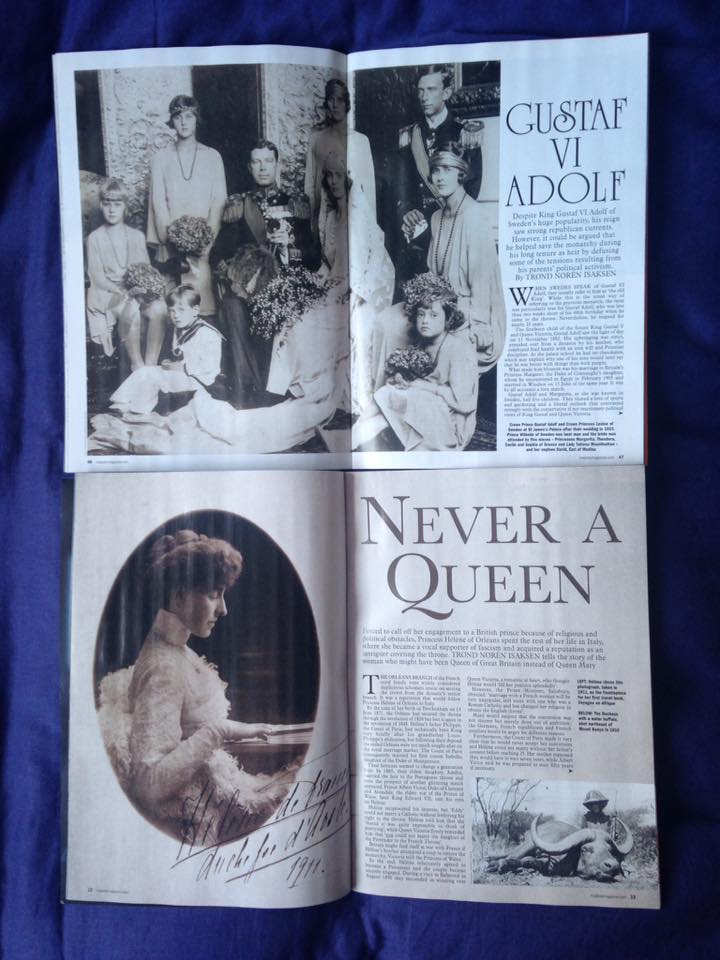
My latest articles: Gustaf VI Adolf & Hélène of Aosta
In the March issue of Majesty (Vol. 39, No. 3), which has been on sale in Britain for two weeks and is on sale in Norway from today, I write about the life of King Gustaf VI Adolf of Sweden, who is often credited with the survival of the Swedish monarchy. I also write about the French-born Princess Hélène, Duchess of Aosta, who was engaged to Prince Albert Victor, heir to the British throne (Queen Maud's brother), but married into the Italian royal family, became an enthusiastic fascist and was widely suspected of coveting the throne for her husband and sons.
In the same issue there is also a report on Prince William and Kate's official visit to Sweden and Norway, a report on the engagement of Princess Eugenie of Britain and Jack Brooksbank and a profile of Meghan Markle (who is also on the cover).
The magazine was already being printed when Prince Henrik of Denmark died, so my obituary of him will appear in the next issue, alongside an article on King Christian IX of Denmark, who was born 200 years ago in April 1818.
In the same issue there is also a report on Prince William and Kate's official visit to Sweden and Norway, a report on the engagement of Princess Eugenie of Britain and Jack Brooksbank and a profile of Meghan Markle (who is also on the cover).
The magazine was already being printed when Prince Henrik of Denmark died, so my obituary of him will appear in the next issue, alongside an article on King Christian IX of Denmark, who was born 200 years ago in April 1818.
Tuesday, 19 December 2017
My latest article: The last King of Romania
Because of Christmas, the January issue of Majesty (Vol. 39, No. 1) is out in Britain already today. In it, I write about the life of King Mihai I of Romania, who died two weeks ago at the age of 96. Mihai, who was the last surviving adult head of state from World War II, reigned from 1927 to 1930, when he was deposed by his father, but returned to the throne ten years later. In 1944, he played a key role in toppling the dictator Antonescu and shifting Romania from the Axis to the Allied side, but in 1947 he was forced to abdicate while being held at gunpoint by the Communists. After the fall of the Iron Curtain he enjoyed tremendous respect and popularity in his former kingdom and was given a state funeral with full military honours last Saturday.
Labels:
history,
Hohenzollern,
Romania,
royalty,
WWII
Tuesday, 5 December 2017
At the road's end: Ex-King Mihai I of Romania (1921-2017)
The last King of Romania, Mihai I, died in his home in Aubonne, Switzerland at noon Central European Time today, aged 96.
Born on 25 October 1921, ex-King Mihai was the longest living king in history and the last surviving adult head of state from the Second World War.
Mihai I became King as far back as in 1927, following the death of his grandfather, Ferdinand I. He was deposed by his father, Carol II, in 1930, but again became King after Carol's abdication in 1940. Romania at first sided with the Axis powers, but King Mihai played a key role in toppling the Fascist dictator Antonescu and switching to the Allied side in 1944. In December 1947, he was forced to abdicate while being held at gunpoint by the Communists.
My obituary of the former King will appear in the next issue of Majesty.
Born on 25 October 1921, ex-King Mihai was the longest living king in history and the last surviving adult head of state from the Second World War.
Mihai I became King as far back as in 1927, following the death of his grandfather, Ferdinand I. He was deposed by his father, Carol II, in 1930, but again became King after Carol's abdication in 1940. Romania at first sided with the Axis powers, but King Mihai played a key role in toppling the Fascist dictator Antonescu and switching to the Allied side in 1944. In December 1947, he was forced to abdicate while being held at gunpoint by the Communists.
My obituary of the former King will appear in the next issue of Majesty.
Labels:
history,
Hohenzollern,
obituaries,
Romania,
royalty,
WWII
Wednesday, 28 September 2016
My latest article: Crown Princess Märtha and Franklin D. Roosevelt
While a new film on the royal family during the Second World War has just opened in cinemas, the October issue of Majesty (Vol. 37, No. 10), which is now on sale, contains an article I have written about the wartime relationship between Crown Princess Märtha and US President Franklin D. Roosevelt. Their warm friendship has prompted much speculation about the nature of their relationship, but as I have shown in my biography of the Crown Princess and King Olav it was also a political partnership of mutual value.
Labels:
Bernadotte,
Glücksburg,
history,
Norway,
politics,
royalty,
USA,
WWII
Monday, 24 November 2014
My latest article: Crown Prince Rupprecht of Bavaria
The Bavarian royal house of Wittelsbach is in my opinion one of the most interesting dynasties in history, and in the December issue of Majesty (Vol. 35, No. 12), which went on sale in Britain on Thursday, I write about the life of Crown Prince Rupprecht, the eldest son of the last King of Bavaria, who in the words of the historian Golo Mann was more suited to be king than several of his forebears. The revolution of 1918 prevented that, but the life of Rupprecht - a First World War commander who during the Second World War had to go into hiding while his family languished in concentration camps and who might have been not only King of Bavaria, but German Emperor and King of Britain - is nevertheless an interesting one.
Tuesday, 13 August 2013
Book news: Some books due this autumn
With autumn approaching it seems this year’s book harvest will be a rather rich one. Among the most interesting titles expected in the coming months is Dynastiet Glücksburg - En danmarkshistorie (“The Glücksburg Dynasty: A History of Denmark”) by the historian Jes Fabricius Møller, a political history of the current Danish royal house which is due to be published by Gad at the end of September. The history of the Danish monarchy will also be covered in a new work on the tombs of Danish kings, Danske kongegrave, which is also due this autumn.
The King of Sweden is celebrating his fortieth anniversary on the throne in September, which is the occasion for the book Mina 40 år för Sverige (“My Forty Year for Sweden”), which consists of some 300 photos from the past four decades to which the King has added his comments.
Queen Silvia is probably not looking forward to the publication later this month of Erik Åsard’s book Drottningens hemlighet (“The Queen’s Secret”), which again addresses the issue of her father’s membership of the German Nazi party and his actions during the Second World War.
That war will also be at the centre of the sixth volume of Tor Bomann-Larsen’s biography of King Haakon VII of Norway, which will be published in mid-October and which will take the story from June to September 1940. The events of that crucial year will obviously also be addressed in Halvdan Koht - Veien mot framtiden (“Halvdan Koht: The Road to the Future”), the historian Åsmund Svendsen’s biography of the eminent historian Halvdan Koht, who served as foreign minister in Johan Nygaardsvold’s government and consequently had to accept some of the blame for Norway’s being poorly prepared for the German invasion on 9 April 1940.
The upcoming centenary of the outbreak of the First World War has already led to a number of books. One which seems particularly promising is The War that Ended Peace: How Europe Abandoned Peace for the First World War by the historian Margaret MacMillan, who is perhaps best known for her book on the Paris peace conference of 1919. That book will be out at the middle of October. The military historian Max Hastings will give his version of those events in Catastrophe: Europe Goes to War 1914, to be published in September.
The First World War was unleashed by the assassination in Sarajevo of the heir to the Austro-Hungarian thrones, Archduke Franz Ferdinand, and his wife, Duchess Sophie of Hohenberg. Their story is told by Greg King and Sue Woolmans in The Assassination of the Archduke: Sarajevo 1914 and the Murder that Changed the World, which is due to be published in September.
The lead-up to the Second World War sets the stage for Peter Conradi’s Hot Dogs and Cocktails: When FDR Met King George VI at Hyde Park on Hudson, which relates the story of King George VI and Queen Elizabeth of Britain’s visit to the United States and its president, Franklin D. Roosevelt, in 1939. Peter Conradi, a journalist at Sunday Times, is best known as the author of The King’s Speech, the book behind the Academy Award-winning film, but has also written The Great Survivors: How Monarchy Made it into the Twenty-First Century, an interesting book (so far published in English, French, Swedish and Dutch) on the European monarchies of today.
The long-awaited second volume of Philip G. Dwyer’s biography of Emperor Napoléon I of France, Citizen Emperor: Napoleon in Power, 1799-1815, will be published in early November.
This week will see the publication of a new biography of Mary Queen of Scots, Crown of Thistles: The Fatal Inheritance of Mary Queen of Scots, by Linda Porter, who has earlier written acclaimed biographies of Queen Mary I of England and Katherine Parr, the last of Henry VIII’s six queens.
Also out this week is Axel & Margaretha: A Royal Couple, written by the Danish journalist Randi Buchwaldt and published by Rosvall Royal Books. This richly illustrated book tells the story of Prince Axel and Princess Margaretha of Denmark, who played more significant parts in the lives of the Scandinavian royal families than their fairly remote genealogical positions would suggest.
The life of Queen Christina after her abdication in 1654 is the topic of Drottning utan land - Kristina i Rom by the historian Erik Petersson, which will be published in September. The book, which is the 28-year-old author’s fourth, is the sequel to his earlier book on Queen Christina’s reign, Maktspelerskan (2011).
November will see the publication of a biography of Princess Louise of Britain, Duchess of Argyll, the somewhat unconventional daughter of Queen Victoria of Britain. The Mystery of Princess Louise: Queen Victoria’s Rebellious Daughter is written by Lucinda Hawksley.
The King of Sweden is celebrating his fortieth anniversary on the throne in September, which is the occasion for the book Mina 40 år för Sverige (“My Forty Year for Sweden”), which consists of some 300 photos from the past four decades to which the King has added his comments.
Queen Silvia is probably not looking forward to the publication later this month of Erik Åsard’s book Drottningens hemlighet (“The Queen’s Secret”), which again addresses the issue of her father’s membership of the German Nazi party and his actions during the Second World War.
That war will also be at the centre of the sixth volume of Tor Bomann-Larsen’s biography of King Haakon VII of Norway, which will be published in mid-October and which will take the story from June to September 1940. The events of that crucial year will obviously also be addressed in Halvdan Koht - Veien mot framtiden (“Halvdan Koht: The Road to the Future”), the historian Åsmund Svendsen’s biography of the eminent historian Halvdan Koht, who served as foreign minister in Johan Nygaardsvold’s government and consequently had to accept some of the blame for Norway’s being poorly prepared for the German invasion on 9 April 1940.
The upcoming centenary of the outbreak of the First World War has already led to a number of books. One which seems particularly promising is The War that Ended Peace: How Europe Abandoned Peace for the First World War by the historian Margaret MacMillan, who is perhaps best known for her book on the Paris peace conference of 1919. That book will be out at the middle of October. The military historian Max Hastings will give his version of those events in Catastrophe: Europe Goes to War 1914, to be published in September.
The First World War was unleashed by the assassination in Sarajevo of the heir to the Austro-Hungarian thrones, Archduke Franz Ferdinand, and his wife, Duchess Sophie of Hohenberg. Their story is told by Greg King and Sue Woolmans in The Assassination of the Archduke: Sarajevo 1914 and the Murder that Changed the World, which is due to be published in September.
The lead-up to the Second World War sets the stage for Peter Conradi’s Hot Dogs and Cocktails: When FDR Met King George VI at Hyde Park on Hudson, which relates the story of King George VI and Queen Elizabeth of Britain’s visit to the United States and its president, Franklin D. Roosevelt, in 1939. Peter Conradi, a journalist at Sunday Times, is best known as the author of The King’s Speech, the book behind the Academy Award-winning film, but has also written The Great Survivors: How Monarchy Made it into the Twenty-First Century, an interesting book (so far published in English, French, Swedish and Dutch) on the European monarchies of today.
The long-awaited second volume of Philip G. Dwyer’s biography of Emperor Napoléon I of France, Citizen Emperor: Napoleon in Power, 1799-1815, will be published in early November.
This week will see the publication of a new biography of Mary Queen of Scots, Crown of Thistles: The Fatal Inheritance of Mary Queen of Scots, by Linda Porter, who has earlier written acclaimed biographies of Queen Mary I of England and Katherine Parr, the last of Henry VIII’s six queens.
Also out this week is Axel & Margaretha: A Royal Couple, written by the Danish journalist Randi Buchwaldt and published by Rosvall Royal Books. This richly illustrated book tells the story of Prince Axel and Princess Margaretha of Denmark, who played more significant parts in the lives of the Scandinavian royal families than their fairly remote genealogical positions would suggest.
The life of Queen Christina after her abdication in 1654 is the topic of Drottning utan land - Kristina i Rom by the historian Erik Petersson, which will be published in September. The book, which is the 28-year-old author’s fourth, is the sequel to his earlier book on Queen Christina’s reign, Maktspelerskan (2011).
November will see the publication of a biography of Princess Louise of Britain, Duchess of Argyll, the somewhat unconventional daughter of Queen Victoria of Britain. The Mystery of Princess Louise: Queen Victoria’s Rebellious Daughter is written by Lucinda Hawksley.
Monday, 28 January 2013
On this date: Erling S. Lorentzen’s 90th birthday
Erling S. Lorentzen, businessman, war veteran and brother-in-law of the King, celebrates his ninetieth birthday today.
The son of shipping magnate Øivind Lorentzen and his wife Ragna, Erling S. Lorentzen was born in Oslo on 28 January 1923. During World War II he joined the resistance movement, becoming one of the youngest members of the elite resistance group Company Linge.
When the royal family returned from exile in 1945, Lorentzen became part of the royal protection squad. He was also given the task of teaching the young princesses to sail, and captured the heart of Princess Ragnhild in 1946. Despite initial strong opposition from King Haakon and Crown Princess Märtha, Lorentzen and Princess Ragnhild were eventually allowed to marry. The wedding took place in Asker Church in Asker outside Oslo on 15 May 1953.
Meanwhile, Lorentzen had studied at Harvard Business School, graduating with a Master of Business Management degree in 1948. Following their wedding, Lorentzen and the Princess settled in Rio de Janeiro, Brazil, to take care of the Lorentzen family’s business interests. The initial plan was for them to stay there for two years, but it turned out to be forever.
In 1968 Erling S. Lorentzen founded the company Aracruz Cellulose, which turned out to be a great financial success; Lorentzen was able to sell his share for approximately $ 1.7 billion when Aracruz merged with another company in 2008.
At the age of ninety, Erling S. Lorentzen remains active and apparently healthy. Princess Ragnhild died on 16 September last year.
The son of shipping magnate Øivind Lorentzen and his wife Ragna, Erling S. Lorentzen was born in Oslo on 28 January 1923. During World War II he joined the resistance movement, becoming one of the youngest members of the elite resistance group Company Linge.
When the royal family returned from exile in 1945, Lorentzen became part of the royal protection squad. He was also given the task of teaching the young princesses to sail, and captured the heart of Princess Ragnhild in 1946. Despite initial strong opposition from King Haakon and Crown Princess Märtha, Lorentzen and Princess Ragnhild were eventually allowed to marry. The wedding took place in Asker Church in Asker outside Oslo on 15 May 1953.
Meanwhile, Lorentzen had studied at Harvard Business School, graduating with a Master of Business Management degree in 1948. Following their wedding, Lorentzen and the Princess settled in Rio de Janeiro, Brazil, to take care of the Lorentzen family’s business interests. The initial plan was for them to stay there for two years, but it turned out to be forever.
In 1968 Erling S. Lorentzen founded the company Aracruz Cellulose, which turned out to be a great financial success; Lorentzen was able to sell his share for approximately $ 1.7 billion when Aracruz merged with another company in 2008.
At the age of ninety, Erling S. Lorentzen remains active and apparently healthy. Princess Ragnhild died on 16 September last year.
Labels:
anniversaries,
birthdays,
Brazil,
Glücksburg,
Norway,
royalty,
WWII
Thursday, 25 October 2012
What to see: Elverum Church, Elverum
When I visited the small town Elverum last month to attend the opening of the travelling exhibition which is part of the royal jubilee exhibitions I also took the opportunity to visit Elverum Church, which turned out to have a rather remarkable interior (first photo), something one would not guess by its very simple exterior (second photo).
The cross-shaped church was built in 1735-1738 after a design of a lieutenant in the artillery named Nicolai Gustav Sandberg. It was, remarkably for the time, paid for entirely by the citizens of the small community, and most of the work, which is of a very high standard, was also carried out by local artisans: The woodcarvers and carpenters Nils Hansen Engen and Ole Hansen Rønne and the painter Ole Gundersen.
The church is an exquisite example of Norwegian regénce style, a style which takes its name from the regency in France of Philippe, Duke of Orléans during the minority of Louis XV from 1715 to 1723 and in which elements of what would come to be known as rococo began to influence the baroque style.
The interior is a symbolic synthesis of king and god, to institutions which were closely related during the Dano-Norwegian absolute monarchy. The absolute monarchy, which was introduced in 1660, was indeed one of the most absolute monarchies the world has known, and only god was above the King.
King Christian VI’s monogram is to be found on the altar (third photo), which was inspired by Nicodemus Tessin the Younger’s altar in the Church of Our Saviour in Copenhagen (which was again inspired by the altar in the Church of Domenic e Sisto in Rome). The altarpiece, showing the crucifixion, was done in Copenhagen by an unknown artist. The two sculptures standing in front represent justice and piety.
On each side of the altar are clocks (a memento mori) and on each of them stands a little angel (fourth photo) holding respectively the bible and the law book. Altogether there are seven putti – two on the altar, two on the clocks and three in the ceiling, all holding banners with biblical quotations calling on the faithful to praise god, honour the King and love fraternity.
Another, larger angel supports the baptismal font (fifth photo), carved by Nils Hansen Engen (on a personal note I may add that I was myself baptised in this font, as my parents worked at Elverum at the time of my birth). Originally this stood in an enclosure to the right in the choir, under a crown-shaped canopy surmounted by an orb (sixth photo). Another crown-shaped canopy (seventh photo), topped by the monogram of King Christian VI, is found above the richly carved pulpit (eighth photo).
At each side of the entrance to the choir is an obelisk resting on four golden balls (ninth photo). On the top of the obelisk to the left is again the monogram of King Christian VI, on the one to the right the monogram of his consort, Queen Sophie Magdalene. King Christian VI and Queen Sophie Magdalene had both visited Elverum during their great journey through southern Norway in 1733, making the latter the first queen to visit the town. Between the obelisks, hanging from the ceiling, can be seen a crucifix from the thirteenth or fourteenth century, which dates from the first church built in Elverum. Its most recent feature, on the other hand, is the new organ which was installed in 2006-2007.
Most of the original interior was removed when Elverum Church was transformed into a simple and rather unoriginal late neo-Gothic church in 1878-1879. However, it was not long before one wished to restore it to its former splendour, and luckily the original interior could be reassembled from attics and barns. The restoration was completed in time for the church’s bicentenary in 1938.
Two years later the church came close to being obliterated. It was at Elverum on 9 April 1940, the day Norway was invaded by Germany, that Parliament transferred its powers to the government for the duration of the war, and it was at Elverum that King Haakon the following day met the German minister, Curt von Bräuer, and famously refused the German demands that he should appoint Vidkun Quisling, the leader of National Unity (the Nazi party), Prime Minister. The King’s refusal caused the whole town, which had no military or strategic value, to be flattened by German bombers in an attempt to kill the King and government. The church narrowly escaped being hit in the bombing raid and is thus one of the few pre-1940 buildings left in Elverum today. Today it is one of the most interesting sights to be seen if one ventures into this part of Norway.
The cross-shaped church was built in 1735-1738 after a design of a lieutenant in the artillery named Nicolai Gustav Sandberg. It was, remarkably for the time, paid for entirely by the citizens of the small community, and most of the work, which is of a very high standard, was also carried out by local artisans: The woodcarvers and carpenters Nils Hansen Engen and Ole Hansen Rønne and the painter Ole Gundersen.
The church is an exquisite example of Norwegian regénce style, a style which takes its name from the regency in France of Philippe, Duke of Orléans during the minority of Louis XV from 1715 to 1723 and in which elements of what would come to be known as rococo began to influence the baroque style.
The interior is a symbolic synthesis of king and god, to institutions which were closely related during the Dano-Norwegian absolute monarchy. The absolute monarchy, which was introduced in 1660, was indeed one of the most absolute monarchies the world has known, and only god was above the King.
King Christian VI’s monogram is to be found on the altar (third photo), which was inspired by Nicodemus Tessin the Younger’s altar in the Church of Our Saviour in Copenhagen (which was again inspired by the altar in the Church of Domenic e Sisto in Rome). The altarpiece, showing the crucifixion, was done in Copenhagen by an unknown artist. The two sculptures standing in front represent justice and piety.
On each side of the altar are clocks (a memento mori) and on each of them stands a little angel (fourth photo) holding respectively the bible and the law book. Altogether there are seven putti – two on the altar, two on the clocks and three in the ceiling, all holding banners with biblical quotations calling on the faithful to praise god, honour the King and love fraternity.
Another, larger angel supports the baptismal font (fifth photo), carved by Nils Hansen Engen (on a personal note I may add that I was myself baptised in this font, as my parents worked at Elverum at the time of my birth). Originally this stood in an enclosure to the right in the choir, under a crown-shaped canopy surmounted by an orb (sixth photo). Another crown-shaped canopy (seventh photo), topped by the monogram of King Christian VI, is found above the richly carved pulpit (eighth photo).
At each side of the entrance to the choir is an obelisk resting on four golden balls (ninth photo). On the top of the obelisk to the left is again the monogram of King Christian VI, on the one to the right the monogram of his consort, Queen Sophie Magdalene. King Christian VI and Queen Sophie Magdalene had both visited Elverum during their great journey through southern Norway in 1733, making the latter the first queen to visit the town. Between the obelisks, hanging from the ceiling, can be seen a crucifix from the thirteenth or fourteenth century, which dates from the first church built in Elverum. Its most recent feature, on the other hand, is the new organ which was installed in 2006-2007.
Most of the original interior was removed when Elverum Church was transformed into a simple and rather unoriginal late neo-Gothic church in 1878-1879. However, it was not long before one wished to restore it to its former splendour, and luckily the original interior could be reassembled from attics and barns. The restoration was completed in time for the church’s bicentenary in 1938.
Two years later the church came close to being obliterated. It was at Elverum on 9 April 1940, the day Norway was invaded by Germany, that Parliament transferred its powers to the government for the duration of the war, and it was at Elverum that King Haakon the following day met the German minister, Curt von Bräuer, and famously refused the German demands that he should appoint Vidkun Quisling, the leader of National Unity (the Nazi party), Prime Minister. The King’s refusal caused the whole town, which had no military or strategic value, to be flattened by German bombers in an attempt to kill the King and government. The church narrowly escaped being hit in the bombing raid and is thus one of the few pre-1940 buildings left in Elverum today. Today it is one of the most interesting sights to be seen if one ventures into this part of Norway.
Monday, 8 October 2012
New books: Royal anti-Nazis
The Palace and the Bunker: Royal Resistance to Hitler is the title of a very odd new book, written by Frank Millard and recently published by The History Press (apparently the successor to Sutton Publishing, which many of my readers are probably familiar with). Reading it one sometimes wonder if it is the author’s notes which have been published without having passed through the hands of an editor. The subject is very interesting, but the book is one of the weakest I have ever read.
According to the author’s foreword, it “is actually two books in one, each dependent on the other”. The first half deals with the rise of Nazism in Germany; the second is mostly four case studies of royal anti-Nazis. It seems quite obvious that the result would have been much more interesting and readable if the two parts had been worked into an entity where the two things were seen in relation to each other.
The author admits that he “came to the subject of the lead up to the Second World War with little prior knowledge”. While this may seems very surprising for a historian, it makes one realise why the first half of the book is taken up with what seems to be the author’s attempt to explain to himself what Nazism, eugenics, Social Darwinism et al was and how Nazi Germany and World War II came about.
The second part looks at the wartime stories of Prince Louis Ferdinand of Prussia, ex-Crown Prince Rupprecht of Bavaria, Prince Hubertus of Löwenstein-Wertheim-Freudenberg and ex-Crown Prince Otto of Austria-Hungary and his Hohenberg cousins, before adding a chapter summarising what other royals did during the war.
As much as a book about royal resistance to Nazism this is a book about various ideas about monarchical restoration in Germany and Austria-Hungary, and indeed it seems to be the author’s idea that Nazism and World War II would not have happened if the monarchies had been restored in these countries.
The author seems to believe that those belonging to royal families are somehow bound to be good men (there is also an uncomfortable religious overtone which even leads Millard to pronounce god’s blessing over one of his subjects). “Princes are the products of, and are and [sic] susceptible to, the influences of their age like anyone else, but in some ways their position and upbringing equips them [with the ability] to see over the fence and consider what they are witnessing with a little more clarity, perspective and dispassion than most other people”. If this is true, one wonders how so many monarchies have nevertheless destroyed themselves? “Such men are born leaders”, Millard assures us, “brought up to serve their countries and, if denied their destiny, it naturally becomes their perceived duty to serve all humanity”. This is a gross generalisation and it would be easy to point out counter-examples.
Millard stares himself blind on monarchies, even claiming that “[t]he German resistance movement did not and could not exist in any cohesive form without the unifying element of monarchy represented by the modern, Left-leaning Prince Louis Ferdinand, who was preferred future head of state following the fall of Hitler and his regime”. He assures the readers that “[m]onarchy was a potential defence against Hitler before the war [and(?)] became a focus of national unity and identity for exiles and anti-Nazis in Europe during the conflict”. These are widely exaggerated ideas; to the best of my knowledge the restoration of the Hohenzollerns was never a central aim for the German anti-Nazi movement, nor was this movement dependent on the deposed dynasties for to be able to exist.
“Their quiet defiance must have played its part in undermining the pretended authority of the dictator”, the author likes to think. He goes on to list several reasons why Hitler would never have come to power if Germany had been a monarchy, including that Prince Louis Ferdinand would not have been personally inclined to appoint him chancellor and that Hitler could not have opposed or reversed the will of the people. But Millard fails to take into account that Nazism had massive popular support in Germany and that Hitler was democratically elected.
Concerning Austria, we learn that “[r]estoration of the monarchy, there also, promised national integrity and moderate government safe from the Nazi menace”. However, the author fails to make any convincing argument for why an Austrian monarchy would have prevented the Anschluss that the Austrian republic did not manage to prevent. “There could have been no takeover of Austria without a fight and a real risk of international condemnation and foreign involvement”, we learn, without the author explaining why the Austrians themselves, who generally welcomed the German takeover, and the world, who did nothing in response to it, would have reacted differently if Austria had been a monarchy rather than a republic. Indeed this seems to be little but fanciful fantasies and wishful thinking by the author.
“Democracy is not automatically representative and what is representative is not always democratic”, the author explains, “but sensibly there was general agreement among the princes featured in this book – and there is agreement among their heirs [!] – that democracy should be the principal element of government[,] guided, assisted and defended by other constitutional elements, such as the hereditary principle and the rule of law as enshrined constitutionally”.
But how does he imagine that individuals such an Emperor Otto or Emperor Louis Ferdinand would have managed to stop a mass movement like Nazism? And how is this fundamental democratic spirit reconcilable with the idea that Louis Ferdinand would have refused to appoint the winner of democratic elections chancellor? And what about Italy, one may ask? The existence of a monarchy did not exactly prevent the rise of Mussolini.
To make things worse, the book is not well written. Sometimes the author jumps back and forth in time in a way that makes it almost impossible to follow events, for instance making it seem as though King Carol II of Romania was deposed twice and leaving one wondering where Prince Napoléon had been before “his return to Switzerland”.
There are many and long quotes in this book, indeed it seems sometimes to consist of little but quotes, which gives the impression that the author does not feel confident enough to stand on his own feet. Not all of the quotes are very relevant or well-chosen. For instance, most of what he has to say about the British royal family during World War II deals with the relationship between King George VI and US President Franklin D. Roosevelt until 1941. Having said that King George wanted to be present during D Day, the author suddenly quotes a long and seemingly random passage from an article in a 2011 issue of Time magazine about the royal visit to the USA in 1939, all of it information which could have found many other places. The passage about Britain’s royal family suddenly ends with an unexpected list of some random royals from various countries and various ages who were awarded the Garter, which the author imagines “was a sign of diplomatic if not military alliance from its inception when applied to foreign heads of state”.
“There will, no doubt, be errors (all mine), but hopefully none of substance”, the author writes in the foreword, before going on to tell us that Queen Wilhelmina of the Netherlands was married to her son-in-law Prince Bernhard, that King Haakon VII of Norway was the brother of his adversary King Gustaf V of Sweden, that Sovereign Prince Louis II of Monaco was the father of his grandson “Rainer” (indeed names tend to be misspelt throughout) and so on. When Marshal Antonescu shows disrespect towards “his sovereign”, King Mihai of Romania, he has suddenly become the “dictator of Hungary”.
One also wonders about the author’s choice of sources. There are two German books, one Czech book and a German book about the Hohenbergs listed in the bibliography; everything else is in English. The author says in the foreword that he has “used a lot of English and American sources because this book is aimed primarily at an English-speaking audience”. But surely that is no reason to leave out the relevant literature from other countries and I can hardly imagine that English-speaking readers would find any reason to object to the use of relevant sources even if originally written in a foreign language. Was there for instance nothing of interest or relevance about ex-Crown Prince Rupprecht to find in Dieter J. Weiß’s monumental political biography from 2007, so that the author had to try to piece together his story from what little has been written about him in English?
The overall impression is of a book written by an author whose insufficient knowledge of Nazi Germany and World War II coupled with his blind faith in monarchy make him fail to see the things he write about in their proper context and grossly exaggerate the importance of his subjects. As it is this book might as well not have been published.
According to the author’s foreword, it “is actually two books in one, each dependent on the other”. The first half deals with the rise of Nazism in Germany; the second is mostly four case studies of royal anti-Nazis. It seems quite obvious that the result would have been much more interesting and readable if the two parts had been worked into an entity where the two things were seen in relation to each other.
The author admits that he “came to the subject of the lead up to the Second World War with little prior knowledge”. While this may seems very surprising for a historian, it makes one realise why the first half of the book is taken up with what seems to be the author’s attempt to explain to himself what Nazism, eugenics, Social Darwinism et al was and how Nazi Germany and World War II came about.
The second part looks at the wartime stories of Prince Louis Ferdinand of Prussia, ex-Crown Prince Rupprecht of Bavaria, Prince Hubertus of Löwenstein-Wertheim-Freudenberg and ex-Crown Prince Otto of Austria-Hungary and his Hohenberg cousins, before adding a chapter summarising what other royals did during the war.
As much as a book about royal resistance to Nazism this is a book about various ideas about monarchical restoration in Germany and Austria-Hungary, and indeed it seems to be the author’s idea that Nazism and World War II would not have happened if the monarchies had been restored in these countries.
The author seems to believe that those belonging to royal families are somehow bound to be good men (there is also an uncomfortable religious overtone which even leads Millard to pronounce god’s blessing over one of his subjects). “Princes are the products of, and are and [sic] susceptible to, the influences of their age like anyone else, but in some ways their position and upbringing equips them [with the ability] to see over the fence and consider what they are witnessing with a little more clarity, perspective and dispassion than most other people”. If this is true, one wonders how so many monarchies have nevertheless destroyed themselves? “Such men are born leaders”, Millard assures us, “brought up to serve their countries and, if denied their destiny, it naturally becomes their perceived duty to serve all humanity”. This is a gross generalisation and it would be easy to point out counter-examples.
Millard stares himself blind on monarchies, even claiming that “[t]he German resistance movement did not and could not exist in any cohesive form without the unifying element of monarchy represented by the modern, Left-leaning Prince Louis Ferdinand, who was preferred future head of state following the fall of Hitler and his regime”. He assures the readers that “[m]onarchy was a potential defence against Hitler before the war [and(?)] became a focus of national unity and identity for exiles and anti-Nazis in Europe during the conflict”. These are widely exaggerated ideas; to the best of my knowledge the restoration of the Hohenzollerns was never a central aim for the German anti-Nazi movement, nor was this movement dependent on the deposed dynasties for to be able to exist.
“Their quiet defiance must have played its part in undermining the pretended authority of the dictator”, the author likes to think. He goes on to list several reasons why Hitler would never have come to power if Germany had been a monarchy, including that Prince Louis Ferdinand would not have been personally inclined to appoint him chancellor and that Hitler could not have opposed or reversed the will of the people. But Millard fails to take into account that Nazism had massive popular support in Germany and that Hitler was democratically elected.
Concerning Austria, we learn that “[r]estoration of the monarchy, there also, promised national integrity and moderate government safe from the Nazi menace”. However, the author fails to make any convincing argument for why an Austrian monarchy would have prevented the Anschluss that the Austrian republic did not manage to prevent. “There could have been no takeover of Austria without a fight and a real risk of international condemnation and foreign involvement”, we learn, without the author explaining why the Austrians themselves, who generally welcomed the German takeover, and the world, who did nothing in response to it, would have reacted differently if Austria had been a monarchy rather than a republic. Indeed this seems to be little but fanciful fantasies and wishful thinking by the author.
“Democracy is not automatically representative and what is representative is not always democratic”, the author explains, “but sensibly there was general agreement among the princes featured in this book – and there is agreement among their heirs [!] – that democracy should be the principal element of government[,] guided, assisted and defended by other constitutional elements, such as the hereditary principle and the rule of law as enshrined constitutionally”.
But how does he imagine that individuals such an Emperor Otto or Emperor Louis Ferdinand would have managed to stop a mass movement like Nazism? And how is this fundamental democratic spirit reconcilable with the idea that Louis Ferdinand would have refused to appoint the winner of democratic elections chancellor? And what about Italy, one may ask? The existence of a monarchy did not exactly prevent the rise of Mussolini.
To make things worse, the book is not well written. Sometimes the author jumps back and forth in time in a way that makes it almost impossible to follow events, for instance making it seem as though King Carol II of Romania was deposed twice and leaving one wondering where Prince Napoléon had been before “his return to Switzerland”.
There are many and long quotes in this book, indeed it seems sometimes to consist of little but quotes, which gives the impression that the author does not feel confident enough to stand on his own feet. Not all of the quotes are very relevant or well-chosen. For instance, most of what he has to say about the British royal family during World War II deals with the relationship between King George VI and US President Franklin D. Roosevelt until 1941. Having said that King George wanted to be present during D Day, the author suddenly quotes a long and seemingly random passage from an article in a 2011 issue of Time magazine about the royal visit to the USA in 1939, all of it information which could have found many other places. The passage about Britain’s royal family suddenly ends with an unexpected list of some random royals from various countries and various ages who were awarded the Garter, which the author imagines “was a sign of diplomatic if not military alliance from its inception when applied to foreign heads of state”.
“There will, no doubt, be errors (all mine), but hopefully none of substance”, the author writes in the foreword, before going on to tell us that Queen Wilhelmina of the Netherlands was married to her son-in-law Prince Bernhard, that King Haakon VII of Norway was the brother of his adversary King Gustaf V of Sweden, that Sovereign Prince Louis II of Monaco was the father of his grandson “Rainer” (indeed names tend to be misspelt throughout) and so on. When Marshal Antonescu shows disrespect towards “his sovereign”, King Mihai of Romania, he has suddenly become the “dictator of Hungary”.
One also wonders about the author’s choice of sources. There are two German books, one Czech book and a German book about the Hohenbergs listed in the bibliography; everything else is in English. The author says in the foreword that he has “used a lot of English and American sources because this book is aimed primarily at an English-speaking audience”. But surely that is no reason to leave out the relevant literature from other countries and I can hardly imagine that English-speaking readers would find any reason to object to the use of relevant sources even if originally written in a foreign language. Was there for instance nothing of interest or relevance about ex-Crown Prince Rupprecht to find in Dieter J. Weiß’s monumental political biography from 2007, so that the author had to try to piece together his story from what little has been written about him in English?
The overall impression is of a book written by an author whose insufficient knowledge of Nazi Germany and World War II coupled with his blind faith in monarchy make him fail to see the things he write about in their proper context and grossly exaggerate the importance of his subjects. As it is this book might as well not have been published.
Friday, 21 September 2012
King attends opening of another royal jubilee exhibition - and appoints new ministers
Today I have been to Elverum to attend the opening of the exhibition “The Longest Journey, 1940-1945” at the Glomdal Museum. The exhibition is one of the six exhibitions based on the Royal Collection which are the government’s 75th birthday present to the King and Queen. The King attended, wearing mourning for his sister, Princess Ragnhild, who died on Sunday.
“The Longest Journey, 1940-1945” is a travelling exhibition which deals with the royal family’s flight, exile and homecoming. Elverum seemed a natural starting point as this small town, some two hours north of Oslo, was the second stop on the royal family’s and government’s flight and it was there that King Haakon on 10 April 1940 refused the German demand that he should appoint a government led by the leader of the Norwegian Nazi party, Vidkun Quisling. (Most of the town was consequently flattened by German bombers).
The exhibition will later be shown at Ørlandet, Ålesund, Bodø, Tromsø, Alta, Hammerfest, Harstad, Lista and Stord before ending up at the Defence Museum in Oslo in 2014.
The exhibition was supposed to be opened by Culture Minister Anniken Huitfeldt, but a cabinet reshuffle meant that she was no longer Culture Minister by the time the exhibition opened. Instead the task of declaring it open fell to Rigmor Aasrud, Minister of Government Administration, Reform and Church Affairs.
The reshuffle was formalised in a State Council at the Royal Palace at 11 a.m. The King appointed Hadia Tajik, a 29-year-old MP from Rogaland, who is considered as a rising star of the Labour Party, Minister of Culture. Jonas Gahr Støre, who had been Foreign Minister for seven years, was moved to the Ministry of Health and Care Services and was succeeded by Espen Barth Eide, until now Minister of Defence. Støre replacesAnne-Grete Strøm-Erichsen, who returns to the Ministry of Defence, where she also preceded Mr Eide. The outgoing Minister of Culture, Anniken Huitfeldt, took on the portfolio of Labour, until now held by Hanne Bjurstrøm, who left the government today.
“The Longest Journey, 1940-1945” is a travelling exhibition which deals with the royal family’s flight, exile and homecoming. Elverum seemed a natural starting point as this small town, some two hours north of Oslo, was the second stop on the royal family’s and government’s flight and it was there that King Haakon on 10 April 1940 refused the German demand that he should appoint a government led by the leader of the Norwegian Nazi party, Vidkun Quisling. (Most of the town was consequently flattened by German bombers).
The exhibition will later be shown at Ørlandet, Ålesund, Bodø, Tromsø, Alta, Hammerfest, Harstad, Lista and Stord before ending up at the Defence Museum in Oslo in 2014.
The exhibition was supposed to be opened by Culture Minister Anniken Huitfeldt, but a cabinet reshuffle meant that she was no longer Culture Minister by the time the exhibition opened. Instead the task of declaring it open fell to Rigmor Aasrud, Minister of Government Administration, Reform and Church Affairs.
The reshuffle was formalised in a State Council at the Royal Palace at 11 a.m. The King appointed Hadia Tajik, a 29-year-old MP from Rogaland, who is considered as a rising star of the Labour Party, Minister of Culture. Jonas Gahr Støre, who had been Foreign Minister for seven years, was moved to the Ministry of Health and Care Services and was succeeded by Espen Barth Eide, until now Minister of Defence. Støre replacesAnne-Grete Strøm-Erichsen, who returns to the Ministry of Defence, where she also preceded Mr Eide. The outgoing Minister of Culture, Anniken Huitfeldt, took on the portfolio of Labour, until now held by Hanne Bjurstrøm, who left the government today.
Labels:
Elverum,
exhibitions,
Glücksburg,
Norway,
politics,
royalty,
WWII
Friday, 25 May 2012
State funeral held for war hero Gunnar Sønsteby
At noon today the state funeral of Gunnar Sønsteby, widely considered the ultimate war hero, was held in the Cathedral of a sweltering Oslo. Sønsteby died on 10 May, aged 94.
The Cathedral was not quite full, but in addition to family, friends and fellow war veterans there were many VIPs to be seen. The King was on the first row, together with Princess Märtha Louise and Ari Behn, Princess Astrid and Johan Martin Ferner (both with newly acquired walking sticks), and Princess Ragnhild’s husband Erling Lorentzen, accompanied by his eldest daughter, Ingeborg Lorentzen Ribeiro. Lorentzen was one of Sønsteby’s closest friends, a fellow veteran of the elite resistance group Company Linge, chose him as his best man in 1953 and later set up a company with him. Lorentzen, who is 89, had travelled all the way from Brazil to bid farewell to his friend. Almost the entire Cabinet was also in attendance, as well as most living former defence ministers.
The Dean, Olav Dag Hauge, officiated, and there were eulogies by the Speaker of Parliament, Dag Terje Andersen, the Prime Minister, Jens Stoltenberg, the Chief of Defence, General Harald Sunde, and two of Sønsteby’s grandchildren. Six guardsmen from His Majesty the King’s Guard formed a guard of honour at the sides of the coffin, which was draped in the Norwegian flag, while another 24 guardsmen (Sønsteby’s most famous code name was “No 24”) formed a guard of honour outside the Cathedral.
At the end of the service the coffin was carried out of the Cathedral by six officers and as it was placed in the hearse, four fighter planes flew past above in the so-called “Missing Man” formation, which pays tribute to the dead. Despite her eighty years and somewhat weak legs, Princess Astrid curtseyed to the ground as the hearse departed, accompanied by a mounted police escort.
The funeral was followed by a reception in the City Hall.
The Cathedral was not quite full, but in addition to family, friends and fellow war veterans there were many VIPs to be seen. The King was on the first row, together with Princess Märtha Louise and Ari Behn, Princess Astrid and Johan Martin Ferner (both with newly acquired walking sticks), and Princess Ragnhild’s husband Erling Lorentzen, accompanied by his eldest daughter, Ingeborg Lorentzen Ribeiro. Lorentzen was one of Sønsteby’s closest friends, a fellow veteran of the elite resistance group Company Linge, chose him as his best man in 1953 and later set up a company with him. Lorentzen, who is 89, had travelled all the way from Brazil to bid farewell to his friend. Almost the entire Cabinet was also in attendance, as well as most living former defence ministers.
The Dean, Olav Dag Hauge, officiated, and there were eulogies by the Speaker of Parliament, Dag Terje Andersen, the Prime Minister, Jens Stoltenberg, the Chief of Defence, General Harald Sunde, and two of Sønsteby’s grandchildren. Six guardsmen from His Majesty the King’s Guard formed a guard of honour at the sides of the coffin, which was draped in the Norwegian flag, while another 24 guardsmen (Sønsteby’s most famous code name was “No 24”) formed a guard of honour outside the Cathedral.
At the end of the service the coffin was carried out of the Cathedral by six officers and as it was placed in the hearse, four fighter planes flew past above in the so-called “Missing Man” formation, which pays tribute to the dead. Despite her eighty years and somewhat weak legs, Princess Astrid curtseyed to the ground as the hearse departed, accompanied by a mounted police escort.
The funeral was followed by a reception in the City Hall.
Thursday, 10 May 2012
At the road’s end: Gunnar Sønsteby (1918-2012), Norway’s greatest war hero
One could almost hear the sound of the biggest tree in the forest crashing to the ground when the news came through this afternoon of the death at the age of 94 of Gunnar Sønsteby, a national icon and the ultimate war hero. One of the bravest of the resistance fighters of World War II, Sønsteby dedicated his old age to bearing witness to younger generations and was widely considered this country’s greatest hero.
He was born on 11 January 1918 and was working as an accountant when war came to Norway. He is generally believed to be the young man with the bike standing in the foreground of the famous photo of the citizens of Oslo passively watching the German troops march down Karl Johan Street on 9 April 1940.
But Sønsteby did not remain inactive long. He took part in the fighting outside Oslo that spring and soon joined the illegal press as well as acting as courier for between Norway and Sweden. He was recruited by the British Special Operations Executive (SOE) and became something of a spider in the network of resistance groups. From the spring of 1944 he led the so-called Oslo Gang, which carried out crucial acts of sabotage against the occupants and where described by the British historian William Mackenzie as “the best group of saboteurs in Europe”.
Gunnar Sønsteby often said that he believed his ability to get away had something to do with how ordinary he looked. It was only towards the end of the war that the Gestapo finally succeeding in revealing his true identity. “No 24”, “Erling Fjeld” and “Kjakan” were among the cover names he went by; the latter eventually becoming the name under which he was known to all Norwegians.
During the war King Haakon instituted the War Cross, which ranks as Norway’s highest decoration (above even the Grand Cross and Collar of the Order of St Olav) and which is awarded for exceptional gallantry during war. Gunnar Sønsteby was alone in being awarded the War Cross three times, making him the most decorated citizen of this country. He also held a multitude of other Norwegian and foreign honours.
In the summer of 1945 Gunnar Sønsteby led the group of resistance fighters who took care of the royal family’s security upon their return to Norway. When one of his men, Erling S. Lorentzen, eventually married Princess Ragnhild in 1953, Sønsteby acted as best man at the wedding.
Following the war Gunnar Sønsteby worked as a businessman. After he reached the age of retirement he began a new career as a travelling time witness. Unlike so many of his friends and fellow resistance fighters, he had lived to tell the tale and was determined to do so. Until he was well past ninety he toured this country from one end to another and back, talking about his wartime experiences, but also the values of democracy. He was known for his ability to hold groups of unruly teenagers completely spellbound. For this voluntary work he was created a Commander of the Order of St Olav by the King in 2006.
Gunnar Sønsteby also wrote several books and contributed to many other works. He was, however, occasionally criticised by revisionist historians for holding too firmly on to the “official” war history, i.e. the one most agreeable to the war veterans. Sønsteby himself maintained that there were many secrets he would take with him to his grave.
Sønsteby could regularly be seen in the streets of Oslo (he was a slow driver and a fast walker) until last autumn, when his health began to give way. At the end of April it was announced that Sønsteby would be the first recipient of the new decoration the Military Cross of Honour. But on Liberation Day two days ago, Sønsteby was absent from the ceremonies at Akershus Fortress; nor did he attend the unveiling of a statue of himself in his hometown Rjukan the same day.
His death had hardly been announced before the first flowers were laid at the feet of the statue of him erected a few years ago in Oslo’s Solli Square, while tributes were led by the King and the Prime Minister. The government has decided to give him a state funeral.
On a personal note I remember meeting him in the Bird Room of the Royal Palace while we were both waiting for an audience with the King. “Sønsteby”, he said, extending his hand – obviously an entirely unnecessary introduction of himself. His physical presence was small, but his legend filled the room.
He was born on 11 January 1918 and was working as an accountant when war came to Norway. He is generally believed to be the young man with the bike standing in the foreground of the famous photo of the citizens of Oslo passively watching the German troops march down Karl Johan Street on 9 April 1940.
But Sønsteby did not remain inactive long. He took part in the fighting outside Oslo that spring and soon joined the illegal press as well as acting as courier for between Norway and Sweden. He was recruited by the British Special Operations Executive (SOE) and became something of a spider in the network of resistance groups. From the spring of 1944 he led the so-called Oslo Gang, which carried out crucial acts of sabotage against the occupants and where described by the British historian William Mackenzie as “the best group of saboteurs in Europe”.
Gunnar Sønsteby often said that he believed his ability to get away had something to do with how ordinary he looked. It was only towards the end of the war that the Gestapo finally succeeding in revealing his true identity. “No 24”, “Erling Fjeld” and “Kjakan” were among the cover names he went by; the latter eventually becoming the name under which he was known to all Norwegians.
During the war King Haakon instituted the War Cross, which ranks as Norway’s highest decoration (above even the Grand Cross and Collar of the Order of St Olav) and which is awarded for exceptional gallantry during war. Gunnar Sønsteby was alone in being awarded the War Cross three times, making him the most decorated citizen of this country. He also held a multitude of other Norwegian and foreign honours.
In the summer of 1945 Gunnar Sønsteby led the group of resistance fighters who took care of the royal family’s security upon their return to Norway. When one of his men, Erling S. Lorentzen, eventually married Princess Ragnhild in 1953, Sønsteby acted as best man at the wedding.
Following the war Gunnar Sønsteby worked as a businessman. After he reached the age of retirement he began a new career as a travelling time witness. Unlike so many of his friends and fellow resistance fighters, he had lived to tell the tale and was determined to do so. Until he was well past ninety he toured this country from one end to another and back, talking about his wartime experiences, but also the values of democracy. He was known for his ability to hold groups of unruly teenagers completely spellbound. For this voluntary work he was created a Commander of the Order of St Olav by the King in 2006.
Gunnar Sønsteby also wrote several books and contributed to many other works. He was, however, occasionally criticised by revisionist historians for holding too firmly on to the “official” war history, i.e. the one most agreeable to the war veterans. Sønsteby himself maintained that there were many secrets he would take with him to his grave.
Sønsteby could regularly be seen in the streets of Oslo (he was a slow driver and a fast walker) until last autumn, when his health began to give way. At the end of April it was announced that Sønsteby would be the first recipient of the new decoration the Military Cross of Honour. But on Liberation Day two days ago, Sønsteby was absent from the ceremonies at Akershus Fortress; nor did he attend the unveiling of a statue of himself in his hometown Rjukan the same day.
His death had hardly been announced before the first flowers were laid at the feet of the statue of him erected a few years ago in Oslo’s Solli Square, while tributes were led by the King and the Prime Minister. The government has decided to give him a state funeral.
On a personal note I remember meeting him in the Bird Room of the Royal Palace while we were both waiting for an audience with the King. “Sønsteby”, he said, extending his hand – obviously an entirely unnecessary introduction of himself. His physical presence was small, but his legend filled the room.
Tuesday, 1 November 2011
My latest article: Royal appeasers
On Friday I attended the release of the fifth volume of Tor Bomann-Larsen’s biography of King Haakon and Queen Maud, Æresordet (published by Cappelen Damm). The media has made a big deal out of the fact that the author quotes a letter the then Crown Prince Olav wrote to his cousin the Prince of Wales in December 1935, advocating rapproachment between Britain and Germany. While this has been presented as a huge revelation it is in fact not a revelation at all, given that Philip Ziegler writes about it in his official biography of Edward VIII, which was published in 1990, and that I quoted from the letter in my biography of King Olav and Crown Princess Märtha (Dronningen vi ikke fikk - En biografi om kronprinsesse Märtha og kong Olav) eight years ago.
What I have been missing in the media is the context in which this should be seen, which is not, as Professor Trond Nordby claimed in a radio debate we took part in on Friday, that Crown Princess Märtha’s family were Nazi sympathisers (they were most certainly not), but that Crown Prince Olav’s closest family was his mother’s British family and that the British royal family were all warm supporters of appeasement until the bitter end. About this I have written a short article (external link) which is published in Aftenposten, Norway’s biggest newspaper, today.
Labels:
books,
Britain,
Glücksburg,
history,
Norway,
Norwegian literature,
royalty,
Windsor,
WWII
Wednesday, 24 August 2011
Historian criticises Queen Silvia’s Nazi investigation
It is now two weeks since the Swedish royal court published Erik Norberg’s investigation into the Nazi past of Queen Silvia’s father Walther Sommerlath, which had been commissioned by the Queen. The investigation mostly confirmed the findings of TV4’s two-part documentary on the topic last year, but nuanced some points, most importantly that Sommerlath had paid for the factory he took over from the Jewish businessman Efim Wechsler, who was forced to sell it by the Nazi authorities, by giving him a coffee plantation in Brazil in exchange, which also made it possible for Wechsler to emigrate to Brazil.
However, Norberg’s report is fiercely criticised by historian Håkan Arvidsson in a long article in Svenska Dagbladet today (external link). As I expected, the fact that Erik Norberg is a Lord-in-Waiting to the King is used to cast doubt over the impartiality of Norberg’s investigation. The report seems mostly solid to me, but exactly to avoid such doubts it would have been better if the task of investigating the issue had been given to someone not bound to the King and Queen by bonds of loyalty.
Arvidsson also criticises the fact that Norberg describes his investigation as a “narration”, arguing that a narration and an investigation are in themselves incompatible. Arvidsson considers the report “a mix of narration and investigation where narration progressively becomes dominant”.
A large part of Arvidsson’s article is a summary of Norberg’s report. He takes issue with how Norberg’s choice of words occasionally appears to try to put a positive spin on things and makes some valid points about certain weaknesses of Norberg’s investigation.
He points out that the report does not say anything about the value of Wechsler’s factory, which Arvidsson estimates at between 55 000 and 65 000 Reichsmark. As the value of the plantation and the stocks Wechsler received in exchange was 25 000 Reichsmark, this was a good affair for Sommerlath, but not for Wechsler.
Arvidsson also points out that the report says that Wechsler immediately after his arrival in Brazil handed over the plantation to Sommerlath’s brother-in-law, but that it does not say at what prize, if any at all. This, Arvidsson suspects, could possibly mean that it had been agreed that Wechsler should return the plantation and that he might not have received any compensation for doing so.
Arvidsson’s perhaps most interesting point is that what Norberg says about Sommerlath’s apparently passive membership of the Nazi party is based solely on Brazilian sources and thus only concerns the years when Sommerlath was living in Brazil. But Sommerlath returned to Germany in 1938, Arvidsson points out, and Norberg has not looked at whether he was an active or passive party member during those years he lived in Germany and thus had more of an opportunity to be active. The way he took over Wechsler’s factory as part of the “Aryanising” process at least shows that Sommerlath knew how to use his position as a party member to his own advantage, Arvidsson argues.
Arvidsson’s view of Walther Sommerlath is harsh. He believes that there are a lot of indications of Sommerlath being “a man without any particular moral conviction, a fellow traveller who seems to have cynically exploited every opportunity to save his own skin even at the expense of others”.
I cannot agree with his conclusion that “this entire sad and tragic story remains as shrouded in darkness as it was before Chamberlain [sic] Norberg’s effort”, but at least he shows that there are still questions which remain unanswered.
However, Norberg’s report is fiercely criticised by historian Håkan Arvidsson in a long article in Svenska Dagbladet today (external link). As I expected, the fact that Erik Norberg is a Lord-in-Waiting to the King is used to cast doubt over the impartiality of Norberg’s investigation. The report seems mostly solid to me, but exactly to avoid such doubts it would have been better if the task of investigating the issue had been given to someone not bound to the King and Queen by bonds of loyalty.
Arvidsson also criticises the fact that Norberg describes his investigation as a “narration”, arguing that a narration and an investigation are in themselves incompatible. Arvidsson considers the report “a mix of narration and investigation where narration progressively becomes dominant”.
A large part of Arvidsson’s article is a summary of Norberg’s report. He takes issue with how Norberg’s choice of words occasionally appears to try to put a positive spin on things and makes some valid points about certain weaknesses of Norberg’s investigation.
He points out that the report does not say anything about the value of Wechsler’s factory, which Arvidsson estimates at between 55 000 and 65 000 Reichsmark. As the value of the plantation and the stocks Wechsler received in exchange was 25 000 Reichsmark, this was a good affair for Sommerlath, but not for Wechsler.
Arvidsson also points out that the report says that Wechsler immediately after his arrival in Brazil handed over the plantation to Sommerlath’s brother-in-law, but that it does not say at what prize, if any at all. This, Arvidsson suspects, could possibly mean that it had been agreed that Wechsler should return the plantation and that he might not have received any compensation for doing so.
Arvidsson’s perhaps most interesting point is that what Norberg says about Sommerlath’s apparently passive membership of the Nazi party is based solely on Brazilian sources and thus only concerns the years when Sommerlath was living in Brazil. But Sommerlath returned to Germany in 1938, Arvidsson points out, and Norberg has not looked at whether he was an active or passive party member during those years he lived in Germany and thus had more of an opportunity to be active. The way he took over Wechsler’s factory as part of the “Aryanising” process at least shows that Sommerlath knew how to use his position as a party member to his own advantage, Arvidsson argues.
Arvidsson’s view of Walther Sommerlath is harsh. He believes that there are a lot of indications of Sommerlath being “a man without any particular moral conviction, a fellow traveller who seems to have cynically exploited every opportunity to save his own skin even at the expense of others”.
I cannot agree with his conclusion that “this entire sad and tragic story remains as shrouded in darkness as it was before Chamberlain [sic] Norberg’s effort”, but at least he shows that there are still questions which remain unanswered.
Tuesday, 9 August 2011
A new report on Walther Sommerlath’s actions in the Nazi era
It caused quite a stir earlier this year when Swedish TV4 ran a two-part documentary investigating the Nazi past of Queen Silvia’s father Walther Sommerlath, which, contrary to claims earlier made by the Queen and her brother, showed that their father, who joined the Nazi party in 1934, in 1939 took over a factory belonging to a Jew, Efim Wechsler, who was forced to leave Germany following the Kristallnacht, and that Sommerlath’s factory subsequently contributed to the war industry.
Queen Silvia was deeply affected by these accusations against her father and claimed to know nothing about it (she was born in 1943). She subsequently announced that the family would carry out an investigation to uncover the facts and the results of this investigation have now been published on the royal website (external link) in Swedish, English, German and Portuguese.
The report, written by Erik Norberg, Lord-in-Waiting to King Carl Gustaf and former national archivist, confirms much of TV4’s findings, but adds some important information about how Walther Sommerlath took over Wechsler’s factory, which makes Sommerlath appear in a better light than previously.
At the time of his daughter’s wedding to the King of Sweden in 1976, Walther Sommerlath denied to Swedish media that he had ever been a member of the Nazi party. This was disclosed as a lie nine years ago by journalists of the newspaper Arbetet, who simply checked the membership files and found that Sommerlath joined the party in 1934.
Norberg’s report confirms this, showing that Sommerlath joined the Brazilian branch of the German Nazi party in 1934, a year in which its membership rose from 107 to 1014. While Queen Silvia has earlier claimed that “everyone” joined the party, Norberg states that NSDAP eventually had approximately 2,900 members in Brazil, but insists that other organisations associated with the party should also be counted and thus reaches the number 12,000. The German colony in Brazil at that time consisted of some 89,000 individuals, which confirms that a Brazilian historian interviewed by TV4 was right when she shot down Queen Silvia’s claim.
In the absence of any proof of why Sommerlath joined the Nazi party, Norberg speculates about the reasons, but mentions only “social” reasons – the idea that it might have been for ideological reasons is not even hinted at. However, there is nothing which suggests that Sommerlath was an active party member.
It was in December 1938 that Efim Wechsler was asked to leave Germany and in June 1939 he emigrated to Brazil, where his only child was already living. TV4’s documentary showed that at this time, when forced sales of Jewish companies were commonplace, Walther Sommerlath took over his firm Wechsler und Henning in Berlin.
Norberg confirms that Sommerlath’s factory did contribute to the war industry, but adds that the “company was of course insignificant in relation to the overall production apparatus, and it was also a subcontractor to pure military equipment industries”.
Most importantly Norberg shows that the circumstances in which Sommerlath took over Wechsler’s factory were not as black as TV4’s documentary may have made it seem. Walther Sommerlath had in 1937 decided to leave Brazil for Germany, which he did the following year. However, during 1938 he returned briefly to Brazil and at this time bought 20.5 % of a coffee plantation, Fazenda Santa Joaquina, which belonged to his wife’s family.
On 29 April 1939 Walther and Alice Sommerlath sold this to Efim Wechsler, whose company Firma Wechsler und Hennig was taken over by Walther Sommerlath a few days later. But already on 21 December 1939 Wechsler sold his shares in the plantation to Alice Sommerlath’s brother-in-law José Baptista de Almeida Barbosa, using the money to set himself up with a new job and new home in Rio de Janeiro.
Although the sale of Wechsler’s company was obviously forced upon him by the Nazi regime, this goes a long way in indicating that the new owner, Walther Sommerlath, tried to help Wechsler make the best out of the situation.
“All indications are that this was an agreement that had been put in place to compensate Wechsler for the takeover of Firma Wechsler und Hennig and to make it possible for Wechsler to establish himself in Brazil”, Norberg writes. “The price of Firma Wechsler und Hennig was thus quite simply the plantation and the land in Santo André, and these assets in turn created the conditions for Wechsler eventually to become established with his workshop in Rio de Janeiro”.
Norberg also points out that following the end of the war it was “possible to apply to the German State with claims for compensation for economic damage suffered during the period of the Third Reich”. The fact that Wechsler in 1949 applied to the Wiedergutmachungsamt only for compensation for a property in Berlin and not for the company, means that it is “not unreasonable to assume that he considered that payment had already been made for the transfer”, Norberg concludes.
Queen Silvia was deeply affected by these accusations against her father and claimed to know nothing about it (she was born in 1943). She subsequently announced that the family would carry out an investigation to uncover the facts and the results of this investigation have now been published on the royal website (external link) in Swedish, English, German and Portuguese.
The report, written by Erik Norberg, Lord-in-Waiting to King Carl Gustaf and former national archivist, confirms much of TV4’s findings, but adds some important information about how Walther Sommerlath took over Wechsler’s factory, which makes Sommerlath appear in a better light than previously.
At the time of his daughter’s wedding to the King of Sweden in 1976, Walther Sommerlath denied to Swedish media that he had ever been a member of the Nazi party. This was disclosed as a lie nine years ago by journalists of the newspaper Arbetet, who simply checked the membership files and found that Sommerlath joined the party in 1934.
Norberg’s report confirms this, showing that Sommerlath joined the Brazilian branch of the German Nazi party in 1934, a year in which its membership rose from 107 to 1014. While Queen Silvia has earlier claimed that “everyone” joined the party, Norberg states that NSDAP eventually had approximately 2,900 members in Brazil, but insists that other organisations associated with the party should also be counted and thus reaches the number 12,000. The German colony in Brazil at that time consisted of some 89,000 individuals, which confirms that a Brazilian historian interviewed by TV4 was right when she shot down Queen Silvia’s claim.
In the absence of any proof of why Sommerlath joined the Nazi party, Norberg speculates about the reasons, but mentions only “social” reasons – the idea that it might have been for ideological reasons is not even hinted at. However, there is nothing which suggests that Sommerlath was an active party member.
It was in December 1938 that Efim Wechsler was asked to leave Germany and in June 1939 he emigrated to Brazil, where his only child was already living. TV4’s documentary showed that at this time, when forced sales of Jewish companies were commonplace, Walther Sommerlath took over his firm Wechsler und Henning in Berlin.
Norberg confirms that Sommerlath’s factory did contribute to the war industry, but adds that the “company was of course insignificant in relation to the overall production apparatus, and it was also a subcontractor to pure military equipment industries”.
Most importantly Norberg shows that the circumstances in which Sommerlath took over Wechsler’s factory were not as black as TV4’s documentary may have made it seem. Walther Sommerlath had in 1937 decided to leave Brazil for Germany, which he did the following year. However, during 1938 he returned briefly to Brazil and at this time bought 20.5 % of a coffee plantation, Fazenda Santa Joaquina, which belonged to his wife’s family.
On 29 April 1939 Walther and Alice Sommerlath sold this to Efim Wechsler, whose company Firma Wechsler und Hennig was taken over by Walther Sommerlath a few days later. But already on 21 December 1939 Wechsler sold his shares in the plantation to Alice Sommerlath’s brother-in-law José Baptista de Almeida Barbosa, using the money to set himself up with a new job and new home in Rio de Janeiro.
Although the sale of Wechsler’s company was obviously forced upon him by the Nazi regime, this goes a long way in indicating that the new owner, Walther Sommerlath, tried to help Wechsler make the best out of the situation.
“All indications are that this was an agreement that had been put in place to compensate Wechsler for the takeover of Firma Wechsler und Hennig and to make it possible for Wechsler to establish himself in Brazil”, Norberg writes. “The price of Firma Wechsler und Hennig was thus quite simply the plantation and the land in Santo André, and these assets in turn created the conditions for Wechsler eventually to become established with his workshop in Rio de Janeiro”.
Norberg also points out that following the end of the war it was “possible to apply to the German State with claims for compensation for economic damage suffered during the period of the Third Reich”. The fact that Wechsler in 1949 applied to the Wiedergutmachungsamt only for compensation for a property in Berlin and not for the company, means that it is “not unreasonable to assume that he considered that payment had already been made for the transfer”, Norberg concludes.
Monday, 11 July 2011
At the road’s end: George Lascelles, 7th Earl of Harewood (1923-2011)
The 7th Earl of Harewood, the eldest son of the late Princess Mary of Britain and thus a first cousin of Queen Elizabeth II, died from a heart attack at his home Harewood House near Leeds this morning at the age of 88, following a long illness.
George Henry Hubert Lascelles was born on 7 February 1923 and was the first grandchild born to King George V and Queen Mary of Britain. His mother Princess Mary (who was created Princess Royal in 1932) had married the then Viscount Lascelles, who succeeded his father as the 6th Earl of Harewood in 1929, in Westminster Abbey on 28 February 1922. At that time he was sixth in line to the throne; at the time of his death he was 46th.
Educated at Eton and Cambridge, George Lascelles joined the Grenadier Guards, where he eventually rose to the rank of Captain, and served in Italy during World War II. In 1944 he was captured by the Germans and was subsequently held prisoner at Colditz, where the Nazis held several relatives of prominent enemies. These hostages eventually included Giles Romilly (a nephew of Clemetine Churchill), John Elphinstone (nephew of Queen Elizabeth of Britain), George Haig (son of Field Marshal Douglas Haig), John Winant Jr (son of the US Ambassador to Britain) and Charles Hope (son of the Viceroy of India) and five Poles. The prisoners were freed on 5 May 1945.
George succeeded to the earldom on the death of his father on 23 May 1947 and took his seat in the House of Lords (which he lost in 1999) on 7 February 1956. At that time he was still high enough in the line of succession to the British throne to act as Councellor of State in the absence of the monarch, which he did in 1947, 1953-1954 and in 1956.
On 29 September 1949 he married the pianist Marion Stein, with whom he had three sons: David (now the 8th Earl of Harewood), James and Jeremy. Their divorce in 1967 was considered quite a scandal because of his genealogical proximity to the British royal family and he was subsequently excluded from a number of family events, including the funeral of his uncle the Duke of Windsor in 1972, which seems quite ironic given what the future had in hold for the royal family when it came to divorces.
While the former Countess of Harewood remarried Jeremy Thorpe, leader of the Liberal Party, the Earl of Harewood married the violinist Patricia Tuckwell on 31 July 1967. They already had a son, Mark, born in 1964.
Lord Harewood had a great passion for opera and was editor of the magazine Opera 1951-1953 and 1969-1972 as well as musical director of the board of the English Nationa Opera 1972-1985 and its chairman of the board 1986-1995. Among the other posts held by Lord Harewood was Governor of the BBC 1985-1987, Chancellor of the University of Leeds 1962-1967 and President of the Football Association 1963-1972. Most of his rather dull autobiography, The Tongs and the Bones (1981), is devoted to opera.
Lord Harewood was last seen in public when he, seated in a wheelchair, attended the memorial service for Dame Joan Sutherland in Westminster Abbey on 15 February this year. He did not return there for the wedding of the Duke and Duchess of Cambrige in April.
George Henry Hubert Lascelles was born on 7 February 1923 and was the first grandchild born to King George V and Queen Mary of Britain. His mother Princess Mary (who was created Princess Royal in 1932) had married the then Viscount Lascelles, who succeeded his father as the 6th Earl of Harewood in 1929, in Westminster Abbey on 28 February 1922. At that time he was sixth in line to the throne; at the time of his death he was 46th.
Educated at Eton and Cambridge, George Lascelles joined the Grenadier Guards, where he eventually rose to the rank of Captain, and served in Italy during World War II. In 1944 he was captured by the Germans and was subsequently held prisoner at Colditz, where the Nazis held several relatives of prominent enemies. These hostages eventually included Giles Romilly (a nephew of Clemetine Churchill), John Elphinstone (nephew of Queen Elizabeth of Britain), George Haig (son of Field Marshal Douglas Haig), John Winant Jr (son of the US Ambassador to Britain) and Charles Hope (son of the Viceroy of India) and five Poles. The prisoners were freed on 5 May 1945.
George succeeded to the earldom on the death of his father on 23 May 1947 and took his seat in the House of Lords (which he lost in 1999) on 7 February 1956. At that time he was still high enough in the line of succession to the British throne to act as Councellor of State in the absence of the monarch, which he did in 1947, 1953-1954 and in 1956.
On 29 September 1949 he married the pianist Marion Stein, with whom he had three sons: David (now the 8th Earl of Harewood), James and Jeremy. Their divorce in 1967 was considered quite a scandal because of his genealogical proximity to the British royal family and he was subsequently excluded from a number of family events, including the funeral of his uncle the Duke of Windsor in 1972, which seems quite ironic given what the future had in hold for the royal family when it came to divorces.
While the former Countess of Harewood remarried Jeremy Thorpe, leader of the Liberal Party, the Earl of Harewood married the violinist Patricia Tuckwell on 31 July 1967. They already had a son, Mark, born in 1964.
Lord Harewood had a great passion for opera and was editor of the magazine Opera 1951-1953 and 1969-1972 as well as musical director of the board of the English Nationa Opera 1972-1985 and its chairman of the board 1986-1995. Among the other posts held by Lord Harewood was Governor of the BBC 1985-1987, Chancellor of the University of Leeds 1962-1967 and President of the Football Association 1963-1972. Most of his rather dull autobiography, The Tongs and the Bones (1981), is devoted to opera.
Lord Harewood was last seen in public when he, seated in a wheelchair, attended the memorial service for Dame Joan Sutherland in Westminster Abbey on 15 February this year. He did not return there for the wedding of the Duke and Duchess of Cambrige in April.
Labels:
aristocracy,
Britain,
obituaries,
royalty,
WWII
Sunday, 1 May 2011
New books: The drama of April 1940
There seems to be no end to the flow of books on World War II and one such book which has become an instant bestseller is the journalist Alf R. Jacobsen’s Kongens nei – 10. april 1940, which was published by Vega Forlag in Oslo some weeks ago.The book’s title, which translates as “The King’s No: 10 April 1940”, is rather misleading. More than half of the book takes place on 9 April and it is really an account of the campaign in south-eastern Norway up until 23 April and telling the story of much more than King Haakon’s historic no to the German demands that he should appoint the Nazi leader Vidkun Quisling Prime Minister.
The story of the German attack on Norway in April 1940 and the following campaign is well-known and has been told over and over again. There are some long and detailed accounts of the military action in this book, but Jacobsen’s way of (re-)telling the story is mostly well-written and riveting, although the way he jumps back and forth between various events taking place in different places does occasionally make his narrative rather fragmentary and at times one must concentrate in order not to lose the thread.
What is new in this book is primarily the author’s perspective on two key events. In the night between 9 and 10 April the air attaché at the German legation in Oslo, Eberhard Spiller, made an attempt at capturing the King, the Crown Prince and the government, but the attempt failed and Spiller himself was mortally wounded. When meeting King Haakon the next day, the German Minister, Curt von Bräuer, brushed the incident away by saying that it had been Spiller’s own initiative.
Jacobsen argues convincingly that although this version has entered history books, it was merely a convenient excuse used by Bräuer (and later repeated by General Nikolaus von Falkenhorst when he stood trial) and that Spiller’s attempt was in fact authorised by his superiors, indeed not only by Falkenhorst, but by Hitler himself, who had taken personal command of “Operation Weserübung”.
In recent years there some revisionist writers have wanted to downplay the role played by King Haakon in order to present a picture where Prime Minister Johan Nygaardsvold and his government were the decisive actors behind the refusal of the German demands on 10 April 1940. As Jacobsen sees it King Haakon and Crown Prince Olav tower above the cabinet and he is of the opinion that “the King’s decisiveness and strength of character on several occasions saved the government from capitulating and made it continue the fight against bad odds”.
Indeed Jacobsen argues that Johan Nygaardsvold’s words at 7.15 p.m. on 9 April that “One of the conditions [for negotiations] ought to be that we got Quisling out or perhaps rather in” can hardly be interpreted in other ways than that the Prime Minister was willing to include Quisling in the cabinet. However, there are other possible interpretations; one of them that “getting Quisling in” could possibly mean “into prison”.
Nevertheless, such defeatism as was expressed by Nygaardsvold was stalled by King Haakon’s decision that he would for his own part rather abdicate than agree to the German demands, which would mean that he would have had to violate his oath to uphold the Constitution. But when Jacobsen writes that King Haakon through 35 years had become an integral part of “Europe’s youngest parliamentary democracy”, one must ask oneself from where on earth he has got the idea that Norway in 1940 was “Europe’s youngest parliamentary democracy”.
As a historian one may also note that the endnotes are not altogether satisfactory. For some quotes a source can be found in the endnotes, for other quotes there are no sources given, and occasionally the endnotes will refer to a book which is not listed in the bibliography (am I allowed to complain that my name is given wrongly?). But all in all it is a book worth reading.
Subscribe to:
Posts (Atom)