
Showing posts with label Italy. Show all posts
Showing posts with label Italy. Show all posts
Monday, 10 September 2018
My latest articles: Princess Elisabeth of Denmark and Palermo

Thursday, 8 March 2018
My latest articles: Gustaf VI Adolf & Hélène of Aosta
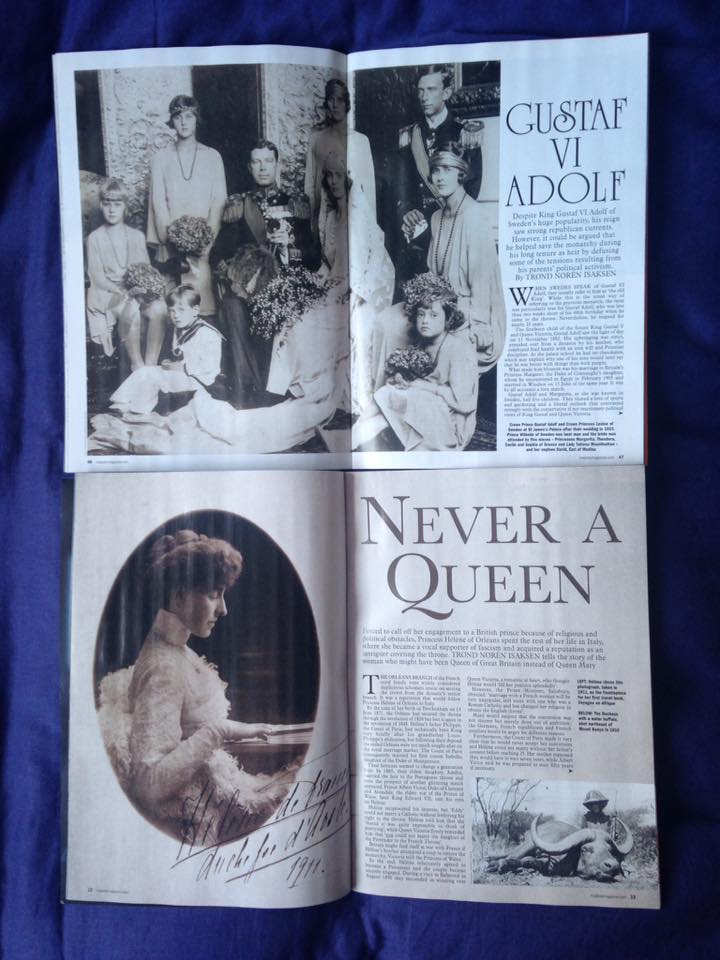
In the same issue there is also a report on Prince William and Kate's official visit to Sweden and Norway, a report on the engagement of Princess Eugenie of Britain and Jack Brooksbank and a profile of Meghan Markle (who is also on the cover).
The magazine was already being printed when Prince Henrik of Denmark died, so my obituary of him will appear in the next issue, alongside an article on King Christian IX of Denmark, who was born 200 years ago in April 1818.
Wednesday, 21 December 2016
Book news: The soft power of royal heirs

Thursday, 30 June 2016
My latest articles: Empress Marie-Louise & Swedish royal dukedoms
The July issue of Majesty (Vol. 37, No. 7) went on sale in Britain last week and this month I have contributed an article on Empress Marie-Louise of the French, Napoléon I's second wife. In the eyes of posterity she has been overshadowed by her predecessor Joséphine, but she is fondly remembered in Parma, where she reigned as duchess from 1816 until her death in 1847 and where the bicentenary of her arrival is commemorated this year.
Also just out is Royalty Digest Quarterly no. 2 - 2016, in which I write about Swedish royal dukedoms - their origins, history and statistics - which might be of some interest these days, when new dukes and duchesses are born so frequently that many find it hard to keep track.
Also just out is Royalty Digest Quarterly no. 2 - 2016, in which I write about Swedish royal dukedoms - their origins, history and statistics - which might be of some interest these days, when new dukes and duchesses are born so frequently that many find it hard to keep track.
Sunday, 6 March 2016
My latest articles: Royal Trieste & Princess Ashraf
I have written two articles in the March issue of Majesty (Vol. 37, No. 3), which went on sale in Britain last week. The first one deals with the Italian city of Trieste, once the Habsburg Empire's thriving, cosmopolitian port on the Adriatic but now something of a backwater.
The article focuses on the many royals who made Trieste their home, more often than not as exiles, among them two of Louis XV's daughters who escaped the Revolution, Napoléon I's youngest brother ex-King Jérôme of Westphalia, Queen Maria Carolina of Naples and Sicily and the Carlist pretenders to the Spanish throne, several of whom are buried in Trieste's Cathedral. On the other hand, two princes - Archduke Maximilian of Austria and Prince Amedeo of Savoy, Duke of Aosta - spent their happiest years in Trieste, where they resided at Miramare Palace, but both these princes would die in captivity on another continent.
The second article is about Princess Ashraf of Iran, the last Shah's powerful twin sister, who died in January at the age of 96.
The article focuses on the many royals who made Trieste their home, more often than not as exiles, among them two of Louis XV's daughters who escaped the Revolution, Napoléon I's youngest brother ex-King Jérôme of Westphalia, Queen Maria Carolina of Naples and Sicily and the Carlist pretenders to the Spanish throne, several of whom are buried in Trieste's Cathedral. On the other hand, two princes - Archduke Maximilian of Austria and Prince Amedeo of Savoy, Duke of Aosta - spent their happiest years in Trieste, where they resided at Miramare Palace, but both these princes would die in captivity on another continent.
The second article is about Princess Ashraf of Iran, the last Shah's powerful twin sister, who died in January at the age of 96.
Saturday, 26 May 2012
Prince Carl Philip renounces Galliera inheritance
Svenska Dagbladet reports that Prince Carl Philip of Sweden has agreed to let the Galliera inheritance, which consists of an exquisite art collection and a financial fund, pass to his sister Crown Princess Victoria, although the Prince would be the legal inheritor according to the terms laid down by Emperor Napoléon I of the French.
The art collection contains some sixty Italian works and are among the jewels of the Swedish royal collection. Piero di Cosimo’s “Madonna with Child” is widely considered the greatest masterpiece of the collection, while the financial fund was worth millions already at the time of the death of King Gustaf VI Adolf in 1973.
The reason why Prince Carl Philip rather than his elder sister has, until now, been heir to the Galliera inheritance, is that this is an entail governed by male primogeniture.
The Duchy of Galliera, which lies in the province of Bologna, was bestowed by Napoléon I, Emperor of the French and King of Italy, upon the eldest child of his adopted son, Prince Eugène, Viceroy of Italy, on 14 May 1913. The child, named Joséphine after her paternal grandmother the Empress, also held the title Princess of Bologna, which had been given her shortly after her birth in 1807. After the fall of Napoléon, his adoptive granddaughter retained possession of her duchy, but never visited it. In 1823 she married Crown Prince Oscar of Sweden and of Norway, but as the income from the Duchy was considered too low and it lay unpractically far away from Sweden, she eventually decided to sell it. Finding a buyer took a decade, but in 1837 the Duchy was sold to Marquis Raffaele de Ferrari, who was created Duke of Galliera by Pope Gregory XVI the following year.
Works of art and furniture from the Ducal Palace in Galliera were transferred to Sweden, and in her will, drawn up on 6 June 1876, the day before her death, Dowager Queen Josephina confirmed that the collection and the money from the sale should be inherited undivided by the eldest son of each generation.
As her two eldest sons had already died, this meant that the inheritance passed to her third son, King Oscar II, from him to King Gustaf V and then to King Gustaf VI Adolf. As his eldest son had predeceased him, the Galliera inheritance passed to his grandson Carl XVI Gustaf in 1973. However, when the Act of Succession was amended in 1980, King Carl Gustaf’s eldest child, Victoria, replaced her younger brother Carl Philip as heir to the throne, which, until now, has meant that the Galliera inheritance would have split from the main royal line.
(It could be added that the title Duke of Galliera still exists. The widow of Raffaele de Ferrari, whose name lives on in the Musée Galliera, her Parisian mansion which is now a museum of fashion, bequeathed the Italian properties to Prince Antoine, Duke of Montpensier, son of King Louis-Philippe I of the French and a Prince (Infante) of Spain by his marriage to the sister of Queen Isabel II of Spain. Following the death of the Dowager Duchess in 1888, Antoine was also created Duke of Galliera by King Umberto I of Italy. The current and fifth Duke of Galliera is his great-great-grandson Don Alfonso de Orleans-Borbón y Ferrara-Pignatelli).
The art collection contains some sixty Italian works and are among the jewels of the Swedish royal collection. Piero di Cosimo’s “Madonna with Child” is widely considered the greatest masterpiece of the collection, while the financial fund was worth millions already at the time of the death of King Gustaf VI Adolf in 1973.
The reason why Prince Carl Philip rather than his elder sister has, until now, been heir to the Galliera inheritance, is that this is an entail governed by male primogeniture.
The Duchy of Galliera, which lies in the province of Bologna, was bestowed by Napoléon I, Emperor of the French and King of Italy, upon the eldest child of his adopted son, Prince Eugène, Viceroy of Italy, on 14 May 1913. The child, named Joséphine after her paternal grandmother the Empress, also held the title Princess of Bologna, which had been given her shortly after her birth in 1807. After the fall of Napoléon, his adoptive granddaughter retained possession of her duchy, but never visited it. In 1823 she married Crown Prince Oscar of Sweden and of Norway, but as the income from the Duchy was considered too low and it lay unpractically far away from Sweden, she eventually decided to sell it. Finding a buyer took a decade, but in 1837 the Duchy was sold to Marquis Raffaele de Ferrari, who was created Duke of Galliera by Pope Gregory XVI the following year.
Works of art and furniture from the Ducal Palace in Galliera were transferred to Sweden, and in her will, drawn up on 6 June 1876, the day before her death, Dowager Queen Josephina confirmed that the collection and the money from the sale should be inherited undivided by the eldest son of each generation.
As her two eldest sons had already died, this meant that the inheritance passed to her third son, King Oscar II, from him to King Gustaf V and then to King Gustaf VI Adolf. As his eldest son had predeceased him, the Galliera inheritance passed to his grandson Carl XVI Gustaf in 1973. However, when the Act of Succession was amended in 1980, King Carl Gustaf’s eldest child, Victoria, replaced her younger brother Carl Philip as heir to the throne, which, until now, has meant that the Galliera inheritance would have split from the main royal line.
(It could be added that the title Duke of Galliera still exists. The widow of Raffaele de Ferrari, whose name lives on in the Musée Galliera, her Parisian mansion which is now a museum of fashion, bequeathed the Italian properties to Prince Antoine, Duke of Montpensier, son of King Louis-Philippe I of the French and a Prince (Infante) of Spain by his marriage to the sister of Queen Isabel II of Spain. Following the death of the Dowager Duchess in 1888, Antoine was also created Duke of Galliera by King Umberto I of Italy. The current and fifth Duke of Galliera is his great-great-grandson Don Alfonso de Orleans-Borbón y Ferrara-Pignatelli).
Sunday, 27 November 2011
New books: Royal splendour from across Europe
On the occasion of the wedding of Sovereign Prince Albert II and Princess Charlène of Monaco this summer the Grimaldi Forum in Monaco held an exhibition titled no less than “Magnificence and Grandeur of the Royal Houses in Europe”. I did not see the exhibition, but a while ago I got hold of the eponymous catalogue, edited by Catherine Arminjon, which bears testimony to a sumptuous exhibition of royal treasures from across Europe.
The catalogue is arranged geographically, starting with Portugal and Spain before moving north to France, Britain, Luxembourg, Belgium, the Netherlands, Denmark, Norway and Sweden and then south again from Russia via Poland, Prussia, Saxony, Bavaria, Austria, the Hungarian Esterházys, the Savoys of Turin and the Bourbons of Naples before ending up in Monaco.
Thus Liechtenstein is the only of the current European monarchies not included in the exhibition, which is a pity given that the princely collection is one of the grandest in Europe, probably second only to that of Britain. The British Royal Collection has also not lent anything to the exhibition, so the British section is made up of loans from mostly French collections (a bust from the Victoria & Albert Museum is the only British-owned item included).
But the other extant monarchies have all lent items from their royal collections – some more generously than others. Being Norwegian I notice that the loans from this country are actually quite impressive, even including Queen Maud’s coronation gown.
Covering all this in one exhibition or one volume would obviously be impossible and the solution chosen is to focus on one monarch (or couple) per country – Denmark and Prussia being the exceptions by including respectively both Christian IV and Christian IX and the entire Hohenzollern dynasty from Friedrich I to Friedrich Wilhelm IV. The chosen person(s) is often, but not always, the founder of a dynasty – Felipe V of Spain, Adolphe of Luxembourg, Léopold I of the Belgians, Haakon VII of Norway.
For each country there is one main essay, generally followed by one or two shorter and more specific texts and finally a catalogue of the items relating to the country in question. The essays are diverse in their contents, with some authors choosing to write short biographical essays while authors set focus on one topic in particular.
As is the case with all anthologies, some essays are obviously more successful than others. Among the better ones one could mention Philippe Maarschalkerweerd on the education of Queen Wilhelmina of the Netherlands, Andrea Merlotti on the achievements of King Vittorio Amadeo of Sardinia and Sicily, Gustaf Janssens on King Léopold I of the Belgians’s brand of constitutional monarchy, Peter Kristiansen on King Christian IV of Denmark-Norway, Magnus Olausson on the public persona of King Gustaf III of Sweden and Lorenz Seelig on the artistic patronage of King Ludwig I of Bavaria.
The only main essay which does not measure up is, unfortunately I must say, the Norwegian one, which has been written by Widar Halén, director of design and decorative art at the National Museum in Oslo. It seems obvious that Halén has very little knowledge and understanding of the topic he has been asked to write about and has done little about this.
His essay is, bewilderedly, entitled “The new Norwegian monarchy and its context”, and from the text it seems clear that he does indeed think that there was an entirely new Norwegian monarchy in 1905. Thus he refers to “King Oscar II of Sweden” as if Norway had been a Swedish province rather than an independent kingdom in a personal union with its eastern neighbour. He also claims that independence came only in 1905 and that the monogram of Haakon VII “was soon being brandished as a symbol of freedom, particularly during World War II”. In fact this happened only during World War II. It seems obvious that Halén has understood little of what really happened in 1905.
He adds some nonsense about the mediaeval book The King’s Mirror saying that “to serve and honor the king is to pay homage to God”. If this “is seen simply as a description of the king’s immunity and exceptional status, its significance for modern Norway is more readily understood. It was on this basis ten that the Norwegian people chose Prince Carl of Denmark and Princess Maud, daughter of King Edward VII and Queen Alexandra of Great Britain, as king and queen of Norway”. Reading this, one can but wonder what on earth he is talking about.
To these examples of his own confusion he adds several factual mistakes, such as the claim that Queen Maud died at Appleton House, that the accession of a new monarch was proclaimed from the palace balcony in 1958 (sic) as well as in 1991 or that the Constitution of 17 May 1814 irrevocably abolished the nobility. Using Snorre Sturlason’s Heimskringla as a historical source is highly questionable, to put it mildly.
If asked to write an essay on a topic about which one knows little, one can either decline, or try to learn something about it in order to make the best out of it, or put one’s own confusion into print. Sadly the Norwegian essay of this catalogue is an example of the latter option.
There are inevitably some mistakes to be found also in other parts of the catalogue and the English language is sometimes flawed. Occasionally there is a quaint expression, sometimes a sentence does not make sense, but I am left wondering whether this is due to the translators or a result of the various authors with varying command of the language having been required to write in English.
The catalogue is beautifully designed and having read it, the main impression is that it makes for an interesting grand tour through the history of Europe’s monarchies, taking in some of the most interesting stories to be found along the way and giving an impression of the splendour associated with the royal courts of Europe in recent centuries.
The catalogue is arranged geographically, starting with Portugal and Spain before moving north to France, Britain, Luxembourg, Belgium, the Netherlands, Denmark, Norway and Sweden and then south again from Russia via Poland, Prussia, Saxony, Bavaria, Austria, the Hungarian Esterházys, the Savoys of Turin and the Bourbons of Naples before ending up in Monaco.
Thus Liechtenstein is the only of the current European monarchies not included in the exhibition, which is a pity given that the princely collection is one of the grandest in Europe, probably second only to that of Britain. The British Royal Collection has also not lent anything to the exhibition, so the British section is made up of loans from mostly French collections (a bust from the Victoria & Albert Museum is the only British-owned item included).
But the other extant monarchies have all lent items from their royal collections – some more generously than others. Being Norwegian I notice that the loans from this country are actually quite impressive, even including Queen Maud’s coronation gown.
Covering all this in one exhibition or one volume would obviously be impossible and the solution chosen is to focus on one monarch (or couple) per country – Denmark and Prussia being the exceptions by including respectively both Christian IV and Christian IX and the entire Hohenzollern dynasty from Friedrich I to Friedrich Wilhelm IV. The chosen person(s) is often, but not always, the founder of a dynasty – Felipe V of Spain, Adolphe of Luxembourg, Léopold I of the Belgians, Haakon VII of Norway.
For each country there is one main essay, generally followed by one or two shorter and more specific texts and finally a catalogue of the items relating to the country in question. The essays are diverse in their contents, with some authors choosing to write short biographical essays while authors set focus on one topic in particular.
As is the case with all anthologies, some essays are obviously more successful than others. Among the better ones one could mention Philippe Maarschalkerweerd on the education of Queen Wilhelmina of the Netherlands, Andrea Merlotti on the achievements of King Vittorio Amadeo of Sardinia and Sicily, Gustaf Janssens on King Léopold I of the Belgians’s brand of constitutional monarchy, Peter Kristiansen on King Christian IV of Denmark-Norway, Magnus Olausson on the public persona of King Gustaf III of Sweden and Lorenz Seelig on the artistic patronage of King Ludwig I of Bavaria.
The only main essay which does not measure up is, unfortunately I must say, the Norwegian one, which has been written by Widar Halén, director of design and decorative art at the National Museum in Oslo. It seems obvious that Halén has very little knowledge and understanding of the topic he has been asked to write about and has done little about this.
His essay is, bewilderedly, entitled “The new Norwegian monarchy and its context”, and from the text it seems clear that he does indeed think that there was an entirely new Norwegian monarchy in 1905. Thus he refers to “King Oscar II of Sweden” as if Norway had been a Swedish province rather than an independent kingdom in a personal union with its eastern neighbour. He also claims that independence came only in 1905 and that the monogram of Haakon VII “was soon being brandished as a symbol of freedom, particularly during World War II”. In fact this happened only during World War II. It seems obvious that Halén has understood little of what really happened in 1905.
He adds some nonsense about the mediaeval book The King’s Mirror saying that “to serve and honor the king is to pay homage to God”. If this “is seen simply as a description of the king’s immunity and exceptional status, its significance for modern Norway is more readily understood. It was on this basis ten that the Norwegian people chose Prince Carl of Denmark and Princess Maud, daughter of King Edward VII and Queen Alexandra of Great Britain, as king and queen of Norway”. Reading this, one can but wonder what on earth he is talking about.
To these examples of his own confusion he adds several factual mistakes, such as the claim that Queen Maud died at Appleton House, that the accession of a new monarch was proclaimed from the palace balcony in 1958 (sic) as well as in 1991 or that the Constitution of 17 May 1814 irrevocably abolished the nobility. Using Snorre Sturlason’s Heimskringla as a historical source is highly questionable, to put it mildly.
If asked to write an essay on a topic about which one knows little, one can either decline, or try to learn something about it in order to make the best out of it, or put one’s own confusion into print. Sadly the Norwegian essay of this catalogue is an example of the latter option.
There are inevitably some mistakes to be found also in other parts of the catalogue and the English language is sometimes flawed. Occasionally there is a quaint expression, sometimes a sentence does not make sense, but I am left wondering whether this is due to the translators or a result of the various authors with varying command of the language having been required to write in English.
The catalogue is beautifully designed and having read it, the main impression is that it makes for an interesting grand tour through the history of Europe’s monarchies, taking in some of the most interesting stories to be found along the way and giving an impression of the splendour associated with the royal courts of Europe in recent centuries.
Monday, 12 September 2011
New books: The history and art history of Rome
 Recently I have been reading several books on cities, among them Simon Sebag Montefiore’s latest book Jerusalem: The Biography and Robert Hughes’s Rome, the latter published by Weidenfeld & Nicolson before the summer. The Australian-born, US-based art critic Robert Hughes first came to Rome in 1959 and his book, in which he charts the history and art history of Rome from its beginnings until the present day, is the product of a lifetime’s acquaintance with the city (in which it should be said he has never actually lived).
The book is engagingly written, with some refreshing personal asides and the author does away with some popular myths (no, Caligula did not make his horse a consul and no, Nero did not fiddle while Rome burnt). The sheer magnitude of the topic such as the Eternal City obviously means that the author has to be selective when deciding what to include and on what to focus.
The author’s perspective is indeed often that of the critic, which means that there are many highly personal evaluations. Personal preferences also seem to have a strong influence on what Hughes chooses to focus one.
Occasionally the author will allow himself to be carried away into some rather lengthy digressions on topics which appear rather peripheral to the story but for which he evidently has great enthusiasm. There are for instance several pages on the brilliance of Velazquez, who was never more than a visitor to Rome.
At first the focus is mostly on the history of the city, but as one reads on its shifts to Rome’s art history and one is able to tell that the author feels more at ease with the arts than with history. The best part of the whole book is probably the pages on Bernini, whose artistic genius Hughes does full justice – to the extent that one may wish that a book on Bernini might be his next project.
The shifting of focus is not entirely unproblematic, as some key historical events during recent centuries are passed over quite summarily. This is also the case for the post-war years. Hughes is rather pessimistic about the current condition of Roman and Italian culture and although he argues that nothing of great value – except Fellini’s films – have been produced after World War II, he spends many pages on saying so while hardly saying a word about the post-war history of Rome.
There are some unnecessary repetitions and some contradictions. For instance that Vercingetorix is said to have been “ignominiously strangled in a dungeon” in 52 BCE on page 49, but “beheaded in 46 CE” on page 104. To die twice, in two different ways and 98 years apart would surely have been a remarkable feat.
But all in all this 534-page tome is an enjoyable and informative, although selective and not exhaustive, account of the rises and falls of one of the world’s most intriguing cities.
Monday, 28 March 2011
Edward Bernadotte to wed in May
The latest issue of Svensk Damtidning reports that Count Edward Bernadotte af Wisborg is set to marry his Italian fiancée of two years, Nathalie Frediani, at Villa Rusconi-Clerici in Verbania by the Lake Maggiore, Italy, on 29 May.
The great-great-grandson of King Oscar II of Sweden and Norway, Count Edward Gustaf Bernadotte af Wisborg is born on 18 April 1984. He is the youngest son of Count Bertil Bernadotte and his second wife, the artist Jill Bernadotte, née Rhodes-Maddox. His father is the youngest son of the famous Count Folke Bernadotte af Wisborg, who was himself the youngest son of Oscar II’s second son, Prince Oscar Bernadotte, who in 1888 forfeited his rights to the Swedish and Norwegian thrones when he married his sister-in-law’s former lady-in-waiting, Ebba Munck af Fulkila.
The great-great-grandson of King Oscar II of Sweden and Norway, Count Edward Gustaf Bernadotte af Wisborg is born on 18 April 1984. He is the youngest son of Count Bertil Bernadotte and his second wife, the artist Jill Bernadotte, née Rhodes-Maddox. His father is the youngest son of the famous Count Folke Bernadotte af Wisborg, who was himself the youngest son of Oscar II’s second son, Prince Oscar Bernadotte, who in 1888 forfeited his rights to the Swedish and Norwegian thrones when he married his sister-in-law’s former lady-in-waiting, Ebba Munck af Fulkila.
Wednesday, 19 January 2011
New books: Venice and the staging of its glory
 After two critically acclaimed books on Rome, the Danish art historian Mogens Nykjær has moved his focus further north, more precisely to Venice. The result is Venezia – Byhistorie og kunst, a gem among the many books on this most enchanting of cities.
In this lavishly illustrated, information-packed volume Nykjær investigates the relation between history and art in Venice, focusing on the years between the thirteenth century and the Napoleonic age immediately after the fall of the Republic.
Many of Venice’s many famous churches, palatial mansions and artworks go by in this book, but also simpler dwelling houses, communal wells and the many campos around which entire societies in miniature could revolve (Nykjær relates the story of an author who went to see an 100-year-old lady living near the Church of San Pietro di Castello in order to ask her about life in St Mark’s Square in her youth, only to be told that the centenarian had never once been to the Square).
But naturally the major sites, such as the Basilica of St Mark, the Ducal Palace and St Mark’s Square, are given the most thorough treatment and a chapter on ducal funerary monuments are among what stands out in this book.
Venice, Nykjær points out, is virtually alone among major Italian cities in not having a Roman past. This makes it a polycentric city, not a planned, monocentric city like those of Roman origins. But most importantly it meant that when Venice became a great power in the thirteenth century, one saw the need for inventing a past which could bear comparison to those cities with such a past.
And this – the staging of Venice, its self-celebration through art – is the main theme of Mogens Nykjær’s book. Venice cast itself in the role as the new Rome and the new Byzantium, a chosen city with a privileged position, closer to Christ and the Virgin Mary than any other city.
Nykjær highlights how the Doge’s throne in the Sala Del Maggior Consiglio in the Ducal Palace is situated immediately beneath Christ in Tintoretto’s glorious fresco “Paradise”, alluding to the Doge as the earthly mirror image of Christ. The same relation between Christ and the Doge can be found in Pietro Lombardo’s funerary monument to Doge Pietro Mocenigo in the Basilica of San Zanipolo.
In another of the Ducal Palace’s halls, those saved in Palma il Giovane’s “Doomsday” rush to that corner of the picture which is to be found above the door leading to the short corridor linking this hall to the Sala Del Maggior Consiglio. This is as Nykjær sees it the very culmination of how Venice presents itself through its art as a privileged, chosen city. Those redeemed on doomsday are shown rushing towards the door to Paradise – to Venice.
The self-staging of Venice reached its climax in the sixteenth century, when the might of the Republic was in fact in decline – partly as a result of Vasco da Gama’s finding an alternative route to India in 1498 and thus depriving Venice of its monopoly in trading with spices. But, as Nykjær points out, this was only a logical result of the usual practice whereby the urge for stressing the magnitude of one’s power increases when actual power decreases.
Thus, the sixteenth century was nevertheless the “imperial age” of Venice, when she rested contentedly in the position she had acquired while watching it slowly crumble. The fall of Constantinople in 1453 and the sack of Rome in 1527 provided Venice with an even greater opportunity to present itself as the new Constantinople and the new Rome – the imperial survivor.
Yet even the thousand-year-old Republic of Venice eventually came to an end. In the eighteenth century the authorities could no longer afford embellishing the city in the way it had hitherto done and the initiative shifted to private actors who also no longer refrained from glorifying themselves or their families rather than Venice – as can be seen in for instance Villa Pisani in Stra.
Mogens Nykjær’s interpretation of Venice and how it staged its own power and position through the arts is an excellent book which will hopefully be translated into other languages and take its natural place among the classics on this fascinating city.
Sunday, 15 August 2010
New books: Habsburg drama
 In Destiny’s Hands: Five Tragic Rulers, Children of Maria Theresa is the somewhat overwrought title of a somewhat overwrought new book by Justin C. Vovk, who, according to the book’s cover, is “a critically acclaimed historian whose work is archived in the Library of Congress”. This sounds quite pretentious as this is his first book and as far as I know nearly everything published is “archived in the Library of Congress” – I think they have at least one of my books as well.
Basing his work entirely on secondary sources, Vovk builds his book over the same pattern as Julia Gelardi’s Born to Rule: Granddaughters of Victoria, Queens of Europe (2005) and his subjects are Empress Maria Theresia and what he describes as her five “reigning” children – the Emperors Joseph II and Leopold II, Duchess Amalia of Parma, Queen Maria Carolina of Naples and Queen Marie-Antoinette of France.
The Duchess of Parma is the one we hear the least about and also the one the author seems to have least sympathy for, while the lives of the other four are more or less equally covered. Maria Theresia herself is another main figure in this book. These five out of sixteen children have been chosen because they were, in the author’s words, those of the Empress’s children who came to rule states.
But out of these five only two did in fact reign. Yet all of them are constantly referred to as “reigning” or “rulers” and we learn that “[t]hey all shared the same experience of becoming a monarch”. But the spouse of a monarch is as little a monarch as the spouse of the President of the USA is head of state or Commander-in-Chief.
We are told that the fact that it was Amalia’s husband who was Duke of Parma, “in no way diminished her role as a reigning consort”, but this term is clearly an oxymoron. And when Maria Carolina marries the King of Naples, we learn that “she was now the reigning Queen of Naples”.
The author does not make a lot of factual mistakes (there are however some, such as the claim that Marie-Thérèse was Marie-Antoinette’s last surviving child at the time of the latter’s execution), but he obviously struggles with the terminology. “Leopold was now heir apparent to the imperial throne”, he states, before adding that “only a unanimous election could make him emperor”. But one cannot possible be heir apparent if an election is needed and one can hardly be heir apparent to an elective monarchy at all. And Marie-Antoinette, the youngest but one of sixteen children, was certainly not Maria Theresia’s heir, although Vovk writes about the Empress and Louis XV agreeing about “the marriage of their heirs”.
Despite the author’s annoying insistence on referring to all of his subjects as rulers, it is true that two of the imperial daughters who became the consorts of monarchs – Amalia of Parma and Maria Carolina of Naples – came to wield great influence in their adopted countries. Maria Carolina’s husband was, in the words of a historian, “born to be ruled by others” and Vovk writes: “There was never a question of who was in charge. Queen Maria Carolina knew exactly how to control King Ferdinand. She masterfully crafted a smokescreen of melodrama and marital discourse that made hum submissive to her will”.
Queen Marie-Antoinette cannot really be said to have wielded the same sort of influence in France and thus cannot be called the ruler of France neither in name nor in reality. Yet the author writes of how she and Louis XVI travelled to Reims for “their coronation”, which made her “the first reigning queen to attend a French coronation since 1549”. But not only was she not a reigning queen; it was furthermore only Louis XVI who was crowned, making it his coronation and not theirs.
The author does not at all dwell on the reasons why Marie-Antoinette was not crowned, which could be seen as a symptom of the animosity displayed towards her even early in her husband’s reign. But this animosity is not something Vovk will go to any length to try and explain to the reader; in his version, Marie-Antoinette was entirely without any human faults or shortcomings. Axel von Fersen only makes a brief appearance as a letter-writer and courtier and is never directly linked to the Queen. The story of the unconsummated marriage, which was certainly of enormous dynastic consequences and which will be familiar to anyone who has read anything about Marie-Antoinette, goes entirely unmentioned. The portrayal of Joseph II as quite simply an enormous failure also tends to speak of a tendency to paint people in black and white.
There are some gross simplifications, such as the assertion that Napoléon “engulfed it [the continent] in the flames of war”. Those wars had started before Napoléon came along and he was certainly not alone in prolonging them, as the author also acknowledges when he writes about how Britain broke the peace of Amiens because it was in its own interest to do so. Hand in hand with the simplifications go the many exaggerations, such as referring to Catherine Mary Bearne, who a century ago wrote some romanticised royal biographies full of tittle-tattle, as a “famed historian”.
Both the author and the publisher could have made more of an effort about the language, which contains rather too many clichés – clichés which occasionally contradict each other. On page 208 we read: “If the French monarchy were an opera, then the Diamond Necklace Affair would be its closing act”. On page 210 we read: “The death of Princess Sophie marked the beginning of the end of Marie Antoinette and her family”. But can the beginning of the end really take place after the closing act?
On page 250 Leopold II’s death gives the author cause to write that “[t]he Holy Roman Empire mourned the passing of a sovereign for the second time in two years”, but what he writes on page 233 about how “[t]housands of people [had] lined the streets of Vienna to say good riddance” during Joseph II’s funeral and thrown rocks, mud and other objects at the coffin, does not exactly convey the sense of a people in mourning.
There are also some translations from German which make absolutely no sense, such as the following ending to a letter: “Although I am more than persuaded, that such a loss cannot be repaired, I dare to offer you in me, who in friendship, attachment, [and] true and sincere interest in everything that could interest you in all ways”. What? The author will insert a “[sic]” after words spelt in an older manner or according to English rather than American grammar, yet he will himself make a rather high number of grammatical mistakes, including some rather basic ones.
And then there are some downright silly statements, such as the claim that the Duke of Lorraine upon marrying Maria Theresia “took the name Francis Stephen” – of course he did no such thing, as taking an English name would make no sense for a man about to become Emperor of the Holy Roman Empire. The same goes for the claim that Felipe of Spain “took the name Philip” when he became Duke of Parma.
But what is most annoying about this book is the constant insistence on drama or tragedy even where there is none. Emperor Franz Stephan had a “dramatic funeral”, but we never hear of any drama played out during this ceremony. The Augustinerkirche in Vienna is also “dramatic”, although I personally found it quite peaceful when I visited it last summer.
“But the conclusion of the war and the restoration of peace in Austria would pale in comparison to the tragedies that were about to befall Emperor Leopold II and Queen Marie Antoinette” is just one example of how we are constantly told of grim forebodings and unexpected fates. These often begin with words such as “No one could know that...”, but the author often overdoes it. When a queen gives birth to her second son it is not an entirely unimaginable possibility that this second son might one day be king – history is full of second sons acceding to thrones, either of their own countries or of another kingdom.
On the other hand there are some refreshing anecdotes, such as Maria Theresia writing to her daughter about her future husband: “Although an ugly prince, he is not absolutely repulsive…at least he does not stink”. One would wish Vovk had included more of this and less of the melodrama.
The story which forms the backdrop for Vovk’s book is certainly fascinating and the most valuable aspect of this book is that it tells the stories of some interesting, lesser-known individuals as well as those of their more famous siblings - my main reason for reading this book was a desire to learn more about Queen Maria Carolina of Naples.
The book is not bad in itself, but as I read on I eventually began feeling rather tired out by the constant melodrama and all the exaggerations. The book is otherwise held in an accessible, easily read prose and the author seems to have the potential for becoming a good storyteller. My advice to the author would therefore be to take some time to learn and understand the correct terminology of his subject and to work on restraining his sense for melodrama.
Saturday, 14 August 2010
My latest article: A book on guilt
 In Klassekampen’s book magazine today you can read my review article of the Norwegian translation of Henrik Arnstad’s very interesting and thought-provoking book Skyld – En europeisk reise i Nazi-Tysklands skygge, which investigates how three countries which were Nazi Germany’s allies (Finland, Italy and Austria) have subsequently dealt with the issue of their own guilt. I reviewed the Swedish original here at the blog seven months ago.
Thursday, 25 March 2010
My latest article: The Principality of Pontecorvo
 In the recent issue of Royalty Digest Quarterly (no 1-2010) I have an article on the Pontecorvo, the small Italian principality which was granted Marshal Jean-Baptiste Bernadotte by Emperor Napoléon I in 1806 and whose arms still feature in the escutcheon of the Bernadotte dynasty and thereby in Sweden’s Great Coat of Arms.
Formerly a Papal enclave, Pontecorvo is situated approximately halfway between Rome and Naples. Bernadotte was created Sovereign Prince and Duke of Pontecorvo on 5 June 1806. This set him apart from the other marshals, who were only made dukes and princes of non-territorial locations at a later date. The principality was granted Bernadotte at the time when the relationship between him and Napoléon was at its best, but it has also been suggested that the Emperor through the grant wanted to draw Bernadotte closer to him.
The Prince of Pontecorvo never set his foot there and had to renounce the principality when he was elected Crown Prince of Sweden in 1810. The title was later held for a few years by Achille Murat, the son of King Joachim (Murat) of Naples, and was offered to Prince Eugène, the former Viceroy of Italy, by the Congress of Vienna on the condition that he never settled there, which made him decline the offer.
Most of Pontecorvo was destroyed in a wartime air raid in 1943, after which it was rebuilt in a quite ugly manner. There are no great tourist attractions and this city of some 13,000 inhabitants lies far away from the tourist track.
Except for Via Giovanni Battista Bernadotte I found no traces of the Bernadotte reign when I went there in January 2008. Apparently Gustaf VI Adolf is the only Bernadotte to have visited Pontecorvo, which he did while still Crown Prince in 1949.
My article explores the history of Pontecorvo while focusing on Bernadotte’s reign. In fact this was the first out of the three realms which the Bernadotte dynasty came to rule, and in the 19th century Pontecorvo was often used as the name of the dynasty before the name Bernadotte took over entirely.
The photo shows the bridge, the most famous landmark in Pontecorvo and still part of the arms of the town as well as of the dynasty. To the right is the Cathedral and further to the left one can glimpse the tower of the Town Hall, both buildings which were severely damaged in 1943.
Monday, 4 January 2010
New books: Nazi Germany’s allies and the question of guilt
 In 2006 the Swedish journalist Henrik Arnstad published his biography of Christian Günther, the country’s wartime foreign minister who bears much of the responsibility for the country’s somewhat too friendly attitude towards Nazi Germany during the first years of World War II. This policy has come under debate in Sweden in recent decades, and in his new book, Skyldig till skuld – En europeisk resa i Nazitysklands skugga, Arnstad looks at how the countries which were Nazi Germany’s actual allies have dealt with the question of their own share in the guilt.
He argues that the Axis countries’ collective memories are often very selective and that some of them have chosen to cast themselves in the role as victims rather than facing their own crimes. The fact that Germany has taken on the guilt issue so openly that the collective sense of responsibility is ever present in that country has in Arnstad’s view contributed to making it more difficult for other countries to do so – or easier to avoid doing so.
Finland is the prime example, according to Arnstad. The national hero Marshal Mannerheim was a “war criminal – responsible for concentration camps, ethnic cleansing and mass murder”. The book offers a detailed background for these charges, and Arnstad points out that Finland in cooperation with Germany planned and carried out the attack on the Soviet Union in 1941.
Following the war Finland’s view of its own wartime history has been characterised by concerns for the nation’s honour being put above truth. Rather than taking to task their country’s crimes, the Finns prefer to remember the more glorious Winter War of 1939-1940 and have indulged in debates such as if Finland and Germany were not really allied but just happened to fight a common enemy. Arnstad dismisses such notions and concludes that Finland in reality was Germany’s most important ally.
In Rome Henrik Arnstad found the “Liberation Museum” (Museo Storico della Liberazione) symptomatic of how Italy sees its role in the war. The museum is concerned solely with the allied “liberation” of Italy in 1943 and the German atrocities committed on Italian soil during the next two years. Italy’s own alliance with Nazi Germany before that is simply ignored.
To select only one part of one’s story and thereby being able to cast oneself in the role of victim is something which has also been done in Austria, a country where the denials had to be faced when the old Nazi Kurt Waldheim was elected President in 1986. But the idea that Austria was “Hitler’s first victim” still prevails and as recently as 2008 Otto von Habsburg said that “no country in Europe has a greater right than Austria to call itself a victim”. Arnstad sees these ideas in relation with the growing right-wing extremism in both Italy and Austria.
Henrik Arnstad’s book is thought-provoking and an important contribution to the fight against historical forgetfulness. It might however have been interesting if he had also included Spain and how that country is currently trying to come to terms with its Fascist past.
Friday, 27 November 2009
What to see: Arco della Pace, Milan


 When Emperor Napoléon I became King of Italy he ordered the construction of a rod linking his capitals Milan and Paris via Lake Maggiore, Switzerland and the Simplon Pass. The beginning of that road, the tree-lined Corso Sempione, was modelled on Avenue des Champs-Élysées. At the top of Corso Sempione, serving as an entrance to the Sempione Park and its medieval Castello Sforzesco, stands the Arco della Pace, the triumphal arch commemorating Napoléon’s victories, which he commissioned the architect Luigi Cagnola to build.
The building of the Arch of Victories, as it was then called, was not completed at the time of Napoléon’s downfall, when Milan reverted to the Habsburgs. Work was only resumed in 1826 on the orders of Emperor Franz I, who changed the subjects of the reliefs to commemorate the peace of 1815 rather than his son-in-law’s victories, thereby also giving the arch its new name. It was inaugurated in connection with Emperor Ferdinand I’s coronation as King of Lombardy in September 1838.
The arch is made of Crevola marble and on top is a bronze quadriga – the Chariot of Peace by Abbondio Sangiorgio, each horse cast in one piece. The quadriga originally faced the Corso Sempione – and thereby France – but the Habsburgs had it turned around so that it now faces the Castello and the centre of Milan beyond it.
The arch is flanked by two identical, now disused guards’ pavilions (second photo). As the arch is currently under renovation (third photo), the first photo is borrowed from Wikipedia.
Tuesday, 6 October 2009
What to see: Church of Santa Maria di Nazareth (Scalzi), Venice


 The Church of Santa Maria di Nazareth is one of Venice’s best examples of Baroque churches. The popular name “Scalzi” refers to the Carmelite barefoot monks who established their order in Venice in 1633 and bought the plot of land facing the Grand Canal on which their church was built.
The architect Baldassare Longhena enlarged the church in 1654 and it was given its present appearance between 1660 and 1689 by Giuseppe Pozzo, who created the sumptuous interior seen in the first two pictures, and Giuseppe Sardi, who built the façade of Carrara marble. The church is a good example of how many Venetian churches have spent everything on the main façade and nothing on the side walls, as seen in the fourth photo. The vault originally had a fresco by Tiepolo, but this was unfortunately destroyed in a WWI air raid on Venice in 1915.
There are several side chapels on either side of the nave. In the Manin chapel (fifth photo) a simple stone slab marks the resting place of Ludovico Manin, the last Doge. It was he who, after the French invasion in 1797 brought down the millennial Republic, took of his ducal cornice and gave it to his servant with the words: “Take it away, I shall not be needing it again”. The text on the stone reads simply: “Manini cineres”, “the ashes of Manin”.
Sunday, 5 July 2009
What to see: The former royal palace Villa Pisani, Stra


 A little-known but splendid former royal palace can be found in the small town of Stra, a few kilometres outside Padua on the road to Venice. Villa Pisani was built to glorify the noble Venetian family Pisani and is situated at the bend of the Brenta Canal. There the Pisani family already owned a villa known as Santo Stefano, a simple building from the late 16th century which was demolished in 1720 to make way for a new house.
The task of building the new villa was first given to the architect Girolamo Frigimelica Roberti (1653-1732), but his plans were soon shelved. Following his death the commission was given to Francesco Maria Preti (1701-1774), who completed the work on Villa Pisani in 1756.
In 1735 Alvise Pisani had been elected the 114th Doge of the Republic of Venice and it is said that this was the reason why the villa originally had 114 rooms – today the number is officially given as 168. There are two inner courtyards, separated by the colonnade seen in the last picture. Currently the colonnade houses a sculpture by Mimmo Paladino, which is part of the exhibition “I classici del contemporaneo”, which is on until 30 September.
At the centre of the building is the most magnificent of the rooms – the Ballroom, seen in the fifth photo. The fresco, “The Glory of the Pisani Family”, was done by Giambattista Tiepolo in 1761-1762 and took him only 76 working days. The walls are decorated in trompe l’oeil technique by Pietro Visconti.
The villa itself is Palladian in style, marked by the emerging neoclassicism, but there are also still traces of Baroque. The main façade towards the canal, seen in the first and second pictures, is richly decorated, while the garden façade, seen in the third photo, is simpler. Opposite the villa is the building for the stables, itself a magnificent creation which also served as open-air banqueting hall and now also as an orangery. The Long Pond between them was built in the 20th century.
Following the fall of the Republic of Venice in 1797, the Pisani family found themselves in financial difficulties and on 11 January 1807 its then owner, Ermoloa “Alvise” Pisani, sold the villa to Napoléon I. The French Emperor also being King of Italy, this made Villa Pisani one of the two royal palaces in the Veneto region, the other being the Royal Palace in Venice (now the Correr Museum).
Napoléon himself spent only two nights at the palace – those of 28 November and 13 December 1807, on his way to and from his only visit to Venice. Ten years earlier he had stopped briefly at the villa during the campaign in Italy, commenting on Tiepolo’s masterpiece that it was a pity it was a fresco, “if it had been on canvas it would have looked superb at Fontainebleau!”
The Emperor-King gave the right of disposal to his adopted son Prince Eugène, Viceroy of Italy and Prince of Venice, who hired the architects Giovannia Antonio Antolini, Giuseppe Mezzani and Giuseppe Maria Soli to modernise the palace. Rebuilding, including the creation of imperial and viceregal apartments in Empire style, lasted for several years, which means that Napoléon never actually slept in the so-called “Napoleonic bed” which is now in his bedchamber.
The sixth photo shows one of the redecorated rooms – the Dining Room, which was redecorated in Pompeian style by G. Borsato and Pietro Moro in 1808-1814. The seventh picture is of a pre-imperial room, the Salon of the View-Paintings, which also holds a model of the famous maze which can be found in the palace’s park.
Following the downfall of Napoléon’s empire, Villa Pisani passed to the Habsburgs. It was a favourite residence of Empress Maria Anna, consort of the unfortunate Emperor Ferdinand. The Savoys, who took over in 1866, soon lost interest in the palace. It was abandoned in 1874 and after unsuccessful attempts at renting it out, management was entrusted to the Regional Office for Monuments in the Veneto in 1882.
Although named a national museum, Villa Pisani came to house offices and institutions of various kinds and the palace fell into disrepair. In 1934 Benito Mussolini and Adolf Hitler held their first meeting there. It is only in recent decades that interest in this glorious building has been revived. Still much of the furniture can be found in other places, such as the Correr Museum in Venice and the Quirinal Palace in Rome, but since the mid-1980s extensive renovation work has been carried out.
The official website:
http://www.villapisani.beniculturali.it/en/index.php
Saturday, 4 July 2009
What to see: The Dano-Nordic pavilion, the 53rd Biennale, Venice


 Some days ago I wrote about the 53rd International Art Exhibition, La Biennale, in Venice. I should also include something about the Norwegian contribution, which is in fact a pan-Nordic one. The Nordic pavilion (Sweden, Norway and Finland) is located next to the Danish and for this Biennale they have joined forces for the exhibition “The Collectors”, curated and staged by the Norwegian duo Elmgreen & Dragset and with 24 artists participating.
The two pavilions are furnished as a deserted home where some sort of disaster with homoerotic undertones has struck and is as such reminiscent of the exhibition “Home is the place you left” at Trondheim Art Gallery last year.
To the left in the first photo are several pictures by Tom of Finland, while “Maquette for a Giant Spinning O” by Jonathan Monk can be seen outside the windows. In the second photo is “Butterflies” by Han & Him, while the third shows the painting “The act of pollination” by Herman Bas and the fourth two Polynesian sculptures lent by Francesca von Habsburg.
In the fifth photo is a detail of “Table for Bergman” by Elmgreen & Dragset. Then comes the staircase in the library and the mirror in the hallway and finally “Death of a Collector”, also by Elmgreen & Dragset.
Wednesday, 1 July 2009
What to see: The 53rd International Art Exhibition – La Biennale, Venice


It is summer in an odd-numbered year, which means the Biennale is taking place in Venice. Since the first exhibition in 1895, the Biennale has been one of the most important venues for showing modern and avant-garde art.
This year’s Biennale, the 53rd in the row, is called “Making Worlds”. It opened on 7 June and is on until 22 November, with more countries (77) than ever before taking part. The largest sections are at the Giardini and the Arsenale, but there are also exhibitions and events on many locations in the city itself and outside it.
The first photo shows glass artworks outside the Venetian pavilion, while the second shows a globe by Chen Zhen. Following them are images from the Spanish, Polish, Egyptian, French, Russian and Hungarian pavilions and finally a view of the Moroccan contribution, which is housed in the Church of Pietà.
The Biennale’s website: http://www.labiennale.org/en/art/index.html
This year’s Biennale, the 53rd in the row, is called “Making Worlds”. It opened on 7 June and is on until 22 November, with more countries (77) than ever before taking part. The largest sections are at the Giardini and the Arsenale, but there are also exhibitions and events on many locations in the city itself and outside it.
The first photo shows glass artworks outside the Venetian pavilion, while the second shows a globe by Chen Zhen. Following them are images from the Spanish, Polish, Egyptian, French, Russian and Hungarian pavilions and finally a view of the Moroccan contribution, which is housed in the Church of Pietà.
The Biennale’s website: http://www.labiennale.org/en/art/index.html
Tuesday, 30 June 2009
What to see: The former Cathedral of San Pietro di Castello, Venice


All visitors to Venice will be familiar with the city’s cathedral, St Mark’s Basilica. But this spectacular church has in fact only been the cathedral of Venice for 202 years – its predecessor, the Basilica of San Pietro, can be found at the tip of the island of Castello. The island, formerly called Olivolo, has been inhabited since the fifth century and the first church on the spot was built in the seventh century and dedicated to the saints Serge and Bacchus.
The first church of San Pietro was dedicated in 841 and became the seat of the patriarch of Venice in 1451, meaning that it also became the cathedral of the city of Venice. In 1556 the Patriarch, Vincenzo Diedo, commissioned the great architect Andrea Palladio (1508-1580) to rebuild the cathedral. Work started the following year. Palladio began with the façade, but work stopped when Diedo died.
It was only in 1621 that the new church was completed by Palladio’s disciple Francesco Girolamo Grapiglia, who followed Palladio’s plans, but made certain changes. The façade, built of Istrian stone, is typically Palladian and reflects the church’s Latin cross shape with three naves. In true Palladian fashion the church also has a large dome. The bell tower is by Mauro Codussi and was built 1482-1488.
The church’s interior is a blend of renaissance and baroque, with Giovanni Antonio Pellegrini’s cycle of St Peter’s life culminating in the apotheosis painted above the high altar. The high altar itself was designed by Baldassare Longhena and executed in 1649. The church has several side chapels; one of them, Capella Vendramin, can be seen in the final photo.
San Pietro di Castello kept its status as the Cathedral of Venice until 1807 when Napoléon I, Emperor of the French and King of Italy, transferred that status to the Basilica of St Mark, which until the fall of the Republic ten years earlier had been simply the chapel of the Doge’s Palace.
In the photos one can also see the Rossall School Chamber Choir, conducted by Margaret E. Young, rehearsing for a concert in the former cathedral last Sunday.
The first church of San Pietro was dedicated in 841 and became the seat of the patriarch of Venice in 1451, meaning that it also became the cathedral of the city of Venice. In 1556 the Patriarch, Vincenzo Diedo, commissioned the great architect Andrea Palladio (1508-1580) to rebuild the cathedral. Work started the following year. Palladio began with the façade, but work stopped when Diedo died.
It was only in 1621 that the new church was completed by Palladio’s disciple Francesco Girolamo Grapiglia, who followed Palladio’s plans, but made certain changes. The façade, built of Istrian stone, is typically Palladian and reflects the church’s Latin cross shape with three naves. In true Palladian fashion the church also has a large dome. The bell tower is by Mauro Codussi and was built 1482-1488.
The church’s interior is a blend of renaissance and baroque, with Giovanni Antonio Pellegrini’s cycle of St Peter’s life culminating in the apotheosis painted above the high altar. The high altar itself was designed by Baldassare Longhena and executed in 1649. The church has several side chapels; one of them, Capella Vendramin, can be seen in the final photo.
San Pietro di Castello kept its status as the Cathedral of Venice until 1807 when Napoléon I, Emperor of the French and King of Italy, transferred that status to the Basilica of St Mark, which until the fall of the Republic ten years earlier had been simply the chapel of the Doge’s Palace.
In the photos one can also see the Rossall School Chamber Choir, conducted by Margaret E. Young, rehearsing for a concert in the former cathedral last Sunday.
Subscribe to:
Posts (Atom)


