When Margaret Thatcher was elected Prime Minister of Britain in 1979, it was the first time since Ekaterina II of Russia died and Maria I of Portugal went insane in the 1790s that a European government was led by a woman, states the American historian William Monter in his new book The Rise of Female Kings in Europe, 1300-1800, published by Yale University Press.
Some might perhaps object that there had been several female monarchs in between, but, Monter argues, the advent of constitutional monarchy in the early nineteenth century meant that these queens regnant were not executive heads of state. The women who reigned over European kingdoms during the preceding five centuries were, on the other hand, also heads of government.
There were thirty of them, ranging from the sixteen-year-old Jeanne II, who became Queen of Navarre in 1328, to the forty-two-year-old Maria I of Portugal, whose effective reign came to an end with her mental breakdown in 1792 and the regency of her son from 1799. Except from France, the Holy Roman Empire and the Papal States, female monarchs were found all over Europe, covering the map from Oslo in the north to Palermo in the south, and from Lisbon in the west to Nicosia in the east.
There had, as her numeral alone suggest, been female monarchs even before Jeanne II, and Monter gives an overview of female rule both before 1300 and outside Europe before embarking on his main subject. In Europe, female monarchs before 1300 were mostly found in Latin countries during the twelfth century, and must then be considered anomalies. After 1300, they became a more regular, although still rare occurrence, and, Monter points out, “centered in Christian Europe”, while vanishing from most Asian monarchies. The author identifies two ways through which most female monarchs acceded to their thrones: inheritance from fathers and usurpation by regents.
Monter shows how his list of thirty female monarchs through five centuries might meaningfully be split into two halves to find that most of the fifteen rulers during the first 250 years “were younger women who generally ruled in close association with and often politically subordinated to their husbands”. After 1550, on the other hand, the majority of the female monarchs “governed her kingdom autonomously for at least part of her reign”, while husbands as co-rulers became rarer and were eventually reduced to subordinated positions – if the female monarchs were married at all.
Fernando of Aragón and Isabel of Castile are without doubt the most famous – and arguably the most successful – couple to have served as joint monarchs, but the author highlights the pioneering role of the now mostly forgotten Kingdom of Navarre, which saw unusually many female monarchs, for the concept of joint rule between a queen regnant and her husband (Danish readers might well note that the part of France from which hails the family of Henrik the Prince Consort, who has often voiced the idea that he ought to be King Consort, was subject to the monarchs of Navarre).
When Jeanne II became Queen of Navarre in 1328, she and her husband insisted on a joint coronation, despite official Navarrese opposition, and the reins of power were thereafter left in the hands of the King Consort, Philippe of Evreux. This, which Monter calls “the Navarrese solution to female inheritance”, became the norm throughout Europe for most of the fourteenth and fifteenth centuries – although there were of course exceptions. But, the author points out, this solution failed everywhere but in Navarre, and in Navarre itself it eventually unravelled following the death in 1441 of Queen Blanche, whose widower clung on to the throne until his death 38 years later, preventing their son from ascending the throne.
Female regents are not included in this book; although rulers, they held power only temporarily and were not monarchs in their own rights. Nevertheless Monter chooses to take a closer look at some female regents which he considers of great importance for the development whereby it was gradually accepted that women ruled on their own even while married. This, Monter considers, was “greatly assisted by various printed, painted, sculpted, and engraved endorsements of women’s capacities for ruling, [...] the most audacious of these [...] sponsored or commissioned not by female monarchs (whose sovereignty was permanent and divinely ordained) but by eight female regents, each of whom governed a major state for at least five years between 1507 and 1633”.
1550 marks the turning point in Monter’s book. The six queens regnant between 1550 and 1700 were married for a total of only 20 % of their reigns (nineteen of eighty-eight years), and two of them (Elizabeth I of England and Christina of Sweden) never married at all. In England, the husband of Mary I, Philip II of Spain, was accorded the title of King, but a prenuptial agreement left him no independent powers, an act which Monter considers “a watershed in the history of marriages of royal heiresses”.
While the first husband of Mary Queen of Scots was given the crown matrimonial, her second husband received the title of king, but without the right to act on his own, and her third husband did not receive the royal title. At the same time, the Navarrese pattern “broke down in Navarre itself”, where Jeanne III d’Albret, despite strong opposition from the estates, insisted on a joint role with her husband and got her way. But the Queen’s conversion to the Reformed church caused the marriage to break down, and Queen Jeanne and King Antoine found themselves on opposing sides in the religious wars (in which the King was killed).
There were two notable exceptions to the general trend at this time. The joint rule of William III and Mary II of England, Scotland and Ireland was in reality William III’s sole rule, and when the Swedish estates refused to agree to a joint rule, Queen Ulrika Eleonora abdicated in favour of her husband, who became King Fredrik I. But, as the author points out, “England after 1688 looks less like the dawn of modern liberalism than the last gasp of the Middle Ages”. And when William III died and Queen Anne came to the throne, her husband received neither title nor powers.
Like Queen Anne, Western Europe’s two other female monarchs of the eighteenth century – Maria Theresia of Austria, Hungary and Bohemia and Maria I of Portugal – “exercised power while finding various ways to keep their husbands in politically useful but subordinate roles”. And none of the four Russian empresses of the eighteenth century was married at any stage of her reign. So within five centuries, Europe moved from a situation where female monarchs were generally dependent on their husbands to a situation where male consorts, if they existed at all, were generally sidelined and the female monarch exercised her powers on her own. Thus it seems quite ironic that, after the 1790s, 180 years would pass before a woman again became the actual rather than merely symbolic head of a European government.
Monter finds that women did not generally rule very differently from men; “for all the talk about female inferiority and frailty, having a woman as divine-right sovereign made very little practical difference in the way governments actually operated”. However, the reigns of female monarchs were much likelier than those of male monarchs to be prematurely or dramatically terminated. The statistics also show that only 40 % of female monarchs, as opposed to 70 % of male monarchs, were succeeded by their direct descendants.
Monter’s analytical powers seem to be at their sharpest in the earlier parts of the book; towards the end it tends to read too much like a collection of short biographies of female monarchs. The book also suffers from its lack of a final and concluding chapter where the author might have summed up his findings; instead he treats the readers to an epilogue about how female monarchs have been represented in twentieth century films, pointing out that while “[s]uccessful women rulers from Hatsheput to Thatcher have been rulers first and women second [...], popular representations of them have always reversed these aspects because romance sells infinitely better than political power in female hands”.
There are some factual mistakes to be found and, when attempting to cover such a vast field, the author cannot possibly have as sure a grasp on all countries and persons involved. There are, obviously, also some language barriers to struggle with. A Norwegian historian like myself might notice that this colours some of what he writes about the Scandinavian female monarchs. And when covering such a vast topic in little more than 200 pages, there will necessarily be some summarising and generalising which causes some nuances to be lost – for instance one might argue that there were certain variances in Navarre which are lost and that the author’s view of “the Navarrese solution” is somewhat too static.
But although one may occasionally disagree with some of the author’s view, the main impression is that this is a significant contribution to the historiography of European monarchies as well as of female rule. There have in recent years been several studies devoted to female monarchs – among them Charles Beem’s The Lioness Roared: The Problems of Female Rule in English History (2006) and Karin Tegenborg Falkdalen’s Kungen är en kvinna – Retorik och praktik kring kvinnliga monarker under tidigmodern tid (2003), both of them excellent – but William Monter’s book is the first study to cover all Europe and such a large time span. This enables him to see individual queens regnant in an international context and to describe general trends which have until now not been clearly identified. That alone makes this book a study of great value which might well inspire many future works on the challenges which arose when women were kings.
Showing posts with label American literature. Show all posts
Monday, 20 August 2012
Monday, 12 September 2011
New books: The history and art history of Rome
Recently I have been reading several books on cities, among them Simon Sebag Montefiore’s latest book Jerusalem: The Biography and Robert Hughes’s Rome, the latter published by Weidenfeld & Nicolson before the summer. The Australian-born, US-based art critic Robert Hughes first came to Rome in 1959 and his book, in which he charts the history and art history of Rome from its beginnings until the present day, is the product of a lifetime’s acquaintance with the city (in which it should be said he has never actually lived).The book is engagingly written, with some refreshing personal asides and the author does away with some popular myths (no, Caligula did not make his horse a consul and no, Nero did not fiddle while Rome burnt). The sheer magnitude of the topic such as the Eternal City obviously means that the author has to be selective when deciding what to include and on what to focus.
The author’s perspective is indeed often that of the critic, which means that there are many highly personal evaluations. Personal preferences also seem to have a strong influence on what Hughes chooses to focus one.
Occasionally the author will allow himself to be carried away into some rather lengthy digressions on topics which appear rather peripheral to the story but for which he evidently has great enthusiasm. There are for instance several pages on the brilliance of Velazquez, who was never more than a visitor to Rome.
At first the focus is mostly on the history of the city, but as one reads on its shifts to Rome’s art history and one is able to tell that the author feels more at ease with the arts than with history. The best part of the whole book is probably the pages on Bernini, whose artistic genius Hughes does full justice – to the extent that one may wish that a book on Bernini might be his next project.
The shifting of focus is not entirely unproblematic, as some key historical events during recent centuries are passed over quite summarily. This is also the case for the post-war years. Hughes is rather pessimistic about the current condition of Roman and Italian culture and although he argues that nothing of great value – except Fellini’s films – have been produced after World War II, he spends many pages on saying so while hardly saying a word about the post-war history of Rome.
There are some unnecessary repetitions and some contradictions. For instance that Vercingetorix is said to have been “ignominiously strangled in a dungeon” in 52 BCE on page 49, but “beheaded in 46 CE” on page 104. To die twice, in two different ways and 98 years apart would surely have been a remarkable feat.
But all in all this 534-page tome is an enjoyable and informative, although selective and not exhaustive, account of the rises and falls of one of the world’s most intriguing cities.
Sunday, 6 March 2011
New books: Obama’s first year
The truth in Mario Cuomo’s famous words that politicians campaign in poetry and govern in prose has perhaps never been more obvious than in the case of Barack Obama. In his book The Promise: President Obama, which was published last year and is now out in paperback, American historian and journalist Jonathan Alter assesses the troubled first year of Obama’s presidency.But the book begins already in September 2008 and ends in March 2010, making it an account of more than just the first twelve months in the White House (the paperback edition adds a short epilogue on the remaining months of 2010). In giving his reasons for starting four months before the inauguration, Alter argues that this was when Obama actually took charge. This was clear from the bipartisan White House meeting which Republican presidential candidate John McCain talked President George W. Bush into convening when the financial crisis hit, a meeting to which McCain himself contributed absolutely nothing. Even President Bush presumably then realised how little McCain had to offer and joked to Nancy Pelosi: “I told you you’d miss me when I’m gone”. From then on, Alter argues, Bush was convinced that Obama would be his successor.
His taking control continued during the transition period and Alter argues that no previous president-elect had made “so many presidential-level decisions before being sworn in”. But this was necessary because of the wreckage Bush left to his successor, a wreckage the new president would have to spend much of his time trying to repair.
While Bill Clinton left office in 2001 with a $ 236 billion budget surplus, George W. Bush amassed more debt during his presidency than all previous US presidents combined and left his successor a budget deficit of $ 1.3 trillion. Jonathan Alter’s previous book was The Defining Moment: FDR’s First Hundred Days and the Triumph of Hope, a work which he is able to draw upon in many ways in this book as the situation facing Obama in 2009 had much in common with that Roosevelt faced in 1933. But Alter argues that Roosevelt’s task was in fact easier: “Taking action to get out of a major depression was less controversial than taking action to prevent one”. And Roosevelt’s predecessor did not leave him with two mismanaged wars.
Under such circumstances it is quite astonishing that President Obama was able to achieve so much in his first year. Only the bill stimulating the economy which was passed (with Democratic votes only) shortly after his inauguration was in itself “the biggest tax cuts for the middle class since Reagan, the biggest infrastructure bill since the Interstate Highway Act in the 1950s, the biggest education bill since Lyndon Johnson’s first federal aid to education, the biggest scientific and medical research investment in forty years, and the biggest clean energy bill ever”.
The historic healthcare reform which was passed in March 2010 (again with only Democratic votes) meant that “Barack Obama was in the company of Franklin Roosevelt and Lyndon Johnson [...] in terms of domestic achievement, a figure of history for reasons far beyond the color of his skin”.
When Bush left office the US economy was shrinking with 6 percent annually and was losing 741,000 jobs every month. After Obama had been in the White House for one year the annual growth was 6 percent and the job losses only 20,000. And then there were many other achievements in between, including almost overnight restoring the US’ standing abroad and setting his country back on a more constructive foreign policy course.
Although it seems clear that the author is impressed with President Obama, this is not a partisan account and Alter is not uncritical of his subject. For despite his great political achievements it remains an obvious fact that much of the trouble he encountered during his first year in the office was a result of the fact that the great orator did not succeed in communicating with his people, Alter argues.
Obama himself believed that he should have focused more on the legacy left him by the failed Bush presidency, as FDR did with Herbert Hoover and Ronald Reagan with Jimmy Carter. But this would only have worked for a limited amount of time, Alter argues, after which the sitting president would anyway own the mess the country was in no matter who had made it.
He took Mario Cuomo’s words too literally and failed “not just to communicate but to inspire once he reached the presidency” and the White House “couldn’t make basic information about its accomplishments stick”. According to Alter, “the real blame rested with Obama, who, from the first days after the election, retained too much control. He resolved in the new year [2010] to widen his circle of advice and trust his Cabinet and other surrogates to speak for him. He had failed, he knew, to ‘flood the zone’ with a consistent, memorable message”.
Another mistake was made when the Democrats for too long a time tried to win at least some Republicans’ support for the healthcare reform bill, attempts which were entirely rejected by an opposition party with their mind set on being as unconstructive as possible. (“Had they chosen to take part”, Alter reminds us, “they could have passed many amendments and wielded considerable power over the final shape of the legislation”). Thus much time was lost, and Obama’s strategy was built on speed. When healthcare reform took a much longer time than anticipated, “it threw a monkey wrench into the engine”.
It was certainly a crowded first year, in which the new President was met with countless challenges on many fronts. Not every single issue can be crammed into a book of 475 pages and it seems that the author has chosen to concentrate on those issues where Obama made a difference, a choice which for instance means that we hear little about the Middle East peace process, where he has not been able to bring about any progress.
But Alter mostly succeeds in saying at least something about all the major issues and decisions without losing track of the main story. It is not a book only about Obama; the author offers sharp profiles not only of the President, but of Secretary of State Hillary Clinton and Chief of Staff Rahm Emanuel, and on several occasions he highlights the contrasts between President Obama and President Clinton. The other players are also given their due and the result is a fascinating and insightful account of a pivotal year in US politics.
Like all books on what the late George F. Kennan dubbed “the history of the present” this book is to a fairly great extent based on anonymous sources, but that is how things have become these days and in a postscript Alter takes care to give a clear explanation of how he has approached his sources.
Naturally most of what he writes is based on what he has been told by others, many of whose identities remain unknown to the reader, and is thus difficult to verify. There may be things in this book which future historians will be in a position to reject when primary sources become available and there may have been major things going on behind closed doors which remain unknown to Jonathan Alter and other outsiders. But as for now, his book is probably as close as we can get to the inside story of the early stages of Barack Obama’s presidency.
Labels:
American literature,
books,
politics,
reviews,
USA
Thursday, 2 December 2010
My latest article: Bush and the lessons of history
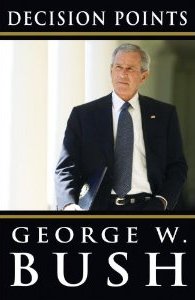
George W. Bush’s recently published memoirs, Decision Points, is in many ways a book of contradictions, where Bush unintentionally demonstrates his readiness to say one thing but do the complete opposite without realising the obvious discrepancy.
One of the more surprising aspects of the book is how Bush stresses his great love for of history and how widely read he is about that subject. But in an article in Klassekampen today I highlight how this is another of those discrepancies, for as one reads on it becomes more and more obvious that Bush himself learnt next to nothing from history.
He tells us how he was aware that wartime presidents tended to “overreach” – and then goes on to do so himself, without realising it. He recounts the mistakes made by the Soviet Union when they occupied Afghanistan – and then made most of the same mistakes (last Saturday was the day when the USA and NATO had been in Afghanistan longer than the Soviet Union).
He also accidentally reveals that neither he did learn much from the history of which he was himself part, as some of the mistakes made in Afghanistan were repeated in Iraq with disastrous consequences. And one cannot help noticing the contrast between how he stresses his admiration for his father’s achievements as president and how he obviously did not learn anything from it and therefore went on to make several of the mistakes his father was clever enough to avoid.
These discrepancies are almost a red thread through Bush’s autobiography, which clearly shows how the professed lover of history learnt very little from the lessons of history. Perhaps Napoléon I was right when he supposedly said that history teaches us that one learns nothing from history?
One of the more surprising aspects of the book is how Bush stresses his great love for of history and how widely read he is about that subject. But in an article in Klassekampen today I highlight how this is another of those discrepancies, for as one reads on it becomes more and more obvious that Bush himself learnt next to nothing from history.
He tells us how he was aware that wartime presidents tended to “overreach” – and then goes on to do so himself, without realising it. He recounts the mistakes made by the Soviet Union when they occupied Afghanistan – and then made most of the same mistakes (last Saturday was the day when the USA and NATO had been in Afghanistan longer than the Soviet Union).
He also accidentally reveals that neither he did learn much from the history of which he was himself part, as some of the mistakes made in Afghanistan were repeated in Iraq with disastrous consequences. And one cannot help noticing the contrast between how he stresses his admiration for his father’s achievements as president and how he obviously did not learn anything from it and therefore went on to make several of the mistakes his father was clever enough to avoid.
These discrepancies are almost a red thread through Bush’s autobiography, which clearly shows how the professed lover of history learnt very little from the lessons of history. Perhaps Napoléon I was right when he supposedly said that history teaches us that one learns nothing from history?
Labels:
American literature,
books,
history,
USA
Tuesday, 30 November 2010
New books: A crowded marriage
On the day of Franklin D. Roosevelt’s death his close friend and distant cousin Margaret Suckley wrote in her diary of Eleanor Roosevelt that “I believe she loved him more deeply than she knows herself, and his feeling for her was deep & lasting. The fact that they could not relax together, or play together, is the tragedy of their joint lives, for I believe, from everything that I have seen of them, that they had everything else in common. It was probably a matter of personalities, of a certain lack of humor on her part – I can not blaime either of them. They are both remarkable people – sky-high above the average”. The marriage of Franklin and Eleanor Roosevelt was arguably one of the most consequential marriages in history and much has already been written about it by their many biographers. But so far no book has dealt exclusively with the marriage from its beginning to the end and this is what the American author Hazel Rowley, perhaps best known for her book on Simone de Beauvoir and Jean-Paul Sartre, has intended to do in her new book Franklin and Eleanor: An Extraordinary Marriage, published by Farrar, Strauss and Giroux of New York just recently.
It is of course a well-known story and the sources available to Rowley have been consulted by many authors before her. Yet her well-written, engaging account of the Roosevelt marriage has potential for becoming one of the classic books on Franklin D. Roosevelt, one of the greatest US presidents, and Eleanor Roosevelt, the most significant of the country’s first ladies.
Rowley’s book provides a brief summary of the main protagonists’ respective backgrounds, but the main story is of course the marriage, which lasted for forty years. Thus the focus is more on the persons than the politics, but as politics was at the centre of the couple’s lives it all gets weaved together.
It is, in Rowley’s words, the story of the marriage’s “evolution from a conventional Victorian family into the bold and radical partnership that made Franklin and Eleanor Roosevelt go down in history as one of the most inspiring couples of all time”.
Although I have read many books about them already I keep getting astounded by the remarkable transformation of Eleanor Roosevelt, beginning in the early 1920s, from a rather conventional upper-class woman who professed her lack of interest in politics and held most of the same prejudices as so many others of her class and generation into a radical champion of freedom and a significant politician in her own right, who went on to play an important role on her own in her widowhood.
She never held elected office herself, but obviously grew into a great asset for her husband in his political career. Thus it was both a marriage and a political partnership which both of them would have been poorer without. But it was not always an easy one.
The late Diana, Princess of Wales famously remarked that there were three people in her marriage. In the marriage of Franklin and Eleanor Roosevelt there were a lot more than three persons. For 36 out of the forty years the marriage lasted Eleanor had to put up with a domineering, interfering mother-in-law, but a greater strain was perhaps the other women in her husband’s life.
Rumours, speculations and gossip have been ripe about various women, including Crown Princess Märtha. The President liked to be surrounded by adoring women he could charm, but Rowley concludes that only two of them really mattered to him in a way that might be called love – Lucy Mercer Rutherford and Marguerite “Missy” LeHand.
Eleanor indulged in a series of what Rowley calls “romantic friendships” with both men and women, of whom she sees Lorena Hickok as someone Eleanor Roosevelt really fell in love with. She obviously also had strong, romantic feelings for younger men such as Joseph Lash and David Gurewitsch, both of whom seem not to have reciprocated her feelings in the way she might have wished for them to do.
Eleanor and Franklin Roosevelt seem not always to have cared much for the other’s companions, with Louis Howe standing out as an exception. Howe was alone in meaning as much to both of them and Rowley greatly stresses his importance for their development
Although Rowley writes much on the crowd of other people in the lives of Franklin and Eleanor Roosevelt, this is not a book for gossips. It is to her credit that Hazel Rowley, unlike several other authors who have dealt with the Roosevelts and their relationship, does not rush to any conclusions and rather leaves the questions open if there are no satisfactory proofs to answer them definitely.
All in all she has produced a well-written (bar some unnecessary repetitions) and balanced account of the complex partnership between these two remarkable people. As I read it just after I had finished George W. Bush’s memoirs, I could not help being reminded of the words of the filmmaker and journalist Arne Skouen, who shortly before his death in 2003 remarked on the stark contrast between the then US administration and what he described as the decency he had experienced in the White House when he worked as a Norwegian publicity officer in the USA during World War II.
Thursday, 25 November 2010
New books: Distortion points
Since leaving office nearly two years ago, former US President George W. Bush has had the decency to remain quiet and not join those of his fellow Republicans who hurl unconstructive abuse at the current administration no matter what they do (or do not do) as they try to clean up the mess left by their predecessors. However, this month Bush has broken his silence by launching his memoirs, Decision Points, published by Crown Publishers of New York on 9 November, a week after his party regained control of the House of Representatives in the midterm elections. But Bush steers clear of current politics and rather focuses on his own career and the decisions he made.The book’s title is obviously chosen to highlight Bush’s preferred image as the great decider – he writes that when he entered politics, “I made a decision: I would confront problems, not pass them on to future generations”. “I prided myself on my ability to make crisp and effective decisions”, Bush congratulates himself and lets us know that making decisions was “the most important part of the job”.
Thus, rather than telling the entire story of his life and dealing with every issue he had to handle, he has chosen to structure the fourteen chapters of his autobiography around central decisions he made. He believes he “got some of those decisions right, and I got some wrong. But on every one, I did what I believed was in the best interests of our country”.
He has, however, not been consistent in this approach. While some chapters deal entirely with one decision or several related decisions, such as Iraq, others are a mix of miscellanea only loosely related to each other. For instance the chapter “Leading” covers the No Child Left Behind programme, the failed Social Security reform, his state visit to Britain, his 2004 re-election campaign and more.
The first chapter, “Quitting”, begins with his decision to give up his hard drinking, a decision without which “none of the others that follow in this book would have been possible”, and then goes on to chart his background and the first forty years of his life – without giving much details about the drinking, but assuring us that he does not consider himself an alcoholic.
The third chapter, “Personnel”, is more concentrated and deals entirely with the choice of key members of his staff. He reveals he had suggested Dick Cheney to his father as a running mate already in 1988 and stresses the importance of choosing a vice president “fully capable o assuming the presidency”. (Whatever one may think of Cheney this stands in sharp contrast to the irresponsibility of John McCain, who in a moment of desperation chose a running mate wholly unsuitable to assume the presidency – and thereby created a Frankenstein’s monster within the party).
The book is interesting and mostly well-written – better than Blair’s recent autobiography, which is quite surprising giving the stark contrast between Bush and Blair as communicators. But the big problem about it is that Bush thinks he can simply leave out those parts of the story which do not really fit in with his narrative and apparently expects that the reader will not notice. Of course neither one-sidedness nor selective memory is new for political memoirs. But several of the omissions made by Bush are so obvious that it makes the book far from convincing.
This becomes clear early on in the book. We have only reached page 16 when he writes heroically that when the draft was introduced during the Vietnam War, “my decision was easy” when faced with the choice of “join[ing] the military or find[ing] a way to escape the draft. [...] I was going to serve. [...] I would have been ashamed to avoid duty”. He goes on to tell us how he joined the Texas Air National Guard, omitting to mention that this choice of service guaranteed that he would not actually have to go to Vietnam.
During the presidential election in 2004 supporters of George W. Bush chose to cast doubt upon the wartime credentials of his opponent John Kerry, who had served in Vietnam and won several medals. This shameless act goes entirely unmentioned by Bush, who, however, vents his anger at Dan Rather at CBS having “aired a report influencing a presidential election based on a fake document” claiming that Bush had not served his required hours with the guard when he moved to Alabama to work on Red Blount’s Senate campaign.
In the same vein we hear that John McCain during the Republican primary of 2000 was “justifiably upset about insulting language some of my supporters had used in South Carolina” – read: “the smear campaign directed at him, his character and his family by my supporters”.
This tendency to give us only that half of the story which reflects well on him is present throughout the book, also when it comes to graver issues such as Guantanamo and the “War on Terror”. The prisoner camp at Guantanamo was established to avoid giving the prisoners the rights stipulated by the US Constitution. However, the only problem about Guantanamo was obviously that it was on the soil of the country ruled by Fidel Castro.
The prisoner camp (pardon, “detention facility” seems to be the correct newspeak term) itself was really a spa hotel, we are given to understand: “At Guantanamo, detainees were given clean and safe shelter, three meals a day, a personal copy of the Koran, the opportunity to pray five times daily, and the same medical care their guards received. They had access to exercise space and a library stocked with books and DVDs. One of the most popular was an Arabic translation of Harry Potter”. The prisoners must really have had a swell time in between the mistreatments.
He goes on to stress that “our humane treatment of the Guantanamo detainees was consistent with the Geneva Conventions”, but that “al Qaeda did not meet the qualifications for Geneva protection as a legal matter” simply because “the terrorists did not represent a nation-state” and the Geneva Conventions apparently only apply for wars between nation-states. This is of course one of the more dubious of the Bush administration’s reinterpretation of laws.
Bush frequently stresses how much history he had read and obviously hopes that history will save his reputation in the longer term. He states that he was “struck by how many presidents had endured harsh criticism” and reminds us that “[t]he measure of their character, and often their success, was how they responded. Those who based decisions on principle, not some snapshot of public opinion, were often vindicated over time”. But what strikes me is how often he points to history, yet failed to learn any lessons from it.
The book opens with a photo of George W. Bush standing among the ruins of the World Trade Center in September 2001. This was the peak of his presidency and is of course how he would wish to go down in history. “This conflict was begun on the timing and terms of others. It will end in a way, and at an hour, of our choosing”, he said in his speech at the memorial service held at the National Cathedral on 14 September 2001. Nearly ten years on these words seem even more incredibly naïve than back then.
The events of 9/11 redefined the entire purpose of his presidency. Here he points towards the lessons of history and writes on page 155 that he was “keenly aware that presidents had a history of overreaching during war”. He gives the examples of John Adams, Abraham Lincoln and Franklin D. Roosevelt, before adding that his own “most solemn duty, the calling of my presidency, was to protect America – within the authority granted to me by the Constitution”.
Interestingly, on page 169 we are told that his “most solemn responsibility as a president was to protect the country” and that he therefore “approved the use of the [enhanced] interrogation techniques”. In only fourteen pages the “authority granted to me by the Constitution” has dropped out of the context.
The importance of the Constitution is again brought up when he states that he wanted Supreme Court judges “who believed the Constitution meant what it said”. This comes from a man whose administration, as Anders Henriksen has shown in his interesting book Arven efter Bush – Præsidentembedet og krigen mod terror, subscribed to the so-called Unitary Executive Theory, which argues that the usual interpretation of the US Constitution’s words on the separation of power is wrong and that the original intention was that certain powers were reserved exclusively for the President and others exclusively for Congress, and used this theory in many creative ways to stretch the President’s authority, to ignore Congress, to reinterpret laws and conventions to suit their needs and how they by this sort of manipulation were able to justify (at least to themselves) their right to hold prisoners without giving them access to the judicial system, to treat prisoners in a way which we now know amounted to torture, etc. It should be added that the Unitary Executive Theory has few supporters among constitutional experts and was in the end soundly rejected by the US Supreme Court.
Bush maintains that what he calls “enhanced interrogation techniques” and used on prisoners of the “War on Terror” were entirely legal. Thus he replied “Damn right!” when asked to authorise water-boarding. This was in fact really great, he tells us, as they got so much out of it, including information which prevented attacks on Heathrow Airport and Canary Wharf in London – incidentally, these claims have already been rejected by British intelligence. (He misses out on the parallel, or rather contrast, to his own words in the debate on stem cell research: “Even the most noble ends do not justify any means”).
“[Y]ears later” (in fact as soon as it was revealed in 2004) some lawmakers “charged that Americans had committed unlawful torture”. According to Bush, this view was not only wrong, but also outrageous. “I had asked the most senior legal officers in the U.S. government to review the interrogation methods, and they had assured me they did not constitute torture”. Naturally Bush does not mention that the US after World War II executed as war criminals Japanese soldiers who had water-boarded American prisoners.
And even though countless legal expert, human rights activists, politicians and others agree that it was indeed torture, it seems that in Bush’s eyes the government’s own experts could not possibly be wrong – in that he reminds me of how Nixon famously told David Frost that things were not illegal if they were done by the President.
“To suggest that our intelligence personnel violated the law by following the legal guidance they received is insulting and wrong”, fumes Bush as he goes down in the history as the US President who with a light-hearted “damn right!” set aside human rights and became responsible for war crimes by authorising torture. This is indeed only the most serious example of how Bush throughout the book shows a tendency to mark out disagreement with his own views in strong terms as well as an inability to handle unwelcome truths.
This significant flaw to his character has obviously been with him for a long time. When he was a young man and his adored father lost his run for the Senate against Democrat Ralph Yarborough, the chaplain at Yale, an old acquaintance of his father’s, told him that he had been “beaten by a better man”. This was, in the words of the younger Bush, a “self-righteous attitude” which “was a foretaste of the vitriol that would emanate from many college professors during my presidency”. So it could not possibly happen to be the simple truth?
Howard Dean saying that “[t]he idea that we’re going to win this war is an idea that unfortunately is just plain wrong” is given as an example of the “hot” rhetoric on Iraq at the time of the 2006 midterm elections. To most others this would seem a truthful assessment of realities rather than “hot rhetoric”, but of course the truth may hurt when it does not correspond with what one wants to hear.
Similarly Edward M. Kennedy is castigated for “his vitriolic speeches, in which he claimed I had ‘broken the basic bond of trust with the American people,’ compared me to Richard Nixon, and called Iraq ‘George Bush’s Vietnam’”, all of it examples of a rhetoric which Bush wished he had been able to “tone down”.
When the New York Times drew a comparison between Afghanistan and Vietnam, Bush “was amazed the Times couldn’t even wait a month to tag Afghanistan with the Vietnam label”. However, the press’s role is not to act as cheerleaders for the government, but rather to present background and possible consequences of the events taking place. And nine years on, with no-one seriously believing the war in Afghanistan can be won, it seems the newspaper’s comparison has turned out to be a rather accurate foresight.
It is also striking how Bush frequently contradicts himself, apparently without realising that what he writes in one chapter entirely undermines the impression he has tried to create in another chapter. For instance he tells us on page 184 that in attacking Afghanistan “[w]e were acting out of necessity and self-defense, not revenge”, yet he has let us know on page 127 that his “first reaction” after 9/11 “was outrage. Someone had dared attack America. They were going to pay”, on page 128 that his “blood was boiling. We were going to find out who did this, and kick their ass” and on page 148 told us of how people he met in New York a few days after 9/11 told him to “find the bastards who did this and kill them”, himself adding: “This was personal”. When the first bombs fell on Afghanistan, “our troops had painted the letters FDNY” onto several on them for the New York fire-fighters who died on 9/11. When he was asked to authorise water-boarding he thought of those killed on 9/11 and on Daniel Pearl, the journalist who was taken hostage and killed by al-Qaeda, before replying “Damn right!” Obviously, revenge was actually a rather major reason for what he did.
“I supported the [Palestinian] elections”, he tells us, adding: “America could not be in the position of endorsing elections only when we liked the projected outcome”. This is one of the best examples of the blatant hypocrisy found in parts of this book, for obviously they could refuse to accept the outcome of that very election.
Another: That Harry Reid had “written off the surge [in Iraq] as a failure before all of the additional troops had even arrived” was “one of the most irresponsible acts I witnessed in my eight years in Washington”, writes the man who on false pretexts invaded a country without a plan B and hardly a plan A.
He insists that he really wanted a diplomatic solution over Iraq, which simply does not ring very convincing at all, particularly not compared to what other insiders have already written in their books. And he shows repeatedly that diplomacy and dialogue were not really his cups of tea. After January 2002 he never again spoke to Yassir Arafat before his death in November 2004, having concluded “that peace would not be possible with Arafat in power”; he would not talk to Ahmadinejad because doing so “would legitimize him and his views and dispirit Iran’s freedom movement”; and in general “[b]ilateral negotiations with a tyrant rarely turn out well for a democracy”.
Bush can be funny at times, as when he writes about the lawyer Jim Towey, among whose clients was Mother Teresa: “I used to tell Towey that we sure had a litigious society if Mother Teresa needed a lawyer”. But the most humorous parts of the books are the unintended ironies which occur when Bush does not have self-insight enough to understand how badly what he writes reflect on him. One delightful example is his telling us that his “favorite Bible verse for politicians is Matthew 7:3 – ‘Why do you see the speck that is in your brother’s eye, but do not notice the log that is in your own eye?’.”
One example of this could be Bush writing that the fact that President Mahmoud Ahmadinejad of Iran “used a United Nations speech to predict that the hidden imam would reappear to save the world” was one of the reasons why Bush started to think that “[t]his guy could be nuts”. He is certainly not alone in suspecting that, but still it seems a bit rich coming from a former world leader who has just filled more than 400 pages with references to “God”, “the Almighty” and “the Good Lord”, stressed the importance of talking to other leaders about their faith and given religion a place in politics, which is a very dangerous thing to do.
Bush’s account of the Middle East is so one-sided that one sees why even his mother (!) called him “the first Jewish president”, although Barbara Bush obviously made the classic mistake of treating the terms “Jewish” and “Israeli” as synonyms. He wrings his hand over the possibility that certain states such as Syria or Libya might acquire nuclear weapons but makes no mention of Israel’s illegal possession of such weapons, but this is of course entirely in keeping with US foreign policy.
Ariel Sharon was “a leader who understood what it meant to fight terror”. It might be added that the old general also knew quite a lot about carrying it out. The war in Gaza launched by Israel in January 2009 is casually described as “an offensive in Gaza in response to Hamas rocket attacks”. Indeed it was in response to such attacks, but still it will go down in history as one of the most disproportional responses ever carried out. Again, Bush misses out on the parallel when he writes that he told Dmitry Medvedev during the war against Georgia in August 2008 that “[t]he disproportionality of your actions is going to turn the world against you. We’re going to be with them”.
This again confirms that in Bush’s worldview there are different rules for different countries. The Bush doctrine is of course the very “personification” of these ideas. “If the United States had the right to defend itself and prevent future attacks, other democracies had those rights, too”, he writes when referring to Israel. Israel’s 2007 bombing of Syria is admiringly described as Ehud Olmert having “done what he believed was necessary to protect Israel”. But does this mean that any democracy has the right to attack any country by which it feels threatened (even on shaky grounds?). If so, it would mean the end of international law and world order.
The fondness for telling only the suitable parts of the story appears again in Bush’s account of the war against Iraq and its background. “Saddam Hussein didn’t just threaten his neighbors. He had invaded two of them, Iran in the 1980s and Kuwait in the 1990s”, Bush writes. The support given to Saddam Hussein in the war against Iran by the USA led by Bush’s fellow-Republican Ronald Reagan and assisted by among others the man who had gone on to become Bush’s own Secretary of Defense, does of course go entirely unmentioned. (“How can Donald Rumsfeld be so sure that Saddam Hussein has weapons of mass destruction? He’s got the receipts”, went one of the great jokes of 2003).
Bush is not beyond hinting about hidden motives behind other countries’ opposition to the war. In his eyes Vladimir Putin “didn’t want to jeopardize Russia’s lucrative oil contracts”, while “France also had significant economic interests in Iraq”. It could be added that the very same suspicions have been directed at Bush and Cheney.
Bush confirms that the idea of attacking Iraq was brought up by members of his administration immediately after 9/11. However, it was decided not to go ahead with that idea at the time and rather concentrate on Afghanistan first – and to do so with force. “Our response [to 9/11] would not be a pinprick cruise missile strike. [...] When America responded to these attacks, it would be deliberate, forceful, and effective”. It seems strength was more important than precision, which goes a long way in explaining the failure of the mission.
At first Bush followed in his father’s footstep by rallying an international coalition. “The coalition of the willing in the war against terror was forming, and – for the time being – everyone wanted to join”. What the interjection hints at is really one of the great failures of his presidency. After 9/11 almost the entire world showed its sympathy and solidarity with the USA – here in Oslo the pavement opposite the US Embassy was covered in flowers – but by his aggressive “lone ranger attitude” Bush quickly threw away most of this goodwill and alienate several allies.
As we know, the USA and a handful of other countries (primarily Britain) decided to launch a war on Iraq without a UN resolution. As Bush sees it this was obviously not a problem. “Dick [Cheney] and Don[ald Rumsfeld] argued we didn’t need one for Iraq [...]. After all, we already had sixteen”. This is a flagrant distortion of truth – there were indeed several UN resolutions dealing with Iraq, but none of them authorised an attack on the country.
They did succeed in having Saddam Hussein removed from power and eventually captured and killed, but they did also come very close to tearing Iraq apart and even seven years much remains to be fixed, to put it mildly. As many have suggested, some of the chaos might have been avoided if the attackers had had a clearer idea of what to do after the actual military campaign was over.
Bush indirectly admits that this was indeed true and that they did realise this even before they went in. “The military strike would be the easy part”, Secretary of State Colin Powell said, while Defense Secretary Donald Rumsfeld warned that “Iraq could fracture after liberation”. That they were aware of this yet still did not prepare properly for it speaks of great irresponsibility.
Bush admits that “we made two errors”: “the intelligence failure on Iraq’s WMD” and that they “did not respond more quickly or aggressively when the security situation started to deteriorate after Saddam’s regime fell”. “Cutting troop levels too quickly was the most important failure of execution in war”, he adds.
The surge is later portrayed as one of the great successes of Bush’s presidency, although extremely costly in human lives – perhaps it would not have been necessary if one had thought the whole strategy and consequences thing more thoroughly through in the first place? And why it took so long for him to realise that another strategy was needed is another of those questions left unanswered in this book.
The illegal invasion of Iraq was as we know based on the claim that Saddam Hussein possessed weapons of mass destruction. Yet these supposed weapons were never found and it is now clear that Iraq had complied with the UN resolutions and got rid of them. Like Tony Blair and other warmongers, Bush now has to admit that they invaded Iraq on a false pretext, which he somehow regrets. “In retrospect, of course, we should have pushed harder on the intelligence and revisited our assumptions. But at the time, the evidence and the logic pointed in the other direction”, he writes.
He stresses that he was not alone in believing that Saddam Hussein had WMD. “If Saddam didn’t have the WMD, why wouldn’t he just prove it to the inspectors? [...] If he cared so much about staying in power, why would he gamble his regime by pretending to have WMD?” Explanations which seemed possible to some of us already then were simply madness or that the dictator’s pride meant that he would not admit to having had to get rid of them. After his capture Saddam Hussein himself told the FBI “that he was more worried about looking weak to Iran than being removed by the coalition. He never thought the United States would follow through on our promises to disarm him by force”.
But if Bush regrets that the premises were wrong, he has no regrets about what they did and goes to considerable lengths to argue his case for why invading Iraq was the right thing to do, first and foremost because “the world was undoubtedly safer with Saddam gone”. But is that really the case?
Except extremists no-one disputes the fact that Saddam Hussein was one of the greatest bastards to walk upon earth, but at the time of the US-led invasion he was no longer in a position to pose much of a threat to the outside world. On the other hand the falling-apart of Iraq made the country a hotbed for terrorism and has helped the spread of terrorism, in other words the exact opposite of what Bush wanted.
Bush himself mentions that following 9/11 terrorists have “struck Bali, Jakarta, Riyadh, Istanbul, Madrid, London, Amman, and Mumbai”. Hardly a week goes by without reports of plots uncovered and terror attempts foiled. It might well be argued that the world is less safe today than a decade ago and that Bush bears parts of the blame for this.
“For all the difficulties that followed, America is safer without a homicidal dictator pursuing WMD and supporting terror at the heart of the Middle East. The region is more hopeful with a young democracy setting an example for others to follow”, Bush writes. But not only has the region seen an increase in terrorism, it has also seen the dangerous strengthening of Iran, which happened while the world was preoccupied with Iraq. Much of the same is true about North Korea.
“Imagine what the world would look like today with Saddam Hussein still ruling Iraq. He would still be threatening his neighbors, sponsoring terror, and pilling bodies into mass graves”, says Bush. To a large extent this role has now been taken over by Iran. “The most volatile region in the world lost one of its greatest sources of violence and mayhem”, Bush tells us, without adding that the war he started provided the chance for another such source to replace it.
Later he tells us that Iran’s refusal of European offers of support for a civilian nuclear program made him conclude that “[t]here was only one logical explanation: Iran was enriching uranium to use in a bomb”. The failure of his so-called logical explanations relating to Iraq’s supposed arsenal of WMD does not seem to have weakened his trust in his own judgements.
This was in fact “a major decision point”. Iran could not be allowed to develop nuclear weapons as it will enable them “to dominate the Middle East, blackmail the world, pass nuclear weapons technology to its terrorist proxies, or use the bomb against Israel”.
But is not the fact that Iran has come this far really also a result of the Iraq war, which strengthened Iran while the world looked away to other preoccupations? Rather, Bush was “confident that the success of the surge and the emergence of a free Iraq on Iran’s border would inspire Iranian dissidents and help catalyze change”. That the very opposite has happened must be added to the list of failures caused by Bush’s foreign policy and the war on Iraq.
About that war Bush assures us that “[t]here was one person with the power to avoid war, and he chose not to use it”. He refers to Saddam Hussein, but actually it was Bush himself who was that person. So this, perhaps his most important and ill-fated decision, has suddenly become Saddam Hussein’s decision, although ultimately the responsibility for the war and all the tragedies, hardships and difficulties it created lies at Bush’s own door.
But as the failure of his presidency folds out Bush shows a marked tendency to blame others than himself. “Nobody was lying [about WMD]. We were all wrong”. Not really everyone, but more importantly: Bush, not all of us, was the one to decide.
His 2004 Democratic opponent John Kerry’s “argument that I had misled the country on Iraq didn’t pass the commonsense test. As a member of the Senate in 2002, he had access to the same intelligence I did and decided to cast his voice in support of the war resolution”. But still there is a difference between leaders and fellow-travellers.
When he infamously declared victory in Iraq on 1 May 2003, he “hadn’t noticed the large banner” reading “Mission Accomplished” which had been placed behind him by “my staff”. “It was a big mistake”, he admits, but obviously it was the staff’s mistake.
The press team was to blame for having “ushered photographers into the cabin” when Bush flew over New Orleans looking aloofly down on the devastation caused by hurricane Katrina – perhaps the lowest of the many low points of his presidency. Bush himself “barely noticed them at the time; I couldn’t take my eyes off the devastation below”. NBC News’ Brian Williams is obviously also to blame for having reported predictions that Katrina would not actually hit downtown New Orleans.
Bush himself had absolutely nothing whatsoever at all to do with the reasons for the financial crisis which hit his country and spread to the rest of the world towards the end of his presidency after he had managed to turn the surplus inherited from Bill Clinton (much of it “an illusion”, according to Bush) into a record deficit. The whole crisis was caused by “[a] relatively small group of people – many on Wall Street, some not – [who] had gambled that the housing market would keep booming forever”. The people would wonder why the state was “spending their money to save the firms that created the crisis in the first place”.
When Paul “Jerry” Bremer issued orders banning members of the Baath Party from serving in the new Iraqi government and disbanding the Iraqi army, “I should have insisted on more debate on Jerry’s orders”. So it was really Jerry’s fault, not Bush’s. Bush only approved it too quickly.
Harry Truman famously had a sign reading “The buck stops here” on his desk reminding him that whatever happens on his watch is ultimately the President’s responsibility – he cannot kick the buck further up and blame others. Bush has no such reservations and happily passes the blame on to his staff, the press team, Jerry, Kerry, firms, a relatively small group of people and even random journalists.
He does admit to certain mistakes, but it is frequently how things appeared and reflected on him he regrets rather than the actual events. “Not disclosing the DUI [drink-driving conviction] on my own terms may have been the single costliest political mistake I ever made”. When the photos of prisoners being mistreated in the Abu Ghraib prison were published, “America’s reputation took a severe hit. [...] I was not happy with the way the situation had been handled”. And that is virtually everything he has to say about Abu Ghraib.
“I am frustrated that the military tribunals moved so slowly”. Guantanamo “was necessary”, but “had become a propaganda tool for our enemies and a distraction for our allies”. His “one regret” about the PATRIOT Act is not its contents, but the name, which is short for “the Uniting and Strengthening America by Providing Appropriate Tools Required to Intercept and Obstruct Terrorism Act” and which he assures us was chosen by Congress, not himself. In hindsight he “should have pushed Congress to change the name of the bill before I signed it” as “there was an implication that people who opposed the law were unpatriotic”.
“The toxic atmosphere in American politics discourages good people from running for office”, he writes. But to what extent is he himself responsible for having created this “toxic atmosphere”? Surprisingly, in a rare bout of self-insight he admits that “[n]o doubt I bear some of the responsibility as well” and adds: “Whatever the cause, the breakdown in bipartisanship was bad for my administration and bad for the country, too”. Indeed. And that this extreme polarising of American politics now threatens to leave the country almost ungovernable is one of the saddest parts of the legacy of the Bush presidency. It is to his credit that he at least presents one constructive idea for what might possibly be done to adjust this.
There is of course also a lot one misses in this book. How did it feel to assume the presidency under the circumstances he did, i.e. based on a 5-4 Supreme Court decision and having received half a million votes less than his opponent? Incidentally, Bush forgets to mention that he lost the popular vote. What is the justification for taking lives, which he frequently authorised while Governor of Texas and as commander-in-chief? He frequently mentions several of the Americans killed or injured in action and carefully gives the number of 4,429 “American service members who gave their lives in Iraq during my presidency”. Did he ever spare a thought for those others killed, for instance the 66,081 innocent civilians killed in Iraq between 2004 and 2009?
Environmental issues and climate change, arguably one of the most important issues of our day, is dealt with in a single sentence describing it as “something that might be a problem fifty years from now”. True leadership is also about laying the foundations for a better future and doing what is in one’s power to prevent future disasters, but in this case it seems lost on a president who declares that he had entered politics with an intention to “confront problems, not pass them on to future generations”.
Bush tells us that it was said about Treasury Secretary Henry Paulson that “his brain was moving too fast for his mouth to keep up. That didn’t bother me. People accused me of having the same problem”. Did they really? Is he sure it was not the other way around with him?
As one reads this book one is left with the impression of a man who really does not get the bigger picture. For politicians to twist the truth in autobiographies in order to present themselves in a better light is of course nothing new, but this politician thinks he can leave out those parts of the story that does not really fit in with the picture he intends to give, and at the same time he makes self-contradictions which undermine his narrative and shows that he does not really understand how some of the things he write actually point back at him in a rather bad way.
The best example of the latter is the way he ends the book with an oft-told anecdote about how he took his dog for a walk a few days after he had left the White House. “There I was, the former president of the United States, with a plastic bag on my hand, picking up that which I had been dodging for the past eight years”.
Did he not realise what a great metaphor this is for the mess he had left behind for others to pick up?
Sunday, 15 August 2010
New books: Habsburg drama
In Destiny’s Hands: Five Tragic Rulers, Children of Maria Theresa is the somewhat overwrought title of a somewhat overwrought new book by Justin C. Vovk, who, according to the book’s cover, is “a critically acclaimed historian whose work is archived in the Library of Congress”. This sounds quite pretentious as this is his first book and as far as I know nearly everything published is “archived in the Library of Congress” – I think they have at least one of my books as well.Basing his work entirely on secondary sources, Vovk builds his book over the same pattern as Julia Gelardi’s Born to Rule: Granddaughters of Victoria, Queens of Europe (2005) and his subjects are Empress Maria Theresia and what he describes as her five “reigning” children – the Emperors Joseph II and Leopold II, Duchess Amalia of Parma, Queen Maria Carolina of Naples and Queen Marie-Antoinette of France.
The Duchess of Parma is the one we hear the least about and also the one the author seems to have least sympathy for, while the lives of the other four are more or less equally covered. Maria Theresia herself is another main figure in this book. These five out of sixteen children have been chosen because they were, in the author’s words, those of the Empress’s children who came to rule states.
But out of these five only two did in fact reign. Yet all of them are constantly referred to as “reigning” or “rulers” and we learn that “[t]hey all shared the same experience of becoming a monarch”. But the spouse of a monarch is as little a monarch as the spouse of the President of the USA is head of state or Commander-in-Chief.
We are told that the fact that it was Amalia’s husband who was Duke of Parma, “in no way diminished her role as a reigning consort”, but this term is clearly an oxymoron. And when Maria Carolina marries the King of Naples, we learn that “she was now the reigning Queen of Naples”.
The author does not make a lot of factual mistakes (there are however some, such as the claim that Marie-Thérèse was Marie-Antoinette’s last surviving child at the time of the latter’s execution), but he obviously struggles with the terminology. “Leopold was now heir apparent to the imperial throne”, he states, before adding that “only a unanimous election could make him emperor”. But one cannot possible be heir apparent if an election is needed and one can hardly be heir apparent to an elective monarchy at all. And Marie-Antoinette, the youngest but one of sixteen children, was certainly not Maria Theresia’s heir, although Vovk writes about the Empress and Louis XV agreeing about “the marriage of their heirs”.
Despite the author’s annoying insistence on referring to all of his subjects as rulers, it is true that two of the imperial daughters who became the consorts of monarchs – Amalia of Parma and Maria Carolina of Naples – came to wield great influence in their adopted countries. Maria Carolina’s husband was, in the words of a historian, “born to be ruled by others” and Vovk writes: “There was never a question of who was in charge. Queen Maria Carolina knew exactly how to control King Ferdinand. She masterfully crafted a smokescreen of melodrama and marital discourse that made hum submissive to her will”.
Queen Marie-Antoinette cannot really be said to have wielded the same sort of influence in France and thus cannot be called the ruler of France neither in name nor in reality. Yet the author writes of how she and Louis XVI travelled to Reims for “their coronation”, which made her “the first reigning queen to attend a French coronation since 1549”. But not only was she not a reigning queen; it was furthermore only Louis XVI who was crowned, making it his coronation and not theirs.
The author does not at all dwell on the reasons why Marie-Antoinette was not crowned, which could be seen as a symptom of the animosity displayed towards her even early in her husband’s reign. But this animosity is not something Vovk will go to any length to try and explain to the reader; in his version, Marie-Antoinette was entirely without any human faults or shortcomings. Axel von Fersen only makes a brief appearance as a letter-writer and courtier and is never directly linked to the Queen. The story of the unconsummated marriage, which was certainly of enormous dynastic consequences and which will be familiar to anyone who has read anything about Marie-Antoinette, goes entirely unmentioned. The portrayal of Joseph II as quite simply an enormous failure also tends to speak of a tendency to paint people in black and white.
There are some gross simplifications, such as the assertion that Napoléon “engulfed it [the continent] in the flames of war”. Those wars had started before Napoléon came along and he was certainly not alone in prolonging them, as the author also acknowledges when he writes about how Britain broke the peace of Amiens because it was in its own interest to do so. Hand in hand with the simplifications go the many exaggerations, such as referring to Catherine Mary Bearne, who a century ago wrote some romanticised royal biographies full of tittle-tattle, as a “famed historian”.
Both the author and the publisher could have made more of an effort about the language, which contains rather too many clichés – clichés which occasionally contradict each other. On page 208 we read: “If the French monarchy were an opera, then the Diamond Necklace Affair would be its closing act”. On page 210 we read: “The death of Princess Sophie marked the beginning of the end of Marie Antoinette and her family”. But can the beginning of the end really take place after the closing act?
On page 250 Leopold II’s death gives the author cause to write that “[t]he Holy Roman Empire mourned the passing of a sovereign for the second time in two years”, but what he writes on page 233 about how “[t]housands of people [had] lined the streets of Vienna to say good riddance” during Joseph II’s funeral and thrown rocks, mud and other objects at the coffin, does not exactly convey the sense of a people in mourning.
There are also some translations from German which make absolutely no sense, such as the following ending to a letter: “Although I am more than persuaded, that such a loss cannot be repaired, I dare to offer you in me, who in friendship, attachment, [and] true and sincere interest in everything that could interest you in all ways”. What? The author will insert a “[sic]” after words spelt in an older manner or according to English rather than American grammar, yet he will himself make a rather high number of grammatical mistakes, including some rather basic ones.
And then there are some downright silly statements, such as the claim that the Duke of Lorraine upon marrying Maria Theresia “took the name Francis Stephen” – of course he did no such thing, as taking an English name would make no sense for a man about to become Emperor of the Holy Roman Empire. The same goes for the claim that Felipe of Spain “took the name Philip” when he became Duke of Parma.
But what is most annoying about this book is the constant insistence on drama or tragedy even where there is none. Emperor Franz Stephan had a “dramatic funeral”, but we never hear of any drama played out during this ceremony. The Augustinerkirche in Vienna is also “dramatic”, although I personally found it quite peaceful when I visited it last summer.
“But the conclusion of the war and the restoration of peace in Austria would pale in comparison to the tragedies that were about to befall Emperor Leopold II and Queen Marie Antoinette” is just one example of how we are constantly told of grim forebodings and unexpected fates. These often begin with words such as “No one could know that...”, but the author often overdoes it. When a queen gives birth to her second son it is not an entirely unimaginable possibility that this second son might one day be king – history is full of second sons acceding to thrones, either of their own countries or of another kingdom.
On the other hand there are some refreshing anecdotes, such as Maria Theresia writing to her daughter about her future husband: “Although an ugly prince, he is not absolutely repulsive…at least he does not stink”. One would wish Vovk had included more of this and less of the melodrama.
The story which forms the backdrop for Vovk’s book is certainly fascinating and the most valuable aspect of this book is that it tells the stories of some interesting, lesser-known individuals as well as those of their more famous siblings - my main reason for reading this book was a desire to learn more about Queen Maria Carolina of Naples.
The book is not bad in itself, but as I read on I eventually began feeling rather tired out by the constant melodrama and all the exaggerations. The book is otherwise held in an accessible, easily read prose and the author seems to have the potential for becoming a good storyteller. My advice to the author would therefore be to take some time to learn and understand the correct terminology of his subject and to work on restraining his sense for melodrama.
Thursday, 4 March 2010
Book news: Tony Blair’s memoirs due in September
It was announced today that former British Prime Minister Tony Blair’s memoirs will be published in September. The book, titled The Journey, is due to be published by Random House. As one of the most significant political figures of recent years, Blair’s memoirs can be counted on to give his version of his premiership’s successes, such as constitutional reforms and the Good Friday agreement, and its great failure, the Iraq War, which has so far almost entirely overshadowed the rest of his legacy (although we can expect the failure to be fermently denied).Tony Blair’s “partner in crime”, George W. Bush, will also appear in print this autumn, with the memoir Decision Points. This book will not be a traditional autobiography, but focus on some of the key decisions made by Bush as President of the USA. Meanwhile Karl Rove is releasing his own memoirs, Courage and Consequence: My Life as a Conservative in the Fight, this coming Tuesday.
http://www.guardian.co.uk/books/2010/mar/04/tony-blair-memoirs-september
Labels:
American literature,
books,
Britain,
British literature,
history,
politics,
USA
Tuesday, 23 February 2010
New books: The battle for the White House
The US election campaign in 2008 was one of the most exciting presidential races in recent years. Not only because virtually any outcome would result in a historic first (the first black president, the first female president, the first Mormon president or the oldest president ever to be sworn in), but also because of its intensity and length, with the Democratic nomination fight going on all the way to June rather than finishing in the winter.Many books have already been written about the campaign, but the latest addition, Game Change: Obama and the Clintons, McCain and Palin, and the Race of a Lifetime by political journalists John Heilemann and Mark Halperin (the UK edition is titled Race of a Lifetime: How Obama Won the White House), seems already to have ascertained its place as the classic account.
It is indeed a gripping account and a book which is hard to put down, offering much new insight into what went on behind the scenes during that dramatic campaign. Thus it can be recommended to anyone with an interest in US politics or election campaigns in general, but it also has some obvious weaknesses.
The most serious one is that no sources are given. The authors maintain that they have spoken to most people mentioned in the book, but as no sources are ever identified, it is difficult to evaluate the credibility of what we are told.

Another, but lesser, weakness is that the Democratic campaign is given much more space than the Republican. This can be defended for two reasons – that it lasted longer and was therefore more exciting, and that the Democrats won the election. But 270 pages on the Democratic primaries and less than fifty out of the book’s about 450 pages on the Republicans, followed by 100 pages on the general election campaign, is a very uneven balance which left me wishing to know more about how John McCain became the Republican nominee.
It might seem that the Republicans, as so often before, chose to nominate the party elder who was “next in line”. Yet, as the authors do acknowledge, McCain was at a certain stage almost counted out of the race. He ran a fairly amateurish campaign, but still managed to stage a comeback and win the nomination. It might have improved the book if they had tried harder to explain how that came about.
The book is very much centred on the people, particularly Barack Obama, the Clinton couple, John McCain and Sarah Palin, and to a certain extent John Edwards. There are some entertaining bits, such as Hillary Clinton not wanting to be Vice President because she had already been so, and Obama not wanting to choose her to be VP because he thought one could not possibly have three presidents in the White House.
But the focus on the persons and their actions and choices leaves little place for issues and strategies. Having read the book one may have got a better picture of how Obama won, but not why he won. What were the issues, if any, which made him stand out among the contenders? And little is said about the Obama campaign’s quite innovative mobilisation of the “grass roots”.
The authors take little, if any, human considerations. With their strengths and weaknesses, Obama and Hillary Clinton emerge from it with the fewest bruises, while Bill Clinton is portrayed as a troublesome block around the foot of his wife’s campaign and a loose gun on deck, but who still did his “duty” in the end.
Few of the main players in this book make such a bad impression as that ambitious, conceited and deceitful John Edwards. Not even his terminally ill wife, Elizabeth Edwards (who is now divorcing him after he has acknowledged what is said almost straight out in this book – that he was indeed the father of the child born to one of his campaign workers), is spared.
But then Sarah Palin comes along. An unreliable populist who was prone to blame her failures on anyone but herself, whose gross ignorance involved such things as having no idea why North and South Korea were two nations and not possibly being able to remember if her Democrat counterpart’s name was Joe Obiden or Joe O’Biden, yet believed her nomination for Vice President was the will of God. The book makes it clear that the choice of Palin to be McCain’s running mate was made only at the last moment, after it had become clear that they could not go through with picking the independent Democrat Joe Lieberman, and was made in such a haste that there was almost no time to check her credentials in a proper way.
John McCain himself seems more sympathetic. But when one reads about his recklessness, his temper which apparently made it nearly impossible to utter a sentence without the F word, how he in the wake of the financial crisis insisted on a bipartisan White House meeting yet wasted the time to prepare for it by chatting with his wife about tonight’s dinner on the phone before contributing absolutely nothing to the meeting, and not least the irresponsibility by which he, a 72-year-old cancer survivor, without any proper vetting chose such a person as Sarah Palin to be a heartbeat away from the Oval Office, it seems clear that the reason why he lost the election was probably not only because of Barack Obama’s strengths, but also because John McCain himself had little to offer his country when it came to leadership and was himself unfit for the presidency.
Saturday, 21 November 2009
New books: The nanny and her nephew
The Prince and the Nanny: The Life of Prince Harald, now King of Norway, as told in Historical Context and through the Journal of his Nurse, Inga Berg is the title of a book I found in a museum shop here in Oslo earlier this week. Written by Odell M. Bjerkness and published by Skandisk in Bloomington, Minnesota, the book is based on the diary kept by the author’s late aunt, Inga Berg, when she worked as a pediatric nurse caring for the then Prince Harald between March 1937 and July 1938.The author, who is said to be a Professor Emeritus (what discipline is not mentioned) apparently considers his aunt’s diaries a source of great historical value. In reality they are almost entirely without interest. A typical diary entry reads: “Cloudy, but he’s still outside today and in a great mood. Sleeps well at night and slept until 5:00 A.M. this morning [sic]” or “Sun, but cold wind. Took a picture of the Prince and me. He cried”.
This rather monotonous day-by-day account of the Prince’s weight and mood, the weather and what was for lunch is supplemented by an introduction, a postscript and footnotes by Bjerkness. The subtitle promises a “historical context” – the author therefore starts with Norwegian unification in the 9th century and goes on to describe some events in Norwegian history and his aunt’s family background, and after she leaves royal service he summarises the Second World War and the births, deaths and marriages in the royal family up until the present day. Americans of Norwegian descent are often more proud to be Norwegian than Norwegians themselves and subsequently the author or publisher, in a rather distasteful manner, puts a Norwegian flag on top of every other page.
The “facts” presented in his footnotes and chapters of “historical context” are nearly always wrong. When it comes to history he is blatantly ignorant of the nature of the 19th century union between Norway and Sweden. The Swedish Parliament had as little say in Norwegian affairs as Norway’s Parliament had in Swedish issues, yet the author tells us that King Carl XIII ruled Norway “with the oversight of Sweden’s parliament”. The Royal Palace in Oslo (which is not a castle) was not built by the Swedish monarchy, but by the Norwegian State. It could be added that no royal has ever married in the Palace Chapel and that King Olav did not use Oscarshall Palace as a summer residence.
It was in 1814, and not when the union came to an end in 1905, that Norway became independent. Bjerkness claims that Norway in 1905 “surveyed those European royals with the highest probability of Norwegian ancestry”. This is just silly – naturally there were more important concerns than that to be considered. Women did not take part in the referendum by which King Haakon was elected.
Fritz Wedel Jarlsberg, who was one of the Norwegian negotiators in 1905, was not a Count, as he was born more than three decades after nobility was abolished in Norway. And Mr Wedel was certainly not “the recipient of the Nobel Peace Prize” – it is beyond me what that ludicrous figure could possibly have accomplished to be so honoured.
Professor Bjerkness also shows himself ignorant of the Norwegian Constitution when he tells us that the State Council includes “the prime minister and other select government officials”. In fact it consists of the King and all the ministers of the government. Later the Professor has changed his mind as well as forgotten his Montesquieu when he informs us that the State Council consists of “leaders of government and the Storting”. King Haakon is said to have “transferred his duties as Commander of Norwegian armed forces to his son Olav” during the Second World War, but this is not constitutionally possible – Crown Prince Olav did however become Chief of Defence. Bjerkness also lets us know that “the coronation language” (whatever that is) was abolished by Parliament in 1908 and that neither Olav V nor Harald V were therefore crowned, which is a bit surprising to read as it comes merely one page after he has told us that King Olav was indeed crowned. He also tells us that “a Prince of the Royal House may not marry a commoner without consent of the king” – in fact he may not marry at all without the King’s consent.
Family issues are not Bjerkness’s strongest side either. Princess Ragnhild’s birthday is mistakenly given as 4 June rather than 9 June, Marius Borg Høiby is not born in 1996 but in 1997 and Crown Princess Märtha’s eldest sister was called neither Margarethe nor Margrethe, but Margaretha. There has never been an Åke Bernadotte in the family and Folke Bernadotte was not titled “Count of Sweden”. After the German attack in 1940 Crown Princess Märtha did not go to Fridhem and Fridhem was anyway not the estate of “Märtha’s brother, Carl Bernadotte”, but of her parents. She did on the other hand go to Frötuna, the estate of her cousin Carl Bernadotte. I also doubt that there were concerns during WWII that Queen Victoria of Sweden would influence her husband “in favor of Germany” – by then she had in fact been dead for a decade.
He also makes mistakes about the location of places in both Oslo and Stockholm, upgrades Asker to a town and tells us that Aftenposten is the largest newspaper in Norway, a position which is in fact held by VG. It is not correct to say that Queen Maud was unable to speak Norwegian and she did not die at Marlborough House, but at the London Clinic. Not cancer, but cirrhosis of the liver, was the cause of Crown Princess Märtha’s death and when King Olav died people did not place candles in the palace courtyard, but in the Palace Square in front of the Palace. I also find it hard to imagine that King Olav “often traveled alone by train to his mountain cabin”.
The author, who claims that he “continued to have ongoing contact” with the royal family, wants us to believe that Princess Ingrid Alexandra is “the first Norwegian queen to be born on Norwegian soil in 600 years”. Obviously she is not yet queen and when she becomes so she will follow her mother and grandmother, who are both born on Norwegian soil.
When it comes to the position of women in Norwegian society, Bjerkness grandly writes that “women have recently held top government positions including Supreme Court Justice [which is by the way not a government position], Minister of Defense, and Prime Minister. Determined and succesful women like Inga Berg are no longer exceptions in Norway”. Some of us would think that for a woman to be a pediatric nurse in the 1930s is not exactly comparable to a woman becoming Prime Minister in the 1980s.
In an appendix Professor Bjerkness tells us that kings and queens in Norway are generally titled His or Her Royal Highness, although some people in formal writing choose to use His or Her Majesty instead. Consequently he writes about “HRH King Haakon VII”, “HRH Queen Maud”, “HRH King Olav V”, “HRH King Harald V” and “HRH Queen Sonja”. When his aunt in her diary refers to Queen Maud as “Hennes Majestet” Bjerkness translates it as “Her Highness”. We also learn that as the King’s “two sisters Ragnhild and Astrid, were married in civil ceremonies, they have not been given the title ‘Royal Highness’, by King Harald but each has retained the title of Princess”. Both princesses were in fact married in Asker Church.
Other mistakes could also be pointed out and all this gives the lie to the preposterous claim on the book’s back flap that “Thanks to Odell’s meticulous research and undying enthusiasm, The Prince and the Nanny is a treasure that capitalizes on his gifts as a historian and a linguist for the benefit of us all”. In fact this is a book of no historical value or interest.
Labels:
American literature,
books,
Glücksburg,
Norway,
reviews,
royalty
Sunday, 25 October 2009
New books: The Kennedys, by one of them
Edward M. Kennedy was alone among the Kennedy brothers in reaching old age. That also meant that he was the only of them able to write his memoirs. But only just – True Compass: A Memoir arrived at his home from the printers on in the morning of the day of his death and was published in the USA on 14 September. It is an insightful account from the inside of American politics and of the Kennedy clan.Although “Ted” Kennedy, a Senator for 46 years, made a good career in politics he will of course be remembered not only for that, but also for his role in the legend that was the Kennedy clan. Joseph and Rose Kennedy’s four sons and five daughters fascinated and appealed to the people of the USA and abroad in a way that no other American family has done.
Senator Kennedy begins his autobiography with the illness that afflicted him in 2008 and which lead to his death this August, writing that “the dire implications” of it made him realise that “my own life has always been inseparable from that of my family” and that the term “family” “virtually defined my entire consciousness”, concluding: “My story is their story, and theirs is mine. And so it shall be in these pages”. Thus the book deals not only with his own life and career, but also with those of his parents, brothers and sisters. That alone makes it stand out among the floods of Kennedy books – this is one of the few where a central member of the family tells the story himself.
His father, Joseph P. Kennedy, is portrayed as the patriarch of the family who was a strong presence in the lives of his children until a stroke deprived him of the ability to speak in the early 1960s. Strict, but fair, well-meaning and genuinely concerned about his children seems to be the essence of his son’s view, which mostly leaves out the darker sides of Joseph P. Kennedy’s activities.
Ted Kennedy denies the oft-repeated myth that his father had “designated” all his sons for high office, with the eldest brother, Joseph Jr, to be President of the USA. “My eldest brother’s political ambitions were entirely his own”, the youngest brother writes. Those ambitions came to nothing when Joseph P. Kennedy, Jr was killed on active service during WWII. A few years after the war ended, the eldest sister, Kathleen, Marchioness of Hartington, was also killed in a flying accident. Thus “Teddy” had lost two of his siblings to violent deaths when he was only 16. But, as we know, worse was to come.
The second oldest brother, John F. Kennedy, obviously meant much to “Teddy”, who describes him as “my mentor, protector, wise counsel, and constant friend” – in fact he was also his godfather. There are many fond memories of the elder brother recalled in the pages of this book. Edward Kennedy’s first campaigning was done on the behalf of his brother and the three surviving brothers all had the chance to work together politically when “Teddy” became a Senator in 1962, while John was President and Robert Attorney-General.
After the assassination of President Kennedy in November 1963 the youngest brother “was so worried about Bobby that I tried to suppress my own grief”. He pushed away his grief inside him. He was himself nearly killed in a plane accident the following year and then, in 1968, came Robert F. Kennedy’s presidential campaign, which “Teddy” was actively involved with until it was so brutally brought to an end by another assassin’s bullet. He was almost knocked to the ground by this fourth tragedy and he rejected all suggestions that he should run for president himself. In the following years he also turned down repeated offers of the vice-presidential slot on several election tickets.
His brothers “established a soaring standard for public service”, the author writes, a standard which “to a great extent has defined my life and my aims. I have always measured myself against that standard. Jack and Bobby were my heroes”. The sole survivor of the brothers continued their work in the Senate, where he sat until his death. The great causes of his political career – civil rights and health care in particular – are extensively dealt with in the book, as is natural in a politician’s memoirs.
But there are also a succession of “lesser” issues, Supreme Court nominations and other political events which he mostly manages to relate in a way which does not become boring. But it should be pointed out that there are some mistakes and inaccuracies which are really quite unnecessary in such a book (there was for example no presidential election in 1994, Ronald Reagan was inaugurated in 1981 rather than 1980 and Vladimir Putin was certainly not “Soviet President”).
Edward M. Kennedy lived almost his entire life in the public spotlight – thus the world came to share not only his joys and triumphs, but also his tragedies and his failures. When he was caught cheating at a Harvard exam, his father told him: “There are people who can mess up in life and not get caught, but you’re not one of them, Teddy”. He did mess up a few times during his life and could therefore not avoid addressing these episodes in his memoirs.
The gravest was of course the Chappaquiddick tragedy in 1969, when the Senator accidently drove his car into a lake and did not alert the police until the next day, by which time a young woman passenger who was unable to escape from the car had suffered a painful death by drowning. He once again denies rumours that he had an extramarital relationship with this young woman and acknowledges, as he has done many times before, that his “actions were inexcusable”. However, what seems to have been the worst part of it all for him was the thought that he might have “shortened my father’s life from the shock I had visited on him [...]. The pain of that burden was almost unbearable”.
This was certainly the nadir of Edward Kennedy’s life and career, but, although the accident would haunt him for the rest of his life, he managed to rise again and restore himself to a place of national importance. In fact, he probably achieved more during his nearly five decades in the Senate than his brothers ever had the chance to do in the short time they held their more powerful positions.
He came to work with many presidents, but concludes that in “my nearly fifty years of public life, we have not had a president as successful as FDR. The closest we’ve come (family relations excluded) is Lyndon Johnson. Civil rights was the issue of our time. He picked up that unfinished work and ensured the passage of the Civil Rights Act and Voting Rights Act. If he hadn’t, we certainly wouldn’t be where we are today”.
Kennedy seems to have respected the elder George Bush, while his enthusiasm for John Kerry speaks volumes of his views of George W. Bush. Ronald Reagan is portrayed as a light-weight president who mostly preferred talking about anything but the issue at hand, while Kennedy asserts that he has “remained a close friend of Nancy Reagan”. Among the presidents, the harshest judgements are reserved for Richard Nixon and Jimmy Carter.
In 1984 Kennedy took the dramatic decision to challenge the incumbent president for the party’s nomination, stating that he “felt almost forced into the decision by what I saw as Carter’s dragging down of the country and the party”. Kennedy lost the nomination to Carter, who then lost the presidency to Reagan, something Carter has often blamed Kennedy for. In Kennedy’s eyes Carter did not need much “help” losing the election.
The 1990s were on the whole a good decade for Edward Kennedy. Following the divorce from his first wife in 1981, he married his “soul-mate” Victoria Reggie in 1992 and became a happier man. Yet the 1990s also held their share of grief – the death of “dear Jackie [...], heartbreakingly young at sixty-four”, the passing of his 104-year-old mother, which made him feel as if “the legs had been knocked out from under me”, and the tragic plane accident which claimed the lives of John F. Kennedy, Jr, his wife and her sister. “A lot of people have wondered whether John ultimately would have sought public office”, his uncle writes. “I think he might have, and that he would have excelled”.
One of Edward M. Kennedy’s last public appearances was at the Democrat party convention in August 2008, when the mortally ill Senator declared in his speech that “this November, the torch will be passed again to a new generation of Americans”. He came to believe that Barack Obama “was the candidate we needed now at this time in our history” and that “history had handed us that rarest of figures, one who could truly carve out new frontiers”. But then illness cut Kennedy down. He lived to see Obama installed as President of the USA, but he did not live to see what the results may be.
Labels:
American literature,
books,
politics,
reviews,
USA
Subscribe to:
Posts (Atom)