Showing posts with label bridges. Show all posts

Monday, 11 April 2011

What to see: Alexander III Bridge, Paris

Of the bridges linking the left and right banks of the Seine, the Alexander III Bridge (Pont Alexandre III) might well be considered the most spectacular. At the time of its inauguration it was also a feast of engineering with its single span of 107 metres. The arch itself is six metres high and was constructed so that the view between the Invalides and Champs-Elysées would not be disrupted.
The foundation stone was laid in 1896 by President Félix Faure and Emperor Nikolaj II of Russia. The bridge was named for the latter’s father, the despotic Alexander III, who had died two years previously. Thus it was a symbol of the newly forged alliance between France and Russia, which would come to play such a significant role in 1914. Built for the World Exposition of 1900 and linking the exhibition grounds on either side of the river, the bridge was sometimes also referred to as the “Pont de l’Exposition”.
At either corner of the bridge is an imposing stone column, seventeen metres high, topped by a gilt bronze group of a Pegasus and symbols of glory. On the Left Bank one will find glorifications of commerce and industry above bas-reliefs representing “The Ressurgence of France” (Renaissance France) and “The France of Louis XIV”. On the Right Bank are glorifications of science and the arts as well as bas-reliefs representing modern France and France in the days of Charlemagne.
The figures and the reliefs are by P. Garnet, C. Steiner, J. Coutan, L. Marqueste, E. Frémiet, G. Michel and A. Lenoir, while the bridge itself was constructed by Jean Résal, Amédée Alby, Joseph Cassien-Bernard and Gaston Cousin.

Wednesday, 16 March 2011

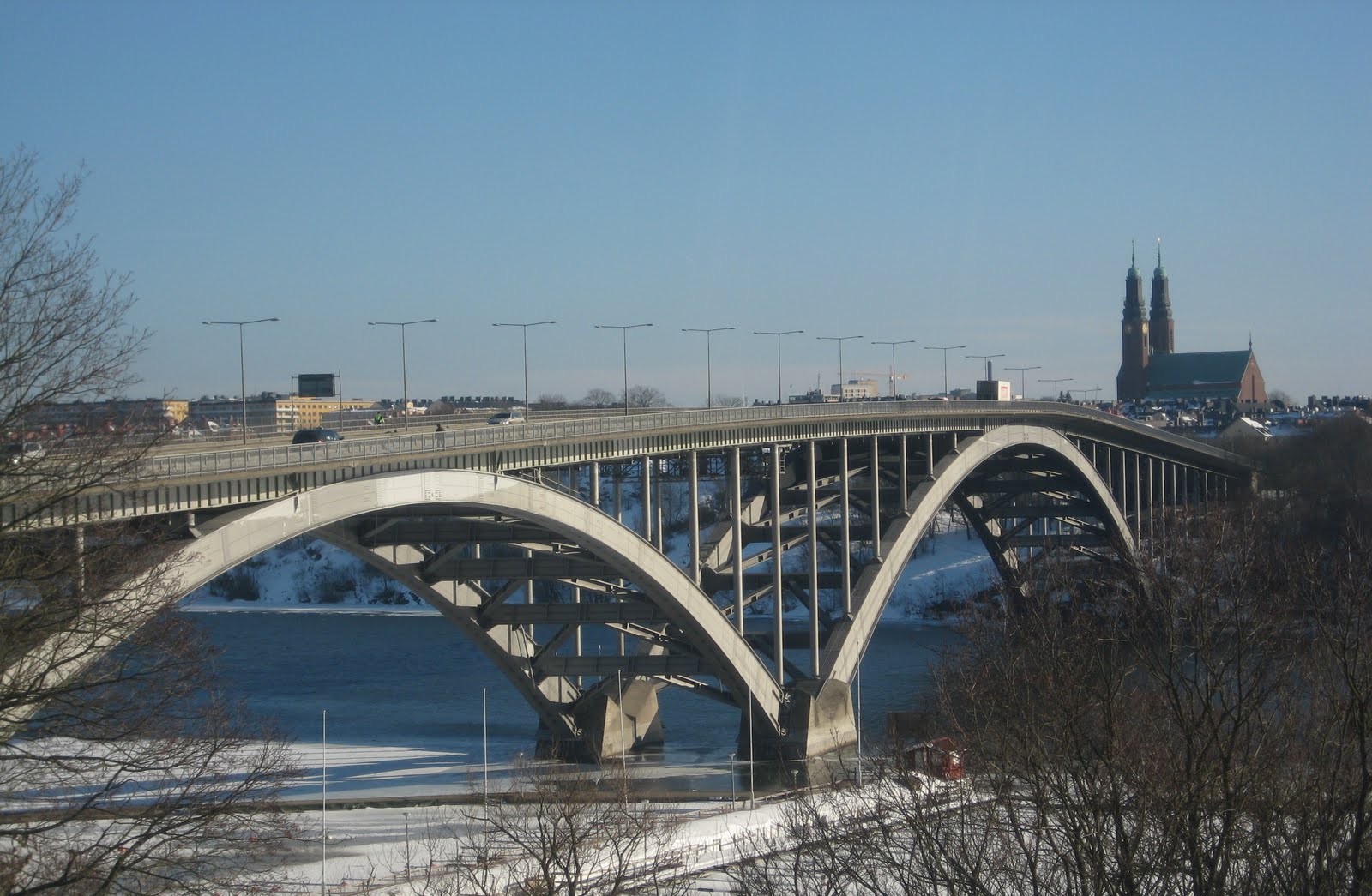
What to see: The Western Bridge, Stockholm

One third of the surface of Stockholm consists of water. It is a city built on islands linked by bridges and among these the Western Bridge (Västerbron) is perhaps the most beautiful and also the most appreciated.
Until 1935 the Sluice (Slussen) in central Stockholm was the only bridge east of Strängsnäs linking Södermanland and Uppland, but the explosive increase in traffic made obvious the need for another bridge, this time between Södermalm and Kungsholmen.
An international contest was held in 1930 and won by German architects and engineers, but instead one settled for a rather similar design by the Swedish architects Birger Borgström, David Dahl and Paul Hedqvist, constructed by the engineers Ernst Nilsson and Salomon Kasarnowsky.
The bridge was built between 1931 and 1935 and was hailed as a feast of engineering. It consists of two arches measuring respectively 168 and 204 metres; the latter remains unsurpassed in Sweden to this day.
Many others and poets have written about the Western Bridge or sung its praises. Some unhappy persons have jumped to their deaths from it. And many couples have fastened padlocks to its railings as a symbol of their love.
From the bridge one also has a wonderful view towards the city, as can be seen in the last photo from two weeks ago.

Saturday, 14 November 2009

What to see: The Széchenyi Chain Bridge, Budapest


Among the bridges crossing the Danube from Buda to Pest, the Széchenyi Chain Bridge, or Széchenyi-lánchid, is perhaps the better-known landmark of the Hungarian capital. The first permanent bridge linking the two then separate cities, it was built between 1839-1849 after an initiative by Count István Széchenyi, who is considered one of the greatest statesmen and reformers in Hungarian history.
The bridge was designed by the Englishman William Tierney Clark and built by the Scot Adam Clark (no relation). With its length of 380 metres it was considered a major feat of engineering at the time. Like all the other bridges across the Danube, the Chain Bridge was destroyed during World War II and faithfully rebuilt after the end of the war. The lions guarding the bridgeheads at either side are by the sculptor János Marschalkó.
Close to the bridge are famous buildings such as the Royal Palace (now the Hungarian National Gallery), seen in the first and third photos; the Parliament (the largest such building on the continent), seen in the second picture; and Gresham Palace (now the Four Seasons Hotel), glimpsed in the fourth photo.