Today is the 95th birthday of Princess Lilian of Sweden. Born into poverty in Swansea on 30 August 1915, Lillian May Davies is one of the unlikeliest grande dames of the European monarchies and was at the centre of one of the greatest love stories of the 20th century.
Her first marriage, to the actor Ivan Craig, was what she herself described as a typical wartime marriage, which was dissolved in 1947. She met Prince Bertil of Sweden in London in 1943, but by marrying her he would forfeit his right to the Swedish throne. This he was prepared to do and two of his three brothers had already done so by the time the eldest brother, Prince Gustaf Adolf, was killed in a plane crash in 1947. This left Prince Bertil as the only possible regent for his infant nephew, the current King Carl XVI Gustaf, in the all too likely event of his succeeding his grandfather on the throne before reaching his majority.
For the sake of duty, Prince Bertil and Mrs Craig decided to postpone their wedding until the future of the dynasty had been settled. In the event they were to wait 33 years, which was no small sacrifice as they thereby forfeited the chance to have children of their own.
Aged 64 and 61 respectively, Prince Bertil and Lilian Craig married in Drottningholm Palace Church on 7 December 1976. King Carl Gustaf rewarded their loyalty and sacrifice by giving his consent to the marriage, which meant that Prince Bertil, unlike his brothers, retained his royal title and succession rights, and that Mrs Craig became Her Royal Highness Princess Lilian of Sweden, Duchess of Halland.
The former actress and model from the poor mining districts of Wales became one of the greatest assets to the Swedish royal family, combining grace and a regal dignity with timeless elegance and a great sense of fun. With Prince Bertil she was often called up on to perform important duties on behalf of the Swedish royal family, which she continued to do following her husband’s death in 1997.
With no children of their own, Prince Bertil and Princess Lilian came to look upon King Carl Gustaf, Queen Silvia and their three children as their surrogate family. Crown Princess Victoria has always been tremendously fond of her “Auntie” and chose to wear a brooch given to her by Princess Lilian to the press conference when her engagement to Daniel Westling was announced last year.
Some seven years ago Princess Lilian sadly began to show signs of senility and increasing physical frailty caused her to withdraw from public life in 2008. Earlier this year her Court Marshal, Elisabeth Palmstierna, confirmed that the Princess suffers from Alzheimer’s disease, which caused her to miss the wedding of Crown Princess Victoria and Prince Daniel. As recently as last month I heard that Princess Lilian is still living at her house, Villa Solbacken at Djurgården in Stockholm, where she receives around-the-clock care.
Monday, 30 August 2010

Sunday, 29 August 2010
On this date: Death of Queen Astrid 75 years ago
Today is the 75th anniversary of the tragic death of Queen Astrid of the Belgians in a car accident at Küssnacht in Switzerland on 29 August 1935. Her only surviving child, King Albert II, will take part in a commemorative event held in the chapel which was built on the spot where his mother lost her life. As he was barely a year old when Queen Astrid was killed, King Albert has no memories of his mother, but he has shown a great interest in and attachment to her life story.
The Belgian royal family had been spending part of the summer of 1935 at their summer house by the Vierwaldstättersee. Queen Astrid and King Léopold III stayed behind for a few days after the children had been sent back to Belgium. The accident happened when the King, who was behind the wheel, took his eyes off the road for a brief look at the map. The car veered out from the narrow road, down into a meadow, ending in the water. The passengers were thrown out and Queen Astrid was killed when she landed with her head against a tree.
Queen Astrid was 29 years old and had been queen for merely 553 days. Her death came as a great shock to the people of Belgium as well as of her native Sweden, particularly as it happened only a year and a half after her father-in-law, King Albert I, had also been killed in an accident.
A strong legend grew around the memory of the young queen, a legend which to a certain extent survives to this day, although it is no longer as strong as in the days when most people could still remember her. The subsequent events, whereby Belgium was invaded by Germany in 1940, King Léopold refused to follow his government into exile and surrendered himself and his children to the Germans, remarried while in captivity and, following the end of the war, found himself at the core of a prolonged constitutional struggle which ended with his abdication in favour of his 21-year-old son Baudouin, probably also helped strengthen the legend, whereby the young queen who had died so tragically came to symbolise happier days of the past.
This is perhaps best expressed in the title of a book on Queen Astrid which was published fifty years after her death: Astrid, ou le rêve fracasse – “Astrid, or the interrupted dream”.
The Belgian royal family had been spending part of the summer of 1935 at their summer house by the Vierwaldstättersee. Queen Astrid and King Léopold III stayed behind for a few days after the children had been sent back to Belgium. The accident happened when the King, who was behind the wheel, took his eyes off the road for a brief look at the map. The car veered out from the narrow road, down into a meadow, ending in the water. The passengers were thrown out and Queen Astrid was killed when she landed with her head against a tree.
Queen Astrid was 29 years old and had been queen for merely 553 days. Her death came as a great shock to the people of Belgium as well as of her native Sweden, particularly as it happened only a year and a half after her father-in-law, King Albert I, had also been killed in an accident.
A strong legend grew around the memory of the young queen, a legend which to a certain extent survives to this day, although it is no longer as strong as in the days when most people could still remember her. The subsequent events, whereby Belgium was invaded by Germany in 1940, King Léopold refused to follow his government into exile and surrendered himself and his children to the Germans, remarried while in captivity and, following the end of the war, found himself at the core of a prolonged constitutional struggle which ended with his abdication in favour of his 21-year-old son Baudouin, probably also helped strengthen the legend, whereby the young queen who had died so tragically came to symbolise happier days of the past.
This is perhaps best expressed in the title of a book on Queen Astrid which was published fifty years after her death: Astrid, ou le rêve fracasse – “Astrid, or the interrupted dream”.
Sunday, 22 August 2010
Another exhibition on Danish absolutism
 I recently mentioned that the Museum of National History at Frederiksborg Palace in Hillerød this autumn and winter will hold an exhibition on the Danish absolute monarchy, commemorating the 350th anniversary of its introduction in 1660. I have now learnt that Rosenborg Palace in Copenhagen will also do an exhibition on absolutism to mark the occasion. Titled “Pomp og pragt – Kongemagt og enevælde” (“Pomp and Splendour – Royal Power and Absolute Monarchy”), it will be shown between 16 October and 27 February.
Saturday, 21 August 2010
What to see: The Carl XIV Johan monument, Örebro


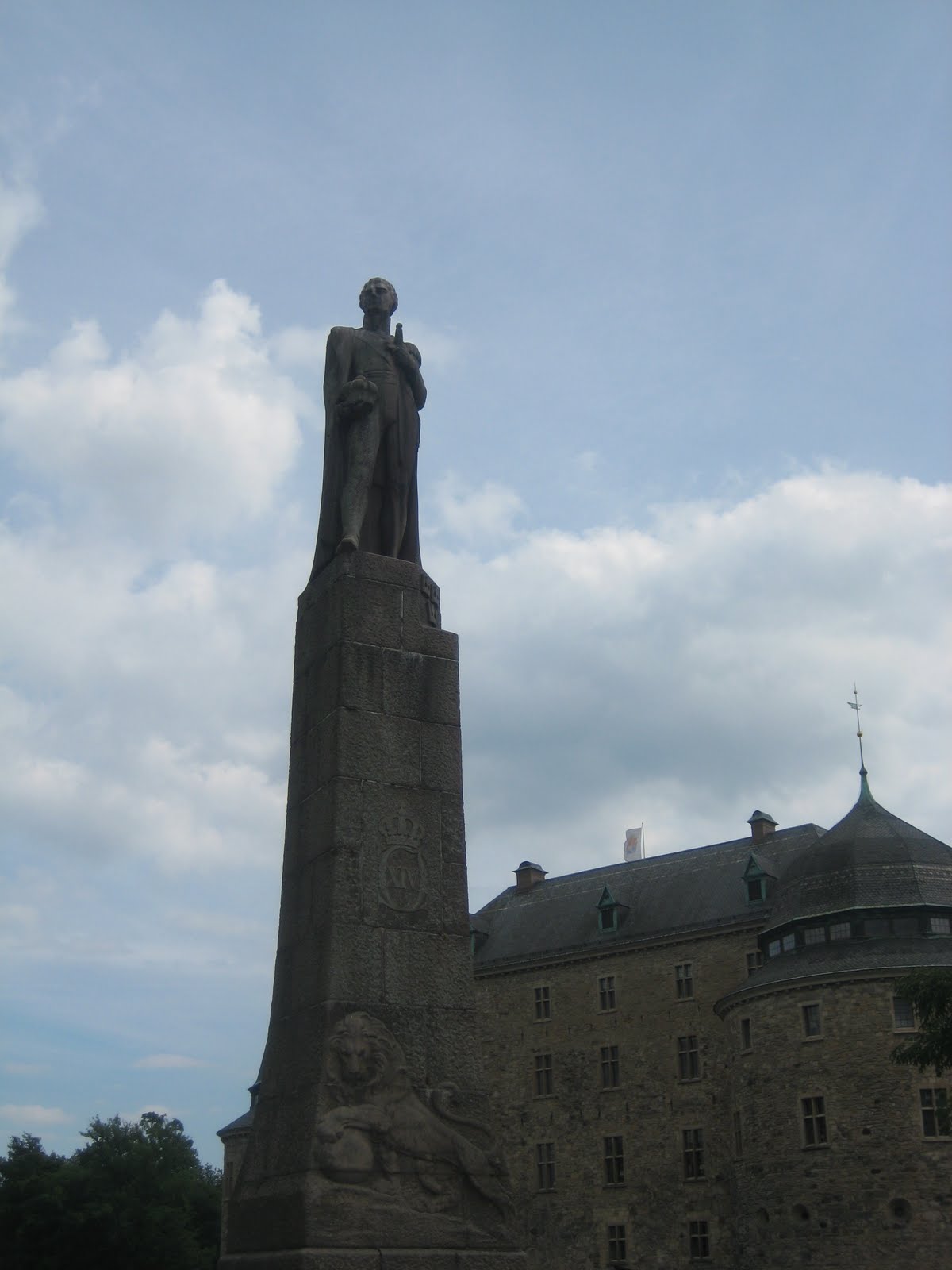
 200 years ago on this very day Jean-Baptiste Bernadotte, Marshal of the French Empire and Sovereign Prince of Pontecorvo, was elected crown prince of Sweden by the four estates assembled in the Church of St Nicolai in Örebro and today King Carl Gustaf, Queen Silvia, Crown Princess Victoria, Prince Daniel, Prince Carl Philip and Princess Madeleine take part in the celebrations in Örebro, including a celebratory mass in that church. The day began with a visit to Stjernsund Palace in the rain. For Prince Daniel these are his first public engagements after his wedding and very appropriately they bring him back to the town where both he and the Bernadotte dynasty were born.
The celebrations will include a speech by King Carl Gustaf at the Iron Square, close to the monument to his ancestor Carl XIV Johan which stands on the edge of the Central Park outside Örebro Castle.
The statue was erected following a 1913 initiative of Erik B:son Lilliehöök, who had hoped it could be unveiled in February 1918, a century after Carl Johan succeeded to the thrones of Sweden and Norway. It was however not until sixteen months later that the monument was unveiled.
Four of Sweden’s most prominent sculptors – Carl Milles, Christian Eriksson, Teodor Lundberg and C. J. Eld – had been invited to take part in a competition for the monument, but thirteen other artists also entered the contest, which was in the end won by an equestrian statue by Teodor Lundberg and the architect Aron Johansson. Yet the commission was eventually given to the artist who had come fourth in the competition – the comparatively little-known, virtually autodidact Alfred Ohlsson (1868-1940).
The monument is made of Vätö granite and was carved in Roslagen, arriving in Örebro by train in early June 1919. It was unveiled on 12 June 1919 by King Gustaf V, who had come to Örebro accompanied by his brothers Prince Carl and Prince Eugen (who was Duke of Nerike, the landscape in which Örebro is located), Prime Minister Nils Edén, Foreign Minister Johannes Hellner and other notabilities.
The monument is in my opinion one of the best statues of Carl XIV Johan. It shows the King standing, wearing military uniform and a cloak. With his left hand he holds the royal crown at hip level, while the right hand clutches his sword to his chest, symbolising that Carl Johan, unlike most kings, owed his elevation to the status of a monarch not to his ancestry but to his military deeds.
This morning it was discovered that someone during the night has vandalised the plinth by spraying the words “Opposition? That is treason!” onto it. King Carl Johan is famously alledged to have said “Opposition, that is conspiracy!” so this also appears to be a misquote.
Wednesday, 18 August 2010
“Christian IX suggested Danish membership of German Confederation”
 Politiken today (external link) tells about a coming book by Tom Buk-Swienty, titled Dommedag Als, which, based on research in the Danish Royal Archives, reveals that King Christian IX in July 1864 contacted King Wilhelm I of Prussia to suggest that Denmark join the German Confederation.
 According to the article it was a desperate attempt from the King at avoiding losing Schleswig and Holstein following the defeat by Prussia and Austria in the war of 1864. The King at first made the proposal without consulting his government, which the article describes as bordering on treason, but with the government’s agreement he later repeated the proposal twice during the peace negotiations in Vienna.
The response of the Prussian Chancellor, Otto von Bismarck, was however lukewarm. The Chancellor pointed out that such an arrangement would not solve the disagreements between Danish speakers and German speakers in Schleswig and that the Confederation thus might be obliged to support the King against the German Schleswigers. Access to the Danish fleet was what Bismarck considered spoke most strongly in favour of King Christian’s idea, but the Chancellor feared an aggressive response from France if the German fleet were significantly strengthened.
The author Tom Buk-Swienty says to Politiken: “I have often thought: Holy shit, does it really say that one tried to make Denmark part of Germany?” The answer to that question is in my opinion really no, as joining the German Confederation in 1864 did not mean becoming part of Germany. The Confederation was not a country in itself and consisted mostly of what was then the Habsburg empire and the territories which came to make up the German Empire, but these countries were by 1864 still 43 independent states. Two of them, Luxembourg and Liechtenstein, remain independent states outside Germany and Austria to this day.
It could be added that this is another example of a welcome recent policy of Queen Margrethe’s to give researchers access to the papers in the Royal Archives. A decade ago the archive of the Glücksburg dynasty was entirely inaccessible, but since then several researchers have been given access: Birgitta Eimer for her political biography of Queen Sophia of Norway and Sweden, Tor Bomann-Larsen for his multi-volume biography of King Haakon and Queen Maud, I for my dissertation on the Swedish candidacy to the Norwegian throne in 1905, Roy Andersen for his book on the dissolution of the Swedish-Norwegian union in 1905 and Knud J. V. Jespersen for his biography of King Christian X.
The photo above shows Anne Marie Carl-Nielsen’s equestrian statue of King Christian IX outside Christiansborg Palace in Copenhagen.
Tuesday, 17 August 2010
Royal jewels: The Vasa diadem
The Vasa diadem, currently the property of Princess Astrid of Norway, was a present from the City of Stockholm to her mother, the then Princess Märtha of Sweden, on the occasion of the reading of the banns of marriage between her and Crown Prince Olav of Norway in 1929. (Also Princess Märtha’s younger sister Astrid had been given a tiara by the City of Stockholm when she married the heir to the Belgian throne in 1926, while their eldest sister Margaretha received no such present).
The name “the Vasa diadem” derives from the tiara’s central motif being the heraldic symbol of the Vasa family, who ruled Sweden from 1523 to 1654. The diadem is in art deco style, was made by the jeweller C. F. Carlman and consists of 956 diamonds set in platinum. In keeping with 1920s fashion it was made to be worn across the forehead, a trend which was however short-lived.
Crown Princess Märtha wore the tiara frequently, particularly in the pre-war years when she was not yet the owner of the emerald parure and Queen Josephina’s diamond tiara. After the war it was most frequently seen on her daughters Ragnhild and Astrid, who were allowed to borrow it when they came of age.
Following Crown Princess Märtha’s early death in 1954, the division of her estate was postponed until her youngest child, the present King, had reached his majority. The Vasa diadem then made part of Princess Astrid’s lot and she has worn it frequently ever after.
In the course of my work on her biography she did however tell me that this tiara will return to the King following her death. The same goes for the turquoise crown which was made for Queen Alexandra of Britain and some other jewellery, while her three smaller tiaras will be inherited by her children.
(PS. From the backlinks I can see that one of those who have linked another website to this blogpost doubts its correctness and thinks that it must have been a “misprint” when I wrote that the turquoise tiara was made for Queen Alexandra of Britain. The reader offers no reasons for why he/she thinks this should be a misprint, but I can inform him/her that it is not and that the turquoise tiara was not a wedding present to Queen Maud).
The name “the Vasa diadem” derives from the tiara’s central motif being the heraldic symbol of the Vasa family, who ruled Sweden from 1523 to 1654. The diadem is in art deco style, was made by the jeweller C. F. Carlman and consists of 956 diamonds set in platinum. In keeping with 1920s fashion it was made to be worn across the forehead, a trend which was however short-lived.
Crown Princess Märtha wore the tiara frequently, particularly in the pre-war years when she was not yet the owner of the emerald parure and Queen Josephina’s diamond tiara. After the war it was most frequently seen on her daughters Ragnhild and Astrid, who were allowed to borrow it when they came of age.
Following Crown Princess Märtha’s early death in 1954, the division of her estate was postponed until her youngest child, the present King, had reached his majority. The Vasa diadem then made part of Princess Astrid’s lot and she has worn it frequently ever after.
In the course of my work on her biography she did however tell me that this tiara will return to the King following her death. The same goes for the turquoise crown which was made for Queen Alexandra of Britain and some other jewellery, while her three smaller tiaras will be inherited by her children.
(PS. From the backlinks I can see that one of those who have linked another website to this blogpost doubts its correctness and thinks that it must have been a “misprint” when I wrote that the turquoise tiara was made for Queen Alexandra of Britain. The reader offers no reasons for why he/she thinks this should be a misprint, but I can inform him/her that it is not and that the turquoise tiara was not a wedding present to Queen Maud).
Sunday, 15 August 2010
New books: Habsburg drama
 In Destiny’s Hands: Five Tragic Rulers, Children of Maria Theresa is the somewhat overwrought title of a somewhat overwrought new book by Justin C. Vovk, who, according to the book’s cover, is “a critically acclaimed historian whose work is archived in the Library of Congress”. This sounds quite pretentious as this is his first book and as far as I know nearly everything published is “archived in the Library of Congress” – I think they have at least one of my books as well.
Basing his work entirely on secondary sources, Vovk builds his book over the same pattern as Julia Gelardi’s Born to Rule: Granddaughters of Victoria, Queens of Europe (2005) and his subjects are Empress Maria Theresia and what he describes as her five “reigning” children – the Emperors Joseph II and Leopold II, Duchess Amalia of Parma, Queen Maria Carolina of Naples and Queen Marie-Antoinette of France.
The Duchess of Parma is the one we hear the least about and also the one the author seems to have least sympathy for, while the lives of the other four are more or less equally covered. Maria Theresia herself is another main figure in this book. These five out of sixteen children have been chosen because they were, in the author’s words, those of the Empress’s children who came to rule states.
But out of these five only two did in fact reign. Yet all of them are constantly referred to as “reigning” or “rulers” and we learn that “[t]hey all shared the same experience of becoming a monarch”. But the spouse of a monarch is as little a monarch as the spouse of the President of the USA is head of state or Commander-in-Chief.
We are told that the fact that it was Amalia’s husband who was Duke of Parma, “in no way diminished her role as a reigning consort”, but this term is clearly an oxymoron. And when Maria Carolina marries the King of Naples, we learn that “she was now the reigning Queen of Naples”.
The author does not make a lot of factual mistakes (there are however some, such as the claim that Marie-Thérèse was Marie-Antoinette’s last surviving child at the time of the latter’s execution), but he obviously struggles with the terminology. “Leopold was now heir apparent to the imperial throne”, he states, before adding that “only a unanimous election could make him emperor”. But one cannot possible be heir apparent if an election is needed and one can hardly be heir apparent to an elective monarchy at all. And Marie-Antoinette, the youngest but one of sixteen children, was certainly not Maria Theresia’s heir, although Vovk writes about the Empress and Louis XV agreeing about “the marriage of their heirs”.
Despite the author’s annoying insistence on referring to all of his subjects as rulers, it is true that two of the imperial daughters who became the consorts of monarchs – Amalia of Parma and Maria Carolina of Naples – came to wield great influence in their adopted countries. Maria Carolina’s husband was, in the words of a historian, “born to be ruled by others” and Vovk writes: “There was never a question of who was in charge. Queen Maria Carolina knew exactly how to control King Ferdinand. She masterfully crafted a smokescreen of melodrama and marital discourse that made hum submissive to her will”.
Queen Marie-Antoinette cannot really be said to have wielded the same sort of influence in France and thus cannot be called the ruler of France neither in name nor in reality. Yet the author writes of how she and Louis XVI travelled to Reims for “their coronation”, which made her “the first reigning queen to attend a French coronation since 1549”. But not only was she not a reigning queen; it was furthermore only Louis XVI who was crowned, making it his coronation and not theirs.
The author does not at all dwell on the reasons why Marie-Antoinette was not crowned, which could be seen as a symptom of the animosity displayed towards her even early in her husband’s reign. But this animosity is not something Vovk will go to any length to try and explain to the reader; in his version, Marie-Antoinette was entirely without any human faults or shortcomings. Axel von Fersen only makes a brief appearance as a letter-writer and courtier and is never directly linked to the Queen. The story of the unconsummated marriage, which was certainly of enormous dynastic consequences and which will be familiar to anyone who has read anything about Marie-Antoinette, goes entirely unmentioned. The portrayal of Joseph II as quite simply an enormous failure also tends to speak of a tendency to paint people in black and white.
There are some gross simplifications, such as the assertion that Napoléon “engulfed it [the continent] in the flames of war”. Those wars had started before Napoléon came along and he was certainly not alone in prolonging them, as the author also acknowledges when he writes about how Britain broke the peace of Amiens because it was in its own interest to do so. Hand in hand with the simplifications go the many exaggerations, such as referring to Catherine Mary Bearne, who a century ago wrote some romanticised royal biographies full of tittle-tattle, as a “famed historian”.
Both the author and the publisher could have made more of an effort about the language, which contains rather too many clichés – clichés which occasionally contradict each other. On page 208 we read: “If the French monarchy were an opera, then the Diamond Necklace Affair would be its closing act”. On page 210 we read: “The death of Princess Sophie marked the beginning of the end of Marie Antoinette and her family”. But can the beginning of the end really take place after the closing act?
On page 250 Leopold II’s death gives the author cause to write that “[t]he Holy Roman Empire mourned the passing of a sovereign for the second time in two years”, but what he writes on page 233 about how “[t]housands of people [had] lined the streets of Vienna to say good riddance” during Joseph II’s funeral and thrown rocks, mud and other objects at the coffin, does not exactly convey the sense of a people in mourning.
There are also some translations from German which make absolutely no sense, such as the following ending to a letter: “Although I am more than persuaded, that such a loss cannot be repaired, I dare to offer you in me, who in friendship, attachment, [and] true and sincere interest in everything that could interest you in all ways”. What? The author will insert a “[sic]” after words spelt in an older manner or according to English rather than American grammar, yet he will himself make a rather high number of grammatical mistakes, including some rather basic ones.
And then there are some downright silly statements, such as the claim that the Duke of Lorraine upon marrying Maria Theresia “took the name Francis Stephen” – of course he did no such thing, as taking an English name would make no sense for a man about to become Emperor of the Holy Roman Empire. The same goes for the claim that Felipe of Spain “took the name Philip” when he became Duke of Parma.
But what is most annoying about this book is the constant insistence on drama or tragedy even where there is none. Emperor Franz Stephan had a “dramatic funeral”, but we never hear of any drama played out during this ceremony. The Augustinerkirche in Vienna is also “dramatic”, although I personally found it quite peaceful when I visited it last summer.
“But the conclusion of the war and the restoration of peace in Austria would pale in comparison to the tragedies that were about to befall Emperor Leopold II and Queen Marie Antoinette” is just one example of how we are constantly told of grim forebodings and unexpected fates. These often begin with words such as “No one could know that...”, but the author often overdoes it. When a queen gives birth to her second son it is not an entirely unimaginable possibility that this second son might one day be king – history is full of second sons acceding to thrones, either of their own countries or of another kingdom.
On the other hand there are some refreshing anecdotes, such as Maria Theresia writing to her daughter about her future husband: “Although an ugly prince, he is not absolutely repulsive…at least he does not stink”. One would wish Vovk had included more of this and less of the melodrama.
The story which forms the backdrop for Vovk’s book is certainly fascinating and the most valuable aspect of this book is that it tells the stories of some interesting, lesser-known individuals as well as those of their more famous siblings - my main reason for reading this book was a desire to learn more about Queen Maria Carolina of Naples.
The book is not bad in itself, but as I read on I eventually began feeling rather tired out by the constant melodrama and all the exaggerations. The book is otherwise held in an accessible, easily read prose and the author seems to have the potential for becoming a good storyteller. My advice to the author would therefore be to take some time to learn and understand the correct terminology of his subject and to work on restraining his sense for melodrama.
Saturday, 14 August 2010
My latest article: A book on guilt
 In Klassekampen’s book magazine today you can read my review article of the Norwegian translation of Henrik Arnstad’s very interesting and thought-provoking book Skyld – En europeisk reise i Nazi-Tysklands skygge, which investigates how three countries which were Nazi Germany’s allies (Finland, Italy and Austria) have subsequently dealt with the issue of their own guilt. I reviewed the Swedish original here at the blog seven months ago.
Friday, 13 August 2010
Thomas Lawrence exhibition in the autumn
 Last week it was announced that the National Portrait Gallery in London this autumn will do an exhibition on Sir Thomas Lawrence – it will consist of some fifty works and be the first major exhibition on him in Britain for thirty years.
This is great news as Lawrence, one of the finest British portraitists of the 19th century, following his death in 1830 has received considerably less attention that some of his contemporaries or near-contemporaries such as Gainsborough, Reynolds, Constable or Turner.
The exhibition will run from 21 October to 23 January and among the works included will be some of the grand portraits from the Waterloo Chamber at Windsor Castle of the leaders of the coalition which defeated France in the Napoleonic Wars – among the portrait of Pope Pius VII which is seen above.
Wednesday, 11 August 2010
Upcoming exhibition on Danish absolutism
 This spring and summer the Museum of National History at Frederiksborg Palace in Hillerød has marked the 70th birthday of Queen Margrethe with an excellent exhibition on her iconography. This exhibition closed a week ago and the next exhibition at Frederiksborg will be about the absolute monarchy, commemorating its introduction 350 years ago. The exhibition on absolutism will open on 16 October and last until mid-January.
Count Christian Bernadotte becomes a father
Count Christian Bernadotte af Wisborg, the youngest son of the late former Prince Lennart of Sweden, and his wife Christine, who married at Mainau on 22 May, yesterday became parents for the first time. Their firstborn is a son whose name will be Maximilian Benedikt.
Count Christian’s sister, Diana Bernadotte, is also expecting a child this month. The identity of the father of her second child is not publicly known.
Count Christian’s sister, Diana Bernadotte, is also expecting a child this month. The identity of the father of her second child is not publicly known.
Sunday, 8 August 2010
Frederik VIII’s Mansion closes after 480,000 visitors
 Today the newly renovated royal residence Frederik VIII’s Mansion at Amalienborg in Copenhagen closed its doors to the public. Since it opened in March, 479,246 visitors have taken the opportunity to see the mansion and the new artworks.
The opening was scheduled to last only until the end of May, but the huge public interest led to it being prolonged until August. Calls for the opening season to be extended even further had to be rejected by the Palaces and Properties Agency, as the mansion must now be furnished and made ready for Crown Prince Frederik and Crown Princess Mary before they move in on 21 September.
Saturday, 7 August 2010
A warm farewell to Countess Ruth
 Yesterday I attended the funeral of Countess Ruth of Rosenborg, who died on 25 July, aged 85, after six months of illness. The funeral took place in Skovshoved Church in Charlottenlund near the Øresund coast north of Copenhagen.
Some 150 people gathered in the small church, which was filled with countless floral tributes and burning candles. The coffin was draped in a Danish flag and in front of it stood a huge wreath from the Queen and Prince Consort of Denmark, marked “Daisy Henri”. There were also wreaths from the four children and their families, the Norwegian royal family, the King and Queen of the Belgians, the Grand Duke of Luxembourg, the ex-King and ex-Queen of the Hellenes, Crown Prince Frederik and Crown Princess Mary, Prince Joachim and Princess Marie, Princess Benedikte and Prince Richard, “Ragnhild, Erling and the entire family in Rio”, Count Ingolf and Countess Sussie of Rosenborg, “the family at Ledreborg” and many more, including Sømandsforeningen af 1856, of which Countess Ruth like her mother-in-law and her grandmother-in-law before her had been patron.
Opposite the immediate family sat Queen Margrethe, who made a deep curtsey in front of the coffin as she arrived. A few minutes after her arrival came the Queen of Norway accompanied by Crown Prince Haakon and Princess Märtha Louise, who took their seats on the first row next to Princess Kristine Bernadotte. Unfortunately the King of Norway had been unable to take time off from sailing at Majorca to attend the funeral of his cousin/best man’s widow.
Also present were two former princes of Denmark who, like Countess Ruth’s late husband, gave up their royal rights for love – Count Ingolf and Countess Sussie of Rosenborg and Count Christian and Countess Anne Dorthe of Rosenborg, the latter couple accompanied by their daughter Feodora af Rosenborg. Among the mourners were also Christian Eugen-Olsen, Master of Ceremonies at the Royal Court, and the 97-year-old businessman Mærsk Mc-Kinney Møller, the only non-royal Danish Knight of the Elephant.
It was a service filled with gratitude for the long and rich life of a lady who meant a lot to many. Except for the priest’s the only eulogy was delivered by Countess Ruth’s eldest son, Count Axel, who drew a warm and balanced portrait of his parents, complete with anecdotes which caused laughter from the congregation. He ended with a poem by Benny Andersen, with whom Countess Ruth corresponded about the interpretation of his poems.
Most moving of all was the end of the service, when the two younger sons and four grandsons carried the flag-draped coffin out of the church to the tunes of a solo singer singing the beautiful hymn “Dejlig er jorden” accompanied by the organ and a trumpet. Large tears ran down Queen Margrethe’s cheeks as she walked out.
The final farewell took place outside the church, where the coffin and the wreath from the Queen and Prince Consort were placed in a hearse and we watched in silence as it departed. Princess Märtha Louise wept and was comforted by her great-aunt.
In the perfect summer afternoon following the funeral there was a reception at a nearby place called Sølyst, situated just above the coastline and next to the villa Hvidøre, which was Empress Dagmar’s home in exile after the Russian revolution. Following cremation Countess Ruth’s ashes will be interred in the park surrounding Bernstorff Palace, where her late husband and his family are already resting.
Crown Princess Mary pregnant with twins
Most of the Danish weeklies this week plastered their frontpages with stories about Crown Princess Mary being pregnant and this time they were actually correct - today (or rather yesterday, by now) the royal court announced (external link) that the Crown Princess is expecting twins in January.
Wednesday, 4 August 2010
New books: Prince Eugen in Copenhagen
 Prins Eugen och Svenska Gustafskyrkan i Köpenhamn (“Prince Eugen and the Swedish Gustaf Church in Copenhagen”) is the title of a small book (95 pages) by Cecilia Lengefeld published last year. It might seem an odd choice of topic for a book, as Prince Eugen is not generally someone one associates with the Swedish church in Copenhagen. This perception is confirmed by the book, which says he is known to have visited the church on one single occasion (in May 1922).
The author weaves her story around two little-known paintings. The first is Prince Eugen’s painting of the vicarage in Örberga, which hangs in the Gustaf Church. The church was dedicated in 1911 and Lengefeld shows that there had been plans for Prince Eugen to paint the altar piece, but that those plans were scrapped because he wanted to paint only a rising sun, which was seen as not sufficiently religious for a church (but was later accepted for the new church in Kiruna). It was only 25 years later, in 1936, that Prince Eugen presented his painting of the vicarage in Örberga, where he had a summer house, to the Gustaf Church.
The other “forgotten” painting is “Among Artists”, by Viggo Johansen, a now mostly forgotten painter who was among Prince Eugen’s close friends – his wife Martha was an untiring letter-writer and nearly 300 letters from her hand are preserved in the archives at Waldemarsudde.
Viggo Johansen’s painting depicts a dinner held in Prince Eugen’s honour during a visit to Copenhagen in 1901. The painting shows the Prince in the company of the host and hostess and several leading Danish artists (two of whom were actually not present). Lengefeld charts the story of the long process which led to Johansen completing the painting, which was bought by the National Museum in Stockholm but quite soon put into storage. In a rather interesting way the author also sees this artwork in contrast with P. S. Krøyer’s more famous painting of a gathering of artists at Skagen.
While the chapter on the Prince and the church is quite thin, the chapter on Johansen’s painting is of interest as the author also looks at Prince Eugen’s relations to Denmark in general. She points out the central position the two kingdoms of which he was a prince (Sweden and Norway) hold in his works as well as his well-known associations with artists from these two countries, while his relations to Denmark have been accorded little attention. The Prince never painted any Danish landscape and mostly only passed through Copenhagen on his way to the continent. But Lengefeld points out that he was well-informed about Danish art and exhibitions as well as the attached debates and conflicts. In such a perspective Viggo Johansen’s painting could be seen as a forgotten manifestation of the Prince’s less-known relations to the south-western neighbour, a country whose art the author observes that the Prince discovered in connection with the Stockholm Exhibition in 1897.
The book ends with some pages on Prince Eugen’s niece, Princess Margaretha of Denmark, who unlike her uncle was closely involved with the Swedish Church and supported its work. Lengefeld also looks at the relationship between uncle and niece, but in this I think she does not quite succeed. From the 75 letters from the Princess in Waldemarsudde’s archives (which the author regrets rarely refer to the Gustaf Church, but why would they, given Prince Eugen’s apparent non-existent interest in the church?) she concludes that Princess Margaretha “very much wanted to meet her uncle as often as possible”, but that Prince Eugen avoided her.
It seems Cecilia Lengefeld bases this conclusion on his writing in a letter in 1901 that he hoped to be left alone by “the dear family” when he made a short visit to Denmark (something which Princess Margaretha advised him to tone down when she proof-read the Danish translation of a book based on his correspondence). However, this was written when Princess Margaretha was two years old and he had no close relations in Denmark. Other sources, including family tradition, are able to tell of a warmer relationship between uncle and niece.
The conclusion must be that the parts of the book dealing with Prince Eugen’s relations to Danish art are the most interesting and that the book’s title might as well have been “Prince Eugen and Denmark”.
Monday, 2 August 2010
Prince Albert changes wedding dates
The princely court of Monaco yesterday announced (external link) that the dates for the wedding of Sovereign Prince Albert II and Charlene Wittstock have been changed from 8 and 9 July to 2 and 3 July - this so that the wedding will not clash with the IOC meeting in Durban.
Sunday, 1 August 2010
What to see: Church of St Nicolai, Örebro


 The Church of St Nicolai, the main church of the town of Örebro, holds a special place in Swedish history as the “birthplace” of the Bernadotte dynasty 200 years ago this month.
 Believed to have been begun in the second half of the 13th century and completed around 1350, the church’s nave is separated into three sections by columned arches in the Romanesque style. The church’s Gothic exterior is mostly a result of renovations carried out in the 19th century.
The altar is by probably the German-born sculptor Markus Hebbel and was presented to the church in 1661. It shows the crucifixion and burial of Jesus as well as the dove representing the Holy Spirit and is also adorned with portraits of the four evangelists as well as St Peter, St Paul and several disciples.
Engelbrekt Engelbrektsson, hero of one of the greatest Swedish rebellions (against the union king Erik of Pomerania in the 15th century), was buried in the Church of St Nicolai following his murder in May 1436 and soon began to attract pilgrims. King Gustaf I’s youngest son, Duke Carl (IX), who governed Nerike, Wermlandia and Sudermania, disapproved of the cult and had Engelbrekt’s remains disinterred and removed (to this no-one knows to where, but some maintain that they were hidden away in the thick walls of Örebro Castle). In 1865 a statue of the freedom fighter was erected in the Great Square behind the church.
The greatest event in the history of the Church of St Nicolai came in the summer of 1810. Following the sudden death of Crown Prince Carl August King Carl XIII called another parliament to elect a new heir to the throne. Stockholm was considered too chaotic to host a meeting of the General Estates – the Marshal of the Realm, Count Axel von Fersen, had been dragged from his carriage and lynched by an angry mob during the Crown Prince’s funeral procession – and Örebro, a small town with 1,303 inhabitants, was chosen instead. It was situated within reasonable distance from Stockholm (the journey then took two days by carriage and now two hours by train) and too far from the coast to risk a Russian attack.
While King Carl XIII and Queen Hedvig Elisabeth Charlotta set up their residence at Örebro Castle, the four estates met in different buildings in town. The Church of St Nicolai was however used as the Hall of State, i.e. where the plenary sittings of all four estates took place. Thus it was in this church that the Estates on 21 August – to the surprise of anyone, themselves included – unanimously elected the Sovereign Prince of Pontecorvo, Marshal Jean-Baptiste Bernadotte, Crown Prince of Sweden.
On 21 August this year there will be bicentenary celebrations in Örebro all day long, with the most formal event being a mass in the Church of St Nicolai. The celebrations will be attended by the royal family, including Crown Princess Victoria and Prince Daniel, who will then make one of their first public appearances after returning from their honeymoon (they are currently reported to be in the USA).
For Prince Daniel it will be some sort of homecoming, as it was at the then Regional Hospital in Örebro on 15 September 1973 that he was born. It would have been an interesting coincidence if he had been christened in the church where the dynasty he has now married into was founded. He was however christened in the 800-year-old Almby Church in southern Örebro, near Björkrisvägen 2, where the Westlings were living at the time.
(Another coincidence is of course that he was born on the very day his future father-in-law succeeded his grandfather on the Swedish throne. It would be interesting to know in which reign he was born; the change happened at 8.35 p.m., but as far as I know no information about what time of the day the future prince was born has been made public).
Subscribe to:
Posts (Atom)


